Eo anno caelum ardere visum, terra ingenti concussa motu est. bovem locutam, cui rei priore anno fides non fuerat, creditum. inter alia prodigia et carne pluit, quem imbrem ingens numerus avium intervolitando rapuisse fertur; quod intercidit, sparsum ita iacuisse per aliquot dies, ut nihil odor mutaret.
(Livy 3.10.6)
This year* the heavens were seen to blaze, and the earth was shaken with a prodigious quake. That a cow had spoken – a thing which had found no credence the year before – was now believed. Among other portents there was even a rain of flesh, which is said to have been intercepted by vast numbers of birds flying round in the midst of it; what fell to the ground lay scattered about for several days, but without making any stench.
Post ipse* dum deficientem a se oppugnat civitatem, sagittae ictu interiit, relicta uxore Semirame cum duobus filiis Trebeta et Nina. quorum primus, videlicet Trebetas, ex regina quadam Chaldeorum, quam ante Semiramem duxerat, Ninas autem de Semirame natus erzat. occiso ergo Nino, Semiramis privignum suum Trebetam maritum ducere voluit, eumque renitentem et execrantem, invidia ac libidine stimulata, tam diu persecuta est, donec eum patria pelleret et regno. pulsus igitur, dum diu longeque sedes vagando quaereret et non inveniret, coepit ex diuturni itineris fatigatione taedere, et ubinam sibi fata quiescendum consulerent, missione sortis inquirere. sors optulit Europam, quae est tertia pars orbis, licet quidam secundam diffiniant et Africam non per se partem esse set ad Europam pertinere contendant. transfretato mari mediterraneo, quod ab Asia dividit Europam, per vasta solitudinum et invia saltuum venit ad Mosellam, in cujus littore repperit vallem speciosam, aquis irriguam, silvis nemorosam, montibus undique circumseptam. captus amenitate loci, ibidem subsistere delegit, urbemque constituit, quam ex suo nomine Treberim appellavit.
(Gesta Treverorum 1 (ed. Georg Waitz, in Monumenta Germaniae Historica, Scriptores tom. VIII, Hannover 1848))
* Ninus, the first Assyrian king. In the next chapter we are informed that all this supposedly took place 1250 years before the founding of Rome.
Afterwards, while Ninus was attacking a city that defected from him, he was wounded by an arrow and died, leaving his wife Semiramis and their two sons Trebetas and Ninas. The first of those, Trebetas, he had from some Chaldean queen that he was married to before Semiramis; but Ninas was born from Semiramis. So when Ninus was killed, Semiramis wanted to marry her son-in-law Trebetas, but when he proved resistant and disgusted, she, incited by spite and lust, persecuted him for a long time, until finally she ejected him from the country and from his royal state. So, having been ejected, while he wandered far and wide in search of a place to live, but couldn’t find any, he began to get sick of the exhaustion brought on by his long journey, and he turned to the throwing of lots to find out where the Fates advised him to find rest. The lot suggested Europe, which is the third part of the world, although some define it as the second, claiming that Africa is not a part in itself but belongs to Europe. Having sailed across the Mediterranean sea, which divides Europe from Asia, through vast deserts and inaccessible mountain passes, he came to the Moselle river, on the banks of which he found a lovely valley, well-watered, covered with woods, and girded on all sides by mountains. Captivated by this lovely place, he chose to halt there, and founded a city, which he named Treberis after himself. (tr. David Bauwens)
CRE. Was not he who dies on the other side also your brother?
ANT. My brother with the same mother and the same father.
CRE. Then how can you render the other a grace which is impious towards him?
ANT. The dead body will not bear witness to that.
CRE. Yes, if you honour him equally with the impious one.
ANT. It was not a slave, but my brother who had died.
CRE. But he was trying to destroy this country, and the other stood against him to protect it.
ANT. None the less, Hades demands these laws.
CRE. But the noble man has not equal claim to honour with the evil.
ANT. Who knows if this action is free from blame in the world below?
CRE. An enemy is never a friend, even when he is dead.
ANT. I have no enemies by birth, but I have friends by birth.
CRE. Then go below and love those friends, if you must love them! But while I live a woman shall not rule!
Grassatis primis duobus seductisque parentibus
secundo ruit diabolus cum suis satellitibus
quorum horrore vultuum sonoque volitantium
consternarentur homines metu territi fragiles
non valentes carnalibus haec intueri visibus
qui nunc ligantur fascibus ergastulorum nexibus.
Hic sublatus e medio deiectus est a Domino
cuius aeris spatium constipatur satellitum
globo invisibilium turbido perduellium
ne malis exemplaribus imbuti ac sceleribus
nullis unquam tegentibus saeptis ac parietibus
fornicarentur homines palam omnium oculis.
(St Columba (?), Altus Prosator G-H)
Our first two parents having been assailed and led astray,
the devil falls a second time, together with his retinue,
by the horror of whose faces and the sound of whose flying
frail men might be dismayed, stricken with fear,
unable to gaze with their bodily eyes on those
who are now bound in bundles in the bonds of their prisons.
Driven out from the midst, he was thrust down by the Lord;
the space of air is choked by a wild mass
of his treacherous attendants, invisible
lest, tainted by their wicked examples and their crimes
– no fences or walls ever concealing them –
folk should sin openly, before the eyes of all.
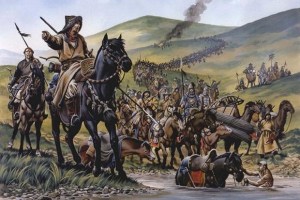
Nemo apud eos arat nec stivam aliquando contingit. omnes enim sine sedibus fixis, absque lare vel lege aut victu stabili dispalantur, semper fugientium similes, cum carpentis in quibus habitant: ubi coniuges taetra illis vestimenta contexunt, et coeunt cum maritis, et pariunt, et ad usque pubertatem nutriunt pueros. nullusque apud eos interrogatus respondere unde oritur potest, alibi conceptus natusque procul, et longius educatus.
(Ammianus Marcellinus, Res Gestae 31.2.10)
No one in their country* ever plows a field or touches a plow-handle. They are all without fixed abode, without hearth, or law, or settled mode of life, and keep roaming from place to place, like fugitives, accompanied by the wagons in which they live; in wagons their wives weave for them their hideous garments, in wagons they cohabit with their p387husbands, bear children, and rear them to the age of puberty. None of their offspring, when asked, can tell you where he comes from, since he was conceived in one place, born far from there, and brought up still farther away.
Have you fallen asleep so early, dear bridegroom? Are your limbs just too heavy? Is sleep what you desire? Or were you far gone in drink when you were put to bed? If you were keen to go to sleep early you should have slept alone and left the girl to play deep into the night with the other girls at her loving mother’s side, for she will be your bride the day after next and the day that dawns after that, and all the years to come. (tr. Neil Hopkinson)
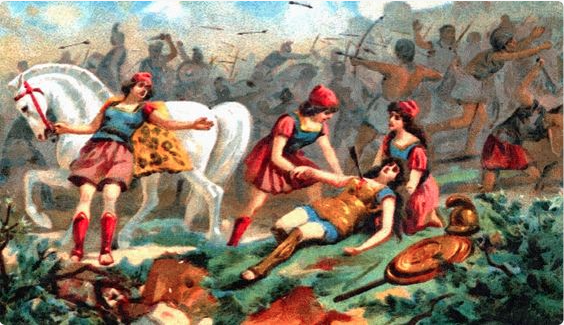
Camilla is killed by Arruns (Liebig trading card).
“Summe deum, sancti custos Soractis Apollo,
quem primi colimus, cui pineus ardor acervo
pascitur et medium freti pietate per ignem
cultores multa premimus vestigia pruna,
da, pater, hoc nostris aboleri dedecus armis,
omnipotens. non exuvias pulsaeve tropaeum
virginis aut spolia ulla peto: mihi cetera laudem
facta ferent; haec dira meo dum volnere pestis
pulsa cadat, patrias remeabo inglorius urbes.”
(Vergil, Aen. 11.785-793)
“Apollo, highest of gods, lord of holy Soracte!
We worship you first and foremost, honor your fires
stoked by cords of pine! And we your celebrants firm
in our faith, we plant our feet in your embers glowing hot!
Grant, Father, our shame be blotted out by our spears,
almighty God Apollo! I am not bent on plunder
stripped from a girl, no trophy over her corpse.
My other feats of arms will win me glory. If only
this murderous scourge drops dead beneath my strokes,
back I’ll go to my fathers’ towns – unsung!” (tr. Robert Fagles)
Nihil est tam populare quam bonitas, nulla de virtutibus tuis plurimis nec admirabilior nec gratior misericordia est. homines enim ad deos nulla re propius accedunt quam salutem hominibus dando; nihil habet nec fortuna tua maius quam ut possis, nec natura melius quam ut velis servare quam plurimos.
(Cicero, Pro Ligario 37-38)
Nothing is so dear to the people as kindness, and none of your many high qualities arouses such admiration and such pleasure as your compassion. For in nothing do men more nearly approach divinity than in doing good to their fellow-men; your situation has nothing prouder in it than the power, your character nothing in it more noble than the wish, to preserve all whom you can. (tr. Nevile Hunter Watts)
Those whose eyes are grey or whitish are cowardly; for a whitish colour has been shown to be a sign of cowardice. But those whose eyes are not grey but bright are stout-hearted; witness the lion and the eagle. Those whose eyes are wine-dark are gluttonous; witness the goats. Those who have flaming eyes are shameless; witness the dogs. Those who have pale and blotchy eyes are cowardly; this refers to the affection, because men who are terrified turn pale with a complexion which changes. But those who have gleaming eyes are sensual; witness cocks and ravens. (tr. W.S. Hett)
To be healthy is best for mortal man, second is to be handsome in body, third is to be wealthy without trickery, fourth, to be young with one’s friends.
When this song had been sung and everyone had enjoyed it and commented that the excellent Plato mentions it as a splendid composition (Gorg. 451e)*, Myrtilus pointed out that the comic poet Anaxandrides made fun of it in his Treasure in these lines:
The man who devised the scolion, whoever he was, was right to name health first as the best thing; but when he put a handsome body second and wealth third he was out of his mind, of course, for wealth is next best to health: a handsome man who is hungry is an ugly beast.
* The scholiast on Plato says it was sometimes attributed to Simonides (see fr. 651), sometimes to Epicharmus (cf. fr. 262 Kaibel); Clement of Alexandria ascribed it to Simonides and Aristotle, Stobaeus to an unknown Sclerias.
(tr. David A. Campbell, with his note)
Note: K.-A. = R. Kassel & C. Austin (edd.), Poetae Comici Graeci, vol. II, Berlin / New York 1991.





 Crambe Repetita