Urbanitas

cicero1

In consulatu Vatinii, quem paucis diebus gessit, notabilis Ciceronis urbanitas circumferebatur. “Magnum ostentum” inquit “anno Vatinii factum est, quod illo consule nec bruma nec ver nec aestas nec autumnus fuit. [Cicero, Dicta 31]” querenti deinde Vatinio quod gravatus esset domum ad se infirmatum venire, respondit, “volui in consulatu tuo venire, sed nox me comprehendit. [Dicta 32]” ulcisci autem se Cicero videbatur, ut qui respondisse sibi Vatinium meminerat, cum umeris se rei publicae de exilio reportatum gloriaretur, “Unde ergo tibi varices?”
(Macrobius, Sat. 2.3.5)

In Vatinius’ consulship, which he held for only a few days, one of Cicero’s noteworthy mots was in circulation: “A great marvel,” he said, “came to pass in the year of Vatinius, when there was neither winter nor spring nor summer nor fall while he was consul.” When Vatinius complained that Cicero had found it a bother to pay him a sick-call at home, Cicero replied, “I wanted to come during your consulship, but nightfall overtook me.” Cicero appeared to be getting his own back, since he recalled that when he boasted how he had been borne back from exile on the shoulders of the commonwealth, Vatinius had said, “How did you get those varicose veins, then?” (tr. Robert A. Kaster)

Graecatim

tertullian

Quid nunc, si est Romanitas omni salus, nec honestis tamen modis ad Graios estis? aut, ni ita est, unde gentium, in provinciis melius exercitis, quas natura agro potius eluctando commodavit, studia palaestrae, male senescentia et cassum laborantia et lutea unctio et pulverea volutatio, arida saginatio? unde apud aliquos Numidas, etiam equis caesariatos, iuxta cutem tonsor, et cultri vertex solus immunis? unde apud hirtos et hirsutos tam rapax a culo resina, tam furax a mento volsella? prodigium est, haec sine pallio fieri; illius est haec tota res Asiae. quid tibi, Libya et Europa, cum xysticis munditiis, quas vestire non nosti? revera enim quale est Graecatim depilari magis quam amiciri? habitum transferre ita demum culpae prope est, si non consuetudo, sed natura mutetur. sat refert inter honorem temporis et religionem; det consuetudo fidem tempori, natura deo.
(Tertullian, De Pallio 4.1.1-4.2.1)

But now, if Romanity is to the benefit of all, why are you nonetheless inclined to the Greeks, even in less honourable matters? Or if this is not the case, from where else in the world is it that in provinces that are better trained, adapted by nature rather for conquering the soil, there are exercises of the wrestling-school (thereby lasting into a bad old age and labouring in vain), and unction with mud, and wallowing in the dust, and living on a dry diet? From where else is it that with some Numidians, who even wear their hair long due to horses, the barber comes close to the skin and just the crown remains exempt from the knife? Whence is it that with hairy and hirsute men the resin is so rapacious at the arse, the tweezers are so ravenous at the chin? It is a marvel that all this happens without the pallium! To it belongs this whole habit of Asia. What do you, Libya and Europe, have to do with athletic elegances when you do not know how to clothe them? Really, what is it like to use the Greek way in depilation rather than in dress? The transfer of clothing only approaches a fault if it is not convention that is changed, but nature. There is an important difference between the honour due to time and to religion. Let convention faithfully follow time, nature God. (tr. Vincent Hunink)

Mainomai

aea1bd7a9b1453260987308ce8468623
Theodoros Rallis

Ὢ ποδός, ὢ κνήμης, ὢ τῶν (ἀπόλωλα δικαίως)
μηρῶν, ὢ γλουτῶν, ὢ κτενός, ὢ λαγόνων,
ὢ ὤμοιν, ὢ μαστῶν, ὢ τοῦ ῥαδινοῖο τραχήλου,
ὢ χειρῶν, ὢ τῶν (μαίνομαι) ὀμματίων,
ὢ κακοτεχνοτάτου κινήματος, ὢ περιάλλων
γλωττισμῶν, ὢ τῶν (θῦέ με) φωναρίων.
εἰ δ’ Ὀπικὴ καὶ Φλῶρα καὶ οὐκ ᾄδουσα τὰ Σαπφοῦς,
καὶ Περσεὺς Ἰνδῆς ἠράσατ’ Ἀνδρομέδης.
(Philodemus, Anth. Gr. 5.132)

Oh feet! Oh calves! Oh (I’m done for – and rightly so!) thighs! Oh buttocks! Oh vulva! Oh flanks! Oh shoulders! Oh breasts! Oh slender neck! Oh arms! Oh (I’m going mad!) eyes! Oh most lascivious movements! Oh outstanding tonguings! Oh (slay me!) her exlamations! If she is Oscan, named Flora, and does not sing Sappho’s songs – well, even Perseus fell in love with Indian Andromeda. (tr. William Roger Paton, revised by Michael A. Tueller)

Lupercalia

lupercalia-large

Sed quid dicitis vos ipsi qui Lupercalia defenditis, et agenda proponitis? vos eadem pretiatis, vos eorum cultum celebritatemque vilem vulgaremque redditis. si ostensio Lupercaliorum nobis adversa procuravit, vestra culpa est; qui quod vobis singulariter prodesse putatis, negligentissime, et non longe impari cultu et devotione ea ducitis celebranda, quam profanitatis vestrae celebravere maiores. apud illos enim nobiles ipsi currebant, et matronae nudato publice corpore vapulabant. vos ergo primi in Lupercalia commisistis: satius fuerat non agere quam ea cum iniuria celebrare; sed deduxistis venerandum vobis cultum, et salutiferum quem putatis, ad viles trivialesque personas, abiectos et infimos. si vere ergo profitemini hoc sacrum, ac potius exsecramentum, vobis esse salutare, ipsi celebrate more maiorum, ipsi cum amiculo nudi discurrite, ut rite vestrae salutis ludibria peragatis. si magna sunt, si divina, si salutifera, si in his vitae vestrae pendet integritas, cur vos pudet per vos ipsos talia celebrare? si pudet et dedecus est, itane salutiferum est et divinum profuturum, quod vos ipsi dedecus esse fateamini? nemo religionem profitetur, quam per se exsequi prorsus erubescit et refugit; ipsa verecundia vestra vos doceat crimen esse publicum, non salutem, et non Divinitatis cultum, de quo sapiens nullus erubescit, sed instrumenta pravitatum, quibus mens vestra contra semetipsam testimonium ferens, quod gerendum profitetur, erubescit implere.
(Gelasius I, Adversus Andromachum 16-17)

But what do you yourselves say, who defend the Lupercalia and declare what should be done? You yourselves deprecate them, you render their cult and its celebration cheap and vulgar. If the scandal of the Lupercalia has had adverse effects on us, it is your fault because what you think is particularly advantageous for you, you believe should be celebrated with an extreme heedlessness in a cult and worship not far inferior to that which the ancestors of your profanity celebrated. For with them the noble men themselves used to run about, and the matrons were whipped on their naked body in public. Therefore, you yourselves were the first to engage in the Lupercalia; it would have been better to have done nothing than to have impaired their celebration. But the cult that is venerable and salutary for you (you think), you have brought down to cheap and vulgar persons, the worthless, and the lowest. Therefore, if you truly confess that this sacred – or rather, execrable – rite is salutary for you, celebrate it yourselves in the manner of your ancestors, run around naked yourselves with a strap so that you carry out ritually the wanton acts of your salvation. If they are substantial, if they are divine, if they are salutary, if the integrity of your life depends on them, why are you ashamed to celebrate such rites by yourselves? If it is a matter of shame and disgrace, is what you yourselves confess is a disgrace so salutary and divine and profitable? Nobody professes a religion that he is ashamed of and completely avoids practising himself: let your very sheepishness teach you that it is a public crime, not salutary and not a worship of the divinity, about which no sane person is ashamed, but instruments of crooked acts about which your mind, in bearing witness against itself, is ashamed to fulfill what it declares should be done. (tr. Pauline Allen)

Valentinus

st-valentine-mosaic

Valentinus dicitur quasi valorem tenens, hoc est, in sanctitate perseverans. vel dicitur Valentinus, quasi valens tyro, id est, miles Christi. miles dicitur valens, qui nunquam cecidit, fortiter ferit, se valenter defendit, potenter vincit. sic Valentinus non cessit martirium vitando, percussit ydololatriam evacuando, defendit fidem communiendo, vicit patiendo. Valentinus reverendus presbiter fuit, quem Claudius imperator ad se adduci faciens interrogavit dicens: “quid est, Valentine? cur amicitia nostra non frueris, ut Deos nostros adores et superstitionem tuae abiicias vanitatis?” cui Valentinus: “si gratiam Dei scires, ista nequaquam diceres, sed ab ydolis animum revocares et Deum, qui est in coelis , adorares.” tunc quidam, qui Claudio adstabat, dixit: “quid vis dicere, Valentine, de sanctitate Deorum nostrorum?” cui Valentinus: “ego de iis nil dico, nisi quod fuerunt homines miseri et omni immunditia pleni.” ad quem Claudius: “si Christus verus Deus est, cur mihi non dicis, quod verum est?” cui Valentinus: “vere Christus solus est Deus, in quem si credideris, anima tua salvabitur, respublica augebitur, omnium inimicorum tibi victoria concedetur.” respondens autem Claudius adstantibus dixit: “viri Romani, audite, quam sapienter et recte homo loquitur iste. tunc dixit praefectus: “seductus est imperator: quomodo deseremus, quod ab infantia tenuimus?” et tunc cor Claudii immutatum est. traditur autem cuidam principi in custodiam et cum in domum eius ductus fuisset, dixit: “domine Jesu Christe, verum lumen, illumina domum istam, ut te verum Deum cognoscant.” cui praefectus: “miror te dicentem, quod Christus est lumen: equidem si filiam meam diu caecam illuminaverit, faciam quaecunque praeceperis.” tunc Valentinus orans eius filiam caecam illuminavit et omnes de domo sua convertit. tunc imperator Valentinum decollari praecepit circa annum domini CCLXXX.
(Jacobus de Voragine, Leg. Aur. 42)

The name Valentine, in Latin Valentinus, is made up of valorem, value, and tenens, holding; and Saint Valentine held on to—persevered in—holiness. Or the name is like valens tiro, valiant soldier of Christ. A valiant soldier is one who has never fallen, who strikes hard, defends himself bravely, and conquers decisively. Thus Valentine never failed by shunning martyrdom, he struck hard by putting down idolatry, he defended his faith by confessing it, he conquered by suffering.
Valentine was a venerable priest, whom the emperor Claudius summoned before him. “What is this, Valentine?” he asked. “Why do you not win our friendship by adoring our gods and abandoning your vain superstitions?” Valentine answered: “If you but knew the grace of God, you would not say such things! You would turn your mind away from your idols and adore the God who is in heaven.” One of the people standing by Claudius said: “Valentine, what have you to say about the holiness of our gods?” “All I have to say about them,” Valentine replied, “is that they were wretched human beings full of every uncleanness!” Claudius spoke: “If Christ is true God, why do you not tell me the truth?” Valentine: “Truly Christ alone is God! If you believe in him, your soul will be saved, the empire will prosper, and you will be granted victory over all your enemies!” Claudius responded, saying to those around him: “Men of Rome, heed how wisely and rightly this man speaks!” Then the prefect said: “The emperor is being led astray! How shall we give up what we have believed from infancy?” At this the heart of Claudius was hardened, and he turned Valentine over to the prefect to be held in custody. When Valentine came into this man’s house, he said: “Lord Jesus Christ, true light, enlighten this house and let all here know you as true God!” The prefect said: “I wonder at hearing you say that Christ is light. Indeed, if he gives light to my daughter who has been blind for a long time, I will do whatever you tell me to do!” Valentine prayed over the daughter, her sight was restored, and the whole household was converted to the faith. Then the emperor ordered Valentine to be beheaded, about A.D. 280. (tr. William Granger Ryan)

Contumulantur

cb8ebccdaddc699a46e9e6e3ceac9d54a23568ec

Cur metuis mortem, cui nascimur? effuge longe,
quo Parthus, quo Medus Arabsque; ubi barbarus ales
nascitur, ac nobis iteratus fingitur orbis;
illic, nate, late: ibi te tua fata sequentur.
perpetuum nihil est, nihil est sine morte creatum:
lux rapitur et nox oritur, moriuntur et anni;
non est terra loco, quo res generaverat ante.
ipse pater mundi fertur tumulatus abisse
et fratris Stygii regnum mutatus obisse;
Bacchum fama refert Titanum ex arte perisse,
perque vadum Lethes Cererem Veneremque subisse.
cur ego de nato doleam, quem fata reposcunt?
cur ego non plangam, sicut planxere priores?
amisit natum Diomede, carpsit Agaue;
perdidit Althaea gnatum, dea perdidit Ino;
flevit Ityn Progne, dum colligit ilia cruda.
nam quaecumque tegit caeli vis vel vagus aër
labuntur, cedunt, moriuntur, contumulantur.
(Alcestis Barcinonensis 53-70)

Why are you afraid of death for which we all are born? Escape to the end of the world—there where the Parthian or Mede or Arab lives; there where the strange bird phoenix is born, so that mankind may imagine the birth of a new world-era. Go, son, and hide there: and there your fate will reach you! Nothing lasts forever, nothing is born free from death. Daylight wanes, and night takes its place; the seasons die, and even the (aging) Earth is no longer the same as she was when creating all things. The Father of the universe himself, they say, was buried and gone: he changed his shape and went down to visit the infernal realm of his brother. Bacchus perished—so the story goes—through the guile of the Titans, and both Ceres and Venus crossed the stream of Lethe. Why should I grieve for a son who is claimed by Destiny? Why should I be exempt from mourning when other mothers mourned in the past? Why, Diomede lost her son, and Agave tore hers asunder. Althaea killed her son, and so did the goddess Ino. Procne too bewailed Itys while collecting his bleeding entrails. For, whatever lives under the heavenly vault and the roaming wind perishes, passes away, dies, and is buried for good. (tr. Miroslav Marcovich)

Erriphthō

l_pl1_37646_fnt_tr_t89iia
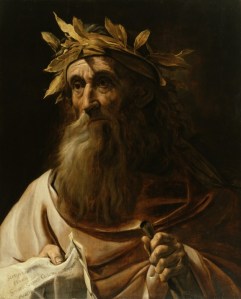
Anonymous portrait of Homer

Εἰ δ’ ἀμαθεῖς τινες ἄνθρωποι τὴν Ὁμηρικὴν ἀλληγορίαν ἀγνοοῦσιν οὐδ’ εἰς τὰ μύχια τῆς ἐκείνου σοφίας καταβεβήκασιν, ἀλλ’ ἀβασάνιστος αὐτοῖς ἡ τῆς ἀληθείας κρίσις ἔρριπται, καὶ τὰ φιλοσόφως ῥηθὲν οὐκ εἰδότες, ὃ μυθικῶς δοκεῖ πλάσαι προαρπάζουσιν, οὗτοι μὲν ἐρρέτωσαν. ἡμεῖς δ’ οἳ τῶν ἀβεβήλων ἐντὸς περιρραντηρίων ἠγνίσμεθα, σεμνὴν ὑπὸ νόμῳ τῶν ποιημάτων τὴν ἀλήθειαν ἀνιχνεύωμεν. ἐρρίφθω δὲ καὶ Πλάτων ὁ κόλαξ καὶ Ὁμήρου συκοφάντης, ἔνδοξον ἀπὸ τῆς ἰδίας πολιτείας μύρῳ τὴν κεφαλὴν διάβροχον. οὐδ’ Ἐπικούρου φροντὶς ἡμῖν, ὃς τῆς ἀσέμνου περὶ τοὺς ἰδίους κήπους ἡδονῆς γεωργός ἐστιν, ἅπασαν ὁμοῦ ποιητικὴν ὥσπερ ὀλέθριον μύθων δέλεαρ ἀφοσιούμενος. πρὸς οὓς μέγα δή τι στενάξας εἴποιμ’ ἂν εὐλόγως·
ὦ πόποι, οἷον δή νυ θεοὺς βροτοὶ αἰτιόωνται. [Od. 1.32]
καὶ τὸ πικρότατον, ἀρχὴν ἑκάτεροι τῶν παρ’ ἑαυτοῖς δογμάτων ἔχοντες Ὅμηρον, ἀφ’ οὗ τὰ πλεῖστα τῆς ἐπιστήμης ὠφέληνται, περὶ τοῦτον ἀχαρίστως εἰσὶν ἀσεβεῖς.
(Heraclitus Stoicus, Hom. Probl. 3.2-4.4)

If some ignorant people fail to recognize Homeric allegory and have not descended into the secret caverns of his wisdom but instead have risked a hasty judgment of the truth without proper consideration, and if then they seize hastily on what they take to be his mythical invention, because they do not know what is said in a philosophical sense – well, off with them and good riddance! But let us, who have been hallowed within the sacred enclosure, methodically track down the grand truth of the poems. Away too with Plato, the flatterer, Homer’s dishonest accuser, who banishes him from his private Republic as an honored exile, garlanded with white wool and with his head drenched with costly perfumes! Nor need we trouble ourselves with Epicurus, who cultivates his low pleasure in his private garden, and abominates all poetry indiscriminately as a lethal allurement of fable. In the face of these two, I might very reasonably groan and cry
Ah me, how mortals put the blame on gods!
And the irony is that both these philosophers found the basis of their doctrines in Homer, and are ungrateful as well as impious toward the person from whom they gained most of their knowledge.
(tr. Donald A. Russell & David Konstan)

Amator

martyrdom-of-st-agnes

Ut vidit Agnes stare trucem virum
mucrone nudo, laetior haec ait:
“exsulto, talis quod potius venit
vesanus, atrox, turbidus, armiger,
quam si veniret languidus ac tener,
mollisque ephebus tinctus aromate,
qui me pudoris funere perderet.
hic, hic amator iam, fateor, placet:
ibo irruentis gressibus obviam,
nec demorabor vota calentia.
ferrum in papillas omne recepero,
pectusque ad imum vim gladii traham.
sic nupta Christo transiliam poli
omnes tenebras aethere celsior.
aeterne rector, divide ianuas
caeli, obseratas terrigenis prius,
ac te sequentem, Christe, animam voca,
cum virginalem, tum Patris hostiam.”
sic fata, Christum vertice cernuo
supplex adorat, vulnus ut imminens
cervix subiret prona paratius.
ast ille tantam spem peragit manu:
uno sub ictu nam caput amputat.
sensum doloris mors cita praevenit.
exutus inde spiritus emicat,
liberque in auras exilit; angeli
saepsere euntem tramite candido.
(Prudentius, Peristephanon 14.67-93)

When Agnes saw the grim figure standing there with his naked sword her gladness increased and she said: “I rejoice that there comes a man like this, a savage, cruel, wild man-at-arms, rather than a listless, soft, womanish youth bathed in perfume, coming to destroy me with the death of my honour. This lover, this one at last, I confess it, pleases me. I shall meet his eager steps halfway and not put off his hot desires. I shall welcome the whole length of his blade into my bosom, drawing the sword-blow to the depths of my breast; and so as Christ’s bride I shall o’erleap all the darkness of the sky and rise higher than the ether. O eternal ruler, open the gates of heaven which formerly were barred against the children of the earth, and call, O Christ, a soul that follows Thee, a virgin’s soul and a sacrifice to the Father.” So saying she bowed her head and humbly worshipped Christ, so that her bending neck should be readier to suffer the impending blow; and the executioner’s hand fulfilled her great hope, for at one stroke he cut off her head and swift death forestalled the sense of pain. Now the disembodied spirit springs forth and leaps in freedom into the air, and angels are round her as she passes along the shining path. (tr. Henry John Thomson)

Inebriter

8151bd4c-41d3-47da-bbe0-4041f532512e

[SACERDOS. DIACONVS]

SAC. Confitemini Dolio quoniam bonum.
DIAC. quoniam in taberna misericordia eius.
SAC. confiteor Dolio, regi Baccho et omnibus schyphis eius a nobis acceptis, quia ego potator potavi nimis in stando, sedendo, videndo, vigilando, ludendo, et ad schyphum inclinando, vestimentaque mea perdendo: mea crapula, mea crapula, mea maxima crapula. ideo precor vos, solemnes potatores et manducatores, devote orare pro me.
DIAC. misereatur vestri ventripotens Bacchus.
SAC. et permittat te perdere omnia vestimenta et sensum, liberetque te ab oculis et dentibus tuis, et perducat te ad plenam tabernam.
DIAC. stramen.
SAC. adiutorium nostrum in nomine Dolii et Bacchi.
DIAC. qui fecit scyphum et tabernam.

OFFICIVM MISSAE

SAC. lugeamus omnes in Dolio, diem maestum ululantes sub honore quadrato Decii, de cuius potatione gaudent miseri.

PSALMVS

DIAC. beati qui habitant in domo Dolii: in pocula poculorum laudabunt te.
SAC. ploremus. ventripotens deus qui tres quadratos decios sexaginta tribus oculis miserabiliter illuminasti, concede propitius ut omnes qui vestimentorum suorum pondere pergravantur quadrati Decii iactatione liberentur, tu qui incessanter bibis et potas, per omnia pocula poculorum.
DIAC. stramen.

EPISTOLAE TEXTVS
LECTIO LIBRI PATERAE AD EBRIOS

SAC. in diebus illis: dixit tabernarius ad potatores: “omnes sitientes venite ad tabernas, et qui non habetis argentum, properate et vendite vestimenta vestra, ac date tabernario et vos habebitis thesaurum in scyphis, nam qui perdit in taberna vestimenta sua, in somnis inveniet ea.”
DIAC. iactate cogitatum tuum in Decio et ipse te deducet ad Dolium. cum inebriter clamavi et potus exaudivit me. allernebria, allernebria.

(Confitemini Dolio, MS cgm. 4379, fols. 88r-90v. s. xvi., Munich, Bayerische Staatsbibliothek)

[PRIEST. DEACON]

PR. We confess to the Cask because he is good.
DEAC. Because his mercy is in the tavern.
PR. I confess to the Cask, to King Bacchus and to all his cups taken up by us, that I, a drinker, have drunk exceedingly while standing, sitting, watching, waking, gambling, and inclining toward the cup, and in losing my clothes, through my drunkenness, through my drunkenness, through my most extreme drunkenness. Therefore I beseech you, solemn drinkers and diners, to pray devotedly for me.
DEAC. May stomach-potent Bacchus have mercy on you.
PR. And allow thee to lose all thy clothes and thy sense, and free thee from thine eyes and teeth, and bring thee into the full tavern.
DEAC. Straw.
PR. Our help is in the name of the Cask and of Bacchus.
DEAC. Who made the goblet and the tavern.

OFFICE OF THE MASS

PR. Let us all lament the Cask, bewailing a mournful day in foursquare honor of the Die, at whose drinking the wretched rejoice.

PSALM

DEAC. Blessed are they who live in the house of the Cask: they shall praise thee, cups without end.
PR. Let us wail. Stomach-potent God who didst wondrously adorn three four-square dice with sixty-three spots, grant most favorably that all who are burdened by the weight of their clothes shall be set free by the tossing of the four-square Die, thou who drinkest and imbibest without ceasing, cups without end.
DEAC. Straw.

TEXT OF THE EPISTLE
READING OF THE BOOK OF THE VESSEL TO THE INEBRIATES

PR. In those days: The tavern keeper said to the drinkers: “All you that thirst, come to the tavern, and you that have no money, make haste and sell your clothes, and give to the tavern keeper, and you shall have treasure in the cups, for he that loses his clothes in the tavern shall keep them in his dreams.”
DEAC. Cast thy thought to the Die and he shall lead thee away to the Cask. When I called out drunkenly the drink also hath heard me. Halledrunken, Halledrunken.

(tr. Martha Bayless)

Lubrico

23d8b6a518ae9938c1c8afae0ba9bf3b

Te cordis ima concinant,
te vox canora concrepet,
te diligat castus amor,
te mens adoret sobria,

ut, cum profunda clauserit
diem caligo noctium,
fides tenebras nesciat
et nox fide reluceat.

dormire mentem ne sinas,
dormire culpa noverit;
castos fides refrigerans
somni vaporem temperet.

exuta sensu lubrico
te cordis alta somnient,
ne hostis invidi dolo
pavor quietos suscitet.

(Ambrose, Hymn. 2.13-28)

From our deep hearts we sing to thee,
Our blended voices hail thy name;
O holy Love, our lover be,
As we adore thee and proclaim.

When shadows round the world shall flow,
And heavy night shut out the day,
Lord, let our faith no darkness know,
But, shining, light us on our way.

Let not the mind in slothful ease
Leave aught of evil to remain;
Let faith drive forth all phantasies,
And every dream impure and vain.

Dispel all vices from the mind,
And be the soul’s one aim to thee,
That thus the tempter shall not find
Power to awake impurity.

(tr. Daniel Joseph Donahoe)