
Amathesteros

daphnis-somov
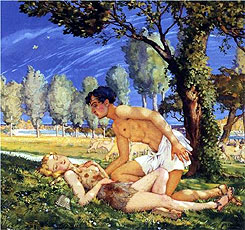
Konstantin Somov, Daphnis & Chloe

Ἤιτει δὴ τὴν Χλόην χαρίσασθαί οἱ πᾶν ὅσον βούλεται καὶ γυμνὴν γυμνῷ συγκατακλιθῆναι μακρότερον ἢ πρόσθεν εἰώθεσαν· τοῦτο γὰρ δὴ λείπειν τοῖς Φιλητᾶ παιδεύμασιν ἵνα γένηται τὸ μόνον ἔρωτα παῦον φάρμακον. τῆς δὲ πυνθανομένης τί πλέον ἐστὶ φιλήματος καὶ περιβολῆς καὶ αὐτῆς κατακλίσεως καὶ τί ἔγνωκε δρᾶσαι γυμνὸς γυμνῇ συγκατακλινείς, “τοῦτο” εἶπεν “ὃ οἱ κριοὶ ποιοῦσι τὰς ὄϊς καὶ οἱ τράγοι τὰς αἶγας. ὁρᾷς ὡς μετὰ τοῦτο τὸ ἔργον οὔτε ἐκεῖναι φεύγουσιν ἔτι αὐτοὺς οὔτε ἐκεῖνοι κάμνουσι διώκοντες ἀλλ̓ ὥσπερ κοινῆς λοιπὸν ἀπολαύσαντες ἡδονῆς συννέμονται; γλυκύ τι ὡς ἔοικεν ἐστὶ τὸ ἔργον καὶ νικᾷ τὸ ἔρωτος πικρόν.” “εἶτα οὐχ ὁρᾷς,  ὦ Δάφνι, τὰς αἶγας καὶ τοὺς τράγους καὶ τοὺς κριοὺς καὶ τὰς ὄϊς ὡς ὀρθοὶ μὲν ἐκεῖνοι δρῶσιν, ὀρθαὶ δὲ ἐκεῖναι πάσχουσιν, οἱ μὲν πηδήσαντες, αἱ δὲ κατανωτισάμεναι; σὺ δέ με ἀξιοῖς συγκατακλινῆναι καὶ ταῦτα γυμνήν; καίτοιγε ἐκεῖναι πόσον ἐνδεδυμένης ἐμοῦ λασιώτεραι.” πείθεται Δάφνις καὶ συγκατακλινεὶς αὐτῇ πολὺν χρόνον ἔκειτο καὶ οὐδὲν ὧν ἕνεκα ὤργα ποιεῖν ἐπιστάμενος ἀνίστησιν αὐτὴν καὶ κατόπιν περιεφύετο μιμούμενος τοὺς τράγους. πολὺ δὲ μᾶλλον ἀπορηθείς, καθίσας ἔκλαεν εἰ καὶ κριῶν ἀμαθέστερος εἰς τὰ ἔρωτος ἔργα.
(Longus, Daphnis & Chloe 3.14)

He pressed Chloe to give him all that he wanted and to lie together naked for longer than they used to before, since this was the last untried step in Philetas’ instructions, so that the sole antidote for love could take effect. She asked what more there was than kissing, hugging, and actually lying down, and what he meant to do once they were lying together naked. “What the rams are doing to the ewes,” he replied, “and the he-goats to the she-goats. Do you notice that after they do that, the females no longer run away from the males and the males no longer wear themselves out chasing the females, but instead they graze together afterwards as if having shared a mutual pleasure? Apparently this behavior has a sweetness that overcomes the bitterness of love.” “Don’t you also notice, Daphnis, that the rams and the he-goats stand when they do this, and the ewes and the she-goats stand when they have it done, the males hopping onto the females and the females carrying them on their backs? And you ask me to lie down with you, and naked to boot? Yet how much woollier these females are than I am, even with my clothes on!” Daphnis agreed. Reclining with her, he lay there a long time, and not knowing how to do any of what he grew taut for, he stood her up and clung to her from behind, imitating the he-goats. But much more frustrated than before, he sat down and started to weep, for being more inept than he-goats in making love. (tr. Jeffrey Henderson)

Lamnothen

Εἰ γὰρ ὁ πᾶς χρόνος ὄλβον μὲν οὕτω καὶ κτεάνων
δόσιν εὐθύνοι, καμάτων δ’ ἐπίλασιν παράσχοι.

[Antistr. γ’]
ἦ κεν ἀμνάσειεν, οἵαις ἐν πολέμοισι μάχαις
τλάμονι ψυχᾷ παρέμειν’, ἁνίχ’ εὑρίσκοντο θεῶν
παλάμαις τιμάν,
οἵαν οὔτις Ἑλλάνων δρέπει,
πλούτου στεφάνωμ’ ἀγέρωχον. νῦν γε μὰν τὰν
Φιλοκτήταο δίκαν ἐφέπων
ἐστρατεύθη· σὺν δ’ ἀνάγκᾳ νιν φίλον
καί τις ἐὼν μεγαλάνωρ ἔσανεν. φαντὶ δὲ Λαμνόθεν
ἕλκει τειρόμενον μεταβάσοντας ἐλθεῖν

[Ep. γ’]

ἥρωας ἀντιθέους Ποίαντος υἱὸν τοξόταν;
ὃς Πριάμοιο πόλιν πέρσεν, τελεύτασέν τε πόνους Δαναοῖς,
ἀσθενεῖ μὲν χρωτὶ βαίνων, ἀλλὰ μοιρίδιον ἦν.

(Pindar, Pyth. 1.46-55)

Would that all of time may, in this way, keep his prosperity and the gift of wealth on a straight course, and bring forgetfulness of troubles. Indeed he might remember in what kind of battles of war he stood his ground with an enduring soul, when, by the gods’ devising, they found honor such as no other Greek can pluck, a proud garland of wealth. But now he has gone to battle in the manner of Philoctetes; and under compulsion even a haughty man fawned on him for his friendship. They say that the god-like heroes went to bring from Lemnos that man afflicted with a wound, the archer son of Poeas, who sacked the city of Priam and brought an end to the toils of the Danaans; he went with a weak body, but it was fated. (tr. Diane Arnson Svarlien)

Primitias

Primitias egomet lacrimarum et caedis acerbae,
ante tubas ferrumque, tuli, dum deside cura
credo sinus fidos altricis et ubera mando.
quidni ego? narrabat servatum fraude parentem
insontesque manus. en quam ferale putemus
abiurasse sacrum et Lemni gentilibus unam
immunem furiis! haec illa (et creditis) ausa,
haec pietate potens solis abiecit in arvis,
non regem dominumque, alienos impia partus,
hoc tantum, silvaeque infamis tramite liquit,
quem non anguis atrox (quid enim hac opus, ei mihi, leti
mole fuit?), tantum caeli violentior aura
impulsaeque noto frondes cassusque valeret
exanimare timor.
(Statius, Theb. 6.146-159)

I bore the first fruit of tears and untimely death before trumpet and sword, as caring but lazily I believed in a nurse’s trusty bosom and handed over my suckling. But why not? She told me how she had saved her father by cunning and kept her hands innocent. Look at her, this woman who we are to think abjured the deadly covenant, alone immune from the madness of her fellow Lemnians; this woman who thus dared (and you believe her), this woman, so strong in her devotion, undutifully cast off in a lonely field – I say not king or master but another’s child, just that, and left him on a track in an ill-famed wood. No frightful snake – what need, alas, for such a mass of death? – but merely a breeze blowing strong or leaves shaken by the wind or idle terror might have been enough to cause his end. (tr. David Roy Shackleton Bailey)

Elaphos

fawn-dingel

Ἔλαφος δ’ ἦν λευκὴ χειροήθης τῷ Σερτωρίῳ καὶ ἄνετος· ἧς ἀφανοῦς γενομένης ὁ Σερτώριος οὐκ αἴσιον ἑαυτῷ τιθέμενος ἐβαρυθύμει τε καὶ ἐπ’ ἀργίας ἦν, καὶ ταῦτ’ ἐπιτωθαζόμενος ἐς τὴν ἔλαφον ὑπὸ τῶν πολεμίων. ὡς δ’ ὤφθη διὰ δρυμῶν δρόμῳ φερομένη, ἀνά τε ἔδραμεν ὁ Σερτώριος καὶ εὐθύς, ὥσπερ αὐτῇ προκαταρχόμενος, ἠκροβολίσατο ἐς τοὺς πολεμίους.
(Appian, Rhōmaïka 13.110)

Sertorius had a white fawn that was tame and allowed to move about freely. When this fawn was not in sight Sertorius considered it a bad omen. He became low-spirited and abstained from fighting; nor did he mind the enemy’s scoffing at him about the fawn. When she made her appearance running through the woods Sertorius would run to meet her, and, as though he were consecrating the first-fruits of a sacrifice to her, he would at once direct a hail of javelins at the enemy. (tr. Horace White)

Desmata

Ἥφαιστος δ’ ὡς οὖν θυμαλγέα μῦθον ἄκουσε,
βῆ ῥ’ ἴμεν ἐς χαλκεῶνα κακὰ φρεσὶ βυσσοδομεύων,
ἐν δ’ ἔθετ’ ἀκμοθέτῳ μέγαν ἄκμονα, κόπτε δὲ δεσμοὺς
ἀρρήκτους ἀλύτους, ὄφρ’ ἔμπεδον αὖθι μένοιεν.
αὐτὰρ ἐπεὶ δὴ τεῦξε δόλον κεχολωμένος Ἄρει,
βῆ ῥ’ ἴμεν ἐς θάλαμον, ὅθι οἱ φίλα δέμνι’ ἔκειτο,
ἀμφὶ δ’ ἄρ’ ἑρμῖσιν χέε δέσματα κύκλῳ ἁπάντῃ·
πολλὰ δὲ καὶ καθύπερθε μελαθρόφιν ἐξεκέχυντο,
ἠύτ’ ἀράχνια λεπτά, τά γ’ οὔ κέ τις οὐδὲ ἴδοιτο,
οὐδὲ θεῶν μακάρων; πέρι γὰρ δολόεντα τέτυκτο.
αὐτὰρ ἐπεὶ δὴ πάντα δόλον περὶ δέμνια χεῦεν,
εἴσατ’ ἴμεν ἐς Λῆμνον, ἐυκτίμενου πτολίεθρον,
ἥ οἱ γαιάων πολὺ φιλτάτη ἐστιν ἁπασέων.
(Homer, Od. 8.272-284)

And when Hephaestus heard the grievous tale*, he went his way to his smithy, pondering evil in the deep of his heart, and set on the anvil block the great anvil and forged bonds which might not be broken or loosed, that the lovers might bide fast where they were. But when he had fashioned the snare in his wrath against Ares, he went to his chamber where lay his bed, and everywhere round about the bed-posts he spread the bonds, and many too were hung from above, from the roof-beams, fine as spiders’ webs, so that no one even of the blessed gods could see them, so exceeding craftily were they fashioned. But when he had spread all his snare about the couch, he made as though he would go to Lemnos, that well-built citadel, which is in his eyes far the dearest of all lands.

* of the minstrel Demodocus, who sang how Aphrodite cheated on Hephaestus with Ares.

(tr. Augustus Taber Murray)

Dephein

Masturbation

Χειροτονεῖν δὲ τὸ αἰδοῖον εἴ τις ὑπολάβοι, δοῦλον ἢ δούλην περανεῖ διὰ τὸ τὰς χεῖρας τὰς προσαγομένας τῶι αἰδοίωι ὑπηρετικὰς εἶναι· εἰ δὲ μὴ ἔχοι θεράποντας, ζημίαν ὑπομενεῖ διὰ τὴν εἰς ἄχρηστον τοῦ σπέρματος ἀπόκρισιν. οἶδα δέ τινα δοῦλον, ὃς ἔδοξε τὸν δεσπότην αὐτοῦ δέφειν, καὶ ἐγένετο τῶν παίδων αὐτοῦ παιδαγωγὸς καὶ τροφός· ἔσχε γὰρ ἐν ταῖς χερσὶ τὸ τοῦ δεσπότου αἰδοῖον ὂν τῶν ἐκείνου τέκνων σημαντικόν. καὶ πάλιν αὖ οἶδά <τινα> ὃς ἔδοξεν ὑπὸ τοῦ δεσπότου δέφεσθαι, καὶ προσδεθεὶς κίονι πολλὰς ἔλαβε πληγάς, καὶ οὕτως ὑπὸ τοῦ δεσπότου ἐνετάθη.
(Artemidorus, Oneirocritica 1.78)

And if one should suppose that he masturbates, he will penetrate a male or female slave because the hands, brought to the genitals, are its servants. But if he should not have servants, he will suffer a loss due to the release of his sperm to no purpose. And I know of a certain slave who imagined he gave a hand job to his master, and he became the tutor and nurse of his children. For he held in his hands the genitals of his master, which are significant of the children of that man. And, moreover, I know of <a certain man> who imagined that he was given a hand job by his master and, being bound to a pillar, he received many lashes, and in this way was he ‘pulled tight’ by his master. (tr. Daniel E. Harris-McCoy)

Claudatur

Ut mihi tu claudis, mater stomachosa, fenestram,
sic tibi claudatur cunnus, iniqua parens!
id tibi erit gravius, caelebs videare licebit,
quam tibi si caeli ianua clausa foret.
(Antonio Beccadelli, Hermaphroditus 2.4)

Just as you close the window against me, ill-tempered mother,
so may your cunt be closed up, cruel parent.
Though you seem to be single, that will be worse for you
than if the gates of heaven were closed against you.
(tr. Holt Parker)

Diamperes

Ulysses_and_Neoptolemus_Taking_Hercules’_Arrows_from_Philoctetes,_1800_by_François-Xavier_Fabre
François-Xavier Fabre, Ulysse et Néoptolème enlèvent à Philoctète l’arc et les flèches d’Héraclès

Ἀτταταῖ.
ὦ ξένε Κεφαλλήν, εἴθε σοῦ διαμπερὲς
στέρνων ἵκοιτ’ ἄλγησις ἥδε. φεῦ, παπαῖ.
παπαῖ μάλ’ αὖθις. ὦ διπλοῖ στρατηλάται,
[Ἀγάμεμνον, ὦ Μενέλαε, πῶς ἂν ἀντ’ ἐμοῦ]
τὸν ἴσον χρόνον τρέφοιτε τήνδε τὴν νόσον.
ὤμοι μοι.
ὦ θάνατε θάνατε, πῶς ἀεὶ καλούμενος
οὕτω κατ’ ἦμαρ οὐ δύνῃ μολεῖν ποτε;
ὦ τέκνον, ὦ γενναῖον, ἀλλὰ συλλαβὼν
τῷ Λημνίῳ τῷδ’ ἀνακαλουμένῳ πυρὶ
ἔμπρησον, ὦ γενναῖε; κἀγώ τοί ποτε
τὸν τοῦ Διὸς παῖδ’ ἀντὶ τῶνδε τῶν ὅπλων,
ἃ νῦν σὺ σῴζεις, τοῦτ’ ἐπηξίωσα δρᾶν.
τί φής, παῖ;
τί φής; τί σιγᾷς; ποῦ ποτ’ ὤν, τέκνον, κυρεῖς;
(Sophocles, Philoctetes 790-805)

A-a-a-a-h! Cephallenian stranger, I wish this pain would go right through your chest! Ah, ah, alas! Alas once more! O you two generals, [Agamemnon, O Menelaus, if only instead of me] may you feed this sickness for an equal time! Ah me! O death, death, why can you never come, though I do not cease to call you thus each day? O my son, O my noble son, take me and burn me with this fire that is invoked as Lemnian, noble one! I also once consented to do this to the son of Zeus in return for those weapons which you now are guarding! What do you say, boy? What do you say? Why are you silent? Where are you, my son? (tr. Hugh Lloyd-Jones)

Crepundiis

1108036_orig

Caduca nimirum et fragilia puerilibusque consentanea crepundiis sunt ista quae vires atque opes humanae vocantur. adfluunt subito, repente dilabuntur, nullo in loco, nulla in persona stabilibus nixa radicibus consistunt, sed incertissimo flatu Fortunae huc atque illuc acta quos sublime extulerunt improviso recursu destitutos profundo cladium miserabiliter immergunt. itaque neque existimari neque dici debent bona quae, ut inflictorum malorum amaritudine desiderium sui duplicent, <…>
(Valerius Maximus, Facta et Dicta Memorabilia 6.9 ext. 7)

Frail and fragile surely and like children’s toys are the so-called power and wealth of humankind. Suddenly they stream in, abruptly they fall apart, in no place or person do they stand on fixed or stable roots, but driven hither and thither by Fortune’s fickle breeze they forsake those they have raised aloft in unexpected withdrawal and lamentably plunge them into an abyss of disaster. Therefore they should neither be thought nor called good things that in order to double the bitterness of inflicted evils by craving for their return * * * (tr. David Roy Shackleton Bailey)

Lopadotemachoselachogaleokranioleipsanodrimupotrimmatosilphioliparomelitokatakechumenokichlepikossuphophattoperisteralektruonoptopiphallidokinklopeleiolagōiosiraiobaphētragalopterygōn

[ΧΟΡΟΣ. ΒΛΕΠΥΡΟΣ]
ΧΟΡ.      Ὢ ὤ, ὥρα δή,
ὦ φίλαι γυναῖκες, εἴπερ μέλλομεν τὸ χρῆμα δρᾶν,
ἐπὶ τὸ δεῖπνον ὑπανακινεῖν. Κρητικῶς οὖν τὼ πόδε
καὶ σὺ κίνει.
ΒΛΕ.                                   τοῦτο δρῶ.
ΧΟΡ.                                                                καὶ τάσδε νῦν <τὰς μείρακας
χρὴ συνυπάγειν κοῦφα> λαγαρὰς τοῖν σκελίσκοιν τὸν ῥυθμόν.
τάχα γὰρ ἔπεισι
λοπαδοτεμαχοσελαχογαλεο-
κρανιολειψανοδριμυποτριμματο-
σιλφιολιπαρομελιτοκατακεχυμενο-
κιχλεπικοσσυφοφαττοπεριστερα-
λεκτρυονοπτοπιφαλλιδοκιγκλοπε-
λειολαγῳοσιραιοβαφητραγα-
λοπτερυγών. σὺ δὲ ταῦτ’ ἀκροασάμε-
νος τρέχε καὶ ταχέως λαβὲ τρύβλιον.
εἶτα κόνισαι λαβὼν
λέκιθον, ἵν’ ἐπιδειπνῇς.
ΒΛΕ.       ἀλλὰ λαιμάττουσί που.
ΧΟΡ.      αἴρεσθ’ ἄνω, ἰαί, εὐαί·
δειπνήσομεν, εὐοῖ, εὐαί,
εὐαί, ὡς ἐπὶ νίκῃ.
εὐαί, εὐαί, εὐαί, εὐαί.
(Aristophanes, Eccl. 1163-1183)

[CHORUS. BLEPYRUS]
CHO.      Hey, hey, it’s time,
dear ladies, to shake a leg and hop off to dinner,
if we mean to do it at all. So you start moving your feet too,
to a Cretan tune.
BLE.                                    That’s what I’m doing!
CHO.                                                                              And these girls too,
so lithe, should join us in lightly moving their gams to the rhythm.
For soon there’ll be served
limpets and saltfish and sharksteak and dogfish
and mullets and oddfish with savory pickle sauce
and thrushes with blackbirds and various pigeons
and roosters and pan-roasted wagtails and larks
and nice chunks of hare marinated in mulled wine
and all of it drizzled with honey and silphium
and vinegar, oil, and spices galore! Now that you’ve heard
what awaits you, run grab your plate quickly,
then raise the dust, but take
some porridge for dinner!
BLE.       I’m sure that they’re stuffing it in.
CHO.      Lift your legs aloft, hey hey,
we’re off to dinner, hoy hoy,
and victory, hurray!
Hurray hurrah!
(tr. Jeffrey Henderson)