Vitiosa

istock-168723925

Innumeros inter laqueos quos callidus hostis
omnes per mundi colles camposque tetendit
maximus est, et quem vix quisquam fallere possit,
femina, triste caput, mala stirps, vitiosa propago,
plurima quae totum per mundum scandala gignit;
quae lites, rixas, et duras seditiones
excitat, et veteres bello committit amicos,
separat affectus, natos ciet atque parentes:
parva loquor, reges solio movet atque tetrarchas,
gentes collidit, quatit oppida, diruit urbes,
caedes multiplicat, letalia pocula miscet;
per villas agrosque furens incendia iactat.
dedique nulla mali species grassatur in orbe,
in qua non aliquam sibi sumat femina partem.
(Marbod of Rennes, Liber Decem Capitulorum 3.1-14)

Countless are the traps which the scheming enemy has set throughout the world’s paths and plains: but among them the greatest – and the one scarcely anybody can evade – is woman. Woman the unhappy source, evil root, and corrupt offshoot, who brings to birth every sort of outrage throughout the world. For she instigates quarrels, conflicts, dire dissensions; she provokes fighting between old friends, divides affections, shatters families. But these are trivia I speak of: she dislodges kings and princes from the throne, makes nations clash, convulses towns, destroys cities, multiplies slaughters, brews deadly poisons. She hurls conflagration as she rampages through farmsteads and fields. In sum, there lurks in the universe no manifestation of evil which woman does not claim some part for herself. (tr. Alcuin Blamires)
Sollicitor

031001agdeath2
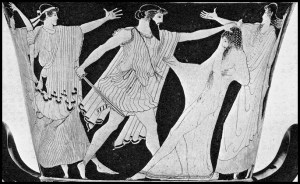
Clytemnestra incites Aegisthus to kill Agamemnon

“Sors pariter nos una manet: iubeoque rogoque,
pastorem regina monens; formidine mortis
territa sollicitor miserandi femina sexus,
conveniens tamen hortor opus, dum congrua vitae
impero, ne moriar tecum peritura cruente;
nam mecum miser ipse cades Agamemnone viso,
impie. funereis nos casibus eripe sollers;
nec labor ullus erit victorem sternere ferro:
semper iners, securus agit, qui perculit hostem,
et patet insidiis nullo terrente quietus.
non est quem metuas: brevis est et parvus Orestes,
unaque natarum cinis est per templa Dianae,
altera sexus iners, recidens, miseranda – quid audet?”
(Dracontius, Orestis Tragoedia 183-195)

“One and the same fate awaits the both of us. I order and beseech you, a queen exhorting a herdsman; I, a woman, belonging to the pitiable sex, am tormented and afflicted by the fear of death. Yet it is a fitting deed to which I urge, a deed wholly agreeing with life which I demand, so that I may not die a bloody death with you. For you, godless one, will perish miserably with me when Agamemnon appears. Save us from these fatal events through your shrewdness. It will be no great trouble to slay the conqueror with your sword. He who has struck down his enemy is always lazy and feels secure; nobody scares him, and in his peace of mind he is easy to deceive. You don’t have anyone to fear. Orestes is but a small child, and of my two daughters one is mere ashes in the temple of Diana; the other one is weak, frail, pitiable – what’s she going to do?” (tr. David Bauwens)

Doloploke

venusklein

Κυπρογενὲς Κυθέρεια δολοπλόκε, σοὶ τί περισσὸν
Ζεὺς τόδε τιμήσας δῶρον ἔδωκεν ἔχειν;
δαμνᾷς δ’ ἀνθρώπων πυκινὰς φρένας, οὐδέ τίς ἐστιν
οὕτως ἴφθιμος καὶ σοφὸς ὥστε φυγεῖν.
(Theognis, Eleg. 1386-1389)

Bred on Cyprus, Cytherean, weaver of deceptions, what is this extraordinary gift that Zeus, showing you honour, has bestowed upon you? You overwhelm the high-mindedness of mankind and there is no one in existence who has the strength or wisdom enough to elude you. (tr. Marguerite Johnson & Terry Ryan)

Venustas

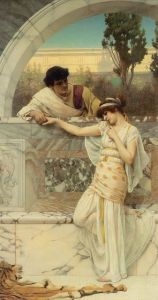
bd7ea05f48a44e7dc1bd367789db06b3

Quintia formosa est multis, mihi candida, longa,
recta est: haec ego sic singula confiteor.
totum illud formosa nego: nam nulla venustas,
nulla in tam magno est corpore mica salis.
Lesbia formosa est, quae cum pulcherrima tota est,
tum omnibus una omnis surripuit Veneres.
(Catullus 86)

Many find Quintia beautiful. For me she’s fair-complexioned,
tall, of good carriage. These few points I concede.
But overall beauty – no. There’s no genuine attraction
in that whole long body, not one grain of salt.
It’s Lebia who’s beautiful, and, being wholly lovely,
has stolen from all of the others their every charm.
(tr. Peter Green)

Olumpon

c35e00f0c5973577647f45e46f4200c6

τοῦτον οὖν ἔχει τὸν λόγον ὁ θεὸς ἐν κόσμῳ, συνέχων τὴν τῶν ὅλων ἁρμονίαν τε καὶ σωτηρίαν, πλὴν οὔτε μέσος ὤν, ἔνθα ἡ γῆ τε καὶ ὁ θολερὸς τόπος οὗτος, ἀλλ’ ἄνω καθαρὸς ἐν καθαρῷ χωρῷ βεβηκώς, ὃν ἐτύμως καλοῦμεν οὐρανὸν μὲν ἀπὸ τοῦ ὅρον εἶναι εἶναι τὸν ἄνω, Ὄλυμπον δὲ οἷον ὁλολαμπῆ τε καὶ παντὸς ζόφου καὶ ἀτάκτου κινήματος κεχωρισμένον, οἷα γίνεται παρ’ ἡμῖν διὰ χειμῶνος καὶ ἀνέμων βίας, ὥσπερ ἔφη καὶ ὁ ποιητὴς
Οὔλυμπόνδ’, ὅθι φασὶ θεῶν ἕδος ἀσφαλὲς αἰεὶ
ἔμμεναι· οὔτ’ ἀνέμοισι τινάσσεται οὔτε ποτ’ ὄμβρῳ
δεύεται, οὔτε χιὼν ἐπιπίλναται, ἀλλὰ μάλ’ αἴθρη
πέπταται ἀνέφελος, λευκὴ δ’ ἐπιδέδρομεν αἴγλη. [Homer, Od. 6.42-45]
(Pseudo-Aristotle, Peri Kosmou 400a3-14)

And this is the position held in the cosmos by God, who maintains the orderliness and preservation of the whole: except that he is not in the centre – for there lies the earth, this turbulent, troubled place – but high aloft, pure in a pure region, which we rightly call “heaven” (οὐρανός) because it forms the uppermost boundary (ὅρος… ἄνω) or “Olympus” because it shines brightly all over (ὁλολαμπής) and is removed from all darkness and disorderly motion such as occurs among us when there is a storm or a violent wind; as the poet says,
To Olympus, where they say the gods’ dwelling stands
always safe; it is not shaken by winds, nor drenched
by showers of rain, nor does snow come near it; always unclouded
the air spreads out, and a white radiance lies upon it.
(tr. D.J. Furley)

Dieirgei


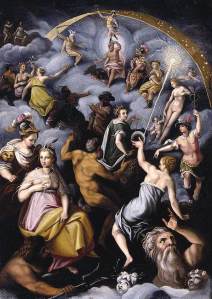
jacopo_zucchi_-_the_assembly_of_the_gods
Jacopo Zucchi

ἓν ἀνδρῶν, ἓν θεῶν γένος· ἐκ μιᾶς δὲ πνέομεν
ματρὸς ἀμφότεροι· διείργει δὲ πᾶσα κεκριμένα
δύναμις, ὡς τὸ μὲν οὐδέν, ὁ δὲ χάλκεος ἀσφαλὲς αἰὲν ἕδος
μένει οὐρανός. ἀλλά τι προσφέρομεν ἔμπαν ἢ μέγαν
νόον ἤτοι φύσιν ἀθανάτοις,
καίπερ ἐφαμερίαν οὐκ εἰδότες οὐδὲ μετὰ νύκτας ἄμμε πότμος
ἅντιν’ ἔγραψε δραμεῖν ποτὶ στάθμαν.
(Pindarus, Nem. 6.1-7)

There is one
race of men, one race of gods; both have breath
of life from a single mother. But sundered power
holds us divided, so that the one is nothing, while for the
other the brazen sky is established
their sure citadel forever. Yet we have some likeness in great
intelligence, or strength, to the immortals,
though we know not what the day will bring, what course
after nightfall
destiny has written that we must run to the end.
(tr. Richard Lattimore)

Revolandum

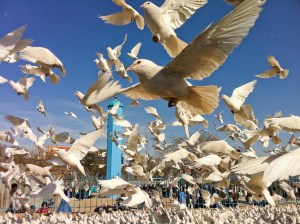
5666186613_b958cb65a0_b

Haud secus ac si olim per sudum lactea forte
lapsa columbarum nubes descendat in arvum
ruris frugiferi, laqueos ubi callidus auceps
praetendit lentoque illevit vimina visco,
sparsit et insidias siliquis vel farre doloso,
illiciunt alias fallentia grana, gulamque
innectunt avidam tortae retinacula saetae,
molle vel implicitas gluten circumligat alas,
ast aliae, quas nullus amor prolectat edendi,
gressibus innocuis sterili spatiantur in herba
suspectamque cavent oculos convertere ad escam;
mox ubi iam caelo revolandum, pars petit aethram
libera sideream plaudens super aëra pinnis,
pars captiva iacet laceris et saucia plumis
pugnat humi et volucres nequiquam suspicit auras;
sic animas caeli de fontibus unicoloras
infundit natura solo, sed suavibus istic
devinctae illecebris retinentur, et aethera paucae
conscendunt reduces, multas viscosus inescat
pastus et ad superas percurrere non sinit auras.
(Prudentius, Hamartigenia 804-823)

Just as sometimes doves in a milk-white cloud,
descending through the bright and lucid sky,
settle in a wheat field, where a clever
fowler set his snares and smeared the twigs
with sticky lime, baiting his traps with peas
and poisoned grain, and some are tempted by
the treacherous grain and caught by nets of woven
cord that choke their greedy throats, or else
soft glue traps and binds their wings: but others,
not seduced by love of eating, stroll
at ease, unharmed, about the barren grass
and take good care not to turn their eyes
toward the suspect food. Soon, when it comes
time to fly back toward the sky, some freely
seek the starry heaven and clap their wings
above the clouds, while others, taken captive,
lie wounded, struggling on the ground, their feathers
torn, looking up in vain at the passing
breezes. In just this way, nature showers
spotless souls from heaven onto earth,
but there they are retained, entrapped by sweet
delights, and very few ascend again
to heaven; the sticky food entices many
and keeps them from advancing to the upper
regions.
(tr. Martha A. Malamud)

Caedebatur

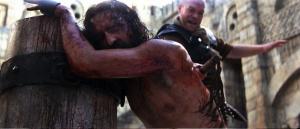
11

Ipse inflammatus scelere et furore in forum venit; ardebant oculi, toto ex ore crudelitas eminebat. exspectabant omnes quo tandem progressurus aut quidnam acturus esset, cum repente hominem proripi atque in foro medio nudari ac deligari et virgas expediri iubet. clamabat ille miser se civem esse Romanum, municipem Consanum; meruisse cum L. Raecio, splendidissimo equite Romano, qui Panhormi negotiaretur, ex quo haec Verres scire posset. tum iste, se comperisse eum speculandi causa in Siciliam a ducibus fugitivorum esse missum; cuius rei neque index neque vestigium aliquod neque suspicio cuiquam esset ulla; deinde iubet undique hominem vehementissime verberari. caedebatur virgis in medio foro Messanae civis Romanus, iudices, cum interea nullus gemitus, nulla vox alia illius miseri inter dolorem crepitumque plagarum audiebatur nisi haec, “Civis Romanus sum.” hac se commemoratione civitatis omnia verbera depulsurum cruciatumque a corpore deiecturum arbitrabatur; is non modo hoc non perfecit, ut virgarum vim deprecaretur, sed cum imploraret saepius usurparetque nomen civitatis, crux,—crux, inquam,—infelici et aerumnoso, qui numquam istam pestem viderat, comparabatur.
(Cicero, In Verrem 2.5.161-162)

Then he* made for the market-place, on fire with mad and wicked rage, his eyes blazing, and cruelty showing clearly in every feature of his face. Everyone was wondering how far he would go and what he was meaning to do, when he suddenly ordered the man to be flung down, stripped naked and tied up in the open market-place, and rods to be got ready. The unhappy man cried out that he was a Roman citizen, a burgess of Consa; that he had served in the army under the distinguished Roman knight Lucius Raecius, who was in business at Panhormus and could assure Verres of the truth of his story. To this Verres replied that he had discovered that Gavius had een sent to Sicily as a spy by the leaders of the fugitive army, a charge which was brought by no informer, for which there was no evidence, and which nobody saw any reason to believe. He then ordered the man to be flogged severely all over his body. There in the open market-place of Messana a Roman citizen, gentlemen, was beaten with rods; and all the while, amid the crack of the falling blows, no groan was heard from his lips in his agony except “I am a Roman citizen.” By thus proclaiming his citizenship he had been hoping to avert all those blows and shield his body from torture; yet not only did he fail to secure escape from those cruel rods, but when he persisted in his entreaties and his appeal to his citizen rights, a cross was made ready—yes, a cross, for that hapless and broken sufferer, who had never seen such an accursed thing till then.

* Verres

(tr. Leonard Hugh Graham Greenwood)

Aoriston

hermes-trismegistus

Ἐννοίας μοί ποτε γενομένης περὶ τῶν ὄντων καὶ μετεωρισθείσης μοι τῆς διανοίας σφόδρα, κατασχεθεισῶν μου τῶν σωματικῶν αἰσθήσεων, καθάπερ οἱ ὕπνῳ βεβαρημένοι ἐκ κόρου τροφῆς ἢ ἐκ κόπου σώματος, ἔδοξά τινα ὑπερμεγέθη μέτρῳ ἀπεριορίστῳ τυγχάνοντα καλεῖν μου τὸ ὄνομα καὶ λέγοντά μοι, “τί βούλει ἀκοῦσαι καὶ θεάσασθαι, καὶ νοήσας μαθεῖν καὶ γνῶναι;” – φημὶ ἐγώ, “σὺ γὰρ τίς εἶ;” – “ἐγὼ μέν” φησίν “εἰμὶ ὁ Ποιμάνδρης, ὁ τῆς αὐθεντίας νοῦς· οἷδα ὃ βούλει, καὶ σύνειμί σοι πανταχοῦ.” – φημὶ ἐγώ, “μαθεῖν θέλω τὰ ὄντα καὶ νοῆσαι τὴν τούτων φύσιν καὶ γνῶναι τὸν θεόν· πῶς” ἔφην “ἀκοῦσαι βούλομαι.” – φησὶν ἐμοὶ πάλιν, “ἔχε νῷ σῷ ὅσα θέλεις μαθεῖν, κἀγώ σε διδάξω.” τοῦτο εἰπὼν ἠλλάγη τῇ ἰδέᾳ, καὶ εὐθέως πάντα μοι ἤνοικτο ῥοπῇ, καὶ ὁρῶ θέαν ἀόριστον, φῶς δὲ πάντα γεγενημένα, εὔδιόν τε καὶ ἱλαρόν, καὶ ἠράσθην ἰδών.
(Corpus Hermeticum 1.1-4)

Once, when thought came to me of the things that are and my thinking soared high and my bodily senses were restrained, like someone heavy with sleep from too much eating or toil of the body, an enormous being completely unbounded in size seemed to appear to me and call my name and say to me: “What do you want to hear and see; what do you want to learn and know from your understanding?”
“Who are you?” I asked.
“I am Poimandres,” he said, “mind of sovereignty; I know what you want, and I am with you everywhere.”
I said, “I wish to learn about the things that are, to understand their nature and to know god. How much I want to hear!” I said.
Then he said to me: “Keep in mind all that you wish to learn, and I will teach you.”
Saying this, he changed his appearance, and in an instant everything was immediately opened to me. I saw an endless vision in which everything became light – clear and joyful – and in seeing the vision I came to love it.
(tr. Brian P. Copenhaver)

Rudente

1231hh4497-lg

Stuppea suppositis tenduntur vincula lignis,
quae fido ascendit docta iuventa gradu.
quam superaërius protendit crura viator
vixque avibus facili tramite currit homo!
brachia distendens gressum per inane gubernat,
ne lapsa gracili planta rudente cadat.
Daedalus adstruitur terras mutasse volatu
et medium pinnis persecuisse diem.
praesenti exemplo firmatur fabula mendax:
ecce hominis cursus funis et aura ferunt.
(Anth. Lat. 101 S-B)

The ropes of tow, which the skilled youth ascends with sure step, are made taut by the poles supporting them. How incredibly high the walker is as he stretches forth his legs and, though human, rushes along a path scarcely easy for birds! Stretching his arms to the side he controls his route through the void, lest he should miss his footing and fall from the slender rope. It is maintained that Daedalus changed country by flight, and that he clove the noonday sky on wings. That story from fiction is proved true by the present example: look, a rope and the air bear a man on his journey! (tr. Nigel M. Kay)