Apēgoreumenon

Pietro_Pajetta_-_Der_Hass_-_1896.jpeg
Pietro Pajetta, L’odio

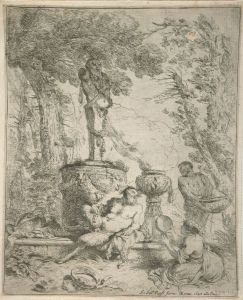
Καὶ ἔτι πλείονας λόγους ποιουμένου τοῦ Ἰωάννου πρὸς τοὺς ἀδελφούς, ὡς τῶν προσκαίρων ἕνεκεν τούτους καταφρονεῖν, ὁ τῆς Δρουσιανῆς ἐρῶν ἐξαφθεὶς δεινοτάτῃ ἐπιθυμίᾳ καὶ ἐνεργείᾳ τοῦ πολυμόρφου Σατανᾶ τὸν τοῦ Ἀνδρονίκου ἐπίτροπον ὄντα φιλάργυρον ὠνεῖται χρήμασιν ἱκανοῖς· ὅστις ἀνοίξας τὸν τάφον Δρουσιανῆς ἐπέτρεψε διαπράξασθαι τὸ ἀπηγορευμένον εἰς νεκρὸν σῶμα. μὴ ἐπιτυγχάνων αὐτῆς ζώσης μετὰ θάνατον τῷ σώματι προσλιπαρῶν ἀπεκρίνατο· “εἰ καὶ ζῶσα οὐκ ἠκολούθεις μοι κοινωνῆσαι, μετὰ θάνατον νεκράν σε οὖσαν ἐνυβρίσω.” τοῦτο οὖν ἐνθυμούμενος, καὶ κατασκευάσας ἑαυτῷ τὴν διὰ τοῦ μιαροῦ ἐπιτρόπου ἀσέβειαν, εἰσεπήδησεν εἰς τὸ μνῆμα σὺν ἐκείνῳ ἅμα· καὶ ἀνοίξαντες τὴν θύραν ἤρξαντο ἀποδύειν τοῦ πτώματος τὰ ἐντάφια λέγοντες· “τί ὠφέλησας ταλαίπωρε Δρουσιανή; τοῦτο ζῶσα πεποιηκέναι οὐκ ἠδύνασο, ὃ τάχα ἂν οὐδέν σε ἐλύπησεν ἑκοῦσαν τοῦτο ποιησαμένην; καὶ ταῦτα τούτων λεγόντων, καὶ μόνον ὃ σύνηθες καρκάλιον περὶ τὴν σάρκα ταύτης ἐναπομεῖναν, ξένον ὁρᾶται θέαμα ὃ παθεῖν ἄξιον τοὺς ταῦτα δρῶντας· ὄφις ποθὲν ἐπιφανεὶς τὸν μὲν ἐπίτροπον μονόπληγα τίθησιν· ὃν καὶ ἀνεῖλεν· ἐκεῖνον δὲ τὸν νεανίσκον οὐ τύπτει, ἀλλὰ τοῖς ποσὶν αὐτοῦ περιειλεῖτο δεινῶς ἀποφυσῶν, καὶ πεσόντος αὐτοῦ ἐπαναβὰς ὁ ὄφις ἐπάνω αὐτοῦ ἐκαθέζετο.
(Acta Joannis 70-71)

While John continued to preach to the brethren that they despise earthly goods for the sake of the eternal ones, the lover of Drusiana, inflamed by the influence of the polymorphous Satan to the most ardent passions, bribed the greedy steward of Andronicus with money. And he opened the tomb of Drusiana and left him to accomplish on the body that which was once denied to him. Since he had not procured her during her lifetime, he continually thought of her body after she was dead, and exclaimed, ‘Although when living you refused to unite with me in love, after your death I will dishonour your corpse.’ Being in such a frame of mind he obtained the opportunity to execute his impious plan through the accursed steward, and both went to the tomb. Having opened the door, they began to take the graveclothes from the corpse, and said, ‘What have you gained, unhappy Drusiana? Could you not have done this while you were alive? It need not have grieved you if you had done it willingly.’ Whilst they spoke and only the shift remained, there appeared something wonderful, which people that do such things deserve to experience. A serpent appeared from somewhere, bit the steward, and killed him. And the serpent did not bite the young man, but encircled his feet, hissing fearfully, and when he fell down, the serpent sat on him. (tr. James Keith Elliott)

Ardua

pliny-the-elder

Res ardua vetustis novitatem dare, novis auctoritatem, obsoletis nitorem, obscuris lucem, fastiditis gratiam, dubiis fidem, omnibus vero naturam et naturae sua omnia. itaque nobis etiam non assecutis voluisse abunde pulchrum atque magnificum est.
(Pliny the Elder, Nat. Hist. praef. 15)

It is a difficult task to give novelty to what is old, authority to what is new, brilliance to the common-place, light to the obscure, attraction to the stale, credibility to the doubtful, but nature to all things and all her properties to nature. Accordingly, even if we have not succeeded, it is honourable and glorious in the fullest measure to have resolved on the attempt. (tr. Harris Rackham)

Vaticinatores

soothsayer-resized-600

Vaticinatores, qui se deo plenos adsimulant, idcirco civitate expelli placuit, ne humana credulitate publici mores ad spem alicuius rei corrumperentur, vel certe ex eo populares animi turbarentur. ideoque primum fustibus caesi civitate pelluntur; perseverantes autem in vincula publica coniciuntur aut in insulam deportantur vel certe relegantur. qui novas sectas vel ratione incognitas religiones inducunt, ex quibus animi hominum moveantur, honestiores deportantur, humiliores capite puniuntur. qui de salute principis vel summa rei publicae mathematicos, hariolos, haruspices, vaticinatores consulit, cum eo qui responderit capite punitur. non tantum divinatione quis, sed ipsa scientia eiusque libris melius fecerit abstinere. quod si servi de salute dominorum consuluerint, summo supplicio, id est cruce, adficiuntur; consulti autem si responsa dederint, aut in metallum damnantur aut in insulam relegantur.
(Paulus, Sent. 5.21.1-4)

It has been decided that soothsayers who assume the characteristics of divinity, shall be expelled from the city to prevent public morals from being corrupted through human credulity entertaining faith in anything of this kind, for there is no doubt that the popular mind is disturbed by these things. Therefore, such persons, after having been beaten with rods, are driven from the city; and if they continue to practise their arts, they are either publicly placed in chains, or deported to an island, or relegated. Those who introduce new religious doctrines which are unknown to use or reason, and by which the minds of men are influenced, if they are of higher rank, shall be deported, if of inferior station, they shall be punished with death. Those who consult astrologers, male or female soothsayers, or diviners, with reference to the life of the Emperor or the safety of the State, shall be punished with death, together with the party who answered their questions. Every one should abstain not only from divination but also from the books teaching that science. If slaves consult a soothsayer with reference to the life of their master, they shall be subjected to extreme punishment, that is to say, to crucifixion; and if those who are consulted give any answer, they shall either be sentenced to the mines, or deported to an island. (tr. Samuel Parsons Scott)

Tullianum

862-1

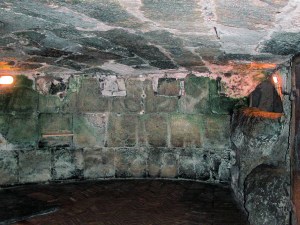
Est in carcere locus, quod Tullianum appellatur, ubi paululum adscenderis ad laevam, circiter duodecim pedes humi depressus. eum muniunt undique parietes atque insuper camera lapideis fornicibus iuncta; sed incultu, tenebris, odore foeda atque terribilis eius facies est. in eum locum postquam demissus est Lentulus, vindices rerum capitalium, quibus praecepta erat, laqueo gulam fregere. ita ille patricius ex gente clarissuma Corneliorum, qui consulare imperium Romae habuerat, dignum moribus factisque suis exitium vitae invenit. de Cethego Statilio Gabinio Caepario eodem modi supplicium sumptum est.
(Sallust, Bell. Cat. 55.3-6)

In the prison, when you have gone up a little to the left, there is a place called the Tullianum which is a depression of about twelve feet into the ground. Walls protect it on all sides and above there is a dome made with stone arches, but squalor, murk, and stench make it hideous and terrible to behold. After Lentulus was sent down into this place, the executioners strangled him with a rope as ordered. Thus that man, an aristocrat from the glorious family of the Cornelii, a man who had held consular power at Rome, found an end that suited his character and his actions. Cethegus, Statilius, Gabinius, and Caeparius were executed in the same way. (tr. William W. Batstone)

Katakekrisai

20120222-Ancient_Greek_Football_Player

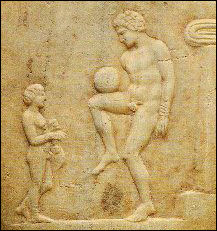
Διὰ τοῦτο γὰρ Ἀγριππῖνος τί ἔλεγεν; ὅτι “ἐγὼ ἐμαυτῷ ἐμπόδιος οὐ γίνομαι.” ἀπηγγέλη αὐτῷ ὅτι “κρίνῃ ἐν συγκλήτῳ.” — “ἀγαθῇ τύχῃ. ἀλλὰ ἦλθεν ἡ πέμπτη” (ταύτῃ δ’ εἰώθει γυμνασάμενος ψυχρολουτρεῖν)· “ἀπέλθωμεν καὶ γυμνασθῶμεν.” γυμνασαμένῳ λέγει τις αὐτῷ ἐλθὼν ὅτι “κατακέκρισαι.” — “φυγῇ,” φησίν, “ἢ θανάτῳ;” — “φυγῇ.” — “τὰ ὑπάρχοντα τί;” — “οὐκ ἀφῃρέθη.” — “εἰς Ἀρίκειαν οὖν ἀπελθόντες ἀριστήσωμεν.” — τοῦτ’ ἔστι μεμελετηκέναι ἃ δεῖ μελετᾶν, ὄρεξιν ἔκκλισιν ἀκώλυτα ἀπερίπτωτα παρεσκευακέναι. ἀποθανεῖν με δεῖ. εἰ ἤδη, ἀποθνῄσκω· κἂν μετ’ ὀλίγον, νῦν ἀριστῶ τῆς ὥρας ἐλθούσης, εἶτα τότε τεθνήξομαι. πῶς; ὡς προσήκει τὸν τὰ ἀλλότρια ἀποδιδόντα.
(Arrian, Epict. Diatr. 1.1.28-32)

Wherefore, what was it that Agrippinus used to remark? “I am not standing in my own way.” Word was brought him, “Your case is being tried in the Senate.” — “Good luck betide! But it is the fifth hour now” (he was in the habit of taking his exercise and then a cold bath at that hour); “let us be off and take our exercise.” After he had finished his exercise someone came and told him, “You have been condemned.” — “To exile,” says he, “or to death?” — “To exile.” — “What about my property?” — “It has not been confiscated.” — “Well then, let us go to Aricia and take our lunch there.” This is what it means to have rehearsed the lessons one ought to rehearse, to have set desire and aversion free from every hindrance and made them proof against chance. I must die. If forthwith, I die; and if a little later, I will take lunch now, since the hour for lunch has come, and afterwards I will die at the appointed time. How? As becomes the man who is giving back that which was another’s. (tr. William Abbott Oldfather)

Limite

Terminus_Emblema_CLVII_(1621)

Part 3 of 3. Part 1 is here. Part 2 is here.

Termine, post illud levitas tibi libera non est:
qua positus fueris in statione, mane;
nec tu vicino quicquam concede roganti,
ne videare hominem praeposuisse Iovi:
et seu vomeribus seu tu pulsabere rastris,
clamato “tuus est hic ager, ille tuus”.’
est via quae populum Laurentes ducit in agros,
quondam Dardanio regna petita duci:
illa lanigeri pecoris tibi, Termine, fibris
sacra videt fieri sextus ab Urbe lapis.
gentibus est aliis tellus data limite certo:
Romanae spatium est Urbis et orbis idem.
(Ovid, Fast. 2.673-684)

Since then, Terminus, you’ve not been free to wander:
Stay there, in the place where you’ve been put,
And yield not an inch to your neighbour’s prayers,
Lest you seem to set men above Jupiter:
And whether they beat you with rakes, or ploughshares,
Call out: “This is your field, and that is his!”‘
There’s a track that takes people to the Laurentine fields,
The kingdom once sought by Aeneas, the Trojan leader:
The sixth milestone from the City, there, bears witness
To the sacrifice of a sheep’s entrails to you, Terminus.
The lands of other races have fixed boundaries:
The extent of the City of Rome and the world is one.
(tr. Tony Kline)

Laudes

Giovanni_Benedetto_Castiglione_-_The_Feast_Before_the_Altar_of_Terminus

Part 2 of 3. Part 1 is here. Part 3 is here.

Conveniunt celebrantque dapes vicinia simplex
et cantant laudes, Termine sancte, tuas:
‘tu populos urbesque et regna ingentia finis:
omnis erit sine te litigiosus ager.
nulla tibi ambitio est, nullo corrumperis auro,
legitima servas credita rura fide.
si tu signasses olim Thyreatida terram,
corpora non leto missa trecenta forent,
nec foret Othryades congestis lectus in armis.
o quantum patriae sanguinis ille dedit!
quid, nova cum fierent Capitolia? nempe deorum
cuncta Iovi cessit turba locumque dedit;
Terminus, ut veteres memorant, inventus in aede
restitit et magno cum Iove templa tenet.
nunc quoque, se supra ne quid nisi sidera cernat,
exiguum templi tecta foramen habent.
(Ovid, Fast. 2.657-672)

Neighbours gather sincerely, and hold a feast,
And sing your praises, sacred Terminus:
‘You set bounds to peoples, cities, great kingdoms:
Without you every field would be disputed.
You curry no favour: you aren’t bribed with gold,
Guarding the land entrusted to you in good faith.
If you’d once marked the bounds of Thyrean lands,
Three hundred men would not have died,
Nor Othryades’ name be seen on the pile of weapons.
O how he made his fatherland bleed!
What happened when the new Capitol was built?
The whole throng of gods yielded to Jupiter and made room:
But as the ancients tell, Terminus remained in the shrine
Where he was found, and shares the temple with great Jupiter.
Even now there’s a small hole in the temple roof,
So he can see nothing above him but stars.
(tr. Tony Kline)

Terminus

1820658_3d03d069

Part 1 of 3. Part 2 is here. Part 3 is here.

Nox ubi transierit, solito celebretur honore
separat indicio qui deus arva suo.
Termine, sive lapis sive es defossus in agro
stipes, ab antiquis tu quoque numen habes.
te duo diversa domini de parte coronant,
binaque serta tibi binaque liba ferunt.
ara fit: huc ignem curto fert rustica testo
sumptum de tepidis ipsa colona focis.
ligna senex minuit concisaque construit arte,
et solida ramos figere pugnat humo;
tum sicco primas inritat cortice flammas;
stat puer et manibus lata canistra tenet.
inde ubi ter fruges medios immisit in ignes,
porrigit incisos filia parva favos.
vina tenent alii: libantur singula flammis;
spectant, et linguis candida turba favet.
spargitur et caeso communis Terminus agno,
nec queritur lactans cum sibi porca datur.
(Ovid, Fast. 2.639-656)

When night has passed, let the god be celebrated
With customary honour, who separates the fields with his sign.
Terminus, whether a stone or a stump buried in the earth,
You have been a god since ancient times.
You are crowned from either side by two landowners,
Who bring two garlands and two cakes in offering.
An altar’s made: here the farmer’s wife herself
Brings coals from the warm hearth on a broken pot.
The old man cuts wood and piles the logs with skill,
And works at setting branches in the solid earth.
Then he nurses the first flames with dry bark,
While a boy stands by and holds the wide basket.
When he’s thrown grain three times into the fire
The little daughter offers the sliced honeycombs.
Others carry wine: part of each is offered to the flames:
The crowd, dressed in white, watch silently.
Terminus, at the boundary, is sprinkled with lamb’s blood,
And doesn’t grumble when a sucking pig is granted him.
(tr. Tony Kline)

Polemētokon

1602b

αὐτὰρ ὁ μέσσῃ
χαλκείῃ κυνέῃ συνελέξατο καρπὸν ὀλέθρου,
θηρείων γενύων βλοσυρὸν θέρος· ἐνδαπίης δὲ
Παλλάδος ὑβὸν ἄροτρον ἀπ᾽ ὀργάδος εἰς χθόνα σύρων
καὶ χαροπῆς ἀρόσας πολεμητόκον αὔλακα γαίης
ἰοβόλων ἔσπειρε πολύστιχον ὄγμον ὀδόντων.
καὶ στάχυς αὐτολόχευτος ἀνηέξητο Γιγάντων,
ὧν ὁ μὲν ὑψικάρηνος ἀνέδραμεν ἄκρα τιταίνων
στήθεος εὐθώρηκος, ὁ δὲ προθορόντι καρήνῳ
φρικτὸν ἀνοιγομένης ὑπερέσχεθεν ὦμον ἀρούρης·
ἄλλος ἄνω προύκυψεν ἐς ὀμφαλόν, ὃς δ᾽ ἐπὶ γαίῃ
ἡμιτελὴς ἀνέτελλε πεδοτρεφὲς ὅπλον ἀείρων·
ἄλλος ὑπερκύπτοντα λόφον προβλῆτα τιταίνων
οὔ πω στέρνον ἔφαινε, καὶ εἰσέτι μητρὸς ἀνέρπων
ἐκ λαγόνων κατὰ βαιὸν ἀταρβέϊ μάρνατο Κάδμῳ
τεύχεσιν αὐτοφύτοις κεκορυθμένος· ἆ μέγα θαῦμα,
ὥπλισεν Εἰλείθυια, τὸν οὐ μαιώσατο μήτηρ·
καί τις ἀνηκόντιζεν ὁμόγνιον ἔγχος ἀφάσσων
ἡμιφανής, ὁ δὲ κοῦφος ὅλον δέμας εἰς φάος ἕλκων
ἄκρα ποδῶν ἀτέλεστα πεπηγότα λεῖπεν ἀρούρῃ.
(Nonnus, Dion. 4.421b-440)

Now he* gathered the fruit of death inside a helmet of bronze, the grim harvest of the creature’s jaws. Then he drew upon the land the humped plow of Pallas from her holy place in those parts, and plowed a battle-breeding furrow in the bright earth and sowed long lines of the poison-casting teeth. There grew out the self-delivered crop of giants: one shot up with head high, shaking the top of a mailcoated breast; one with jutting head stretched a horrid shoulder over the opening earth; another bent forward above ground as far as the midnipple, one again rose on the ground half-finished and lifted a soil-grown shield; another shook a nodding plume before him and showed not yet his chest; while still creeping up slowly from his mother’s flanks he showed fight against fearless Cadmos, clad in the armour he was born in. O what a great miracle! Eileithyia armed him whom the mother had not yet spawned! And there was one who cast his brother-spear, fumbling and half visible; one who lightly drew the whole body in to the light, but left his toes unfinished sticking in the ground.

* Cadmos.

(tr. William Henry Denham Rouse)

Censura

1

Studebant augendo patrimonio singuli, et obliti quid credentes, aut sub apostolis ante fecissent, aut semper facere deberent, insatiabili cupiditatis ardore ampliandis facultatibus incubabant. non in sacerdotibus religio devota, non in ministris fides integra, non in operibus misericordia, non in moribus disciplina. corrupta barba in viris, in feminis forma fucata; adulterati post Dei manus oculi, capilli mendacio colorati. ad decipienda corda simplicium callidae fraudes, circumveniendis fratribus subdolae voluntates. iungere cum infidelibus vinculum matrimonii, prostituere cum gentilibus membra Christi. non iurare tantum temere, sed adhuc etiam peierare: praepositos superbo tumore contemnere, venenato sibi ore maledicere; odiis pertinacibus invicem dissidere. episcopi plurimi, quos et hortamento esse oportet ceteris et exemplo, divina procuratione contempta, procuratores rerum saecularium fieri, derelicta cathedra, plebe deserta, per alienas provincias oberrantes, negotiationis quaestuosae nundinas aucupari, esurientibus in Ecclesia fratribus, habere argentum largiter velle, fundos insidiosis fraudibus rapere, usuris multiplicantibus foenus augere. quid non perpeti tales pro peccatis eiusmodi mereremur, cum iam pridem praemonuerit ac dixerit censura divina: si dereliquerint legem meam, et in iudiciis meis non ambulaverint, si iustificationes meas profanaverint et pracepta mea non observaverint, visitabo in virga facinora eorum et in flagellis delicta eorum.
(Cyprian, De Lapsis 6)

Each one was desirous of increasing his estate; and forgetful of what believers had either done before in the times of the apostles, or always ought to do, they, with the insatiable ardour of covetousness, devoted themselves to the increase of their property. Among the priests there was no devotedness of religion; among the ministers there was no sound faith: in their works there was no mercy; in their manners there was no discipline. In men, their beards were defaced; in women, their complexion was dyed: the eyes were falsified from what God’s hand had made them; their hair was stained with a falsehood. Crafty frauds were used to deceive the hearts of the simple, subtle meanings for circumventing the brethren. They united in the bond of marriage with unbelievers; they prostituted the members of Christ to the Gentiles. They would swear not only rashly, but even more, would swear falsely; would despise those set over them with haughty swelling, would speak evil of one another with envenomed tongue, would quarrel with one another with obstinate hatred. Not a few bishops who ought to furnish both exhortation and example to others, despising their divine charge, became agents in secular business, forsook their throne, deserted their people, wandered about over foreign provinces, hunted the markets for gainful merchandise, while brethren were starving in the Church. They sought to possess money in hoards, they seized estates by crafty deceits, they increased their gains by multiplying usuries. What do not such as we deserve to suffer for sins of this kind, when even already the divine rebuke has forewarned us, and said, “If they shall forsake my law, and walk not in my judgments; if they shall profane my statutes, and shall not observe my precepts, I will visit their offences with a rod, and their sins with scourges?” (tr. Robert Ernest Wallis)