
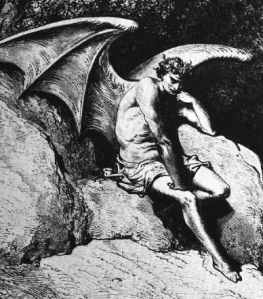
Luciferum

a0016105078b665dcdfb637d861553ab--dark-angels-fallen-angels

This is part 3 of 3. Part 1 is here. Part 2 is here.

Completo vero tam nefandissimo scelere et candelis iterum reaccensis singulisque in suo ordine constitutis, de obscuro scholarum angulo, quo non carent perditissimi homines, quidam homo procedit a renibus sursum fulgens et sole clarior, sicut dicunt, et deorsum hispidus sicut gattus, cuius fulgor illuminat totum locum. tunc magister excerpens quid de veste novitii, fulgido illi dicit: ‘magister, hoc mihi datum tibi do’, illo fulgido respondente: ‘bene mihi servivisti; pluries et melius servies; tuae committo custodiae quod dedisti.’ et his dictis protinus evanescit. corpus etiam Domini singulis annis in Pascha de manu recipiunt sacerdotis, et illud ad domos suas ore portantes in latrinam proiciunt in contumeliam redemptoris. ad haec infelicissimi omnium miserorum gubernantem caelestia pollutis labiis blasphemantes, asserunt delirando, caelorum Dominum violenter, contra iustitiam, et dolose Luciferum in inferos detrusisse. in hunc etiam credunt miseri, et ipsum affirmant caelestium conditorem, et adhuc ad suam gloriam, praecipitato Domino, rediturum, per quem, cum eodem, et non ante ipsum se sperant aeternam beatitudinem habituros. omnia Deo placita non agenda fatentur, et potius agenda quae odit. proh dolor! quis umquam audivit talia?
(Gregory IX, Vox in Rama)

When these abnormal sins have been completed, the candles are lit again and each resumes his place. Then from a dark corner of the room a man comes forward. From the loins upward he shines brighter than the sun, as they say, but his lower part is shaggy like a cat. His brilliance illuminates the entire place. Then the master plucks off something from the novice’s clothing, and says to that radiant figure: “Master, this has been given to me; I in turn give it to you.” The shining one then answers: “You have served me well; and in the future you will often serve me again, and even better. I entrust to your care that which you have given me.” And with these words he vanishes instantly. They even receive the body of the Lord every year at Easter from the hand of the priest, and, carrying it home in their mouths, they throw it into the latrine in contempt of our Saviour. These most wretched of men, who blaspheme the divine ruler with their polluted lips, also claim in their madness that the lord of heavens has acted violently, unjustly and guilefully in casting Lucifer down into hell. These wretches even worship him, they declare that he is the creator of all heavenly bodies, and that after the downfall of God he will return to his former glory. Through him, and with him, and not before him they hope to reach eternal bliss. They profess that all deeds that are pleasing to God should not be done, and one should rather do what God hates. Lord have mercy, who has ever heard of such things? (tr. Alex October1625, adapted and expanded by David Bauwens)

Damnabiliter

93

This is part 2 of 3. Part 1 is here.

Ad convivium postmodum discumbentibus, et surgentibus completo ipso convivio, per quandam statuam, quae in scholis huiusmodi esse solet, descendit retrorsum ad modum canis mediocris gattus niger, retorta cauda; quem a posterioribus primo novitius, post magister, deinde singuli per ordinem osculantur, qui tamen digni sunt et perfecti. imperfecti vero, qui se dignos non reputant, pacem recipiunt a magistro, et tunc singulis per loca sua positis, dictisque quibusdam carminibus, ac versus gattum capitibus inclinatis, ‘parce nobis’ dicit magister, et proximo cuique hoc praecipit, respondente tertio ac dicente, ‘scimus, magister’; quartus ait: ‘et nos oboedire debemus’. et his ita peractis exstinguuntur candelae et proceditur ad fetidissimum opus luxuriae, nulla discretione habita inter extraneas et propinquas. quod si forte virilis sexus supersunt aliqui ultra numerum mulierum, traditi in passiones ignominiae, in desideriis suis invicem exardentes, masculi in masculos turpitudinem operantur, similiter et feminae immutant naturalem usum in eum, qui est contra naturam, hoc ipsum inter se damnabiliter facientes.
(Gregory IX, Vox in Rama)

Afterwards, they sit down to a meal and when they have arisen from it, from a kind of statue that is usually present in a sect of this kind, a black cat, the size of an average dog, descends backwards, with its tail erect. First the novice, next the master, then all those who are worthy and perfect, kiss the cat on its buttocks, each one waiting his turn. To those who have not yet reached perfection, however, and are considered undeserving, the master wishes peace. Then each returns to his place and they recite certain verse, their heads inclined toward to cat. “Forgive us!” then says the master, and the one next to him repeats this, and a third one says in reply: “We know, master!” A fourth says: “We too must obey.” When this has been done, they put out the candles, and turn to the practice of the most disgusting lechery. They make no distinction between strangers and family. And if by chance those of the male sex exceed the number of women, surrendering to their despicable passions, they satisfy their lust among themselves: men engage in depravity with men, and likewise women change their natural function to one that is against nature, and most offensively do these things to each other. (tr. Alex October1625, adapted by David Bauwens)

Osculantes

stufftoblowyourmind-23-2015-04-devilkiss

This is part 1 of 3.

Huius pestis initia talia perferuntur. nam dum novitius in ea quisquam recipitur, et perditorum primitus scholas intrat, apparet ei species quaedam ranae, quam bufonem consueverunt aliqui nominare. hanc quidam a posterioribus et quidam in ore damnabiliter osculantes, linguam bestiae intra ora sua recipiunt et salivam. haec apparet interdum indebita quantitate, et quandoque in modum anseris vel anatis; plerumque furni etiam quantitatem assumit. demum novitio procedenti occurrit miri palloris homo, nigerrimos habens oculos, adeo extenuatus et macer, quod consumptis carnibus sola cutis relicta videtur ossibus superducta; hunc novitius osculatur, et sentit frigidum sicut glaciem, et post osculum catholicae fidei memoria de ipsius corde totaliter evanescit.
(Gregory IX, Vox in Rama)

The following rites of this pestilence are carried out: when any novice is to be received among them and enters the sect of the damned for the first time, the shape of a certain frog appears to him, the type that is usually called a toad. Some kiss this creature despicably on the hind quarters and some on the mouth, and they receive the tongue and saliva of the beast inside their mouths. Sometimes it appears unduly large, and sometimes equivalent to a goose or a duck; often it even assumes the size of an oven. At length, when the novice has come forward, he is met by a man of wondrous pallor, who has the blackest eyes and is so emaciated and thin that, since his flesh has been wasted, only his skin seems remain, drawn over his bones. The novice kisses him and feels cold like ice, and after the kiss the memory of the Catholic faith totally disappears from his heart. (tr. Alex October1625, adapted by David Bauwens)

Nuktipolois

576951_286792278088676_548827086_n

Κἄστι τὸ σύνθημα Ἐλευσινίων μυστηρίων· “ἐνήστευσα, ἔπιον τὸν κυκεῶνα, ἔλαβον ἐκ κίστης, ἐργασάμενος ἀπεθέμην εἰς κάλαθον καὶ ἐκ καλάθου εἰς κίστην.” καλά γε τὰ θεάματα καὶ θεᾷ πρέποντα. ἄξια μὲν οὖν νυκτὸς τὰ τελέσματα καὶ πυρὸς καὶ τοῦ “μεγαλήτορος”, μᾶλλον δὲ ματαιόφρονος Ἐρεχθειδῶν δήμου, πρὸς δὲ καὶ τῶν ἄλλων Ἑλλήνων, οὕστινας “μένει τελευτήσαντας ἅσσα οὐδὲ ἔλπονται.” τίσι δὴ μαντεύεται Ἡράκλειτος ὁ Ἐφέσιος; “νυκτιπόλοις, μάγοις, βάκχοις, λήναις, μύσταις”, τούτοις ἀπειλεῖ τὰ μετὰ θάνατον, τούτοις μαντεύεται τὸ πῦρ· “τὰ γὰρ νομιζόμενα κατὰ ἀνθρώπους μυστήρια ἀνιερωστὶ μυοῦνται.” νόμος οὖν καὶ ὑπόληψις κενὴ καὶ τοῦ δράκοντος τὰ μυστήρια ἀπάτη τίς ἐστιν θρῃσκευομένη, τὰς ἀμυήτους ὄντως μυήσεις καὶ τὰς ἀνοργιάστους τελετὰς εὐσεβείᾳ νόθῳ προστρεπομένων.
(Clement of Alexandria, Protr. 18-19)

And the formula of the Eleusinian mysteries is as follows: “I fasted; I drank the draught; I took from the chest; having done my task, I placed in the basket, and from the basket into the chest.” Beautiful sights indeed, and fit for a goddess! Yes, such rites are meet for night and torch fires, and for the “great-hearted”—I should rather say empty-headed—people of the Erechtheidae, with the rest of the Greeks as well, “whom after death there await such things as they little expect.” Against whom does Heracleitus of Ephesus utter this prophecy? Against “night-roamers, magicians, Bacchants, Lenaean revellers and devotees of the mysteries.” These are the people whom he threatens with the penalties that follow death; for these he prophesies the fire. “For in unholy fashion are they initiated into the mysteries customary among men.” The mysteries, then, are mere custom and vain opinion, and it is a deceit of the serpent that men worship when, with spurious piety, they return towards these sacred initiations that are really profanities, and solemn rites that are without sanctity. (tr. George William Butterworth)

Affectus

ibson_fig_xii

Ego te per omne quod datum mortalibus
et destinatum saeculum est,
claudente donec continebor corpore,
discernam orbe quolibet,

nec ab orbe longe nec remotum lumine
tenebo fibris insitum,
videbo corde, mente complectar pia
ubique praesentem mihi.

et cum solutus corporali carcere
terraque provolavero,
quo me locarit axe communis pater
illic quoque animo te geram.

neque finis idem qui meo me corpore
et amore laxabit tuo.
mens quippe, lapsis quae superstes artubus
de stirpe durat caeliti,

sensus necesse est simul et affectus suos
retineat ut vitam suam;
et ut mori sic oblivisci non capit,
perenne vivax et memor.

(Paulinus of Nola, Carm. 11.49-68)

Throughout the entire span granted and allotted to humankind, for so long as I am contained by this confining body, I may be separated from you by the length of a world, but you will not be far from my face or removed from my eyes. I shall hold you fast within me. I shall see you with my heart’s eye and embrace you with loving mind. You will be before me everywhere. When I am freed from the prison of my body and fly forth from the earth, whatever the heavenly region where our common Father sets me, even there I shall have you in mind. The death which looses me from my body will not loose me from your love, for the mind survives the limbs which fall away, and lives on because its birth is divine. So it must keep its feeling and affections as it keeps its life, and it admits forgetfulness no more than death. It lives and it remembers forever. (tr. Patrick Gerard Walsh)

Pannuchioi

Campfire_Pinecone

Οἱ δὲ μέγα φρονέοντες ἐπὶ πτολέμοιο γεφύρας
ἥατο παννύχιοι, πυρὰ δέ σφισι καίετο πολλά.
ὡς δ’ ὅτ’ ἐν οὐρανῷ ἄστρα φαεινὴν ἀμφὶ σελήνην
φαίνετ’ ἀριπρεπέα, ὅτε τ’ ἔπλετο νήνεμος αἰθήρ·
ἔκ τ’ ἔφανεν πᾶσαι σκοπιαὶ καὶ πρώονες ἄκροι
καὶ νάπαι οὐρανόθεν δ’ ἄρ’ ὑπερράγη ἄσπετος αἰθήρ,
πάντα δὲ εἴδεται ἄστρα, γέγηθε δέ τε φρένα ποιμήν·
τόσσα μεσηγὺ νεῶν ἠδὲ Ξάνθοιο ῥοάων
Τρώων καιόντων πυρὰ φαίνετο Ἰλιόθι πρό.
χίλι’ ἄρ’ ἐν πεδίῳ πυρὰ καίετο, πὰρ δὲ ἑκάστῳ
ἥατο πεντήκοντα σέλᾳ πυρὸς αἰθομένοιο.
ἵπποι δὲ κρῖ λευκὸν ἐρεπτόμενοι καὶ ὀλύρας
ἑσταότες παρ’ ὄχεσφιν ἐΰθρονον Ἠῶ μίμνον.
(Homer, Il. 8.553-565)

These then with high hearts stayed the whole night through along the lines of war, and their fires burned in multitudes. Just as in the sky about the gleaming moon the stars shine clear when the air is windless, and into view come all mountain peaks and high headlands and glades, and from heaven breaks open the infinite air, and all the stars are seen, and the shepherd rejoices in his heart; in such multitudes between the ships and the streams of Xanthus shone the fires that the Trojans kindled before Ilios. A thousand fires were burning in the plain and by each sat fifty men in the glow of the blazing fire. And their horses, eating of white barley and spelt, stood beside the chariots and waited for fair-throned Dawn. (tr. Augustus Taber Murray, revised by William F. Wyatt)

Pōtēsēi

Tanagra,_5th_century_kylix_a_symposiast_sings_Theognis_o_paidon_kalliste

Σοὶ μὲν ἐγὼ πτέρ’ ἔδωκα, σὺν οἷς ἐπ’ ἀπείρονα πόντον
πωτήσῃ καὶ γῆν πᾶσαν ἀειρόμενος
ῥηϊδίως· θοίνῃς δὲ καὶ εἰλαπίνῃσι παρέσσῃ
ἐν πάσαις, πολλῶν κείμενος ἐν στόμασιν,
καί σε σὺν αὐλίσκοισι λιγυφθόγγοις νέοι ἄνδρες
εὐκόσμως ἐρατοὶ καλά τε καὶ λιγέα
ᾄσονται. καὶ ὅταν δνοφερῆς ὑπὸ κεύθεσι γαίης
βῇς πολυκωκύτους εἰς Ἀΐδαο δόμους,
οὐδέποτ’ οὐδὲ θανὼν ἀπολεῖς κλέος, ἀλλὰ μελήσεις
ἄφθιτον ἀνθρώποις αἰὲν ἔχων ὄνομα,
Κύρνε, καθ’ Ἑλλάδα γῆν στρωφώμενος ἠδ’ ἀνὰ νήσους
ἰχθυόεντα περῶν πόντον ἐπ’ ἀτρύγετον,
οὐχ ἵππων νώτοισιν ἐφήμενος, ἀλλά σε πέμψει
ἀγλαὰ Μουσάων δῶρα ἰοστεφάνων·
πᾶσι δ’ ὅσοισι μέμηλε καὶ ἐσσομένοισιν ἀοιδὴ
ἔσσῃ ὁμῶς, ὄφρ’ ἂν γῆ τε καὶ ἠέλιος·
αὐτὰρ ἐγὼν ὀλίγης παρὰ σεῦ οὐ τυγχάνω αἰδοῦς,
ἀλλ’ ὥσπερ μικρὸν παῖδα λόγοις μ᾽ ἀπατᾷς.
(Theognis, Eleg. 237-254)

I have given you wings with which you will fly, soaring easily, over the boundless sea and all the land. You will be present at every dinner and feast, lying on the lips of many, and lovely youths accompanied by the clear sounds of pipes will sing of you in orderly fashion with beautiful, clear voices. And whenever you go to Hades’ house of wailing, down in the dark earth’s depths, never even in death you will lose your fame, but you will be in men’s thoughts, your name ever immortal, Cyrnus, as you roam throughout the land of Greece and among the islands, crossing over the fish-filled, undraining(?) sea, not riding on the backs of horses, but it is the splendid gifts of the violet-wreathed Muses that will escort you. For all who care about their gifts, even for future generations, you will be alike the subject of song, as long as earth and sun exist. And yet I do not meet with a slight respect from you, but you deceive me with your words, as if I were a small child. (tr. Douglas E. Gerber)

Scribe

medieval_writing_desk

Qualiter ambo simul paucis habitavimus horis
non fugit ex oculis, dum manet ista dies.
misimus o quotiens timidis epigrammata chartis!
et tua, ne recreer, pagina muta silet.
quis, rogo, reddat eas taciti quas perdimus horas?
tempora non revocat lux levis atque fugax.
dic homo note meus: quid agis? quid, amice, recurris?
si tua rura colis, cur mea vota neges?
scribe vacans animo, refer alta poemata versu
et quasi ruris agrum me cole voce, melo.
per thoraca meum ducas, precor, oris aratrum,
ut linguae sulcus sint sata nostra tuus,
pectoris unde seges gravidis animetur aristis,
pullulet et nostrum farra novale ferax.
nam mihi si loqueris, bone vir pietatis opimae
exsuperas labiis dulcia mella favis,
plusque liquore placet quem fert oleagina suco,
suavius et recreat quam quod aroma reflat.
cum Aspasio pariter caris patre, fratre Leone
longa stante die, dulcis amice, vale.
(Venantius Fortunatus 7.12.103-122)

How often we exchanged verses on hesitant paper, yet your page is silent now and unspeaking to give me no refreshment! Who, I ask, is to restore the hours we have lost in silence? Each day’s light is frail and fleeting, never recalling time past. Tell me, my good friend, how are you and how do you spend your time? If you are working the land, why do you refuse my requests? Write when you have the free time, send me fine poems in verse, and work on me too, like a field, with voice and with song. Drive, I pray, through my chest the plow of your words so that my field of grain is the furrow of your tongue, so that the harvest of my heart springs to life with swelling ears, and my fallow teems with fertile crops. For if you speak to me, good sir, rich in kindness, you surpass sweet honey with your honeycomb lips, and that liquor gives more pleasure than the oil the olive tree gives and more sweetly refreshes than the scent of a perfume. Along with dear Aspasius, your father, and your brother Leo, sweet friend, fare well for many a day. (tr. Michael Roberts)

Apomachoumenoi

article-1352174-0CFCE87F000005DC-818_964x630

Ἐνδένδε ὁρμηθέντες ἔπλωον ἀκραεί, καὶ διελθόντες σταδίους ἐς πεντακοσίους ὡρμίζοντο πρὸς ποταμῷ χειμαρρόῳ· Τόμηρος οὔνομα ἦν τῷ ποταμῷ. καὶ λίμνη ἦν ἐπὶ τῇσιν ἐκβολῇσι τοῦ ποταμοῦ, τὰ δὲ βραχέα τὰ πρὸς τῷ αἰγιαλῷ ἐπῴκεον ἄνθρωποι ἐν καλύβῃσι πνιγηρῇσι. καὶ οὗτοι ὡς προσπλώοντας εἶδον, ἐθάμβησάν τε καὶ παρατείναντες σφᾶς παρὰ τὸν αἰγιαλὸν ἐτάχθησαν ὡς ἀπομαχεόμενοι πρὸς τοὺς ἐκβαίνοντας. λόγχας δὲ ἐφόρεον παχέας, μέγαθος ὡς ἑξαπήχεας· ἀκωκὴ δὲ οὐκ ἐπῆν σιδηρέη, ἀλλὰ τὸ ὀξὺ αὐτοῖσι πεπυρακτωμένον τωὐτὸ ἐποίεε. πλῆθος δὲ ἦσαν ὡς ἑξακόσιοι. καὶ τούτους Νέαρχος ὡς ὑπομένοντάς τε καὶ παρατεταγμένους κατεῖδε, τὰς μὲν νέας ἀνακωχεύειν κελεύει ἐντὸς βέλεος, ὡς τὰ τοξεύματα ἐς τὴν γῆν ἀπ᾽ αὐτέων ἐξικνέεσθαι· αἱ γὰρ τῶν βαρβάρων λόγχαι ἀγχέμαχοι μὲν ἄφοβοι δὲ ἐς τὸ ἐσακοντίζεσθαι ἦσαν. αὐτὸς δὲ τῶν στρατιωτέων ὅσοι αὐτοὶ τε κουφότατοι καὶ κουφότατα ὡπλισμένοι τοῦ τε νέειν δαημονέστατοι, τούτους δὲ ἐκνήξασθαι κελεύει ἀπὸ συνθήματος. πρόσταγμα δέ σφισιν ἦν, ὅκως τις ἐκνηξάμενος σταίη ἐν τῷ ὕδατι, προσμένειν τὸν παραστάτην οἱ ἐσόμενον, μηδὲ ἐμβάλλειν πρόσθε ἐς τοὺς βαρβάρους, πρὶν ἐπὶ τριῶν ἐς βάθος ταχθῆναι τὴν φάλαγγα· τότε δὲ δρόμῳ ἐπιέναι ἀλαλάζοντας. ἅμα δὲ ἐρρίπτεον ἑωυτοὺς οἱ ἐπὶ τῷδε τεταγμένοι ἐκ τῶν νεῶν ἐς τὸν πόντον, καὶ ἐνήχοντο ὀξέως, καὶ ἵσταντο ἐν κόσμῳ, καὶ φάλαγγα ἐκ σφῶν ποιησάμενοι δρόμῳ ἐπῄεσαν αὐτοὶ τε ἀλαλάζοντες τῷ Ἐνυαλίῳ καὶ οἱ ἐπὶ τῶν νεῶν συνεπήχεον, τοξεύματά τε καὶ ἀπὸ μηχανέων βέλεα ἐφέρετο ἐς τοὺς βαρβάρους. οἳ δὲ τήν τε λαμπρότητα τῶν ὅπλων ἐκπλαγέντες καὶ τῆς ἐφόδου τὴν ὀξύτητα καὶ πρὸς τῶν τοξευμάτων τε καὶ τῶν ἄλλων βελέων βαλλόμενοι, οἷα δὴ ἡμίγυμνοι ἄνθρωποι, οὐδὲ ὀλίγον ἐς ἀλκὴν τραπέντες ἐγκλίνουσι. καὶ οἱ μὲν αὐτοῦ φεύγοντες ἀποθνήσκουσιν, οἳ δὲ καὶ ἁλίσκονται· ἔστι δὲ οἳ καὶ διέφυγον ἐς τὰ οὔρεα. ἦσαν δὲ οἱ ἁλόντες τά τε ἄλλα δασέες καὶ τὰς κεφαλάς, καὶ τοὺς ὄνυχας θηριώδεες· τοῖσι γὰρ δὴ ὄνυξιν ὅσα σιδήρῳ διαχρᾶσθαι ἐλέγοντο καὶ τοὺς ἰχθύας τούτοισι παρασχίζοντες κατεργάζεσθαι καὶ τῶν ξύλων ἃσαμαλθακώτερα. τὰ δὲ ἄλλα τοῖαι λίθοισι τοῖσιν ὀξέσιν ἔκοπτον· σίδηρος γὰρ αὐτοῖσιν οὐκ ἦν. ἐσθῆτα δὲ ἐφόρεον δέρματα θηρήια, οἳ δὲ καὶ ἰχθύων τῶν μεγάλων τὰ παχέα.
(Arrian, Ind. 24)

Thence they set sail and progressed with a favouring wind; and after a passage of five hundred stades the anchored by a torrent, which was called Tomerus. There was a lagoon at the mouths of the river, and the depressions near the bank were inhabited by natives in stifling cabins. These seeing the convoy sailing up were astounded, and lining along the shore stood ready to repel any who should attempt a landing. They carried thick spears, about six cubits long; these had no iron tip, but the same result was obtained by hardening the point with fire. They were in number about six hundred. Nearchus observed these evidently standing firm and drawn up in order, and ordered the ships to hold back within range, so that their missiles might reach the shore; for the natives’ spears, which looked stalwart, were good for close fighting, but had no terrors against a volley. Then Nearchus took the lightest and lightest-armed troops, such as were also the best swimmers, and bade them swim off as soon as the word was given. Their orders were that, as soon as any swimmer found bottom, he should await his mate, and not attack the natives till they had their formation three deep; but then they were to raise their battle cry and charge at the double. On the word, those detailed for this service dived from the ships into the sea, and swam smartly, and took up their formation in orderly manner, and having made a phalanx, charged, raising, for their part, their battle cry to the God of War, and those on shipboard raised the cry along with them; and arrows and missiles from the engines were hurled against the natives. They, astounded at the flash of the armour, and the swiftness of the charge, and attacked by showers of arrows and missiles, half naked as they were, never stopped to resist but gave way. Some were killed in flight; others were captured; but some escaped into the hills. Those captured were hairy, not only their heads but the rest of their bodies; their nails were rather like beasts’ claws; they used their nails (according to report) as if they were iron tools; with these they tore asunder their fishes, and even the less solid kinds of wood; everything else they cleft with sharp stones; for iron they did not possess. For clothing they wore skins of animals, some even the thick skins of the larger fishes. (tr. Ernest Iliff Robson)

Gorillas

Funny_Gorilla

Ἐν δὲ τῷ μυχῷ νῆσος ἦν, ἐοικυῖα τῇ πρώτῃ, λίμνην ἔχουσα· καὶ ἐν ταύτῃ νῆσον ἦν ἑτέρα, μεστὴ ἀνθρώπων ἀγρίων. πολὺ δὲ πλείους ἦσαν γυναῖκες, δασεῖται τοῖς σώμασιν· ἃς οἱ ἑρμηνέες ἐκάλουν Γορίλλας. διώκοντες δὲ ἄνδρας μὲν συλλαβεῖν οὐκ ἠδυνήθημεν, ἀλλὰ πάντες μὲν ἐξέφυγον, κρημνοβάται ὄντες καὶ τοῖς πέτροις ἀμυνόμενοι, γυναῖκας δὲ τρεῖς, αἳ δάκνουσαί τε καὶ σπαράττουσαι τοὺς ἄγοντας οὐκ ἤθελον ἕπεσθαι. ἀποκτείναντες μέντοι αὐτὰς ἐξεδείραμεν καὶ τὰς δορὰς ἐκομίσαμεν εἰς Καρχηδόνα. οὐ γὰρ ἔτι ἐπλεύσαμεν προσωτέρω, τῶν σίτων ἡμᾶς ἐκλιπόντων.
(Hannōnos Periplous 18)

In the recess of this bay there was an island, like the former one, having a lake, in which there was another island, full of savage men. There were women, too, in even greater number. They had hairy bodies, and the interpreters called them Gorillae. When we pursued them we were unable to take any of the men ; for they all escaped, by climbing the steep places and defending themselves with stones; but we took three of the women, who bit and scratched their leaders, and would not follow us. So we killed them and flayed them, and brought their skins to Carthage. For we did not voyage further, provisions failing us. (tr. Wilfred H. Schoff)