Tamon

jd3
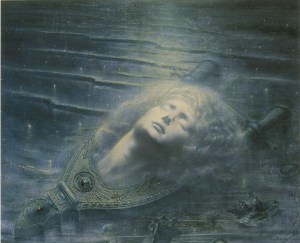
Jean Delville, Orphée (1893)

…ἢ ὡς Οἰάγροιο πάϊς Θρηΐκιος Ὀρφεὺς
ἐκ θυμοῦ Κάλαϊν στέρξε Βορηϊάδην,
πολλάκι δὲ σκιεροῖσιν ἐν ἄλσεσιν ἕζετ᾿ ἀείδων
ὃν πόθον, οὐδ’ ἦν οἱ θυμὸς ἐν ἡσυχίῃ,
ἀλλ’ αἰεί μιν ἄγρυπνοι ὑπὸ ψυχῇ μελεδῶναι
ἔτρυχον, θαλερὸν δερκομένου Κάλαϊν.
τὸν μὲν Βιστονίδες κακομήχανοι ἀμφιχυθεῖσαι
ἔκτανον, εὐήκη φάσγανα θηξάμεναι,
οὕνεκα πρῶτος ἔδειξεν ἐνὶ Θρῄκεσσιν ἔρωτας
ἄρρενας, οὐδὲ πόθους ᾔνεσε θηλυτέρων.
τοῦ δ’ ἀπὸ μὲν κεφαλὴν χαλκῷ τάμον, αὐτίκα δ’ αὐτὴν
εἰς ἅλα Θρηϊκίῃ ῥῖψαν ὁμοῦ χέλυϊ
ἥλῳ καρτύνασαι, ἵν’ ἐμφορέοιντο θαλάσσῃ
ἄμφω ἅμα, γλαυκοῖς τεγγόμεναι ῥοθίοις.
τὰς δ᾿ ἱερῇ Λέσβῳ πολιὴ ἐπέκελσε θάλασσα·
. . .
ἠχὴ δ’ ὣς λιγυρῆς πόντον ἐπέσχε λύρης,
νήσους τ’ αἰγιαλούς θ’ ἁλιμυρέας, ἔνθα λίγειαν
ἀνέρες Ὀρφείην ἐκτέρισαν κεφαλήν,
ἐν δὲ χέλυν τύμβῳ λιγυρὴν θέσαν, ἣ καὶ ἀναύδους
πέτρας καὶ Φόρκου στυγνὸν ἔπειθεν ὕδωρ.
ἐκ κείνου μολπαί τε καὶ ἱμερτὴ κιθαριστὺς
νῆσον ἔχει, πασέων δ’ ἐστὶν ἀοιδοτάτη.
Θρῇκες δ’ ὡς ἐδάησαν ἀρήϊοι ἔργα γυναικῶν
ἄγρια, καὶ πάντας δεινὸν ἐσῆλθεν ἄχος,
ἃς ἀλόχους ἔστιζον, ἵν’ ἐν χροῒ σήματ’ ἔχουσαι
κυάνεα στυγεροῦ μὴ λελάθοιντο φόνου·
ποινὰς δ’ Ὀρφῆϊ κταμένῳ τίνουσι γυναῖκες
εἰσέτι νῦν κείνης εἵνεκεν ἀμπλακίης.
(Phanocles, fr. 1)

Or how Thracian Orpheus, the son of Oeagrus, loved Calaïs, the son of Boreas, with all his heart and often he would sit in the shady groves singing his heart’s desire; nor was his spirit at peace, but always his soul was consumed with sleepless cares as he gazed on fresh Calaïs. But the Bistonian women of evil devices killed Orpheus, having poured about him, their keen-edged swords sharpened, because he was the first to reveal male loves among the Thracians and did not recommend love of women. The women cut off his head with their bronze and straightaway they threw it in the sea with his Thracian lyre of tortoiseshell, fastening them together with a nail, so that both would be borne on the sea, drenched by the grey waves. The hoary sea brought them to land on holy Lesbos […] and thus the lyre’s clear ring held sway over the sea and the islands and the sea-soaked shores, where the men gave the clear-sounding head of Orpheus its funeral rites, and in the tomb they put the clear lyre, which used to persuade even dumb rocks and the hateful water of Phorcys. From that day on, songs and lovely lyre-playing have held sway over the island and it is the most songful of all islands. As for the warlike Thracian men, when they had learned the women’s savage deeds and dire grief had sunk into them all, they began the custom of tattooing their wives, so that having on their flesh signs of dark blue, they would not forget their hateful murder. And even now, the women pay reparations to the dead Orpheus because of that sin. (tr. Sarah Burges Watson)


Mues

web_0009_find-and-order-jax-mice

Ὦ μύες, εἰ μὲν ἐπ’ ἄρτον ἐληλύθατ’, ἐς μυχὸν ἄλλον
στείχετ’ (ἐπεὶ λιτὴν οἰκέομεν καλύβην),
οὗ καὶ πίονα τυρὸν ἀποδρέψεσθε καὶ αὔην
ἰσχάδα καὶ δεῖπνον συχνὸν ἀπὸ σκυβάλων·
εἰ δ’ ἐν ἐμαῖς βύβλοισι πάλιν καταθήξετ’ ὀδόντα,
κλαύσεσθ’ οὐκ ἀγαθὸν κῶμον ἐπερχόμενοι.
(Ariston, Anth. Gr. 6.303)

Mice, if you have come for bread, go to some other corner (my hut is ill-supplied), where ye shall nibble fat cheese and dried figs, and get a plentiful dinner from the scraps. But if ye sharpen your teeth again on my books ye shall suffer for it and find that ye come to no pleasant banquet. (tr. William Roger Paton)

Seirios

Heat-Weather-Generic-600x400

Τέγγε πλεύμονας οἴνῳ, τὸ γὰρ ἄστρον περιτέλλεται,
ἀ δ’ ὤρα χαλέπα, πάντα δὲ δίψαισ’ ὐπὰ καύματος,
ἄχει δ’ ἐκ πετάλων ἄδεα τέττιξ . . .
ἄνθει δὲ σκόλυμος· νῦν δὲ γύναικες μιαρώταται,
λέπτοι δ’ ἄνδρες, ἐπεὶ <δὴ> κεφάλαν καὶ γόνα Σείριος
ἄσδει . . .
(Alcaeus fr. 347)

Wet your lungs with wine: the star* is coming round, the season is harsh, everything is thirsty under the heat, the cicada sings sweetly from the leaves . . . the artichoke is in flower; now are women most pestilential, but men are feeble, since Sirius parches their heads and knees . . .

* The dogstar, Sirius, which brings the heat of the dog days.

(tr. David A. Campbell, with his note)

Lōpodutas

23222252169_57a2283ccd

Τοὺς κυκλίους τούτους, τοὺς “αὐτὰρ ἔπειτα” λέγοντας,
μισῶ, λωποδύτας ἀλλοτρίων ἐπέων.
καὶ διὰ τοῦτ’ ἐλέγοις προσέχω πλέον· οὐδὲν ἔχω γὰρ
Παρθενίου κλέπτειν ἢ πάλι Καλλιμάχου.
“θηρὶ μὲν οὐατόεντι” γενοίμην, εἴ ποτε γράψω,
εἴκελος, “ἐκ ποταμῶν χλωρὰ χελιδόνια.”
οἱ δ’ οὕτως τὸν Ὅμηρον ἀναιδῶς λωποδυτοῦσιν,
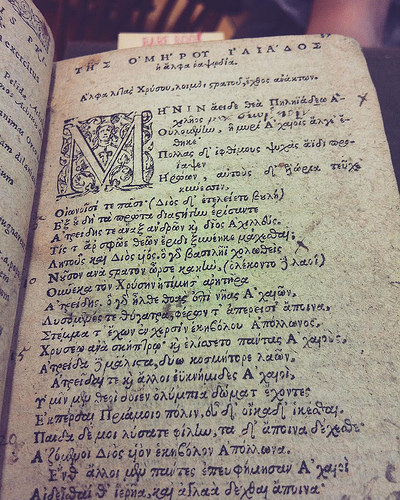
ὥστε γράφειν ἤδη “μῆνιν ἄειδε, θεά.”
(Pollianus, Anth. Gr. 11.130)

I hate these cyclic poets* who say “natheless eftsoon,” filchers of the verses of others, and so I pay more attention to elegies, for there is nothing I want to steal from Callimachus or Parthenius. Let me become like an “eared beast”** if ever I write “from the rivers sallow celandine.”*** But these epic poets strip Homer so shamelessly that they already write “Sing, O Goddess, the wrath.”****

* Contemporary writers of epic poems.
** So Callimachus calls a donkey.
*** Probably a quotation from Parthenius. He like Callimachus, wrote elegies.
**** i.e. the very first words of his poem.

(tr. William Roger Paton, with his notes)

Chlamydem

godong-painting-of-st-martin-sharing-his-coat-st-gatien-cathedral-tours-indre-et-loire_a-G-6223736-4990875

Quodam itaque tempore, cum iam nihil praeter arma et simplicem militiae vestem haberet, media hieme, quae solito asperior inhorruerat, adeo ut plerosque vis algoris exstingueret, obvium habet in porta Ambianensium civitatis pauperem nudum: qui cum praetereuntes ut sui misererentur oraret omnesque miserum praeterirent, intellegit vir Deo plenus sibi illum, aliis misericordiam non praestantibus, reservari. quid tamen ageret? nihil praeter chlamydem, qua indutus erat, habebat: iam enim reliqua in opus simile consumpserat. arrepto itaque ferro, quo accinctus erat, mediam dividit partemque eius pauperi tribuit, reliqua rursus induitur. interea de circumstantibus ridere nonnulli, quia deformis esse truncatus habitu videretur: multi tamen, quibus erat mens sanior, altius gemere, quod nihil simile fecissent, cum utique plus habentes vestire pauperem sine sui nuditate potuissent. nocte igitur insecuta, cum se sopori dedisset, vidit Christum chlamydis suae, qua pauperem texerat, parte vestitum. intueri diligentissime Dominum vestemque, quam dederat, iubetur agnoscere. mox ad angelorum circumstantium multitudinem audit Iesum clara voce dicentem: “Martinus adhuc catechumenus hic me veste contexit.” vere memor Dominus dictorum suorum, qui ante praedixerat: “quamdiu fecistis uni ex minimis istis, mihi fecistis,” se in paupere professus est fuisse vestitum: et ad confirmandum tam boni operis testimonium in eodem se habitu, quem pauper acceperat, est dignatus ostendere.
(Sulpicius Severus, Vita Martini 3.1-4)

One day then, in the middle of a winter more bitterly cold than usual (so much so that many perished as a result of the severity of the icy weather) when Martin had nothing with him apart from his weapons and a simple military cloak, he came across a naked beggar at the gate of the city of Amiens. The man begged the people who were passing to have pity on him but they all walked past him. Then Martin, who was filled with God’s grace, understood that this man had been reserved for him, since the others were not showing him any mercy. But what was he to do? He had nothing apart from the cloak he was wearing, for he had already used up the rest of his things for a similar purpose. So he seized the sword which he wore at his side, divided the cloak in two, gave half to the beggar and then put the remaining piece on again. Some of the bystanders began to laugh because he looked odd with his chopped-up cloak, but many who were more sensible sighed deeply because they had not done the same despite the fact that, because they had more than Martin, they could have clothed the beggar without themselves being reduced to nakedness. The following night, therefore, when Martin had fallen asleep, he saw Christ clothed in the part of his cloak which he had used to cover the beggar. He was told to look very carefully at the Lord and to recognize the clothing which he had given. Then he heard Jesus saying in a clear voice to the host of angels standing all around: ‘Martin who is still a catechumen covered me with this cloak.’ Undoubtedly, when the Lord declared that He Himself was clothed in the person of this beggar, He was recalling His own words for he had once said: ‘As often as you do this to one of the least, you have done it to me.’ [Matt. 25:40] And he deigned to reveal himself in the clothing which the beggar had received in order to confirm His witness to such a good deed. (tr. Carolinne White)

Agalmasin

1-2

Οὐδέ τις ἦν κείνοισιν Ἄρης θεὸς οὐδὲ Κυδοιμός
οὐδὲ Ζεὺς βασιλεὺς οὐδὲ Κρόνος οὐδὲ Ποσειδῶν,
ἀλλὰ Κύπρις βασίλεια.
τὴν οἵ γ’ εὐσεβέεσσιν ἀγάλμασιν ἱλάσκοντο
γραπτοῖς τε ζῴοισι μύροισί τε δαιδαλεόδμοις
σμύρνης τ’ ἀκρήτου θυσίαις λιβάνου τε θυώδους,
ξανθῶν τε σπονδὰς μελίτων ῥίπτοντες ἐς οὖδας·
ταύρων δ’ ἀκρήτοισι φόνοις οὐ δεύετο βωμός,
ἀλλὰ μύσος τοῦτ’ ἔσκεν ἐν ἀνθρώποισι μέγιστον,
θυμὸν ἀπορραίσαντες ἐ<ν>έδμεναι ἠέα γυῖα.
(Empedocles, fr. 128)

To them, neither Ares nor Kydoimos [battle tumult] were gods, neither Zeus the king, nor Kronos, nor Poseidon, but Kypris [Aphrodite] was their queen. Her they appeased with properly respectful gifts: with pictures of animals and with finely crafted perfumes, with burnt offerings of pure myrrh and sweet-smelling frankincense, and by pouring yellow honey on the ground. The altar was not drenched with the pure gore of bulls, but this was the greatest pollution among humans: to wash out the soul and eat the noble limbs. (tr. Andrej & Ivana Petrovic)

Bubla

roast-beef-tenderloin-with-garlic-and-rosemary

Nectar, vina, cibus, vestis, doctrina, facultas—
muneribus largis tu mihi, Gogo, sat es;
tu refluus Cicero, tu noster Apicius extas;
hinc satias verbis, pascis et inde cibis.
sed modo da veniam; bubla turgente quiesco,
nam fit lis uteri, si caro mixtra fremat.
hic, ubi bos recubat, fugiet, puto, pullus et anser;
cornibus et pinnis non furor aequus erit.
et modo iam somno languentia lumina claudo,
nam dormire meum carmina lenta probant.
(Venantius Fortunatus 7.2)

Nectar, wine, food, clothing, learning, and wit—with your generous presents, Gogo, you satisfy me. You are a Cicero reborn, an Apicius for our times; like one you gratify with words, like the other you nurture with food. But now, pray, pardon, because of beef not digested I’m calling a halt, for the belly is the site of dispute, if a mixture of meats growls complaints. Here, where the ox reclines, the chicken and goose will, I think, flee; between horns and feathers there will be no equal fight. But now I am closing my drowsy eyes in sleep; this playful poem gives proof of my sleepy state. (tr. Michael Roberts)

Fruantur

20f85c5f9a15f0d170aa45cf1031e549--kiss-you-the-kiss

Amare liceat, si potiri non licet.
fruantur alii; non moror, non sum invidus;
nam sese excruciat, qui beatis invidet.
quos Venus amavit, facit amoris compotes;
nobis Cupido velle dat, posse abnegat.
olli purpurea delibantes oscula
clemente morsu rosea labia vellicent,
candentes dentes in se effligant suavio,
malas adorent ore et ingenuas genas
et pupularum nitidas geminas gemmulas.
quin et cum tenera membra molli lectulo
complictiora adhaerent Veneris glutino,
libido cum lasciva instinctos suscitat
sinuare ad Veneris cursum femina feminae
inter gannitus et subantis voculas,
carpant papillas atque amplexus intiment
arentque sulcos molles arvo Venerio
thyrsumque pangant hortulo in Cupidinis,
dent crebros ictus conivente lumine,
trepidante cursu Venere et anima fessula
eiaculent tepidum rorem niveis laticibus.
haec illi faciant, queis Venus non invidet;
at nobis casso saltem delectamine
amare liceat, si potiri non licet!
(Apuleius, Anth. Lat. 712)

May I be allowed to love, if I am not allowed to possess!
Others may enjoy it: I do not hinder them, I am not envious;
For he who envies the lucky ones, tortures himself.
To those whom Venus has loved, she grants love:
To me Cupid gives desire, but he denies me fulfilment.
Nibbling someone’s dark-red kisses
With soft biting let them peck rosy lips
Let them strike gleaming teeth against each other in an erotic kiss,
cheeks let them worship with their mouth, and modest temples,
And twinkling little twin gem eyes.
What is more, when tender limbs on a soft bed
Are more closely intertwined by the glue of Venus,
When lascivious lust rouses the instincts
To curve a woman’s thighs to Venus’ course
Between loving whimperings and soft excited words
Let them tease nipples and press embraces,
Let them plough soft furrows on Venus’ field
And plant the thyrsus in Cupid’s garden,
Let them give frequent pushes with closing eyes;
While Venus is still trembling from her course, and the mind is tired,
Let them ejaculate warm dew with snowy liquid.
This those may do whom Venus does not envy;
But as to me, with hollow enjoyment at least,
May I be allowed to love, if I am not allowed to possess!
(tr. Regine May)

Gamein

wedding-mast

Ὡραῖος δὲ γυναῖκα τεὸν ποτὶ οἶκον ἄγεσθαι,
μήτε τριηκόντων ἐτέων μάλα πόλλ’ ἀπολείπων
μήτ’ ἐπιθεὶς μάλα πολλά· γάμος δέ τοι ὥριος οὗτος·
ἡ δὲ γυνὴ τέτορ’ ἡβώοι, πέμπτῳ δὲ γαμοῖτο.
παρθενικὴν δὲ γαμεῖν, ὥς κ’ ἤθεα κεδνὰ διδάξῃς·
τὴν δὲ μάλιστα γαμεῖν, ἥτις σέθεν ἐγγύθι ναίει,
πάντα μάλ’ ἀμφις ἰδών, μὴ γείτοσι χάρματα γήμῃς.
οὐ μὲν γάρ τι γυναικὸς ἀνὴρ ληΐζετ’ ἄμεινον
τῆς ἀγαθῆς, τῆς δ’ αὖτε κακῆς οὐ ῥίγιον ἄλλο,
δειπνολόχης, ἥ τ’ ἄνδρα καὶ ἴφθιμόν περ ἐόντα
εὕει ἄτερ δαλοῖο καὶ ὠμῷ γήραϊ δῶκεν.
(Hesiod, Erga kai Hēmerai 695-705)

Lead a wife to your house when you are in good season, neither falling very many years short of thirty nor having added very many: this is a marriage in good season for you. The woman should have reached puberty four years earlier, and in the fifth she should marry. Marry a virgin so that you can teach her cherished usages: and above all marry one who lives near to you, after you have looked around carefully in all directions, lest your marriage cause your neighbors merriment. For a man acquires nothing better than a good wife, but nothing more chilling than a bad one, a dinner-ambusher, one who singes her husband without a torch, powerful though he be, and gives him over to a raw old age. (tr. Glenn W. Most)

Poēphorous

lorigine-du-monde-1380011477_org

Ἀμφιμεδοῦς θύγατερ
ἐσθλῆς τε καὶ [
γυναικός, ἣν νῦν γῆ κατ’ εὐρώεσσ’ ἔ[χει,
τ]έρψιές εἰσι θεῆς
πολλαὶ νέοισιν ἀνδ[ράσιν
παρὲξ τὸ θεῖον χρῆμα· τῶν τις ἀρκέσε[ι.
τ]αῦτα δ’ ἐπ’ ἡσυχίης εὖτ’ ἂν μελανθη[
ἐ]γώ τε καὶ σὺ σὺν θεῷ βουλεύσομεν·
π]είσομαι ὥς με κέλεαι·
πολλόν μ’ ε[
θρ]ιγκοῦ δ’ ἔνερθε καὶ πυλέων ὑποφ[
μ]ή τι μέγαιρε φίλη· σχήσω γὰρ ἐς ποη[φόρους
κ]ήπους.
(Archilochus, fr. 196a.10-24)

Daughter of Amphimedo,
an excellent and …
woman, whom now the
mouldy earth holds,
there are many sexual delights of
the goddess for young men
besides The Divine Thing. One of them will be enough.
About these things, quietly,
when it becomes dark,
you and I, with the god’s help, will take counsel.
I will obey as you command me.
Much … me …
Under the coping-stone, under the gates …
Do not begrudge anything, dear girl,
for I will come to a halt in the grassy gardens.
(tr. Marguerite Johnson & Terry Ryan)