Animus

shutterstock_243018796

This is part 1 of 3. Part 2 is here. Part 3 is here.

Masculinus animus est vehemens, ad impetum facilis, odii immemor, liberalis, apertus, qui hebetari et circumveniri ingenio atque arte non possit, vincendi per virtutem studiosus, magnanimus. feminus animus est sollers, ad iracundiam pronus, tenax odii, idem immisericors atque invidus, laboris impatiens, docilis, subdolus, amarus, praeceps, timidus.
(Anonymous, De Physiognomonia 4)

The masculine character is forceful, impetuous, forgetful of hatred, generous, open, unable to be blunted and outmanoeuvred by guile or artifice, preferring to overcome through manliness, and is magnanimous. The feminine character is clever, prone to anger, clings to hatred, also pitiless and envious, not enduring hard work, teachable, deceitful, bitter, rash and timid. (tr. Ian Repath)

Humani

Terentius, Heautontimoroumenos

[MENEDEMVS. CHREMES]

MEN. Chreme, tantumne ab re tuast oti tibi
aliena ut cures ea quae nil ad te attinent?
CHR. homo sum: humani nil a me alienum puto.
vel me monere hoc vel percontari puta:
rectumst ego ut faciam; non est te ut deterream.
MEN. mihi sic est usus; tibi ut opus factost face.
CHR. an quoiquamst usus homini se ut cruciet?
MEN. mihi.
CHR. si quid laborist nollem. sed quid istuc malist?
quaeso, quid de te tantum meruisti?
MEN. eheu!
CHR. ne lacruma atque istuc, quidquid est, fac me ut sciam:
ne retice, ne verere, crede inquam mihi:
aut consolando aut consilio aut re iuvero.
MEN. scire hoc vis?
CHR. hac quidem causa qua dixi tibi.
MEN. dicetur.
CHR. at istos rastros interea tamen
adpone, ne labora.
MEN. minime.
CHR. quam rem agis?
MEN. sine me vocivom tempus nequod dem mihi
laboris.
CHR. non sinam, inquam.
MEN. ah! non aequom facis.
CHR. hui! tam gravis hos, quaeso?
MEN. sic meritumst meum.
CHR. nunc loquere.
MEN. filium unicum adulescentulum
habeo. ah! quid dixi? habere me? immo habui, Chremes;
nunc habeam necne incertumst.
CHR. quid ita istuc?
MEN. scies.
(Terence, Heaut. 76-96)

[MENEDEMVS. CHREMES]

MEN. Chremes, have you got so much time to spare from your own work that you interest yourself in other people’s affairs when they don’t concern you at all?
CHR. I’m a man; I don’t regard any man’s affairs as not concerning me. You should regard me either as offering advice or as seeking enlightenment: if it’s right, I want to do it myself; if it isn’t, I want to discourage you.
MEN. This is how I have to behave; you can behave as you need to.
CHR. Does anyone have to torment himself?
MEN. I do.
CHR. If there’s some trouble, I’m sorry. But what’s the matter with you? Tell me, what have you done to earn so much punishment at your own hands?
MEN. (bursting into tears) Oh dear!
CHR. Stop crying! Tell me about it, whatever it is. Don’t keep it to yourself! Don’t feel ashamed; trust me, I tell you. I’ll help you, whether with consolation or advice or money.
MEN. Do you want to know about it?
CHR. Yes, for the reason I’ve given you.
MEN. (finally agreeing) I’ll tell you.
CHR. But meanwhile put your mattock down; you don’t have to tire yourself out. (Moves to take it from him)
MEN. (backing away) Certainly not!
CHR. What are you playing at?
MEN. Let me be! I don’t want to give myself a moment’s rest from hardship!
CHR. (taking the mattock from him) I won’t let you, I tell you!
MEN. Hey, that’s not fair!
CHR. (surprised at its weight) What! Such a heavy one?
MEN. That’s what I deserve.
CHR. (after putting it down on the ground) Now speak.
MEN. (starting on his story) I have one son, a young lad.— But why did I say I have a son? I had one, Chremes; now I don’t know whether I have one or not!
CHR. What do you mean by that?
MEN. I’ll tell you.
(tr. Peter Brown)

Amphibolos

eunuch

Τίνας ἂν εἴποι λόγους εὐνοῦχος ἐρῶν;

Ἓν ἔτι λοιπὸν Ἔρωτι λείπεται τὸ καὶ τοὺς τεθνηκότας ἀλλήλων παρασκευάζειν ἐρᾶν. νεκρὸς γὰρ ὢν καὶ αὐτὸς ἡδονὰς οὐ διέφυγον, ἀλλ’ ἤδη γέγονα τοῖς ἐκείνου βέλεσι θήραμα. ὑπηρέτης κατέστην αὐτοῦ πράττειν ὃ βούλεται μὴ δυνάμενος. ὢ πόθου πέρας οὐκ ἔχοντος. κἂν γὰρ ἀποτύχω, γέγονα δυστυχής, κἂν τύχω, πάλιν εἰμὶ δυστυχέστερος ἄγειν οὐκ ἔχων εἰς πρᾶξιν τὸ τῆς προαιρέσεως. οὐκ ἔστιν, ὦ Ἔρως, ἐν ἐμοὶ τελεῖσθαι τὰ σά. μάτην ἡμῖν ἐπαφῆκας τὰ βέλη καὶ τὴν φαρέτραν ἐκένωσας καὶ πρὸς γάμον ἠνάγκασας σπουδάζειν τὸν οὐκ εἰδότα συνάπτεσθαι. οὐκ ἔστι συνάγειν ἃ μὴ συνελθεῖν ἡ φύσις ἀφῆκε. προῆλθον ἀνὴρ καὶ γέγονα διὰ τέχνης ἀμφίβολος ἄνθρωπος καὶ μὴ πράττων ὡς ἄνθρωπος μόνον πρὸς τὸ νοσεῖν κατέστην ἀνήρ. τὸ γὰρ πράττειν ἀφῄρημαι. οὔτε μένειν εἴασεν ὅπερ ὑπῆρχον ἡ Τύχη οὔτε μεταβεβλημένον ἀφῆκεν ὁ Ἔρως. ἤκουον καὶ πρώην ἐρώτων καὶ παραδόξους τούτους ἐνόμιζον. νῦν δὲ σμικροὶ πάντες πρὸς τὸν ἐμὸν παράλογον κατέστησαν ἔρωτα. ἥλω Πασιφάη ποτὲ ταύρου καὶ τέχνην ἔσχε πρὸς τὴν μίξιν ἐπίκουρον. ἐγὼ δὲ πάντα παρὰ τῆς φύσεως κομισάμενος ἐκ τέχνης ἠτύχησα.  ἀλλ’, ὦ Ἔρως, ἢ παῦσον τὸ πάθος ἢ τὴν φύσιν μετάβαλε. τούτων γὰρ πέφυκεν ἕτερον ἑτέρῳ πολέμιον.
(Libanius, Progymn. 11.26)

What words would a eunuch say when he falls in love?

One thing yet remains for Love: to make even the dead love each other; for though being a corpse, even I myself did not escape sexual pleasures, but have now become quarry to his arrows. I became his servant, though unable to do what he wishes. O, for desire having no fulfillment! For if I miss my target, I have become unfortunate, and if I hit it, I am again more unfortunate, not being able to bring into action the result of my choice. It is not, O Love, in my power to fulfill your tasks. In vain you shot your arrows at me, emptied your quiver, and compelled me to be eager for marriage, a man who does not know how to have intercourse. It is not possible to bring together what nature has not allowed to come together. I was born a man, and I have become an ambiguous human being through craftsmanship; and not acting as a human being I have become a man only in regard to suffering sickness; for I have been robbed of the ability to act. Neither did Fortune permit me to remain as I was, nor did Love release me once transformed. Until recently I would hear of love affairs and consider them paradoxical. But now all of them have become trivial in comparison to my unexpected love. Pasiphae once succumbed to a bull and had craftsmanship to aid her in sexual intercourse. But I, though having received everything from nature, became unlucky because of craftsmanship. But, O Love, either stop this passion or transform my nature; for one of these is naturally hostile to the other. (tr. Craig A. Gibson)

Commemorabo

Royal 19.A.ix,  f. 4. detail

Vos etiam, quos nulla mihi cognatio iunxit,
sed fama et carae religio patriae
et studium in libris et sedula cura docendi,
commemorabo viros morte obita celebres.
fors erit ut nostros manes sic asserat olim
exemplo cupiet qui pius esse meo.
(Ausonius, Commemoratio Professorum Burdigalensium: Praefatio)

Your memories, too, I will recall as famous men now dead, whom no kinship linked with me, but renown, and the love of our dear country, and zeal of learning, and the industrious toil of teaching. Perchance one day another in the same way may make my shade his theme, and after my example will seek to do a pious deed. (tr. Hugh G. Evelyn White)

Katakoitos

73edac2862fab16fe0ea9fced76178b50d30f1eb_thumb

Ἦρι μὲν αἵ τε Κυδώνιαι
μηλίδες ἀρδόμεναι ῥοᾶν
ἐκ ποταμῶν, ἵνα Παρθένων
κῆπος ἀκήρατος, αἵ τ’ οἰνανθίδες
αὐξόμεναι σκιεροῖσιν ὑφ’ ἕρνεσιν
οἰναρέοις θαλέθοισιν· ἐμοὶ δ’ ἔρος
οὐδεμίαν κατάκοιτος ὥραν.
†τε† ὑπὸ στεροπᾶς φλέγων
Θρηΐκιος βορέας
ἀΐσσων παρὰ Κύπριδος ἀζαλέ-
αις μανίαισιν ἐρεμνὸς ἀθαμβὴς
ἐγκρατέως παιδόθεν †φυλάσσει†
ἡμετέρας φρένας.
(Ibycus, fr. 286)

In spring appear the Cydonian
apples, watered by the rivers’
floods, in the untouched
garden of the Virgins, while the grape-blossoms
swell and flourish beneath the shadows
grape-vines cast. But there is no season when
my passion lays calm in bed.
†and† like the Thracian north wind,
burning from the lightning blast,
rushing from Cypris with scorch-
ing madness, dark and fearless
powerfully ever since I was a boy †it guards†
my mind.
(tr. Stuart Douglas Olson)

Arduum

Cicerone

At quae stirpes sunt aegritudinis, quam multae, quam amarae! quae ipso trunco everso omnes eligendae sunt et, si necesse erit, singulis disputationibus. superest enim nobis hoc, cuicuimodi est, otium. Sed ratio una omnium est aegritudinum, plura nomina. nam et invidere aegritudinis est et aemulari et obtrectare et misereri et angi, lugere, maerere, aerumna adfici, lamentari, sollicitari, dolere, in molestia esse, adflictari, desperare. haec omnia definiunt Stoici, eaque verba quae dixi singularum rerum sunt, non, ut videntur, easdem res significant, sed aliquid differunt; quod alio loco fortasse tractabimus. haec sunt illae fibrae stirpium, quas initio dixi, persequendae et omnes eligendae, ne umquam ulla possit existere. magnum opus et difficile, quis negat? quid autem praeclarurn non idem arduum? Sed tamen id se effecturam philosophia profitetur, nos modo curationem eius recipiamus. verum haec quidem hactenus, cetera, quotienscumque voletis, et hoc loco et aliis parata vobis erunt.
(Cicero, Tusc. Disp. 3.83-84)

Yet how numerous are the roots of distress, and how bitter they are! The trunk itself may have been cast down, and still they must be pulled out, every one, by single disputations if need be. I have more than enough free time to do so—if “free time” it can be called. For although all forms of distress have the same explanation, they have many different names. Envy is a form of distress, and so are rivalry, jealousy, pity, anxiety, grief, sorrow, weariness, mourning, worry, anguish, sadness, affliction, and despair. The Stoics have definitions for all of these. For although it may appear that the terms I have listed all mean the same, they in fact refer to slightly different things, as I may perhaps explain later on. These are those root-fibers I mentioned at the start, the ones which must all be found and pulled out, so that none of them can ever arise again. No one would deny that this is a heavy and difficult task. Every great work is arduous, is it not? Yet philosophy promises that she will accomplish it, if only we take her for our physician. But this is enough for now. The rest I am ready to tell you, as many times as you like, both here and elsewhere. (tr. Margaret Graver)


Itur

Ascanius

Aetheria tum forte plaga crinitus Apollo
desuper Ausonias acies urbemque videbat
nube sedens, atque his victorem adfatur Iülum:
‘macte nova virtute, puer, sic itur ad astra,
dis genite et geniture deos. iure omnia bella
gente sub Assaraci fato ventura resident,
nec te Troia capit.’ simul haec effatus ab alto
aethere se mittit, spirantes dimovet auras
Ascaniumque petit; formam tum vertitur oris
antiquum in Buten. hic Dardanio Anchisae
armiger ante fuit fidusque ad limina custos;
tum comitem Ascanio pater addidit. ibat Apollo
omnia longaevo similis vocemque coloremque
et crines albos et saeva sonoribus arma,
atque his ardentem dictis adfatur Iülum:
‘sit satis, Aenide, telis impune Numanum
oppetiisse tuis. primam hanc tibi magnus Apollo
concedit laudem et paribus non invidet armis;
cetera parce, puer, bello.’ sic orsus Apollo
mortales medio aspectus sermone reliquit
et procul in tenuem ex oculis evanuit auram.
agnovere deum proceres divinaque tela
Dardanidae pharetramque fuga sensere sonantem.
ergo avidum pugnae dictis ac numine Phoebi
Ascanium prohibent, ipsi in certamina rursus
succedunt animasque in aperta pericula mittunt.
(Vergil, Aen. 9.638-663)

At that moment Apollo, the youthful god, whose hair is never
cut, chanced to be seated on a cloud, looking down from the
expanse of heaven on the armies and cities of Italy, and he
addressed these words to the victorious Iulus: ‘You have become
a man, young Iulus, and we salute you! This is the way that
leads to the stars. You are born of the gods and will live to be
the father of gods. Justice demands that all the wars that Fate
will bring will come to an end under the offspring of Assaracus.
Troy is not large enough for you.’ At these words he plunged
down from the heights of heaven, parting the breathing winds,
and made for Ascanius, taking on the features of old Butes.
Butes had once been armour-bearer to the Dardan Anchises and
the trusted guard of his door, and Aeneas had then appointed
him as companion to his son Ascanius. This was the guise in
which Apollo came, the old man Butes to the life—voice,
colouring, white hair, weapons grimly clanking—and these were
the words he spoke to Iulus in the flush of his victory: ‘Let that
be enough, son of Aeneas. Numanus has fallen to your arms
and you are unhurt. Great Apollo has granted you this first taste
of glory and does not grudge you arrows as sure as his own.
You must ask for no more, my boy, in this war.’ So began
Apollo, but while speaking, he left the sight of men, fading
from their eyes into the insubstantial air. The Trojan leaders
recognized the god. They knew his divine arrows and the quiver
that sounded as he flew. So, although Ascanius was thirsting for
battle, they held him back, urging upon him the words of
Phoebus Apollo and the will of the god. But they themselves
went back into battle and put their lives into naked danger.
(tr. David West)

Supera

herculesfurens

[LYCVS. MEGARA]

LYC. Animosne mersus inferis coniunx facit?
MEG. inferna tetigit, posset ut supera assequi.
LYC. telluris illum pondus immensae premit.
MEG. nullo premetur onere, qui caelum tulit.
LYC. cogere.
MEG. cogi qui potest nescit mori.
LYC. effare thalamis quod novis potius parem
regale munus.
MEG. aut tuam mortem aut meam.
LYC. moriere demens.
MEG. coniugi occurram meo.
LYC. sceptrone nostro potior est famulus tibi?
MEG. quot iste famulus tradidit reges neci!
LYC. cur ergo regi servit et patitur iugum?
MEG. imperia dura tolle: quid virtus erit?
LYC. obici feris monstrisque virtutem putas?
MEG. virtutis est domare quae cuncti pavent.
LYC. tenebrae loquentem magna Tartareae premunt.
MEG. non est ad astra mollis e terris via.
(Seneca Minor, Herc. Fur. 422-437)

[LYCVS. MEGARA]

LYC. You take courage from a husband sunk in the underworld?
MEG. He visited the underworld to gain the upper world.
LYC. He is crushed by the weight of the vast earth.
MEG. No burden will crush the one who carried the heavens.
LYC. You will be forced.
MEG. One who can be forced does not know how to die.
LYC. Say what kingly gift I should prepare instead for our new marriage.
MEG. Either your death or mine.
LYC. You will die, madwoman.
MEG. Then I shall find my husband.
LYC. And is a slave more to you than my sceptered power?
MEG. How many kings that “slave” has delivered to death!
LYC. Then why does he serve a king and endure subjection?
MEG. Take away harsh commands: what will valour be?
LYC. You think being thrown to beasts and monsters is valour?
MEG. Valour consists of subduing what everyone fears.
LYC. The darkness of Tartarus covers that great boaster.
MEG. The path from earth to the stars is not a smooth one.
(tr. John G. Fitch)

Filius

Waldburg-Gebetbuch_158

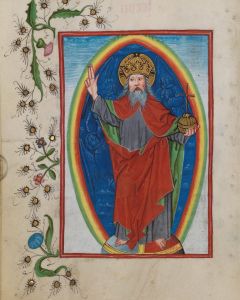
Vellem iam quidem, et forte possem, illum esse verissime Patrem; hoc vero verissime esse Filium concludere. sed nec hoc negligendum existimo, an Patris et Filii, et an matris et filiae magis illis apta sit appellatio, cum in eis nulla sit sexus discretio. nam si idcirco convenienter est ille Pater, et proles eius Filius, quia uterque est Spiritus: cur non pari ratione alteri convenit esse matrem. alteri filiam, quia uterque est veritas et sapientia? an quia in his naturis, quae sexus habent differentiam, melioris sexus est patrem esse vel filium; minoris vero, matrem vel filiam? et hoc quidem naturaliter in pluribus; in quibusdam vero econtrario, ut in quibusdam avium generibus, in quibus femineus sexus semper maior et validior est; masculinus vero minor et infirmior. aut certe idcirco magis convenit summo Spiritui dici Patrem quam matrem, quia prima et principalis causa prolis semper est in patre. nam si maternam causam quolibet modo semper paterna praecedit, nimis est incongruum ut illi parenti adaptetur nomen matris, cui ad gignendam prolem nulla alia causa aut sociatur, aut praecedit. verissimum est igitur summum Spiritum Patrem esse prolis suae. quod si filius semper similior est patri quam filia; nihil autem similius est alteri quam summo Patri proles sua; verissimum est hanc prolem non esse filiam, sed Filium. sicut igitur proprium est illius verissime gignere, istius vero gigni, sic proprium est illius esse verissimum gignitorem, istius vero verissimum esse genitum. et sicut alter est verissimus parens, alter verissima proles; sic alter est verissimus Pater, alter verissimus Filius.
(Anselm of Canterbury, Monologion 42)

I would now like to infer, if I can, that the Supreme Spirit most truly is father and that the Word most truly is son. Yet, I think I ought not to by-pass [the following question]: is the appellation “father and son” or the appellation “mother and daughter” more befitting for them?, for there is no sexual distinction in the Supreme Spirit and the Word. For if the Supreme Spirit is suitably [called] father and its offspring suitably [called] son because each is spirit, then why is it not suitable, by parity of reasoning, for the one to be [called] mother and the other to be [called] daughter because each is truth and wisdom?* Is it [preferable to call them father and son] because among those natures which have a difference of sex it is characteristic of the better sex to be father or son and of the inferior sex to be mother or daughter? Now, although this is by nature the case for many [beings], for others the reverse holds true. For example, in some species of birds the female sex is always larger and stronger, the male sex smaller and weaker. But, surely, the Supreme Spirit is more suitably called father than mother because the first and principal cause of offspring is always in the father. For if the paternal [cause] always in some way precedes the maternal cause, then it is exceedingly inappropriate for the name “mother” to be applied to that parent whom no other cause either joins or precedes for the begetting of offspring. Therefore, it is most true that the Supreme Spirit is father of its own offspring. But if a son is always more like a father than is a daughter, and if no one thing is more like another than this offspring is like the Supreme Father, it is most true that this offspring is a son, not a daughter. Therefore, just as this Spirit has the distinguishing property of most truly begetting and this offspring of most truly being begotten, so the former has the distinguishing property of being the most true begetting one and the latter of being the most true begotten one. And just as the one is the most true parent and the other the most true offspring, so the one is the most true father and the other the most true son.

* “Spirit” is in Latin a masculine noun (“spiritus”); “truth” and “wisdom” are feminine nouns (“veritas,” “sapientia”).

(tr. Jasper Hopkins and Herbert Richardson, with their note)

Auditiones

Munt Tiberius (31 nC) - Damnatio memoriae van Sejanus

Haec vulgo iactata super id, quod nullo auctore certo firmantur, prompte refutaveris. quis enim mediocri prudentia, nedum Tiberius tantis rebus exercitus, inaudito filio exitium offerret, idque sua manu et nullo ad paenitendum regressu? quin potius ministrum veneni excruciaret, auctorem exquireret, insita denique etiam in extraneos cunctatione et mora adversum unicum et nullius ante flagitii compertum uteretur? sed quia Seianus facinorum omnium repertor habebatur, ex nimia caritate in eum Caesaris et ceterorum in utrumque odio quamvis fabulosa et immania credebantur, atrociore semper fama erga dominantium exitus. ordo alioqui sceleris per Apicatam Seiani proditus, tormentis Eudemi ac Lygdi patefactus est, neque quisquam scriptor tam infensus extitit, ut Tiberio obiectaret, cum omnia alia conquirerent intenderentque. mihi tradendi arguendique rumoris causa fuit ut claro sub exemplo falsas auditiones depellerem peteremque ab iis quorum in manus cura nostra venerit, ne divulgata atque incredibilia avide accepta veris neque in miraculum corruptis antehabeant.
(Tacitus, Ann. 4.11)

This was bandied about in public, but, beyond the fact that it is affirmed in no reliable author, you can readily refute it. What man of average prudence—still less Tiberius, practiced as he was in great affairs—would have offered extermination to a son unheard, and that too with his own hand and no recourse for repentance? Would he not rather have racked the server of the poison, searched out its initiator, and finally, given the innate hesitancy and delay with which he treated even outsiders, treated his one and only, who had been discovered in no outrage, with the same? Yet, because Sejanus was considered the deviser of every act, it was owing to Caesar’s excessive affection for him and to everyone else’s hatred of them both that even the most monstrous fantasies were believed—report being always more frightful in relation to one’s departed masters. Besides, the stages of the crime were betrayed by Sejanus’ Apicata and disclosed by the torturing of Eudemus and Lygdus; nor did any writer at all prove so hostile that he cast this imputation at Tiberius, though they raked up and aimed everything else. In my case the reason for transmitting and criticizing the rumor was that on the basis of a resounding example I might dispel false hearsay and ask of those into whose hands my work comes that they should not be hungry to accept well publicized incredibilities nor prefer them to what is genuine and uncorrupted by the miraculous. (tr. Anthony John Woodman)