Korakes

crow

This is part 1 of 3. Part 2 is here. Part 3 is here.

Κἀκεῖ διενυκτέρευσεν ἐπὶ δεινῶν καὶ ἀπόρων λογισμῶν, ὥστε καὶ παρελθεῖν εἰς τὴν Καίσαρος οἰκίαν διενοήθη κρύφα καὶ σφάξας ἑαυτὸν ἐπὶ τῆς ἑστίας ἀλάστορα προσβαλεῖν. ἀλλὰ καὶ ταύτης αὐτὸν ἀπέκρουσε τῆς ὁδοῦ δέος βασάνων· καὶ πολλὰ ταραχώδη καὶ παλίντροπα βουλεύματα τῆς γνώμης μεταλαμβάνων παρέδωκε τοῖς οἰκέταις ἑαυτὸν εἷς Καιήτην κατὰ πλοῦν κομίζειν, ἔχων ἐκεῖ χωρία καὶ καταφυγὴν ὥρᾳ θέρους φιλάνθρωπον, ὅταν ἥδιστον οἱ ἐτησίαι καταπνέωσιν. ἔχει δ’ ὁ τόπος καὶ ναὸν Ἀπόλλωνος μικρὸν ὑπὲρ τῆς θαλάττης. ἐντεῦθεν ἀρθέντες ἀθρόοι κόρακες ὑπὸ κλαγγῆς προσεφέροντο τῷ πλοίῳ τοῦ Κικέρωνος ἐπὶ γῆν ἐρεσσομένῳ· καὶ καθίσαντες ἐπὶ τὴν κεραίαν ἑκατέρωθεν οἱ μὲν ἐβόων, οἱ δ’ ἔκοπτον τὰς τῶν μηρυμάτων ἀρχάς, καὶ πᾶσιν ἐδόκει τὸ σημεῖον εἶναι πονηρόν. ἀπέβη δ’ οὖν ὁ Κικέρων, καὶ παρελθὼν εἷς τὴν ἔπαυλιν ὡς ἀναπαυσόμενος κατεκλίθη. τῶν δὲ κοράκων οἱ πολλοὶ μὲν ἐπὶ τῆς θυρίδος διεκάθηντο φθεγγόμενοι θορυβῶδες, εἷς δὲ καταβὰς ἐπὶ τὸ κλινίδιον ἐγκεκαλυμμένου τοῦ Κικέρωνος ἀπῆγε τῷ στόματι κατὰ μικρὸν ἀπὸ τοῦ προσώπου τὸ ἱμάτιον. οἱ δ’ οἰκέται ταῦθ’ ὁρῶντες, καὶ κακίσαντες ἑαυτοὺς εἰ περιμένουσι τοῦ δεσπότου φονευομένου θεαταὶ γενέσθαι, θηρία δ’ αὐτῷ βοηθεῖ καὶ προκήδεται παρ’ ἀξίαν πράττοντος, αὐτοὶ δ’ οὐκ ἀμύνουσι, τὰ μὲν δεόμενοι, τὰ δὲ βίᾳ λαβόντες ἐκόμιζον ἐν τῷ φορείῳ πρὸς τὴν θάλασσαν.
(Plutarch, Bios Kikerōnos 47.4-6)

And there he spent the night in dreadful and desperate calculations; he actually made up his mind to enter Caesar’s house by stealth, to slay himself upon the hearth, and so to fasten upon Caesar an avenging daemon. But a fear of tortures drove him from this course also; then, revolving in his mind many confused and contradictory purposes, he put himself in the hands of his servants to be taken by sea to Caieta, where he had lands and an agreeable retreat in summer time, when the breath of the Etesian winds is most pleasant. The place has also a temple of Apollo, a little above the sea. From thence a flock of crows flew with loud clamour towards the vessel of Cicero as it was rowed towards land; and alighting on either end of the sail-yard, some cawed, and others pecked at the ends of the ropes, and everybody thought that the omen was bad. Nevertheless Cicero landed, and going to his villa lay down to rest. Then most of the crows perched themselves about the window, cawing tumultuously, but one of them flew down upon the couch where Cicero lay with muffled head, and with its beak, little by little, tried to remove the garment from his face. The servants, on seeing this, rebuked themselves for waiting to be spectators of their master’s murder, while wild beasts came to his help and cared for him in his undeserved misfortune, but they themselves did nothing in his defence. So partly by entreaty, and partly by force, they took him and carried him in his litter towards the sea. (tr. Bernadotte Perrin)
Quicum

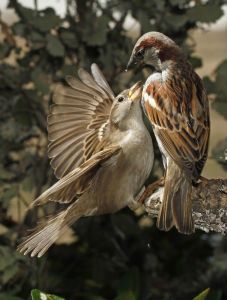
swamp-sparrow-clipart-birdie-17

Hei mihi quam similes ludunt per prata iuvenci,
omnes unanimi secum sibi lege sodales,
nec magis hunc alio quisquam secernit amicum
de grege, sic densi veniunt ad pabula thoës,
inque vicem hirsuti paribus iunguntur onagri;
lex eadem pelagi, deserto in littore Proteus
agmina phocarum numerat, vilisque volucrum
passer habet semper quicum sit, et omnia circum
farra libens volitet, sero sua tecta revisens,
quem si fors letho obiecit, seu milvus adunco
fata tulit rostro, seu stravit arundine fossor,
protinus ille alium socio petit inde volatu.
nos durum genus, et diris exercita fatis
gens homines aliena animis, et pectore discors,
vix sibi quisque parem de millibus invenit unum,
aut si sors dederit tandem non aspera votis,
illum inopina dies qua non speraveris hora
surripit, aeternum linquens in saecula damnum.
(John Milton, Epitaphium Damonis 94-111)

Ah, how like one another are the young bulls which gambol through the meadows! They are all friends together, all of one mind. Not one of them singles out another from the herd as his particular friend. It’s the same with wolves, they hunt their food in packs; and the shaggy wild asses mate together by turn. The law of the sea is the same: on the deserted shore Proteus counts his seals in packs. The sparrow, the humblest of birds, always has a companion with whom he flits gaily round every stack of corn, and returns late to his own nest. And if by chance death carries off his mate, if a hook-billed kite cuts short its days or a peasant brings it to earth with his arrow, he goes off and looks for another, there and then, to keep him company as he flies about. But we men are a hard race: a race harassed by cruel fates. Our minds are unfriendly, our hearts discordant. It is hard for a man to find one kindred spirit among thousands of his fellows; and if at last, softened by our prayers, fate grants one, there comes the unexpected day, the unlooked-for hour, which snatches him away, leaving an eternal emptiness. (tr. John Carey)

Dominum

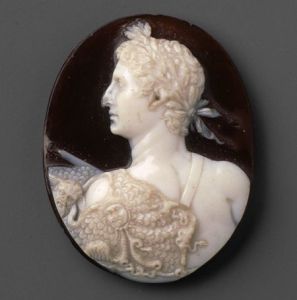
Augustus cameo
The emperor Augustus

Domini appellationem ut maledictum et opprobrium semper exhorruit. cum spectante eo ludos pronuntiatum esset in mimo: “o dominum aequum et bonum!” et universi quasi de ipso dictum exsultantes comprobassent, et statim manu vultuque indecoras adulationes repressit et insequenti die gravissimo corripuit edicto; dominumque se posthac appellari ne a liberis quidem aut nepotibus suis vel serio vel ioco passus est atque eius modi blanditias etiam inter ipsos prohibuit. non temere urbe oppidove ullo egressus aut quoquam ingressus est nisi vespera aut noctu, ne quem officii causa inquietaret. in consulatu pedibus fere, extra consulatum saepe adoperta sella per publicum incessit. promiscuis salutationibus admittebat et plebem, tanta comitate adeuntium desideria excipiens, ut quendam ioco corripuerit, quod sic sibi libellum porrigere dubitaret, “quasi elephanto stipem.” die senatus numquam patres nisi in curia salutavit et quidem sedentes ac nominatim singulos nullo submonente; etiam discedens eodem modo sedentibus valere dicebat. officia cum multis mutuo exercuit, nec prius dies cuiusque sollemnes frequentare desiit, quam grandior iam natu et in turba quondam sponsaliorum die vexatus. Gallum Cerrinium senatorem minus sibi familiarem, sed captum repente oculis et ob id inedia mori destinantem praesens consolando revocavit ad vitam.
(Suetonius, Div. Aug. 53)

He always shrank from the title ‘Master’ as an insult and a reproach. On one occasion at the games when he was watching a farce, the line was spoken: ‘O good and just master!’ and the whole audience indicated their enthusiastic agreement, as if the words were addressed to the emperor. He immediately called a halt to their unbecoming adulation with his gesture and expression and, on the next day, reproached them most severely in an edict. Thereafter he would not even allow his children and grandchildren to call him ‘master’, whether jokingly or in earnest, and forbade them to use such obsequious titles even among themselves. Almost always his arrival at or departure from Rome or any other town was in the evening or at night so that people would not be troubled by the need to pay him respect. When consul, he went about in public places on foot and at other times in a sedan chair. All and sundry were permitted to attend his receptions, including the common people, and he acknowledged the wishes of his petitioners with such good humour that once he teased a man that he was as nervous of handing over his petition as if he were giving a present to an elephant. On days when the senate met, he always greeted the senators in the senate house, addressing each by name with no one prompting him, while they remained in their seats. Even as he left, he would pay his respects in the same manner, while they stayed seated. In the case of many, he discharged the mutual obligations of friendship, and did not fail to attend all their feast days until he was advanced in years and had once been made uncomfortable by the crowd at a betrothal ceremony. When the senator Gallus Cerrinius had suddenly lost his sight and decided to end his life by starvation, Augustus went in person to console him, though he was not a close friend, and persuaded him to live. (tr. Catharine Edwards)

Phallos

Winged phallus of Dionysus

Φαλλός· ξύλον ἐπίμηκες, ἔχον ἐν τῷ ἄκρῳ σκύτινον αἰδοῖον ἐξηρτημένον. ἵστατο δὲ ὁ φάλλος τῷ Διονύσῳ, κατά τι μυστήριον. περὶ δὲ αὐτοῦ τοῦ φαλλοῦ τοιαῦτα λέγεται. Πήγασος ἐκ τῶν Ἐλευθερῶν, αἱ δὲ Ἐλευθεραὶ πόλις εἰσὶ Βοιωτίας, λαβὼν τοῦ Διονύσου τὸ ἄγαλμα ἧκεν εἰς τὴν Ἀττικήν. οἱ δὲ Ἀθηναῖοι οὐκ ἐδέξαντο μετὰ τιμῆς τὸν θεόν. ἀλλ’ οὐκ ἀμισθί γε αὐτοῖς ταῦτα βουλευσαμένοις ἀπέβη. μηνίσαντος γὰρ τοῦ θεοῦ νόσος κατέσκηψεν εἰς τὰ αἰδοῖα τῶν ἀνδρῶν, καὶ τὸ δεινὸν ἀνήκεστον ἦν. ὡς δὲ ἀπεῖπον πρὸς τὴν νόσον κρείττω γενομένην πάσης ἀνθρωπείας μαγγανείας καὶ τέχνης, ἀπεστάλησαν θεωροὶ μετὰ σπουδῆς· οἳ δὴ ἐπανελθόντες ἔφασαν ἴασιν ταύτην εἶναι μόνην, εἰ διὰ τιμῆς ἁπάσης ἄγοιεν τὸν θεόν. πεισθέντες οὖν τοῖς ἠγγελμένοις οἱ Ἀθηναῖοι φαλλοὺς ἰδίᾳ τε καὶ δημοσίᾳ κατεσκεύασαν, καὶ τούτοις ἐγέραιρον τὸν θεὸν, ὑπόμνημα ποιούμενοι τοῦ πάθους.
(Scholia in Aristophanis Acharnenses 243)

A phallus is a large wooden beam with a leather penis attached at the end. The phallus was erected for Dionysus in accordance with one of his mysterious rites. The following story is told about the phallus itself: Pegasus brought the statue of Dionysus from Eleutherae (a town in Boeotia) to Attica. The Athenians however didn’t give the god a respectful welcomebut those responsible paid dearly for that decision. The god got angry and a disease struck the men’s genitals. There was no cure againt this disaster. As they succumbed to the illness, which had become too strong for any human skill or magic, envoys were rapidly dispatched to consult the oracle. On their return they said that the only possible remedy was that they should carry around the god in full honour. Obeying this message, the Athenians constructed phalluses both privately and at public expense, and with these they payed homage to the god, by turning them into a memorial of their suffering. (tr. David Bauwens)

Comitia

Roman_Election

Sequere nunc me in Campum. ardet ambitus. “σῆμα δὲ τοι ἐρέω”: faenus ex triente Idibus Quintilibus factum erat bessibus. dices “istuc quidem non moleste fero.” o virum! o civem! Memmium Caesaris omnes opes confirmant. Cum eo Domitium consules iunxerunt, qua pactione epistulae committere non audeo. Pompeius fremit, queritur, Scauro studet; sed utrum fronte an mente dubitatur. ἐξοχὴ in nullo est; pecunia omnium dignitatem exaequat. Messalla languet, non quo aut animus desit aut amici, sed coitio consulum et Pompeius obsunt. ea comitia puto fore ut ducantur. tribunicii candidati iurarunt se arbitrio Catonis petituros. apud eum HS quingena deposuerunt ut, qui a Catone damnatus esset, id perderet et competitoribus tribueretur. haec ego pridie scribebam quam comitia fore putabantur. sed ad te, quinto Kalendis Sextilibus, si facta erunt et tabellarius non erit profectus, tota comitia perscribam. quae si, ut putantur, gratuita fuerint, plus unus Cato potuerit quam omnes leges omnesque iudices.
(Cicero, Ep. ad Att. 90(=4.15).7-8)

Now follow me to the Campus. Bribery is running riot. ‘A token I shall tell’: interest went up on the Ides of July from 1/3 to 2/3%. ‘That I can bear’, you’ll say—you model of morality and public spirit! Caesar is backing Memmius for all he’s worth. The Consuls have paired him with Domitius in an arrangement which I dare not commit to writing. Pompey is fuming and growling. Ostensibly Scaurus is his man, but does he mean it? We have our doubts. None of the four has any special prominence. Money levels standing all round. Messalla is lagging, not for lack of spirit or friends, but the Consuls’ pact and Pompey are against him. I think these elections are likely to drag on. The tribunician candidates have taken an oath to conduct their campaign with Cato as umpire. Each of them has deposited HS 500,000 with him on the understanding that anyone found guilty of impropriety by Cato shall forfeit his deposit, which will be distributed among his rivals. I write this the day before the elections are expected to take place. If they do, and if the courier has not left, I shall write you the whole story of the elections on 28 July. If they go through without bribery, as it is believed they will, Cato will have done more single-handed than all the laws and all the jurymen. (tr. David Roy Shackleton Bailey)

Cunei

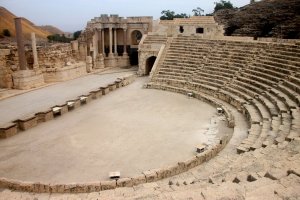
Romeins theater, Israël

Ipsius autem theatri conformatio sic est facienda, uti, quam magna futura est perimetros imi, centro medio collocato circumagatur linea rutundationis, in eaque quattuor scribantur trigona paribus lateribus; intervallis extremam lineam circinationis tangant, quibus etiam in duodecim signorum caelestium astrologia ex musica convenientia astrorum ratiocinantur. ex his trigonis cuius latus fuerit proximum scaenae, ea regione, qua praecidit curvaturam circinationis, ibi finiatur scaenae frons, et ab eo loco per centrum parallelos linea ducatur, quae disiungat proscaenii pulpitum et orchestrae regionem. ita latius factum fuerit pulpitum quam Graecorum, quod omnes artifices in scaena dant operam, in orchestra autem senatorum sunt sedibus loca designata. et eius pulpiti altitudo sit ne plus pedum quinque, uti, qui in orchestra sederint, spectare possint omnium agentium gestus. cunei spectaculorum in theatro ita dividantur, uti anguli trigonorum, qui currunt circum curvaturam circinationis, dirigant ascensus scalasque inter cuneos ad primam praecinctionem; supra autem alternis itineribus superiores cunei medii dirigantur.
(Vitruvius, Arch. 5.6.1-2)

The plan of the theatre is to be thus arranged: that the centre is to be taken, of the dimension allotted to the orchestra at the ground level. The circumference is to be drawn; and in it four equilateral triangles are to be described touching the circumference at intervals (just as in the case of the twelve celestial signs, astronomers calculate from the musical division of the constellations). Of these triangles the side of that which is nearest the scene, will determine the front of the scene, in the part where it cuts the curve of the circle. Through the centre of the circle a parallel line is drawn which is to divide the platform of the proscenium from the orchestra. Thus the stage will be made wider than that of the Greeks because all the actors play their parts on the stage, whereas the orchestra is allotted to the seats of the senators. The height of the stage is not to be more than 5 feet, so that those who are seated in the orchestra can see the gestures of all the actors. The blocks of seats in the theatre are so to be divided that the angles of the triangles which run round the curve of the circle indicate the ascents and the steps between the blocks to the first circular passage. Above, the upper blocks of seats are arranged with alternate staircases facing the middle of the lower blocks. (tr. Frank Granger)

Apērtēmenoi

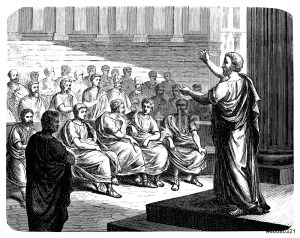
Demosthenes (klein)

Πότ’ οὖν, ὦ ἄνδρες Ἀθηναῖοι, πόθ’ ἃ χρὴ πράξετε; ἐπειδὰν τί γένηται; ἐπειδὰν νὴ Δί’ ἀνάγκη τις ᾖ; νῦν δὲ τί χρὴ τὰ γιγνόμεν’ ἡγεῖσθαι; ἐγὼ μὲν γὰρ οἴομαι τοῖς ἐλευθέροις μεγίστην ἀνάγκην τὴν ὑπὲρ τῶν πραγμάτων αἰσχύνην εἶναι. ἢ βούλεσθ’, εἰπέ μοι, περιιόντες αὑτῶν πυνθάνεσθαι, “λέγεταί τι καινόν;” γένοιτο γὰρ ἄν τι καινότερον ἢ Μακεδὼν ἀνὴρ Ἀθηναίους καταπολεμῶν καὶ τὰ τῶν Ἑλλήνων διοικῶν; “τέθνηκε Φίλιππος;”—”οὐ μὰ Δί’, ἀλλ’ ἀσθενεῖ.” τί δ’ ὑμῖν διαφέρει; καὶ γὰρ ἂν οὗτός τι πάθῃ, ταχέως ὑμεῖς ἕτερον Φίλιππον ποιήσετε, ἄνπερ οὕτω προσέχητε τοῖς πράγμασι τὸν νοῦν· οὐδὲ γὰρ οὗτος παρὰ τὴν αὑτοῦ ῥώμην τοσοῦτον ἐπηύξηται ὅσον παρὰ τὴν ἡμετέραν ἀμέλειαν. καίτοι καὶ τοῦτο· εἴ τι πάθοι καὶ τὰ τῆς τύχης ἡμῖν, ἥπερ ἀεὶ βέλτιον ἢ ἡμεῖς ἡμῶν αὐτῶν ἐπιμελούμεθα, καὶ τοῦτ’ ἐξεργάσαιτο, ἴσθ’ ὅτι πλησίον μὲν ὄντες, ἅπασιν ἂν τοῖς πράγμασιν τεταραγμένοις ἐπιστάντες ὅπως βούλεσθε διοικήσαισθε, ὡς δὲ νῦν ἔχετε, οὐδὲ διδόντων τῶν καιρῶν Ἀμφίπολιν δέξασθαι δύναισθ’ ἄν, ἀπηρτημένοι καὶ ταῖς παρασκευαῖς καὶ ταῖς γνώμαις.
(Demosthenes, Or. 4.10-12)

When, men of Athens, when will you do what is needed? What are you waiting for? For some necessity to arise, by Zeus? What, then, should we call the present developments? For, I believe, the strongest necessity for free men is shame at their situation. Or, tell me, do you wish to go around asking each other, “Is there any news?” What could be graver news than that a Macedonian is waging war on Athens and is in control of the affairs of Greece? “Is Philip dead?” “No, by Zeus, but he is sick.” What difference does it make to you? Even if something were to happen to him, you would soon create another Philip, if this is how you apply yourselves to the situation, since even he has not prospered by reason of his own strength as much as because of our neglect. Moreover, if Fortune, which always takes better care of us than we do of ourselves, should arrange for something to happen to him, you know that if you were on the scene, you might step in and in the general state of confusion arrange matters as you wish. But as you are now, even if the opportunity were to present itself, you would be unable to take Amphipolis, since you are disunited in your preparations and in your resolve. (tr. Jeremy Trevett)

Visu

strabo

Visu deinde plurimum potuit Strabo nomine, quem superspexisse per centum triginta quinque milia passuum Varro significat, solitumque exeunte a Carthagine classe Punica numerum navium manifestissime ex Lilybaetana specula notare. Cicero tradit Iliadam omnem ita subtiliter in membranis scriptam, ut testa nucis clauderetur. Callicrates formicas ex ebore sic scalpsit, ut portio earum a ceteris cerni nequiverit. Apollonides perhibet in Scythia feminas nasci, quae bitiae vocantur: has in oculis pupillas geminas habere et perimere visu si forte quem iratae aspexerint. hae sunt et in Sardinia.
(Solinus, Collectanea Rerum Mirabilium 1.99-101)

The sharpest eyesight was that of one Strabo, who according to Varro could look over a distance of 135 miles. When the Punic fleet left the harbor of Carthage, he could always report the exact number of ships from the watchtower at Lilybaeum*. Cicero mentions that the entire Iliad was written on parchment in such tiny letters, that it could be enclosed in a nut shell. Callicrates carved ivory ants so small that some of them could not be distinguished from real ones. Apollonides claims that in Scythia there is a race of women called bitiae, who have pupils in each eye, and who kill with their sight if they happen to cast an angry look on someone. These can be found in Sardinia as well.

* in Sicily.

(tr. David Bauwens)

Religio

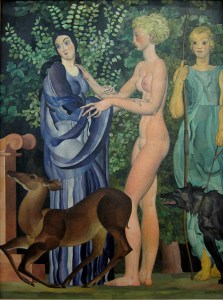
Louis Billotey, Le sacrifice d'Iphigénie, 1935
Louis Billotey, Le sacrifice d’Iphigénie (1935)

Illud in his rebus vereor, ne forte rearis
impia te rationis inire elementa viamque
indugredi sceleris. quod contra saepius illa
religio peperit scelerosa atque impia facta;
Aulide quo pacto Triviai virginis aram
Iphianassai turparunt sanguine foede
ductores Danaum delecti, prima virorum.
cui simul infula virgineos circumdata comptus
ex utraque pari malarum parte profusast,
et maestum simul ante aras adstare parentem
sensit et hunc propter ferrum celare ministros
aspectuque suo lacrimas effundere cives,
muta metu terram genibus submissa petebat.
nec miserae prodesse in tali tempore quibat,
quod patrio princeps donarat nomine regem;
nam sublata virum manibus tremibundaque ad aras
deductast, non ut sollemni more sacrorum
perfecto posset claro comitari Hymenaeo,
sed casta inceste nubendi tempore in ipso
hostia concideret mactatu maesta parentis—
exitus ut classi felix faustusque daretur.
tantum religio potuit suadere malorum.
(Lucretius, De Rerum Natura 1.80-101)

One thing I fear in this matter, that in this your apprenticeship to philosophy you may perhaps see impiety, and the entering on a path of crime; whereas on the contrary more often it is that very Superstition which has brought forth criminal and impious deeds: as when at Aulis the altar of our Lady of the Crossways was foully defiled by the blood of Iphianassa, shed by chosen leaders of the Danai, chieftains of the host. So soon as the ribbon has bound her maiden tresses falling in equal lengths down either cheek, so soon as she saw her father standing sorrowful before the altar, and by his side attendants hiding the knife, and the people shedding tears at the sight of her, dumb with dread, she sank to the ground upon her knees. Alas, poor girl! no help could it be to her at such a time that the name of father had been bestowed on the king first by her; for uplifted by the hands of men, all trembling she was brought to the altar, not that amidst solemn and sacred ritual she might be escorted by loud hymeneal song, but a clean maiden to fall by unclean hands at the very age of wedlock, a victim sorrowful slain by a father’s hand: all in order that a fair and fortunate release might be given to the fleet. So potent was Superstition in persuading to evil deeds. (tr. William Henry Denham Rouse, revised by Martin F. Smith)