Carpamus

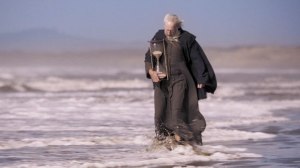
sky-father-time

Aspicis ut densas ponant arbusta coronas
et linquant virides vitis et herba comas,
arida purpurei fugiant violaria flores,
horreat elapsis aspera spina rosis,
cernis et ut nudi iaceant sine gramine campi,
quos florum quondam pinxerat ampla Venus.
pro placidis Zephiris audis Aquilona frementem,
audis nymbriferi flamina saeva Nothi.
nec solitum placidus blanditur in aethere Phoebus,
pendet in oceanas quin mage pronus aquas,
succedentis ubi brumae vice labitur aestas
tristeque sorte venit vere cadente gelu.
sic, sic flos aevi, sic, dulcis amice, iuventus,
heu, properante cadit irreparata pede.
forma perit, pereunt agiles in corpore vires,
et subito ingenii visque calorque cadit.
tristior inde ruit ac plena doloribus aetas,
inde subit propero curva senecta pede.
haec tibi canitie est flavos, formose, capillos
sparsura et frontem findet amara tuam.
candida deformi pallore tibi induet ora,
et rosa purpureis excidet ista genis.
iamque abient numquam redeuntia gaudia vitae,
succedent quorum morsque laborque locis.
ergo ferox dum Parca sinet, patiantur et anni,
dum vireat vicibus laeta iuventa suis,
utamur, ne frustra abeat torpentibus, aevo,
carpamus primes, dulcis amice, dies.
(Erasmus, Elegia de mutabilitate temporum ad amicum)

You see how the trees have put off their thick-
leafed crowns and the vines and the meadows
have lost their green tresses, how the crimson
flowers have fled from the arid violet beds and
the harsh thorns bristle now that the roses
have fallen away. And you perceive how the
fields lie bare of grass, where once Venus had
bountifully bedecked them with flowers.
Instead of gentle western winds, you hear the
raging wind from the north, you hear the
savage blasts of the rain-laden wind from the
south. Nor does mild Phoebus smile as usual
in the sky, but rather he leans down low
toward the waters of the ocean, now that
summer slips away and winter follows in turn
and melancholy frosts, after the end of spring,
have taken their allotted place.
Just so, my sweet friend, just so the flower of
our lifetime, youth, hastens away, alas, and
fails, never to be recovered. Beauty dies, the
nimble strength of the body dies, and suddenly
the force and vitality of the mind fail. Then
age, sad and full of griefs, rushes upon us;
then crook-backed old age steals upon us all
too swiftly. Beautiful lad, she will sprinkle your
yellow locks with gray; she will bitterly plough
furrows in your brow. She will cast an ugly
pallor over the fair white of your face, and
those roses will depart from your ruddy
cheeks. The joys of life are already about to go
away, never to return, and their places will be
taken by hardship and death.
Therefore, while the fierce goddess of fate
still permits it, while the years still allow it,
while youth rejoices and flourishes in its own
season, let us make use of this time in our
lives, lest we lose it in vain through our own
lethargy. Let us seize, sweet friend, the days of
our youth.
(tr. Clarence H. Miller)

Canemus

Moeris & Lycidas

[MOERIS. LYCIDAS]

MOER. Omnia fert aetas, animum quoque; saepe ego longos
cantando puerum memini me condere soles:
nunc oblita mihi tot carmina: vox quoque Moerin
iam fugit ipsa: lupi Moerin videre priores.
sed tamen ista satis referet tibi saepe Menalcas.
LYC. causando nostros in longum ducis amores.
et nunc omne tibi stratum silet aequor, et omnes,
aspice, ventosi ceciderunt murmuris aurae.
hinc adeo media est nobis via; namque sepulcrum
incipit apparere Bianoris. hic, ubi densas
agricolae stringunt frondis, hic, Moeri, canamus;
hic haedos depone, tamen veniemus in urbem.
aut, si nox pluviam ne colligat ante veremur,
cantantes licet usque (minus via laedit) eamus:
cantantes ut eamus, ego hoc te fasce levabo.
MOER. desine plura, puer, et quod nunc instat agamus;
carmina tum melius, cum venerit ipse, canemus.
(Vergil, Ecl. 9.51-67)

[MOERIS. LYCIDAS]

MOER. Time bears all away; the mind as well. As a boy
I recall spending the long sunlit days in song.
Now I’ve forgotten so many songs. Moeris too
loses his voice. The wolves have caught first sight of him.
But Menalcas will recite them often enough to you.
LYC. With talking you put off fulfillment of our desire.
Now look, all the sea is smooth and still, and see,
all the breath of murmuring breezes has died away.
Just from here is half our way, for Bianor’s tomb
begins to show. Here where farmers strip the leaves
grown too dense, here, Moeris, let us sing.
Here put down your kids. Still we’ll reach the town.
Or if we fear that rain will fall before the night,
we can sing as we go (the road will tire us less).
That we sing as we go, I’ll take this bundle from you.
MOER. No more, my boy. Let us do the task at hand.
When Menalcas comes, we’ll better sing his songs.
(tr. Barbara Hughes Fowler)

Muxarion

SEM

Ἐννοεῖν συνεχῶς πόσοι μὲν ἰατροὶ ἀποτεθνήκασι, πολλάκις τὰς ὀφρῦς ὑπὲρ τῶν ἀρρώστων συσπάσαντες· πόσοι δὲ μαθηματικοί, ἄλλων θανάτους ὥς τι μέγα προειπόντες· πόσοι δὲ φιλόσοφοι, περὶ θανάτου ἢ ἀθανασίας μυρία διατεινάμενοι· πόσοι δὲ ἀριστεῖς, πολλοὺς ἀποκτείναντες· πόσοι δὲ τύραννοι, ἐξουσίᾳ ψυχῶν μετὰ δεινοῦ φρυάγματος ὡς ἀθάνατοι κεχρημένοι· πόσαι δὲ πόλεις ὅλαι, ἵν’ οὕτως εἴπω, τεθνήκασιν, Ἑλίκη καὶ Πομπήϊοι καὶ Ἡρκλάνον καὶ ἄλλαι ἀναρίθμητοι. ἔπιθι δὲ καὶ ὅσους οἶδας, ἄλλον ἐπ’ ἄλλῳ· ὁ μὲν τοῦτον κηδεύσας εἶτα ἐξετάθη, ὁ δὲ ἐκεῖνον, πάντα δὲ ἐν βραχεῖ. τὸ γὰρ ὅλον, κατιδεῖν ἀεὶ τὰ ἀνθρώπινα ὡς ἐφήμερα καὶ εὐτελῆ καὶ ἐχθὲς μὲν μυξάριον, αὔριον δὲ τάριχος ἢ τέφρα. τὸ ἀκαριαῖον οὖν τοῦτο τοῦ χρόνου κατὰ φύσιν διελθεῖν καὶ ἵλεων καταλῦσαι, ὡς ἂν εἰ ἐλαία πέπειρος γενομένη ἔπιπτεν, εὐφημοῦσα τὴν ἐνεγκοῦσαν καὶ χάριν εἰδυῖα τῷ φύσαντι δένδρῳ.
(Marcus Aurelius, Ta eis heauton 4.48)

Reflect constantly how many doctors have died, after often knitting their brows over those who were ill; and how many astrologers, after predicting the deaths of other people, as if death were some great thing; and how many philosophers, after countless debates about death or immortality; and how many heroes, after killing many other people, and how many tyrants, after exercising the power of life and death with terrible arrogance, as though they were immortal themselves; and how many entire cities died, if one can put it in this way, Helike and Pompeii and Herculaneum, and others without number. Run over the ones you know, one after the other: one person attended another’s funeral and then was laid out himself, another followed him, and all in so short a time. Taking it all together, keep always in view that human life is transitory and cheap: yesterday a drop of semen, tomorrow a buried corpse or ashes. So make your way through this brief moment of time in line with nature and let go of your life gladly, as an olive might fall when ripe, blessing the earth that bore it and grateful to the tree that gave it growth. (tr. Christopher Gill)

Kērulos

Common kingfisher, Alcedo atthis3

Τῶν δὲ ἀλκυόνων οἱ ἄρσενες κηρύλοι καλοῦνται. ὅταν οὖν ὑπὸ τοῦ γήρως ἀσθενήσωσιν καὶ μηκέτι δύνωνται πέτεσθαι, φέρουσιν αὐτοὺς αἱ θήλειαι ἐπὶ τῶν πτερῶν λαβοῦσαι. καὶ ἔστι τὸ ὑπὸ τοῦ Ἀλκμᾶνος λεγόμενον τούτῳ συνῳκειωμένον· φησὶν γὰρ ἀσθενὴς ὢν διὰ τὸ γῆρας καὶ τοῖς χοροῖς οὐ δυνάμενος συμπεριφέρεσθαι οὐδὲ τῇ τῶν παρθένων ὀρχήσει·
οὔ μ’ ἔτι, παρσενικαὶ μελιγάρυες ἱαρόφωνοι,
γυῖα φέρην δύναται· βάλε δὴ βάλε κηρύλος εἴην,
ὅς τ’ ἐπὶ κύματος ἄνθος ἅμ’ ἀλκυόνεσσι ποτήται
νηλεὲς ἦτορ ἔχων, ἁλιπόρφυρος ἱαρὸς ὄρνις. [Alcman, fr. 26]
(Antigonus of Carystus, De Animalibus fr. 54b Dorandi)

Male halcyons are called ceryli.* When they become weak from old age and are no longer able to fly, the females carry them, taking them on their wings. What Alcman says is connected with this: weak from old age and unable to whirl about with the choirs and the girls’ dancing, he says,
No longer, honey-toned, strong-voiced girls, can my limbs carry me. If only, if only I were a cerylus, who flies along with the halcyons over the flower of the wave with resolute heart, strong, sea-blue bird.

* Both mythical seabirds, sometimes identified with the kingfisher.

(tr. David Campbell, with his note)

Plunon

woman-about-to-brush-teeth

Ἀμήχανον ἦν μύξας μὴ ῥεῖν τοῦ ἀνθρώπου τοιοῦτον ἔχοντος τὸ σύγκραμα· διὰ τοῦτο χεῖρας ἐποίησεν ἡ φύσις καὶ αὐτὰς τὰς ῥῖνας ὡς σωλῆνας πρὸς τὸ ἐκδιδόναι τὰ ὑγρά. ἂν οὖν ἀναρροφῇ τις αὐτάς, λέγω ὅτι οὐ ποιεῖ ἔργον ἀνθρωπικόν. ἀμήχανον ἦν μὴ πηλοῦσθαι τοὺς πόδας μηδὲ ὅλως μολύνεσθαι διὰ τοιούτων τινῶν πορευομένους· διὰ τοῦτο ὕδωρ παρεσκεύασεν, διὰ τοῦτο χεῖρας. ἀμήχανον ἦν ἀπὸ τοῦ τρώγειν μὴ ῥυπαρόν τι προσμένειν τοῖς ὀδοῦσι· διὰ τοῦτο “πλῦνον” φησίν “τοὺς ὀδόντας.” διὰ τί; ἵν’ ἄνθρωπος ᾖς καὶ μὴ θηρίον μηδὲ συίδιον. ἀμήχανον μὴ ἀπὸ τοῦ ἱδρῶτος καὶ τῆς κατὰ τὴν ἐσθῆτα συνοχῆς ὑπολείπεσθαί τι περὶ τὸ σῶμα ῥυπαρὸν καὶ δεόμενον ἀποκαθάρσεως· διὰ τοῦτο ὕδωρ, ἔλαιον, χεῖρες, ὀθόνιον, ξύστρα, νίτρον, ἔσθ’ ὅθ’ ἡ ἄλλη πᾶσα παρασκευὴ πρὸς τὸ καθῆραι αὐτό. οὔ· ἀλλ’ ὁ μὲν χαλκεὺς ἐξιώσει τὸ σιδήριον καὶ ὄργανα πρὸς τοῦτο ἕξει κατεσκευασμένα καὶ τὸ πινάκιον αὐτὸς σὺ πλυνεῖς, ὅταν μέλλῃς ἐσθίειν, ἐὰν μὴ ᾖς παντελῶς ἀκάθαρτος καὶ ῥυπαρός· τὸ σωμάτιον δ’ οὐ πλυνεῖς οὐδὲ καθαρὸν ποιήσεις; — “διὰ τί;” φησίν. — πάλιν ἐρῶ σοι· πρῶτον μὲν ἵνα τὰ ἀνθρώπου ποιῇς, εἶτα ἵνα μὴ ἀνιᾷς τοὺς ἐντυγχάνοντας.
(Arrian, Epict. Diatr. 4.11.9-14)

It is impossible that there should not be some flow of mucus from a human being, since he is constituted in the way that he is. For that reason, nature has created hands, and has made our nostrils themselves like tubes to carry away the fluids. So if anyone sniffs them up again, I say that he isn’t acting as is appropriate for a human being. It was impossible that our feet should not get muddy, or dirty at all, when we pass through filth of that kind; nature has thus provided us with water and with hands. It was impossible that some dirt should not get left behind on our teeth when we’ve eaten; and so nature says to us, “Clean your teeth.” Why? So that you may be a human being, and not a wild beast or a pig. It was impossible that through our sweat and the rubbing of our clothes, some uncleanness should not be left behind on our body and need to be cleaned off; for this reason, we have water, oil, hands, a towel, a scraper, and everything else that is used for cleaning the body. Not in your case? But a smith will remove the rust from his iron, and has tools made for that purpose, and you yourself will wash your plate before you eat, unless you’re irredeemably dirty and unclean; and yet when it comes to your poor body, you don’t want to wash it and make it clean? “Why should I?”, the man says. I’ll tell you again: in the first place, to act as is appropriate for a human being, and secondly, so as not to disgust those whom you meet. (tr. Robin Hard)

Temeritatem

dscf0479-1

Mira etiam censoris Augusti et laudata patientia. corripiebatur eques Romanus a principe, tamquam minuisset facultates suas, at ille se multiplicasse coram probavit. mox eidem obiecit quod ad contrahendum matrimonium legibus non paruisset. ille uxorem sibi et tres esse liberos dixit. tum adiecit: “posthac, Caesar, cum de honestis hominibus inquiris, honestis mandato.” etiam militis non libertatem tantum sed et temeritatem tulit. in quadam villa inquietas noctes agebat rumpente somnum eius crebro noctuae cantu. prendendam curavit noctuam miles aucupii peritus et spe ingentis praemii pertulit. laudato imperator mille nummos dari iussit. ille ausus est dicere: “malo vivat,” avemque dimisit. quis non miratus est non offenso Caesare abisse militem contumacem? veteranus, cum die sibi dicto periclitaretur, accessit in publico ad Caesarem, rogavitque ut sibi adesset. ille advocatum quem ex comitatu suo elegerat sine mora dedit, commendavitque ei litigatorem. exclamavit ingenti voce veteranus: “at non ego, Caesar, periclitante te Actiaco bello vicarium quaesivi, sed pro te ipse pugnavi,” detexitque impressas cicatrices. erubuit Caesar, venitque in advocationem, ut qui vereretur non superbus tantum sed etiam ingratus videri.
(Macrobius, Sat. 2.4.25-27)

As censor Augustus displayed a striking and praiseworthy forbearance. He was upbraiding a Roman knight for having squandered his resources, but the man demonstrated in his presence that he had actually increased them. Soon after he reproached the same man for not obeying the laws prescribing marriage, but the man said he had a wife and three children, and added, “From now on, Caesar, give honorable men the job of investigating honorable men.” In the case of a soldier, he tolerated speech that was not merely free but brazen: when he was passing some restless nights at a villa where an owl’s hooting was disturbing his sleep, a soldier who was also a skilled bird-catcher caught the bird and brought it to Augustus, expecting a huge reward. The emperor praised him and ordered that he be given 1,000 sesterces—at which point the soldier dared to say, “I’d rather see it live,” and let the bird go. Who could not be amazed that Caesar took no offense and let the defiant soldier off scot-free? When an army veteran was facing a trial and had his court-date set, he approached Caesar in public and asked him to support him at his trial. Caesar immediately chose someone from his entourage to serve as his advocate and introduced the man to the soldier: thereupon the veteran cried out in a loud voice, “But did not look for someone to serve in my place when you were in danger at the battle of Actium: I fought for you myself,” and he uncovered his scars. Caesar blushed and came to support him, for fear of appearing not just arrogant but also ungrateful. (tr. Robert A. Kaster)

Uva

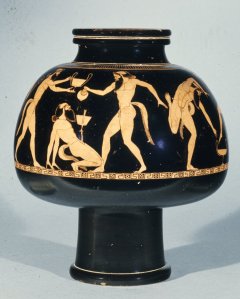
Roodfigurige psykter met uitgelaten saters

Interea pueri florescit pube iuventus
flavaque maturo tumuerunt tempora cornu.
tum primum laetas extendit pampinus uvas:
mirantur Satyri frondes et poma Lyaei.
tum deus ‘o Satyri, maturos carpite fetus’
dixit ‘et ignotos primi calcate racemos.’
vix haec ediderat, decerpunt vitibus uvas
et portant calathis celerique elidere planta
concava saxa super properant: vindemia fervet
collibus in summis, crebro pede rumpitur uva
nudaque purpureo sparguntur pectora musto.
tum Satyri, lasciva cohors, sibi pocula quisque
obvia corripiunt: quae fors dedit, arripit usus.
cantharon hic retinet, cornu bibit alter adunco,
concavat ille manus palmasque in pocula vertit,
pronus at ille lacu bibit et crepitantibus haurit
musta labris; alius vocalia cymbala mergit
atque alius latices pressis resupinus ab uvis
excipit; at potus (saliens liquor ore resultat)
evomit, inque umeros et pectora defluit umor.
(Nemesianus, Ecl. 3.35-54)

Meanwhile the boy’s youth blooms with the coming of manhood, and his yellow temples have swollen with full-grown horns. Then first the tendril outspreads the gladsome grapes. Satyrs are amazed at the leaves and fruitage of the Lyaeus. Then said the god, ‘Pluck the ripe produce, ye Satyrs, be first to tread the bunches whose full power ye know not.’ Scarce had he uttered these words, when they snatched the grapes from the vines, carried them in baskets and hastened to crush them on hollowed stones with nimble foot. On the hill-tops the vintage goes on apace, grapes are burst by frequent tread, and naked breasts are besprinkled with purple must. Then the wanton troop of Satyrs snatched the goblets, each that which comes his way. What chance offers, their need seizes. One keeps hold of a tankard; another drinks from a curved horn; one hollows his hands and makes a cup of his palms; another, stooping forward, drinks of the wine-vat and with smacking lips drains the new wine; another dips therein his sonorous cymbals, and yet another, lying on his back, catches the juice from the squeezed grapes, but when drunk (as the welling liquid leaps back from his mouth) he vomits it out, and the liquor flows over shoulders and breasts. (tr. John Wight Duff & Arnold M. Duff)

Metaphora

3419cf436c2c9d50b27307ec206beab3
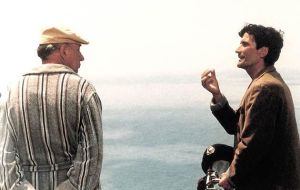
Il Postino

Incipiamus igitur ab eo qui cum frequentissimus est tum longe pulcherrimus, translatione dico, quae μεταφορὰ Graece vocatur. quae quidem cum ita est ab ipsa nobis concessa natura ut indocti quoque ac non sentientes ea frequenter utantur, tum ita iucunda atque nitida ut in oratione quamlibet clara proprio tamen lumine eluceat. neque enim vulgaris esse neque humilis nec insuavis apte ac recte modo adscita potest. copiam quoque sermonis auget permutando aut mutuando quae non habet, quodque est difficillimum, praestat ne ulli rei nomen deesse videatur. transfertur ergo nomen aut verbum ex eo loco in quo proprium est in eum in quo aut proprium deest aut tralatum proprio melius est. id facimus aut quia necesse est aut quia significantius est aut, ut dixi, quia decentius. ubi nihil horum praestabit quod transferetur, improprium erit. necessitate rustici gemmam in vitibus (quid enim dicerent aliud?) et sitire segetes et fructus laborare; necessitate nos durum hominem aut asperum: non enim proprium erat quod daremus his affectibus nomen. iam incensum ira et inflammatum cupiditate et lapsum errore significandi gratia; nihil enim horum suis verbis quam his arcessitis magis proprium erit. illa ad ornatum, lumen orationis et generis claritatem et contionum procellas et eloquentiae fulmina, ut Cicero pro Milone Clodium fontem gloriae eius vocat et alio loco segetem ac materiem.
(Quintilian, Inst. Or. 8.6.4-7)

Let us begin, then, with the commonest and by far the most beautiful of tropes, namely, metaphor, the Greek term for our translatio. It is not merely so natural a turn of speech that it is often employed unconsciously or by uneducated persons, but it is in itself so attractive and elegant that however distinguished the language in which it is embedded it shines forth with a light that is all its own. For if it be correctly and appropriately applied, it is quite impossible for its effect to be commonplace, mean or unpleasing. It adds to the copiousness of language by the interchange of words and by borrowing, and finally succeeds in accomplishing the supremely difficult task of providing a name for everything. A noun or a verb is transferred from the place to which it properly belongs to another where there is either no literal term or the transferred is better than the literal. We do this either because it is necessary or to make our meaning clearer or, as I have already said, to produce a decorative effect. When it secures none of these results, our metaphor will be out of place. As an example of a necessary metaphor I may quote the following usages in vogue with peasants when they call a vinebud gemma, a gem (what other term is there which they could use?), or speak of the crops being thirsty or the fruit suffering. For the same reason we speak of a hard or rough man, there being no literal term for these temperaments. On the other hand, when we say that a man is kindled to anger or on fire with greed or that he has fallen into error, we do so to enhance our meaning. For none of these things can be more literally described in its own words than in those which we import from elsewhere. But it is a purely ornamental metaphor when we speak of brilliance of style, splendour of birth, tempestuous public assemblies, thunderbolts of eloquence, to which I may add the phrase employed by Cicero in his defence of Milo where he speaks of Clodius as the fountain, and in another place as the fertile field and material of his client’s glory(tr. Harold Edgeworth Butler)

Flagrantia

unnamed-7
Willem Strijcker, Theseus en Ariadne (1657)

Nam perhibent olim crudeli peste coactam
Androgeoneae poenas exsolvere caedis
electos iuvenes simul et decus innuptarum
Cecropiam solitam esse dapem dare Minotauro.
quis angusta malis cum moenia vexarentur,
ipse suum Theseus pro caris corpus Athenis
proicere optavit potius quam talia Cretam
funera Cecropiae nec funera portarentur.
atque ita nave levi nitens ac lenibus auris
magnanimum ad Minoa venit sedesque superbas.
hunc simul ac cupido conspexit lumine virgo
regia, quam suavis exspirans castus odores
lectulus in molli complexu matris alebat,
quales Eurotae praecingunt flumina myrtus
aurave distinctos educit verna colores,
non prius ex illo flagrantia declinavit
lumina, quam cuncto concepit corpore flammam
funditus atque imis exarsit tota medullis.
heu misere exagitans immiti corde furores
sancte puer, curis hominum qui gaudia misces,
quaeque regis Golgos quaeque Idalium frondosum,
qualibus incensam iactastis mente puellam
fluctibus, in flavo saepe hospite suspirantem!
quantos illa tulit languenti corde timores!
quanto saepe magis fulgore expalluit auri,
cum saevum cupiens contra contendere monstrum
aut mortem appeteret Theseus aut praemia laudis!
(Catullus 64.76-102)

For long ago, the tale goes, in thrall to a pestilential
cruel demand for atonement after Androgeos’ murder,
the city of Cecrops would send the pick of her young men,
the flower of her maidens, as a feast for the Minotaur.
With this evil hanging heavy over her narrow ramparts,
Theseus chose, for the sake of the Athens he loved, to
expose his own body rather than suffer these dead,
these living dead, to be shipped to Crete like cattle.
So trusting to his light vessel and following breezes
he came to haughty Minos and his palatial abode.
Him, the instant that with eyes of desire the royal
virgin spied him, though still confined to a single
sweet-scented bed and her mother’s soft embraces,
like myrtle brought forth by the waters of Eurotas
or the dappled colors that vernal breezes conjure,
she did not lower her smoldering gaze from him till
through the length of her body the flame was kindled
deep at the core, and blazed up in her inmost marrow.
Ah, wretchedly stirring wild passions, ruthless at heart,
Sacred Boy, you who mingle joy with sorrow for mortals,
and you, Lady, ruler of Golgi and leaf-thick Idalium,
on what rough surges you tossed that girl, mind flaring,
as over and over she sighed for the blond stranger:
what looming terrors with heavy heart she suffered,
how often she turned paler than gold’s bright splendor
when Theseus, hot to contend with the savage monster,
courted either death or the rewards of glory!
(tr. Peter Green)

Inviolatam

Nicolas Poussin, La continence de Scipion, 1640
Nicolas Poussin, La continence de Scipion (1640)

Quartum et vicesimum annum agens Scipio, cum in Hispania Carthagine oppressa maioris Carthaginis capiendae sumpsisset auspicia, multosque obsides, quos in ea urbe Poeni clausos habuerant, in suam potestatem redegisset, eximiae inter eos formae virginem aetatis adultae, et iuvenis et caelebs et victor, postquam comperit illustri loco inter Celtiberos natam, nobilissimoque gentis eius Indibili desponsam, arcessitis parentibus et sponso inviolatam tradidit. aurum quoque, quod pro redemptione puellae allatum erat, summae dotis adiecit. qua continentia ac munificentia Indibilis obligatus Celtiberorum animos Romanis applicando meritis eius debitam gratiam rettulit.
(Valerius Maximus, Facta et Dicta Memorabilia 4.3.1)

When Scipio was in his twenty-fourth year he had caputred Carthage in Spain and so taken auspices for the capture of the greater Carthage. He had brought many hostages into his power, whom the Carthaginians had kept shut up in the former city, among them a girl of adult age and exceptional beauty. Learning that she was born in an exalted station among the Celtiberi and betrothed to Indibilis, the noblest of that nation, Scipio, a young man, unmarried, and a victor, summoned her parents and fiancé and handed her over inviolate. He even added the gold which had been brought for the girl’s ransom to the amount of her dowry. Bound by such continence and generosity, Indibilis attached the hearts of the Celtiberi to Rome and so made due repayment to his benefactor. (tr. David Roy Shackleton Bailey)