Protero

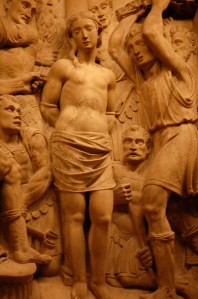
Flagelación_de_Santa_Eulalia
The flagellation of Saint Eulalia of Barcelona

Quaeritis, o miseranda manus,
Christicolum genus? en ego sum
daemonicis inimica sacris,
idola protero sub pedibus,
pectore et ore Deum fateor.

Isis, Apollo, Venus nihil est,
Maximianus et ipse nihil:
illa nihil, quia facta manu,
hic manuum quia facta colit,
frivola utraque et utraque nihil.

(Prudentius, Peristephanon 3.71-80)

Seek ye, O pitiable company, the people who worship Christ? Here am I, a foe to the worship of evil spirits; I trample idols under foot, and with heart and lips I confess God. Isis, Apollo, Venus – they are naught; Maximian* himself too is naught; they because they are works of men’s hands, he because he worships the works of men’s hands, both worthless, both naught.

* Colleague of Diocletian as emperor from 286 to 305. Spain was under his charge.

(tr. Henry John Thomson, with his note)

Iterabimus

Teucer Salamina patremque
cum fugeret, tamen uda Lyaeo
tempora populea fertur vinxisse corona,
sic tristis adfatus amicos:
“quo nos cumque feret melior fortuna parente,
ibimus, o socii comitesque.
nil desperandum Teucro duce et auspice Teucro.
certus enim promisit Apollo
ambiguam tellure nova Salamina futuram.
o fortes peioraque passi
mecum saepe viri, nunc vino pellite curas;
cras ingens iterabimus aequor.”
(Horace, Carm. 1.7.21-32)

Teucer, even when he had to flee into exile from Salamis and his father, is said to have put a garland of white poplar round his head (which was well moistened by the Loosener*) and to have spoken thus to his dejected friends: “Fortune is kinder than my father. Wherever she takes us, my comrades and companions, there will we go. As long as Teucer is your leader and Teucer watches over you, there is no need for despair. Apollo is never wrong, and he has promised there will be another Salamis (the same but different) in a new land. My brave fellows! You have often suffered worse things at my side. Banish your worries now with wine. Tomorrow we shall set out once more over the boundless sea.”

* Bacchus, who brings release from care.

(tr. Niall Rudd, with his note)

Ebdelugmenoi

XIR148827
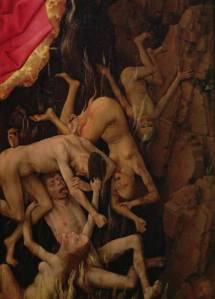
Rogier van der Weyden, The Last Judgement (detail)

Καὶ ἐρημωθήσονται αἱ πόλεις καὶ ἔσονται αἱ χῶραι ἄβατοι διὰ τὸ ὀλιγωθῆναι τὴν ἀνθρωπότητα καὶ μιανθήσεται ἡ γῆ ἐν αἵματι καὶ ἀποκρατήσει τοὺς καρποὺς αὐτῆς· οὐ γὰρ εἰσιν ἄνθρωποι οἱ τυραννικῶς κρατοῦντες βάρβαροι, ἀλλὰ τέκνα τῆς ἐρήμου εἰσὶ καὶ εἰς ἐρήμωσιν ἥξουσιν· ἐφθαρμένοι εἰσὶν καὶ εἰς φθορὰν ἀποσταλήσονται· ἐβδελυγμένοι εἰσὶν καὶ τὸ μύσος ἀσπάζονται. καὶ ἐν τῇ ἀρχῇ τοῦ καιροῦ τῆς ἐξόδου αὐτῶν τῆς ἐξ ἐρήμου γενομένης ῥομφαιᾳ τὰς ἐν γαστρὶ ἐχούσας κεντήσωσι καὶ τὰ βρέφη ἐκ τῶν μητρικῶν ἀγκαλῶν ἁρπάζοντες πατάξωσι, καὶ ἔσονται τοῖς θηρίοις εἰς βρῶσιν.
(Pseudo-Methodius, Apoc. 2.17)

The cities will be made desolate, and the fields will be impassable because of the diminishment of humanity, and the earth will be stained with blood and will withhold her fruits. For these men are not barbarians who rule like tyrants, but children of the desert and they will have come to desolation. They are loathsome and they embrace abomination. And when the time comes when they begin to leave the desert they will stab the pregnant women with a sword and snatch babies from their mothers’ arms and smash them, and they (sc. the babes) will be meat for the beasts. (tr. Benjamin Garstad)

Ptarmos

sneezing kid

Διὰ τί πρὸς τὸν ἥλιον βλέψαντες πτάρνυνται μᾶλλον; ἢ διότι κινεῖ θερμαίνων; καθάπερ οὖν πτεροῖς θιγγάνοντες. ἀμφότεροι γὰρ τὸ αὐτὸ ποιοῦσιν· τῇ γὰρ κινήσει θερμαίνοντες ἐκ τοῦ ὑγροῦ θᾶττον πνεῦμα ποιοῦσιν. τούτου δὲ ἡ ἔξοδος πταρμός.
(Pseudo-Aristotle, Problēmata 961b)

Why is one more apt to sneeze after looking at the sun? Is it because the sun heats us and produces a disturbance? So it is the same thing as tickling with feathers. For both produce the same effect; for producing movement by heat they create breath faster from the moisture. The exit of this breath is a sneeze. (tr. Harris Rackham)

Violavi

Num Veneris magnae violavi numina verbo,
et mea nunc poenas impia lingua luit?
num feror incestus sedes adiisse deorum
sertaque de sanctis deripuisse focis?
non ego, si merui, dubitem procumbere templis
et dare sacratis oscula liminibus,
non ego tellurem genibus perrepere supplex
et miserum sancto tundere poste caput.
(Tibullus 1.2.79-86)

Have I wronged the divinity of mighty Venus with words,
and does my impious tongue now pay the penalty?
Can they say now I’ve sinfully entered the divine sanctuary
and snatched the garland from the holy altar?
I won’t hesitate, if I’m guilty, to kneel in her temple,
and grant her kisses on her sacred threshold,
to crawl on my knees, a suppliant, over the ground
and beat my wretched head against the sacred door.
(tr. Tony Kline)

Chirographum

9659273

Vidi ego miserabile spectaculum, libros pro paterno debito in auctionem deduci, et teneri calamitatis haeredes, qui non essent participes successionis; et hoc tam immane flagitium non erubescere creditorem. instet, urget, addicit. mea, inquit, nutriti pecunia, pro alimonia servitium recognoscant, pro sumptu licitationem subeant. agitetur hasta de pretiis singulorum. non immerito hasta agitatur, ubi caput quaeritur: non immerito ad auctionem pervenitur, ubi sors poscitur. haec est feneratoris inhumanitas, haec debitoris stultitia, ut filiis quibus non relinquit pecuniam, libertatem auferat, pro testamento chirographum dimittat, pro emolumento haereditatis syngrapham obligationis.
(Ambrose, De Tobia 29)

I have seen a pitiful sight, children led forth to sale for their father’s debt and held as the heirs of his misfortune who would not be sharers in his possessions, and the creditor not blushing at so enormous an outrage. He insists, he urges, he puts them up for sale. “Since they were fed by money,” he says, “let them recognize their servitude as a return for their support, let them submit to sale in return for expense. Let the spear be fixed concerning the price of each; not unmeetly is the spear fixed when capital is sought, not unmeetly does one resort to auction when the principal is demanded. This is the inhumanity of the usurer, this is the folly of the debtor, that from the children to whom he does not leave money, he takes away liberty, that he leaves them a written obligation instead of a will, a bond of indebtedness instead of the advantage of an inheritance. (tr. Lois Miles Zucker)

Moderatio

Quatenus autem sint ridicula tractanda oratori, perquam diligenter videndum est, id quod in quarto loco quaerendi posueramus. nam nec insignis improbitas, et scelere iuncta, nec rursus miseria insignis agitata ridetur: facinorosos enim maiore quadam vi quam ridiculi vulnerari volunt; miseros illudi nolunt nisi se forte iactant. parcendum est autem maxime caritati hominum, ne temere in eos dicas qui diliguntur. haec igitur adhibenda est primum in iocando moderatio.
(Cicero, De Oratore 2.237-238)

But the limits within which things laughable are to be handled by the orator, that fourth question we put to ourselves, is one calling for most careful consideration. For neither outstanding wickedness, such as involves crime, nor, on the other hand, outstanding wretchedness is assailed by ridicule, for the public would have the villainous hurt by a weapon rather more formidable than ridicule; while they dislike mockery of the wretched, except perhaps if these bear themselves arrogantly. And you must be especially tender of popular esteem, so that you do not inconsiderately speak ill of the well-beloved. Such then is the restraint that, above all else, must be practised in jesting. (tr. Edward William Sutton)

Kateaxan

museum

Ἄκουε δὴ λόγου ἀτόπου μέν, ἐν ὀφθαλμοῖς δὲ Ἑλλήνων πεπραγμένου. Ἰσθμοῖ γὰρ νόμου κειμένου μήτε κωμῳδίαν ἀγωνίζεσθαι μήτε τραγῳδίαν, ἐδόκει Νέρωνι τραγῳδοὺς νικᾶν. καὶ παρῆλθον εἰς τὴν ἀγωνίαν ταύτην πλείους μέν, ὁ δ’ Ἠπειρώτης ἄριστα φωνῆς ἔχων, εὐδοκιμῶν δ’ ἐπ’ αὐτῇ καὶ θαυμαζόμενος λαμπρότερα τοῦ εἰωθότος ἐπλάττετο καὶ τοῦ στεφάνου ἐρᾶν καὶ μηδ’ ἀνήσειν τῆς νίκης. ὁ δ’ ἠγρίαινέ τε καὶ μανικῶς εἶχε· καὶ γὰρ δὴ καὶ ἠκροᾶτο ὑπὸ τῇ σκηνῇ ἐπ’ αὐτῷ δὴ τἀγῶνι. βοώντων δὲ τῶν Ἑλλήνων ἐπὶ τῷ Ἠπειρώτῃ, πέμπει τὸν γραμματέα κελεύων ὑφεῖναι αὐτῷ τοῦτον. αὐτοῦ δὲ ὑπεραίροντος τὸ φθέγμα καὶ δημοτικῶς ἐρίζοντος εἰσπέμπει Νέρων ἐπ’ ὀκριβάντων τοὺς ἑαυτοῦ ὑποκριτὰς οἷον προσήκοντάς τι τῷ πράγματι· καὶ γὰρ δὴ καὶ δέλτους ἐλεφαντίνους καὶ διθύρους προβεβλημένοι αὐτὰς ὥσπερ ἐγχειρίδια καὶ τὸν Ἠπειρώτην ἀναστήσαντες πρὸς τὸν ἀγχοῦ κίονα κατέαξαν αὐτοῦ τὴν φάρυγγα παίοντες ὀρθαῖς ταῖς δέλτοις.
(Philostratus (?), Nero 8-9)

Listen then to a tale that may be extraordinary but yet took place before the eyes of Greeks. Although custom ordains that there should be no comic or tragic contests at the Isthmus, Nero resolved to win a tragic victory. This contest was entered by several including the man from Epirus*, who, having an excellent voice which had won him fame and admiration, was unusually ostentatious in pretending that he had set his heart on the crown of victory and wouldn’t give it up before Nero gave him ten talents as the price of victory. Nero was mad with rage; for he had been listening under the stage during the actual contest. When the Greeks shouted in applause of the Epirote, Nero sent his secretary to bid him yield to him. But he raised his voice and went on competing as if they were all free and equal, till Nero sent his own actors on to the platform as though they belonged to the act. For they held writing tablets of ivory and double ones indeed poised before them like daggers and, forcing the Epirote against the pillar near-by, they smashed his throat in with the edge of their tablets.

* Alternatively Epirotes may be the man’s name.

(tr. Matthew D. MacLeod, with his note)

Tyrannicidae

TYRANNICIDAE PRAEMIUM.

Tyrannus, suspicatus sibi venenum datum ab eo medico quem in arce habebat, torsit eum. ille pernegavit. misit ad medicum civitatis. dixit datum illi ab illo venenum, sed se remedium daturum. dedit poculum, quo exhausto statim periit tyrannus. contendunt de praemio.
absit, sanctissimi iudices, ut hanc vos fidem tyrannicidii detrahatis quam et medicus confirmaverit et tyrannus. confingunt nocendi voluntatem postquam sanandi rationem perdiderunt. poenas meas hinc cogitate in quibus nec ira nec natura cessavit. tolerabilis vis est ubi ad consuetudinem mali causa necessitatis emergit. ultio quidem illa, non quaestio. tyrannus venenum non quaesivit; se vindicavit! praemium consequitur qui ausus est et confirmare meum venenum et suum remedium polliceri? o quam facile † regunt persuasiones illecebrae, verumque in contrarium tranferunt! † virus serpebat interius et artus omnes longa poenarum dilatione languebant. veneficium iam tyrannus agnoverat. quia instantem interitum sentiebat, festinans medicum flagitabat. unde venenum tam celeriter praeparasti? dicis forte, “maior mihi dandi veneni fiebat occasio quae ex ipsius voluntate veniebat.” nativum hoc genus timoris est, ut ex sensu priore ad cuncta cautior sollicitudo procedat. nonne iam apud tyrannum cuncta suspecta praesens formido faciebat? medicum tota arce clamabat quasi ego de tyrannicidio non negassem. in arce me nec animus deseruit nec venenum. (Calpurnius Flaccus, Decl. 13)

The Doctor Who Killed a Tyrant

The Law: There is a reward for slaying a tyrant.

The Situation: Suspecting that he had been given poison by a particular doctor whom he kept on call in his castle, a tyrant tortured the man, but he steadfastly denied it. The tyrant sent for the city’s doctor. He told the tyrant that he had been given poison by the other doctor, but that he would administer an antidote. He gave the tyrant a cupful, and, after draining it, he immediately died. They dispute over the reward.

(Speech of the castle doctor)

August members of this tribunal, God forbid that you should impugn this convincing evidence of the tyrannicide which both a doctor and a tyrant have corroborated. They are fabricating the intent to harm him, after they lost the means of curing him. Consider my punishment at this man’s hands, in the course of which neither his rage nor his inborn bent relented. Violence is endurable when the reason of its inevitability emerges to deal with the continued suffering of pain. That was indeed his revenge, not an interrogation. The tyrant did not interrogate me about the poison; no, he vented his vengeance! Does the man who dared both to corroborate my own act of poisoning and to promise his own antidote now aim at the reward? Oh, how easily + the enticements carry within them the capacity to convince and shift the truth into its opposite! + The poisonous brew kept slowly spreading more deeply during the lengthy delay caused by my punishment. At this stage the tyrant became fully aware of the poison. Since he began to realize that death was imminent, pressed for time, he began to clamor for a doctor. By what means did you prepare a poison so quickly? Perhaps you are saying, “I had a more favorable opportunity for administering the poison since it arose from his own free choice.” Well, there exists this naturally occurring type of <fear>, with the result that a more cautious concern would arise from his previous experience in regard to all the circumstances. Didn’t his immediate sense of alarm now begin to render everything as suspicious in the tyrant’s eyes? The tyrant kept shouting for a doctor throughout the entire castle as if I hadn’t denied anything about my attempt on his life. In that castle neither my courage – nor my poison – failed me. (tr. Lewis A. Sussman)

Londoniae

London-1_tcm233-2111842

Post illum* successit Hely filius eius: regnumque quadraginta annis tractavit. hic tres generavit filios: Lud, Cassibellaunum, Nennium: quorum primogenitus, videlicet Lud, regnum post obitum patris suscepit. exin gloriosus aedificator urbium existens, renovavit muros Trinovanti et innumerabilibus turribus eam circumcinxit. praecepit etiam civibus ut domus et aedificia sua in eadem construerent, ita ut non esset in longe positis regnis civitas quae pulchriora palatia contineret. fuit ipse bellicosus homo et in dandis epulis profusus. et cum plures civitates possideret, hanc prae omnibus amabat: et in illa maiori parte totius anni commanebat: unde nominata fuit postmodum Kaerlud. et deinde per corruptionem nominis Kaerlondon. succedente vero tempore per commutationem linguarum dicta fuit Londoniae: et postea Londres applicantibus alienigenis, qui patriam sibi submittebant.

* illum = Cligueillum

(Geoffrey of Monmouth, Historia Regum Britanniae 20.3)

Next to him succeeded his son Heli, who reigned forty years. He had three sons, Lud, Cassibellaun, and Nennius; of whom Lud, being the eldest, succeeded to the kingdom after his father’s death. He became famous for the building of cities, and for rebuilding the walls of Trinovantum, which he also surrounded with innumerable towers. He likewise commanded the citizens to build houses, and all other kinds of structures in it, so that no city in all foreign countries to a great distance round could show more beautiful palaces. He was withal a warlike man, and very magnificent in his feasts and public entertainments. And though he had many other cities, yet he loved this above them all, and resided in it the greater part of the year; for which reason it was afterwards called Kaerlud, and by the corruption of the word, Kaer-london; and again by change of languages, in process of time, London; as also by foreigners who arrived here, and reduced this country under their subjection, it was called Londres. (tr. Aaron Thompson & J.A. Giles)