Ignoremus

8a58122c

Uxor, vivamus quod viximus et teneamus
nomina quae primo sumpsimus in thalamo;
nec ferat ulla dies, ut commutemur in aevo,
quin tibi sim iuvenis tuque puella mihi.
Nestore sim quamvis provectior aemulaque annis
vincas Cumanam tu quoque Deiphoben,
nos ignoremus quid sit matura senectus.
scire aevi meritum, non numerare decet.
(Ausonius, Epigr. 20)

Ah wife, let us live as we have lived and keep
those names which we first took upon our bridal bed:
let no day ever work change on time
for I remain your lad and you my lass.
Though I be even more advanced in years than Nestor
and you surpass Deiphobe, the sibyl of Cumae,
let us ignore the frailties nature gives to age.
Better to know the worth of age and not its number.
(tr. James Wallace Binns)

Inconparabilis

matronilla

D.M.S.
Postumia Matronilla inconparabilis coniux, mater bona, avia piissima, pudica religiosa laboriosa frugi efficaxs vigilans sollicita univira uniciba [t]otius industriae et fidei matrona, vixit annis n.LIII mensibus n.V diebus.
(CIL VIII.11294 = ILS 8444)

Sacred to the Spirits of the Deceased.
Postumia Matronilla was a wife without peer, a good mother, a dutiful grandmother, modest, pious, hard-working, thrifty, active, wakeful, concerned; she married one man, and slept with one man; she was a matron who worked hard and could be relied upon. She lived for 53 years, 5 months and 3 days.
(tr. Jane F. Gardner & Thomas Wiedemann)

Officiorum

client

Seniorum hominum et Romae nobilium atque in morum disciplinarumque veterum doctrina memoriaque praestantium disceptatio quaedam fuit praesente et audiente me de gradu atque ordine officiorum. cumque quaereretur, quibus nos ea prioribus potioribusque facere oporteret, si necesse esset in opera danda faciendoque officio alios aliis anteferre, non consentiebatur. conveniebat autem facile constabatque ex moribus populi Romani primum iuxta parentes locum tenere pupillos debere fidei tutelaeque nostrae creditos; secundum eos proximum locum clientes habere, qui sese itidem in fidem patrociniumque nostrum dediderunt; tum in tertio loco esse hospites; postea esse cognatos adfinesque. huius moris observationisque multa sunt testimonia atque documenta in antiquitatibus perscripta, ex quibus unum hoc interim de clientibus cognatisque, quod prae manibus est, ponemus. M. Cato in oratione, quam dixit apud censores in Lentulum, ita scripsit: “quod maiores sanctius habuere defendi pupillos quam clientem non fallere. adversus cognatos pro cliente testatur, testimonium adversus clientem nemo dicit. patrem primum, postea patronum proximum nomen habuere.” Masurius autem Sabinus in libro iuris civilis tertio antiquiorem locum hospiti tribuit quam clienti. verba ex eo libro haec sunt: “in officiis apud maiores ita observatum est: primum tutelae, deinde hospiti, deinde clienti, tum cognato, postea adfini. aequa causa feminae viris potiores habitae pupillarisque tutela muliebri praelata. etiam adversus quem adfuissent, eius filiis tutores relicti in eadem causa pupillo aderant” [fr. 6 Huschke, fr. 2 Bremer]. firmum atque clarum isti rei testimonium perhibet auctoritas C. Caesaris pontificis maximi, qui in oratione quam pro Bithynis dixit, hoc principio usus est: “vel pro hospitio regis Nicomedis vel pro horum necessitate, quorum res agitur, refugere hoc munus, M. Iunce, non potui. nam neque hominum morte memoria deleri debet, quin a proximis retineatur, neque clientes sine summa infamia deseri possunt, quibus etiam a propinquis nostris opem ferre instituimus.”
(Aulus Gellius, Noct. Att. 5.13)

There was once a discussion, in my presence and hearing, of the rank and order of obligations, carried on by a company of men of advanced age and high position at Rome, who were also eminent for their knowledge and command of ancient usage and conduct. And when the question was asked to whom we ought first and foremost to discharge those obligations, in case it should be necessary to prefer some to others in giving assistance or showing attention, there was a difference of opinion. But it was readily agreed and accepted, that in accordance with the usage of the Roman people the place next after parents should be held by wards entrusted to our honour and protection; that second to them came clients, who also had committed themselves to our honour and guardianship; that then in the third place were guests; and finally relations by blood and by marriage. Of this custom and practice there are numerous proofs and illustrations in the ancient records, of which, because it is now at hand, I will cite only this one at present, relating to clients and kindred. Marcus Cato in the speech which he delivered before the censors Against Lentulus wrote thus: “Our forefathers regarded it as a more sacred obligation to defend their wards than not to deceive a client. One testifies in a client’s behalf against one’s relatives; testimony against a client is given by no one. A father held the first position of honour; next after him a patron.” Masurius Sabinus, however, in the third book of his Civil Law assigns a higher place to a guest than to a client. The passage from that book is this: “In the matter of obligations our forefathers observed the following order: first to a ward, then to a guest, then to a client, next to a blood relation, finally to a relation by marriage. Other things being equal, women were given preference to men, but a ward who was under age took precedence of one who was a grown woman. Also those who were appointed by will to be guardians of the sons of a man against whom they had appeared in court, appeared for the ward in the same case.” Very clear and strong testimony on this subject is furnished by the authority of Gaius Caesar, when he was high priest; for in the speech which he delivered In Defence of the Bithynians he made use of this preamble: “In consideration either of my guest-friendship with king Nicomedes or my relationship to those whose case is on trial, O Marcus Iuncus, I could not refuse this duty. For the remembrance of men ought not to be so obliterated by their death as not to be retained by those nearest to them, and without the height of disgrace we cannot forsake clients to whom we are bound to render aid even against our kinsfolk.” (tr. John C. Rolfe)

Tuphōn

Zeus2


This is part 2 of 2. Part 1 is here.

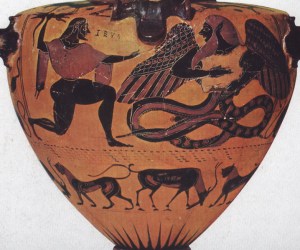
ὡς δ’ ἐκράτησαν οἱ θεοὶ τῶν Γιγάντων, Γῆ μᾶλλον χολωθεῖσα μίγνυται Ταρτάρῳ, καὶ γεννᾷ Τυφῶνα ἐν Κιλικίᾳ, μεμιγμένην ἔχοντα φύσιν ἀνδρὸς καὶ θηρίου. οὗτος μὲν καὶ μεγέθει καὶ δυνάμει πάντων διήνεγκεν ὅσους ἐγέννησε Γῆ, ἦν δὲ αὐτῷ τὰ μὲν ἄχρι μηρῶν ἄπλετον μέγεθος ἀνδρόμορφον, ὥστε ὑπερέχειν μὲν πάντων τῶν ὀρῶν, ἡ δὲ κεφαλὴ πολλάκις καὶ τῶν ἄστρων ἔψαυε· χεῖρας δὲ εἶχε τὴν μὲν ἐπὶ τὴν ἑσπέραν ἐκτεινομένην τὴν δὲ ἐπὶ τὰς ἀνατολάς· ἐκ τούτων δὲ ἐξεῖχον ἑκατὸν κεφαλαὶ δρακόντων. τὰ δὲ ἀπὸ μηρῶν σπείρας εἶχεν ὑπερμεγέθεις ἐχιδνῶν, ὧν ὁλκοὶ πρὸς αὐτὴν ἐκτεινόμενοι κορυφὴν συριγμὸν πολὺν ἐξίεσαν. πᾶν δὲ αὐτοῦ τὸ σῶμα κατεπτέρωτο, αὐχμηραὶ δὲ ἐκ κεφαλῆς καὶ γενύων τρίχες ἐξηνέμωντο, πῦρ δὲ ἐδέρκετο τοῖς ὄμμασι. τοιοῦτος ὢν ὁ Τυφὼν καὶ τηλικοῦτος ἡμμένας βάλλων πέτρας ἐπ’ αὐτὸν τὸν οὐρανὸν μετὰ συριγμῶν ὁμοῦ καὶ βοῆς ἐφέρετο· πολλὴν δὲ ἐκ τοῦ στόματος πυρὸς ἐξέβρασσε ζάλην. θεοὶ δ’ ὡς εἶδον αὐτὸν ἐπ’ οὐρανὸν ὁρμώμενον, εἰς Αἴγυπτον φυγάδες ἐφέροντο, καὶ διωκόμενοι τὰς ἰδέας μετέβαλον εἰς ζῷα. Ζεὺς δὲ πόρρω μὲν ὄντα Τυφῶνα ἔβαλλε κεραυνοῖς, πλησίον δὲ γενόμενον ἀδαμαντίνῃ κατέπληττεν ἅρπῃ, καὶ φεύγοντα ἄχρι τοῦ Κασίου ὄρους συνεδίωξε· τοῦτο δὲ ὑπέρκειται Συρίας. κεῖθι δὲ αὐτὸν κατατετρωμένον ἰδὼν εἰς χεῖρας συνέβαλε. Τυφὼν δὲ ταῖς σπείραις περιπλεχθεὶς κατέσχεν αὐτόν, καὶ τὴν ἅρπην περιελόμενος τά τε τῶν χειρῶν καὶ ποδῶν διέτεμε νεῦρα, ἀράμενος δὲ ἐπὶ τῶν ὤμων διεκόμισεν αὐτὸν διὰ τῆς θαλάσσης εἰς Κιλικίαν καὶ παρελθὼν εἰς τὸ Κωρύκιον ἄντρον κατέθετο. ὁμοίως δὲ καὶ τὰ νεῦρα κρύψας ἐν ἄρκτου δορᾷ κεῖθι ἀπέθετο, καὶ κατέστησε φύλακα Δελφύνην δράκαιναν· ἡμίθηρ δὲ ἦν αὕτη ἡ κόρη. Ἑρμῆς δὲ καὶ Αἰγίπαν ἐκκλέψαντες τὰ νεῦρα ἥρμοσαν τῷ Διὶ λαθόντες. Ζεὺς δὲ τὴν ἰδίαν ἀνακομισάμενος ἰσχύν, ἐξαίφνης ἐξ οὐρανοῦ ἐπὶ πτηνῶν ὀχούμενος ἵππων ἅρματι, βάλλων κεραυνοῖς ἐπ’ ὄρος ἐδίωξε Τυφῶνα τὸ λεγόμενον Νῦσαν, ὅπου μοῖραι αὐτὸν διωχθέντα ἠπάτησαν· πεισθεὶς γὰρ ὅτι ῥωσθήσεται μᾶλλον, ἐγεύσατο τῶν ἐφημέρων καρπῶν. διόπερ ἐπιδιωκόμενος αὖθις ἧκεν εἰς Θρᾴκην, καὶ μαχόμενος περὶ τὸν Αἷμον ὅλα ἔβαλλεν ὄρη. τούτων δὲ ἐπ’ αὐτὸν ὑπὸ τοῦ κεραυνοῦ πάλιν ὠθουμένων πολὺ ἐπὶ τοῦ ὄρους ἐξέκλυσεν αἷμα· καί φασιν ἐκ τούτου τὸ ὄρος κληθῆναι Αἷμον. φεύγειν δὲ ὁρμηθέντι αὐτῷ διὰ τῆς Σικελικῆς θαλάσσης Ζεὺς ἐπέρριψεν Αἴτνην ὄρος ἐν Σικελίᾳ· τοῦτο δὲ ὑπερμέγεθές ἐστιν, ἐξ οὗ μέχρι δεῦρό φασιν ἀπὸ τῶν βληθέντων κεραυνῶν γίνεσθαι πυρὸς ἀναφυσήματα.
(Apollodorus, Bibl. 1.6.3)

When the gods had defeated the Giants, Earth was angrier still. She had intercourse with Tartarus and gave birth in Cilicia to Typhon, who was half man and half wild beast. He was the largest and most powerful of all Earth’s offspring, so huge up to his thighs (which were of human form), that he towered above all mountains. His head touched the stars and his hands, when outstretched, reached the one to the west, the other to the east. From his shoulders extended a hundred snake heads. From his thighs down he had huge coils of vipers which, when stretched out, reached all the way to his head and hissed loudly. His entire body was covered with wings and his hair and beard were unkempt and blew in the wind. Fire flashed from his eyes. Such was Typhon as he hurled fiery rocks at heaven itself and rushed at it with hissing and shouting. From his mouth he spewed out a great stream of fire. When the gods saw him attacking heaven, they quickly fled to Egypt and in the course of their flight changed themselves into animals. Zeus hurled thunderbolts at Typhon while he was yet at a distance from him. When Zeus drew nearer, he struck him with a steel sickle and chased him as far as Mount Casius in Syria. Seeing that he was wounded, he fought him with his bare hands. Typhon wound his coils around him and held him fast. Then, taking the sickle from him, he cut out tendons from his hands and feet, lifted him on his shoulders, and carried him over the sea to Cilicia where he left him in the Corycian cave. He put the tendons in the cave, too, hidden in a bearskin, and placed the she-dragon, Delphyne, as a guard over them. She was half girl and half wild animal. Hermes and Aegipan, however, stole the tendons and secretly replaced them in Zeus’ hands and feet. With his strength now restored, the god suddenly threw thunderbolts at Typhon from the sky, where he had been carried in a chariot with winged horses, and chased him to the mountain called Nysa. There the Fates tricked him, for he tasted the fruit called ”ephemeral,” persuaded that it would make him stronger. He was again driven to Thrace and hurled entire mountains at Zeus in a battle around Mount Haemus. When these bounced back upon him under the force of the thunderbolt, blood gushed out on the mountain. From this, they say, the mountain is called Haemus [“bloody”]. As he started to flee across the Sicilian sea, Zeus threw Mount Aetna in Sicily upon him. It is a large mountain and they say that fire erupts from the thunderbolts which were thrown into it up to the present time. (tr. Michael Simpson)

Gigantas

navata11
Villa del Casale, Piazza Armerino, Sicily


This is part 1 of 2. Part 2 is here.

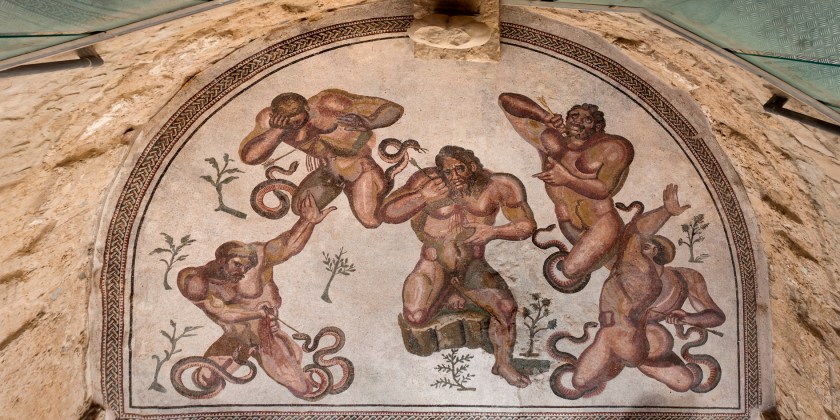
Γῆ δὲ περὶ Τιτάνων ἀγανακτοῦσα γεννᾷ Γίγαντας ἐξ Οὐρανοῦ, μεγέθει μὲν σωμάτων ἀνυπερβλήτους, δυνάμει δὲ ἀκαταγωνίστους, οἳ φοβεροὶ μὲν ταῖς ὄψεσι κατεφαίνοντο, καθειμένοι βαθεῖαν κόμην ἐκ κεφαλῆς καὶ γενείων, εἶχον δὲ τὰς βάσεις φολίδας δρακόντων. ἐγένοντο δέ, ὡς μέν τινες λέγουσιν, ἐν Φλέγραις, ὡς δὲ ἄλλοι, ἐν Παλλήνῃ. ἠκόντιζον δὲ εἰς οὐρανὸν πέτρας καὶ δρῦς ἡμμένας. διέφερον δὲ πάντων Πορφυρίων τε καὶ Ἀλκυονεύς, ὃς δὴ καὶ ἀθάνατος ἦν ἐν ᾗπερ ἐγεννήθη γῇ μαχόμενος. οὗτος δὲ καὶ τὰς Ἡλίου βόας ἐξ Ἐρυθείας ἤλασε. τοῖς δὲ θεοῖς λόγιον ἦν ὑπὸ θεῶν μὲν μηδένα τῶν Γιγάντων ἀπολέσθαι δύνασθαι, συμμαχοῦντος δὲ θνητοῦ τινος τελευτήσειν. αἰσθομένη δὲ Γῆ τοῦτο ἐζήτει φάρμακον, ἵνα μηδ’ ὑπὸ θνητοῦ δυνηθῶσιν ἀπολέσθαι. Ζεὺς δ’ ἀπειπὼν φαίνειν Ἠοῖ τε καὶ Σελήνῃ καὶ Ἡλίῳ τὸ μὲν φάρμακον αὐτὸς ἔτεμε φθάσας, Ἡρακλέα δὲ σύμμαχον δι’ Ἀθηνᾶς ἐπεκαλέσατο. κἀκεῖνος πρῶτον μὲν ἐτόξευσεν Ἀλκυονέα· πίπτων δὲ ἐπὶ τῆς γῆς μᾶλλον ἀνεθάλπετο· Ἀθηνᾶς δὲ ὑποθεμένης ἔξω τῆς Παλλήνης εἵλκυσεν αὐτόν. κἀκεῖνος μὲν οὕτως ἐτελεύτα, Πορφυρίων δὲ Ἡρακλεῖ κατὰ τὴν μάχην ἐφώρμησε καὶ Ἥρᾳ. Ζεὺς δὲ αὐτῷ πόθον Ἥρας ἐνέβαλεν, ἥτις καὶ καταρρηγνύντος αὐτοῦ τοὺς πέπλους καὶ βιάζεσθαι θέλοντος βοηθοὺς ἐπεκαλεῖτο· καὶ Διὸς κεραυνώσαντος αὐτὸν Ἡρακλῆς τοξεύσας ἀπέκτεινε. τῶν δὲ λοιπῶν Ἀπόλλων μὲν Ἐφιάλτου τὸν ἀριστερὸν ἐτόξευσεν ὀφθαλμόν, Ἡρακλῆς δὲ τὸν δεξιόν· Εὔρυτον δὲ θύρσῳ Διόνυσος ἔκτεινε, Κλυτίον δὲ δαισὶν Ἑκάτη, Μίμαντα δὲ Ἥφαιστος βαλὼν μύδροις. Ἀθηνᾶ δὲ Ἐγκελάδῳ φεύγοντι Σικελίαν ἐπέρριψε τὴν νῆσον, Πάλλαντος δὲ τὴν δορὰν ἐκτεμοῦσα ταύτῃ κατὰ τὴν μάχην τὸ ἴδιον ἐπέσκεπε σῶμα. Πολυβώτης δὲ διὰ τῆς θαλάσσης διωχθεὶς ὑπὸ τοῦ Ποσειδῶνος ἧκεν εἰς Κῶ· Ποσειδῶν δὲ τῆς νήσου μέρος ἀπορρήξας ἐπέρριψεν αὐτῷ, τὸ λεγόμενον Νίσυρον. Ἑρμῆς δὲ τὴν Ἄϊδος κυνῆν ἔχων κατὰ τὴν μάχην Ἱππόλυτον ἀπέκτεινεν, Ἄρτεμις δὲ †Γρατίωνα†, μοῖραι δ’ Ἄγριον καὶ Θόωνα χαλκέοις ῥοπάλοις μαχόμεναι τοὺς δὲ ἄλλους κεραυνοῖς Ζεὺς βαλὼν διέφθειρε· πάντας δὲ Ἡρακλῆς ἀπολλυμένους ἐτόξευσεν.
(Apollodorus, Bibl. 1.6.1-2)

Angry because of the Titans, Earth bore the Giants to Sky. They had enormous bodies, were invincible in their power and of fearful appearance. Thick hair hung from their heads and chins, and their feet had scales like snakes. Some say they were born in Phlegrae, but others in Pallene. They hurled rocks and burning oak trees into the sky. Porphyrion and Alcyoneus were the most powerful of them all, and the latter was even immortal whenever he fought in the land where he was born. He stole from Erythia the cattle of the Sun. There was an oracle which said that it was impossible for the gods to kill any of the Giants, although they could be killed with the aid of a mortal. When Earth learned this, she sought a drug which would protect the Giants, even from a mortal. But Zeus, forbidding the Dawn, Moon, and Sun to appear, got possession of the drug first and, through Athena, summoned Heracles as an ally. Heracles first shot Alcyoneus with an arrow, but he revived as he fell upon the ground. At Athena’s suggestion he dragged him outside Pallene and so he died. Porphyrion attacked Heracles and Hera. Zeus then filled him with desire for Hera, but when he tore off her robe and tried to rape her she cried out for help. Zeus struck him with a thunderbolt and Heracles shot him with an arrow, and he was killed. Of the Giants remaining, Apollo blinded Ephialtes in his left eye, Heracles in the right; Dionysus killed Eurytus with his wand; Hecate killed Clytius with torches. Hephaestus threw red-hot iron from the forge at Mimas, and Athena hurled Sicily at Enceladus. She then skinned Pallas and covered her own body with his skin for protection in battle. Poseidon chased Polybotes across the sea to Cos and there broke off that part of the island called Nisyrum and threw it at him. Hermes, wearing Hades’ helmet in the battle, killed Hippolytus, and Artemis killed Gration. The Fates attacked Agrius and Thoas with bronze clubs and killed them. Zeus destroyed the other Giants with thunderbolts, and Heracles shot them all with arrows as they lay dying. (tr. Michael Simpson)

Kētos

Anoniem, Perseus redt Andromeda, ca. 1600
Anonymous, Perseus saves Andromeda from the dragon, ca. 1600

Ἐν δεξιᾷ μὲν οὖν εἰσιόντι Ἀργολικῷ μύθῳ ἀναμέμικται πάθος Αἰθιοπικὸν· ὁ Περσεὺς τὸ κῆτος φονεύει καὶ τὴν Ἀνδρομέδαν καθαιρεῖ, καὶ μετὰ μικρὸν γαμήσει καὶ ἄπεισιν αὐτὴν ἄγων πάρεργον τοῦτο τῆς ἐπὶ Γοργόνας πτήσεως. ἐν βραχεῖ δὲ πολλὰ ὁ τεχνίτης ἐμιμήσατο, αἰδῶ παρθένου καὶ φόβον—ἐπισκοπεῖ γὰρ μάχην ἄνωθεν ἐκ τῆς πέτρας—καὶ νεανίου τόλμαν ἐρωτικὴν καὶ θηρίου ὄψιν ἀπρόσμαχον καὶ τὸ μὲν ἔπεισι πεφρικὸς ταῖς ἀκάνθαις καὶ δεδιττόμενον τῷ χάσματι, ὁ Περσεὺς δὲ τῇ λαιᾷ μὲν προδείκνυσι τὴν Γοργόνα, τῇ δεξιᾷ δὲ καθικνεῖται τῷ ξίφει· καὶ τὸ μὲν ὅσον τοῦ κήτους εἶδε τὴν Μέδουσαν, ἤδη λίθος ἐστίν, τὸ δ᾽ ὅσον ἔμψυχον μένει, τῇ ἅρπῃ κόπτεται.
(Lucian, Peri tou Oikou 22)

As you enter you see on the right a romance set in Ethiopia blended with Argive myth. Perseus slaughters the sea monster and takes Andromeda. Shortly he will marry her and take her off. This is a supplementary scene in the depiction of his flight to the Gorgons. The painter has represented a great deal with efficiency, the girl’s shyness and her fear—for she looks down on the battle from the cliff above—and the young man’s daring, driven by desire, and the invincible appearance of the creature. It attacks with its spines bristling and terrifying with its gaping maw. Perseus shows it the Gorgon with his left hand and with the right he hits it with his sword. That part of the sea monster that has seen Medusa is already stone, but that part that remains alive is being hacked at with the sickle. (tr. Daniel Ogden)

Irrequietus

Thomas R.A. Banks, A dying hero
Thomas R.A. Banks, A dying hero

Hic postquam medio iuvenis stetit aequore Poenus,
vulneris increscens dolor et vicinia durae
mortis, agens stimulis ardentibus, urget anhelum.
ille videns propius supremi temporis horam,
incipit: “heu qualis fortunae terminus altae est!
quam laetis mens caeca bonis! furor ecce potentum
praecipiti gaudere loco. status ille procellis
subiacet innumeris, et finis ad alta levatis
est ruere. heu tremulum magnorum culmen honorum,
spesque hominum fallax et inanis gloria fictis
illita blanditiis! heu vita incerta labori
dedita perpetuo, semperque, heu, certa nec unquam
sat mortis praevisa dies! heu sortis iniquae
natus homo in terris! animalia cuncta quiescunt;
irrequietus homo, perque omnes anxius annos
ad mortem festinat iter. Mors, optima rerum,
tu retegis sola errores, et somnia vitae
discutis exactae. video nunc quanta paravi
ha! miser in cassum, subii quot sponte labores,
quos licuit transire mihi. moriturus ad astra
scandere quaerit homo, sed Mors docet omnia quo sint
nostra loco. Latio quid profuit arma potenti,
quid tectis inferre faces! quid foedera mundi
turbare atque urbes tristi miscere tumultu?
aurea marmoreis quidve alta palatia muris
erexisse iuvat, postquam sic sidere laevo
in pelago periturus eram? carissime frater,
quanta paras animis, heu, fati ignarus acerbi,
ignarusque mei?” dixit: tum liber in auras
spiritus egreditur, spatiis unde altior aequis
despiceret Romam, simul et Carthaginis urbem,
ante diem felix abiens, ne summa videret
excidia et claris quod restat dedecus armis
fraternosque suosque simul patriaeque dolores.
(Petrarca, Africa 6.885-918)

And as the Punic youth thus fared upon
mid-ocean, there the ever-waxing pain
of his deep wound and the clear prescience
of bitter death, as if with fiery goads,
assailed his fever-stricken breast. Aware
that his last hour drew nigh, he voiced his grief:
“Ah, sorry ending to my life of glory!
How blind the soul to its true good and weal!
What mad, tempestuous force of folly moves
a man of mark to struggle to ascend
vertiginous heights! The summit is exposed
to countless tempests, and ascent must end
in ruinous collapse. The lofty peak,
deluding hope of man, is hollow fame
daubed with the glittering tint of false delight.
Our lives are wasted in incessant toil
of no sure issue; only our last day,
to which we give no heed, is fixed and sure.
Alas for the injustice of man’s lot:
the brutes in peace live out their tranquil lives;
mankind alone is harried and harrassed
and driven through laborious year on year
along the road to death. Nay, Death, thou art
the fairest thing we know; thou dost erase
our faults and dissipate our idle dreams,
quenching our lives. At last I can perceive
how long and fruitless have my labors been.
What countless toils I’ve faced that I might well
have put aside! Doomed though he be to die,
man still aspires to Heaven, but death reveals
the worth of his endeavor. What served it me
to ravage Latium with fire and sword,
to breach the universal peace that ruled
throughout the world and spread a panic fear
in countless cities? What did it avail
to raise up golden palaces and gird
their walls with marble if I am at last
to die, ill-starred, upon the lonely sea?
Dear brother, what are you devising now,
all unaware of Fortune’s plan and of
my wretched lot?” And, as he spoke, his soul
broke from the flesh and straightway mounted high
to Heaven, whence it surveyed the earthly plain
and Rome and Carthage with its citadel;
and in its passage Mago found a sad
contentment, that in life he might not see
the final ruin, the shame of mighty arms
once glorious, and the sorrow yet to fall
upon his land, his brother, and his race.
(tr. Thomas G. Bergin & Alice S. Wilson)

Intestinorum

a2dc28a0dd39ec1a436cbbe62333d574

Cibi vero in alvum recepti et cum potus humore permixti, cum iam calore percocti fuerint, eorum succus inenarrabili modo per membra diffusus irrigat universum corpus et vegetat. intestinorum quoque multiplices spirae ac longitudo in se convoluta et uno tantum substricta vinculo—quam mirificum Dei opus est! nam ubi maceratos ex se cibos alvus emiserit, paulatim per illos internorum anfractus extruduntur, ut quicquid ipsis ineset succi quo corpus alitur membris omnibus dividatur. et tamen necubi forte obhaereant ac resistant—quod fieri poterat propter ipsorum voluminum flexiones in se saepe redeuntes, et fieri sine pernicie non poterat—opplevit ea intrinsecus crassiore succo ut purgamenta illa ventris ad exitus suos facilius per lubricum niterentur. illa quoqe ratio subtilissima est quod vesica—cuius usum volucres non habent—cum sit ab intestinis separata nec ullam habeat fistulam qua ex illis urinam trahat, completur tamen et humore distenditur. id quomodo fiat non est difficile pervidere. intestinorum enim partes quae ab alvo cibum potumque suscipiunt patentiores sunt quam ceterae spirae et multo tenuiores. hae vesicam complectuntur et continent: ad quas partes cum potus et cibus mixti pervenerint, firmum quidem crassius fit et transmeat. humor autem omnis per illam teneritudinem percolatur, eumque vesica, cuius aeque tenuis subtilisque membrana est, absorbet ac colligit ut foras qua natura exitium patefecit emittat.
(Lactantius, De Opificio Dei 11)

But once the stomach receives the food, thoroughly mixed with moisture from what we drink and then digested by heat, the juice from this spreads in an indescribable manner through the limbs, watering and enlivening the whole body. Also, the many coils of the intestines, folding lengthwise upon themselves and tied together in just one cord—what an amazing work of God this is! For when the stomach ejects the softened food, it is pressed out little by little through those internal bendings, and any juice inside that nourishes the body divides among all parts. However, so that nothing gets stuck and stays back anywhere—a disastrous result that could occur because the bends in those rolls often turn back on themselves—God filled them inside with thicker juice so that what is cleaned from the stomach can push its way out more easily through something slippery. This structure is also quite intricate because the bladder—whose use birds do not have—fills up with fluid and swells even though it is separated from the intestines ad has no tube to get urine from them. How this happens is not hard to see. For the parts of the intestines that get food and drink from the stomach are more open than the other coils and much finer. These surround and contain the bladder: when the mixed food and drink gets to these parts, the excrement actually becomes thicker and passes through. But all the moisture is strained through its thin fabric, and the bladder, whose membrane is equally thin and delicate, absorbs and collects it in order to expel it outside where nature makes an opening. (tr. Brian P. Copenhaver)

Periphronoumenos

Frederic Leighton, Icarus and Daedalus, ca. 1869
Frederic Leighton, Icarus and Daedalus (ca. 1869)

Ἐνόσει Πασιφάη παράλογον ἔρωτα καὶ παστάδα παραλογωτέραν ἐπήξατο Δαίδαλος. ἐπὶ τούτοις ὀργίζεται Μίνως καὶ σπεύδει τὸν Πασιφάης καὶ ταύρου νυμφοστόλον ἑλεῖν, αλλ’ ἦν ἄρα ἐκεῖνος καὶ πῦρ ἀφροδίσιον ἀποσβέσαι σοφὸς καὶ βασιλέως ἀναφθέντα θυμὸν ἀποδράσαι σοφώτερος. ἀλλὰ κἀνταῦθα τέχνη τὴν φύσιν ὑπερεβάλλετο· καί, ἃ φύσις οὐκ ἴσχυσε, Δαίδαλος ἐτεχνήσατο καί, τὴν φύσιν ἄνθρωπος ὤν, τὸν ὄρνιν ἐσχηματίσατο. ἐπτέρωσε τῇ σοφίᾳ καὶ τὸν παῖδα Ἴκαρον, ἵν’ ὡς ἐκ μιᾶς μηχανῆς καὶ τὸ πατὴρ εἶναι μὴ ζημιωθῇ καὶ τὸ περιεῖναι κερδάνῃ· φιλόστοργον γὰρ ὁ πατὴρ καὶ τὸ παράπαν ἀπολιπέσθαι τοῦ παιδὸς οὐκ ἀνέχεται. ἵπταντο γοῦν ἄμφω καὶ τὸν Μίνω ξυναπεδίδρασκον, ἀλλ’ ὁ μὲν ἅτε σοφὸς καὶ τὴν μηχανὴν εἰδώς, ἐφ’ ὅσον ἂν καὶ πτερύξαιτο, σύμμετρον τῷ σοφίσματι ποιεῖται τὴν πτῆσιν· ὁ δ’ ὑπὲρ τὰ πτίλα καὶ τὸν κηρὸν καὶ τὴν τέχνην πτερύσσεται καὶ περιφρονεῖ μὲν τὸν Ἥλιον, πιστεύει δὲ ταῖς ἀκτῖσι τὸν κηρὸν καὶ τρυφᾶν ἐθέλει μᾶλλον ἢ πρὸς ἀσφάλειαν ἵπτασθαι. τοιοῦτον γάρ τι χρῆμα νεότης· πρὸς ἡδονὰς ἀλόγιστα φέρεται καὶ τῆς χρείας ἐκφέρεται. οὐ φέρει περιφρονούμενος Ἥλιος, ἐπιβάλλει τῷ κηρῷ τὰς ἀκτῖνας, ἀπελέγχει τὸν σοφιστήν, λύει τὸ σόφισμα καὶ ῥίπτει κατὰ πελάγους τὸν Ἴκαρον. καὶ τοῦτο μιμεῖται Δαίδαλον Ἥλιος· ἐκ τῆς Ἡλίου παιδὸς Πασιφάης Μινώταυρον ἐκαινοτόμησε Δαίδαλος καὶ Ἥλιος ἐκ Ἰκάρου τοῦ Δαιδάλου παιδὸς Ἰκάριον πέλαγος ἀνθρώποις ἐγνώρισεν.
(Nikephoros Basilakes, Progymnasmata, Narr. 13)

Pasiphaë suffered from a strange passion, and Daedalus built for her an even stranger bridal chamber. Minos grew angry at this and strove to capture the man who married Pasiphaë to the bull, but Daedalus was clever enough to extinguish the fire of love and was even more clever at escaping the inflamed anger of the king. For yet again Daedalus did not lack a device; rather, once more art overcame nature: what nature could not accomplish, Daedalus contrived by art, and though human by nature, he took on the appearance of a bird. By means of his ingenuity he also fit wings to his boy, Icarus, so that, through a single device, he might preserve his role as father and might gain his own survival. For fathers are affectionate creatures and cannot bear at all to be separated from their sons. So the two flew off and escaped Minos. But the father, who in his wisdom understood how far his device could fly, made his flight according to the limits of his invention. Icarus, however, flew beyond the capacity of the feathers, the wax, and the artistry; he defied the Sun and entrusted the wax to its rays, wishing to indulge himself rather than fly safely. For such a creature is youth: it is driven irrationally toward pleasure and away from what it ought to do. The Sun did not tolerate this defiance. He attacked the wax with his rays; he repudiated the clever inventor and melted his invention; and then he cast Icarus down into the sea; And in this way the Sun imitated Daedalus, because Daedalus created a novel creature, the Minotaur, through Pasiphaë, the daughter of the Sun, and the Sun made the Icarian Sea known to humans through Icarus, the son of Daedalus. (tr. Jeffrey Beneker & Craig A. Gibson)

Prosēkonta

https---blogs-images.forbes.com-sebastianbailey-files-2014-07-Men-vs-women

“Στεγνῶν δὲ δεῖται καὶ ἡ τῶν νεογνῶν τέκνων παιδοτροφία, στεγνῶν δὲ καὶ αἱ ἐκ τοῦ καρποῦ σιτοποιίαι δέονται· ὡσαύτως δὲ καὶ ἡ τῆς ἐσθῆτος ἐκ τῶν ἐρίων ἐργασία. ἐπεὶ δ’ ἀμφότερα ταῦτα καὶ ἔργων καὶ ἐπιμελείας δεῖται τά τε ἔνδον καὶ τὰ ἔξω, καὶ τὴν φύσιν, φάναι, εὐθὺς παρεσκεύασεν ὁ θεός, ὡς ἐμοὶ δοκεῖ, τὴν μὲν τῆς γυναικὸς ἐπὶ τὰ ἔνδον ἔργα καὶ ἐπιμελήματα, <τὴν δὲ τοῦ ἀνδρὸς ἐπὶ τὰ ἔξω>. ῥίγη μὲν γὰρ καὶ θάλπη καὶ ὁδοιπορίας καὶ στρατείας τοῦ ἀνδρὸς τὸ σῶμα καὶ τὴν ψυχὴν μᾶλλον δύνασθαι καρτερεῖν κατεσκεύασεν· ὥστε τὰ ἔξω ἐπέταξεν αὐτῷ ἔργα· τῇ δὲ γυναικὶ ἧττον τὸ σῶμα δυνατὸν πρὸς ταῦτα φύσας τὰ ἔνδον ἔργα αὐτῇ, φάναι ἔφη, προστάξαι μοι δοκεῖ ὁ θεός. εἰδὼς δὲ ὅτι τῇ γυναικὶ καὶ ἐνέφυσε καὶ προσέταξε τὴν τῶν νεογνῶν τέκνων τροφήν, καὶ τοῦ στέργειν τὰ νεογνὰ βρέφη πλέον αὐτῇ ἐδάσατο ἢ τῷ ἀνδρί. ἐπεὶ δὲ καὶ τὸ φυλάττειν τὰ εἰσενεχθέντα τῇ γυναικὶ προσέταξε, γιγνώσκων ὁ θεὸς ὅτι πρὸς τὸ φυλάττειν οὐ κάκιόν ἐστι φοβερὰν εἶναι τὴν ψυχὴν πλέον μέρος καὶ τοῦ φόβου ἐδάσατο τῇ γυναικὶ ἢ τῷ ἀνδρί. εἰδὼς δὲ ὅτι καὶ ἀρήγειν αὖ δεήσει, ἐάν τις ἀδικῇ, τὸν τὰ ἔξω ἔργα ἔχοντα, τούτῳ αὖ πλέον μέρος τοῦ θράσους ἐδάσατο. ὅτι δ’ ἀμφοτέρους δεῖ καὶ διδόναι καὶ λαμβάνειν, τὴν μνήμην καὶ τὴν ἐπιμέλειαν εἰς τὸ μέσον ἀμφοτέροις κατέθηκεν. ὥστε οὐκ ἂν ἔχοις διελεῖν πότερα τὸ ἔθνος τὸ θῆλυ ἢ τὸ ἄρρεν τούτων πλεονεκτεῖ. καὶ τὸ ἐγκρατεῖς δὲ εἶναι ὧν δεῖ εἰς τὸ μέσον ἀμφοτέροις κατέθηκε, καὶ ἐξουσίαν ἐποίησεν ὁ θεὸς ὁπότερος ἂν ᾖ βελτίων, εἴθ’ ὁ ἀνὴρ εἴθ᾽ ἡ γυνή, τοῦτον καὶ πλέον φέρεσθαι τούτου τοῦ ἀγαθοῦ. διὰ δὲ τὸ τὴν φύσιν μὴ πρὸς πάντα ταὐτὰ ἀμφοτέρων εὖ πεφυκέναι, διὰ τοῦτο καὶ δέονται μᾶλλον ἀλλήλων καὶ τὸ ζεῦγος ὠφελιμώτερον ἑαυτῷ γεγένηται, ἃ τὸ ἕτερον ἐλλείπεται τὸ ἕτερον δυνάμενον. ταῦτα δέ, ἔφην, δεῖ ἡμᾶς, ὦ γύναι, εἰδότας, ἃ ἑκατέρῳ ἡμῶν προστέτακται ὑπὸ τοῦ θεοῦ, πειρᾶσθαι ὅπως ὡς βέλτιστα τὰ προσήκοντα ἑκάτερον ἡμῶν διαπράττεσθαι. συνεπαινεῖ δέ, ἔφη φάναι, καὶ ὁ νόμος αὐτά, συζευγνὺς ἄνδρα καὶ γυναῖκα· καὶ κοινωνοὺς ὥσπερ τῶν τέκνων ὁ θεὸς ἐποίησεν, οὕτω καὶ ὁ νόμος <τοῦ οἴκου> κοινωνοὺς καθίστησι. καὶ καλὰ δὲ εἶναι ὁ νόμος ἀποδείκνυσιν <ἃ> καὶ ὁ θεὸς ἔφυσεν ἑκάτερον μᾶλλον δύνασθαι. τῇ μὲν γὰρ γυναικὶ κάλλιον ἔνδον μένειν ἢ θυραυλεῖν, τῷ δὲ ἀνδρὶ αἴσχιον ἔνδον μένειν ἢ τῶν ἔξω ἐπιμελεῖσθαι.”
(Xenophon, Oec. 7.21-30)

“Shelter is needed for the nursing of newborns; shelter is needed for the making of grain into bread, and likewise for the making of clothes from wool. And since both the indoor and the outdoor jobs demand work and care, the god from the first adapted the woman’s nature, I think, to the indoor and man’s to the outdoor works and cares. For he made the man’s body and mind more capable of enduring cold and heat, and journeys and campaigns, and thus has assigned him the outdoor tasks. To the woman, since he has made her body less capable of such endurance, I take it that the god has assigned the indoor tasks. And knowing that he had created in the woman, and had imposed on her, the nurture of the newborns, he meted out to her a larger portion of affection for newborns than to the man. And since he imposed on the woman the protection of what had been brought in as well, knowing that for protection a fearful disposition is no disadvantage, the god meted out a larger share of fear to the woman than to the man; and knowing that the one who deals with the outdoor tasks will have to be their defender against any wrongdoer, he meted out to him again a larger share of courage. But because both must give and take, he granted to both impartially memory and attention; and so you could not distinguish whether the male or the female sex has the larger share of these. And the god also gave to both impartially the power to practice self-control as needed, and gave the privilege to whichever is the better at this—whether it be the man or the woman—to win a larger portion of the good that comes from it. And just because they are not equally well endowed with all the same aptitudes, they have the more need of each other, and each member of the pair is the more useful to the other, the one being competent where the other is deficient. Now, wife, since we know what duties have been assigned to each of us by the god, we must try, each of us, to do the duties allotted to us as well as possible. The law encourages this, for it yokes husband and wife. And as the god has made them partners in their children, so the law appoints them partners in their household. And besides, the law declares those tasks to be seemly for which the god has made the one more naturally capable than the other. Thus for the woman it is more seemly to stay indoors than to be outside, but to the man it is unseemly rather to stay indoors than to tend to business outside.” (tr. Edgar Cardew Marchant, revised by Jeffrey Henderson)