Fuscior

too-much-makeup

Vidua, quae soluta est vinculo maritali, nihil necesse habet nisi perseverare. at scandalizat quempiam vestis fuscior: scandalizet Iohannes, quo inter natos mulierum maior nullus fuit, qui angelus dictus ipsum quoque dominum baptizavit, qui camelorum vestitus tegumine zona pellicia cingebatur. cibi displicent viliores; nihil vilius est locustis. illae Christianos oculos potius scandalizent, quae purpurisso et quibusdam fucis ora oculosque depingunt, quarum facies gypseae et nimio candore deformes idola mentiuntur, quibus si forte improvidens lacrimarum stilla eruperit, sulco defluit, quas nec numerus annorum potest docere, quod vetulae sunt, quae capillis alienis verticem instruunt et praeteritam iuventutem in rugis anilibus poliunt, quae denique ante nepotum gregem trementes virgunculae componuntur.
(Jerome, Ep. 38.3)

A widow who is freed from the marital bond has but one duty laid upon her, and that is to continue as a widow. It may be that some people are offended by her sombre garb: they would be offended also by John the Baptist, and yet among those born of women there has not been a greater than he. He was called God’s messenger and baptized the Lord Himself, but he was clothed in camel’s-hair raiment and girded with a girdle of skins. It may be that some are displeased by a widow’s simple food: nothing can be more simple than locusts. Those women rather should offend a Christian’s eyes, who paint their cheeks with rouge and their eyes with belladonna; whose faces are covered with powder and so disfigured by excessive whiteness that they look like idols; who find a wet furrow on their skin if perchance a careless tear escape them; whom no amount of years can convince that they are old; who heap their heads with borrowed tresses; who polish up past youthfulness in spite of the wrinkles of age; who, in fine, behave like trembling schoolgirls before a company of their own grandsons. (tr. Frederick Adam Wright)

Xeinousthai

Ἦ, καὶ δεξιτερῆς χειρὸς θίγεν· αἶψα δ’ ὀπίσσω
βῆ ῥ’ ἴμεν· ἀμφὶ δὲ τόν γε νεήνιδες ἄλλοθεν ἄλλαι
μυρίαι εἱλίσσοντο κεχαρμέναι, ὄφρα πυλάων
ἐξέμολεν. μετέπειτα δ’ ἐυτροχάλοισιν ἀμάξαις
ἀκτὴν εἰσανέβαν ξεινήια πολλὰ φέρουσαι,
μῦθον ὅτ’ ἤδη πάντα διηνεκέως ἀγόρευσεν,
τόν ῥα καλεσσαμένη διεπέφραδεν Ὑψιπύλεια·
καὶ δ’ αὐτοὺς ξεινοῦσθαι ἐπὶ σφέα δώματ’ ἄγεσκον
ῥηιδίως· Κύπρις γὰρ ἐπὶ γλυκὺν ἵμερον ὦρσεν
Ἡφαίστοιο χάριν πολυμήτιος, ὄφρα κεν αὖτις
ναίηται μετόπισθεν ἀκήρατος ἀνδράσι Λῆμνος.
(Apollonius of Rhodes, Argonautica 1.842-852)

He* spoke and touched her right hand, and immediately set out to go back. And around him from every direction swarmed countless young women full of joy, until he passed outside the gates. Then the women came to the shore in well-wheeled wagons, bringing many guest-gifts, as soon as he had announced from beginning to end the entire proposal Hypsipyle had declared when she summoned him. And the women led the men to their homes to host them – easily, because Cypris had aroused sweet desire in them as a favor to resourceful Hephaestus, so that Lemnos would again be populated by males and suffer no harm thereafter.

* Jason.

(tr. William H. Race)

Umbus

3fac25a353f2be3f2a2314418bcb4158

Umbilicus est medius locus corporis, dictus quod sit umbus iliorum. Unde et umbo appellatur locus in medio clypei, a quo pendet. ex eo enim infans in utero pendet, ex eo etiam et nutritur. ilium Graeco sermone appellatum, quod ibi nos obvolvamus. Graece enim εἰλύειν obvolvere dicitur. clunes vocatae, quod sint iuxta colum, quod est longao. nates, quod in ipsis innitimur dum sedemus. unde et conglobata est in eis caro, ne prementis corporis mole ossa dolerent.
(Isidorus of Sevilla, Etym. 11.1.99-101)

The navel (umbilicus) is the center of the body, so called, because it is a protuberance (umbus) of the belly. Whence also the place in the middle of a shield is called a ‘boss’ (umbo), from which it hangs, for the infant hangs from it in the uterus and it is also nourished from it. The private parts (ilium, i.e. ilia) are referred to with a Greek word, because there we cover ourselves up, for in Greek ilios (i.e. εἰλύειν) means “cover up.” The buttocks (clunis) are so called, because they are situated next to the colon (colum), that is, to the large intestine (longao). The nates (natis) are so called because we support ourselves (inniti) with them when we are seated. Hence also the flesh is bunched up in them, so that the bones may not hurt from the heavy weight of the body when it presses down. (tr. Stephen A. Barney, W.J. Lewis, J.A. Beach and/or Oliver Berghof)

Consilium

Non enim comitiis iudicat semper populus, sed movetur plerumque gratia; cedit precibus; facit eos, a quibus est maxime ambitus. denique, etiam si iudicat, non dilectu aliquo aut sapientia ducitur ad iudicandum, sed impetu nonnumquam, et quadam etiam temeritate. non est enim consilium in vulgo, non ratio, non discrimen, non diligentia: semperque sapientes ea, quae populus fecisset, ferenda, non semper laudanda duxerunt.
(Cicero, Pro Plancio 9)

Deliberate verdicts are not invariably arrived at in popular elections, which are often guided by partiality and swayed by prayers; the people promotes those who court it most assiduously; and even if after all it does give a deliberate verdict, that verdict is determined, not by a discriminating wisdom, but frequently by impulse and a spirit of headstrong caprice. For the multitude is a stranger to deliberation, to reason, to discernment, and to patient scrutiny; and all great thinkers have held that acquiescence, but not alway approval, should be accorded to the acts of the people. (tr. Nevile Hunter Watts)

Plebiculam

main-qimg-5c34e247b5aafc51f2a2d6e5c02e613b-c

Mechanico quoque grandes columnas exigua impensa perducturum in Capitolium pollicenti praemium pro commento non mediocre obtulit, operam remisit praefatus sineret se plebiculam pascere.
(Suetonius, Div. Vesp. 18)

To an engineer who promised that he could transport some huge columns up to the Capitol at almost no cost, he* gave a substantial reward for his device but declined to use it, remarking: ‘I must be allowed to feed my poor common people.’

* Vespasian.

(tr. Catharine Edwards)

Festis

basket-weaving

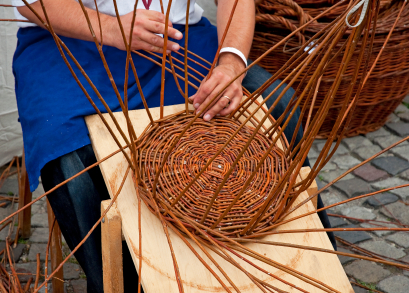
Nunc facilis rubea texatur fiscina virga,
nunc torrete igni fruges, nunc frangite saxo.
quippe etima festis quaedam exercere diebus
fas et iura sinunt: rivos deducere nulla
relligio vetuit, segeti praetendere saepem,
insidias avibus moliri, incendere vepres,
balantumque gregem fluvio mersare salubri.
saepe oleo tardi costas agitator aselli
vilibus aut onerat pomis, lapidemque revertens
incusum aut atrae massam picis urbe reportat.
(Vergil, Georg. 1.266-275)

Now, without trouble, weave small baskets of briar canes,
now parch grain over the fire, now grind it on a stone.
In fact, even on holy days, the laws of gods and men
permit some work. No piety forbids bringing down
irrigation water, fencing in crops with a hedge,
setting snares for birds, burning up tangles of briars,
and dipping a bleating flock in a health-promoting stream.
Often, a driver loads the sides of his slow jackass
with oil or abundant fruit and, on return from town,
brings back a chiseled millstone or a lump of black pitch.
(tr. Janet Lembke)

Desertae

Ah nimium faciles aurem praebere puellae,
discite desertae non temere esse bonae!
huic quoque, qui restet, iam pridem quaeritur alter:
experta in primo, stulta cavere potes.
nos quocumque loco, nos omni tempore tecum
sive aegra pariter sive valente sumus.
(Propertius 2.21.15-20)

Ah, ye girls all to ready to lend an ear, learn from being abandoned not to be rashly kind! My girl too has now for days been looking for another lover who will stay: duped by the first one, silly woman, you had better watch out. As for me, at any time, in any place, alike in sickness and in health, my heart belongs to you. (tr. George Patrick Goold)

Rosa

145

Dum licet, et vernos etiamnum educitis annos,
ludite: eunt anni more fluentis aquae;
nec quae praeteriit, iterum revocabitur unda,
nec quae praeteriit, hora redire potest.
utendum est aetate: cito pede labitur aetas,
nec bona tam sequitur, quam bona prima fuit.
hos ego, qui canent, frutices violaria vidi:
hac mihi de spina grata corona data est.
tempus erit, quo tu, quae nunc excludis amantes,
frigida deserta nocte iacebis anus,
nec tua frangetur nocturna ianua rixa,
sparsa nec invenies limina mane rosa.
(Ovid, Ars Am. 3.61-72)

Be mindful first that old age will come to you:
so don’t be timid and waste any of your time.
Have fun while it’s allowed, while your years are in their prime:
the years go by like flowing waters:
The wave that’s past can’t be recalled again,
the hour that’s past never can return.
Life’s to be used: life slips by on swift feet,
what was good at first, nothing as good will follow.
Those stalks that wither I saw as violets:
from that thorn-bush to me a dear garland was given.
There’ll be a time when you, who now shut out your lover,
will lie alone, and aged, in the cold of night,
nor find your entrance damaged by some nocturnal quarrel,
nor your threshold sprinkled with roses at dawn.
(tr. Tony Kline)

Kalos

062ce2c762fb3778667f605a84285c31

Τὰ μὲν οὖν ἄλλα σαφῶς ἀπαγγέλλειν οὐ πρέπει διὰ τὴν πόλιν, τὴν δὲ Δημοκλέους ἀρετὴν καὶ σωφροσύνην ἄξιόν ἐστι μὴ παρελθεῖν. ἐκεῖνος γὰρ ἦν ἔτι παῖς ἄνηβος, οὐκ ἔλαθε δὲ τὸν Δημήτριον ἔχων τῆς εὐμορφίας τὴν ἐπωνυμίαν κατήγορον· ἐκαλεῖτο γὰρ Δημοκλῆς ὁ καλός. ὡς δὲ πολλὰ πειρώντων καὶ διδόντων καὶ φοβούντων ὑπ’ οὐδενὸς ἡλίσκετο, τέλος δὲ φεύγων τὰς παλαίστρας καὶ τὸ γυμνάσιον εἴς τι βαλανεῖον ἰδιωτικὸν ἐφοίτα λουσόμενος, ἐπιτηρήσας τὸν καιρὸν ὁ Δημήτριος ἐπεισῆλθεν αὐτῷ μόνῳ. καὶ ὁ παῖς, ὡς συνεῖδε τὴν περὶ αὑτὸν ἐρημίαν καὶ τὴν ἀνάγκην, ἀφελὼν τὸ πῶμα τοῦ χαλκώματος εἰς ζέον ὕδωρ ἐνήλατο καὶ διέφθειρεν αὑτόν, ἀνάξια μὲν παθών, ἄξια δὲ τῆς πατρίδος καὶ τοῦ κάλλους φρονήσας…
(Plutarch, Bios Dēmētriou 24.2-3)

Now, to give all the particulars plainly would disgrace the fair fame of the city, but I may not pass over the modesty and virtue of Democles. He was still a young boy, and it did not escape the notice of Demetrius that he had a surname which indicated his comeliness; for he was called Democles the Beautiful. But he yielded to none of the many who sought to win him by prayers or gifts or threats, and finally, shunning the palaestras and the gymnasium, used to go for his bath to a private bathing-room. Here Demetrius, who had watched his opportunity, came upon him when he was alone. And the boy, when he saw that he was quite alone and in dire straits, took off the lid of the cauldron and jumped into the boiling water, thus destroying himself, and suffering a fate that was unworthy of him, but showing a spirit that was worthy of his country and of his beauty. (tr. Bernadotte Perrin)

Arkusi

Χριστὲ ἄναξ, τί με σαρκὸς ἐν ἄρκυσι ταῖσδε ἐνέδησας;
τίπτε με τῷδε βίῳ θῆκας ὑπ’ ἀντιπάλῳ;
πατρὸς μὲν γενόμην θεοειδέος, οὐκ ὀλίγης δὲ
μητέρος· ἐς δὲ φάος ἤλυθον εὐξαμένης.
ηὔξατο, καὶ μ’ ἀνέθηκε θεῷ βρέφος· ἀφθορίης δὲ
θερμὸν ἔρωτα χέεν ὄψις ἐμοὶ νυχίη.
Χριστὸς μὲν δὴ τοῖα· τὰ δ’ ὕστατα κύμασι βράσθην,
ἁρπαλέαις παλάμαις ἤρκεσα, σῶμα λύθην,
ποιμέσιν οὐ φιλίοισι συνέδραμον, ηὗρον ἄπιστα,
χηρώθην τεκέων, πήμασι χασσάμενος.
οὗτος Γρηγορίοιο βίος· τὰ δ’ ἔπειτα μελήσει
Χριστῷ ζωοδότῃ. γράψατε ταῦτα λίθοις.
(Gregory of Nazianzus, Poëm. 2.1.92)

Lord Christ, why have you bound me in these toils of the flesh?
Why have you subjected me to this painful life?
Of a godlike father I was born and of a mother who was not
insignificant. As a result of her prayers I came into the light.
She prayed and dedicated me as a child of God.
A nocturnal vision instilled in me a burning desire for purity.
Christ was responsible for all this, but later I was dashed by the waves,
snatched by greedy hands, my body crushed.
I fell among uncaring shepherds and experienced treachery.
I was deprived of my children and overwhelmed by misfortune.
Such has been the life of Gregory: what remains will be the concern
of Christ the giver of life. Inscribe these words on my tombstone.
(tr. Carolinne White)