Kērulos

Common kingfisher, Alcedo atthis3

Τῶν δὲ ἀλκυόνων οἱ ἄρσενες κηρύλοι καλοῦνται. ὅταν οὖν ὑπὸ τοῦ γήρως ἀσθενήσωσιν καὶ μηκέτι δύνωνται πέτεσθαι, φέρουσιν αὐτοὺς αἱ θήλειαι ἐπὶ τῶν πτερῶν λαβοῦσαι. καὶ ἔστι τὸ ὑπὸ τοῦ Ἀλκμᾶνος λεγόμενον τούτῳ συνῳκειωμένον· φησὶν γὰρ ἀσθενὴς ὢν διὰ τὸ γῆρας καὶ τοῖς χοροῖς οὐ δυνάμενος συμπεριφέρεσθαι οὐδὲ τῇ τῶν παρθένων ὀρχήσει·
οὔ μ’ ἔτι, παρσενικαὶ μελιγάρυες ἱαρόφωνοι,
γυῖα φέρην δύναται· βάλε δὴ βάλε κηρύλος εἴην,
ὅς τ’ ἐπὶ κύματος ἄνθος ἅμ’ ἀλκυόνεσσι ποτήται
νηλεὲς ἦτορ ἔχων, ἁλιπόρφυρος ἱαρὸς ὄρνις. [Alcman, fr. 26]
(Antigonus of Carystus, De Animalibus fr. 54b Dorandi)

Male halcyons are called ceryli.* When they become weak from old age and are no longer able to fly, the females carry them, taking them on their wings. What Alcman says is connected with this: weak from old age and unable to whirl about with the choirs and the girls’ dancing, he says,
No longer, honey-toned, strong-voiced girls, can my limbs carry me. If only, if only I were a cerylus, who flies along with the halcyons over the flower of the wave with resolute heart, strong, sea-blue bird.

* Both mythical seabirds, sometimes identified with the kingfisher.

(tr. David Campbell, with his note)

Plunon

woman-about-to-brush-teeth

Ἀμήχανον ἦν μύξας μὴ ῥεῖν τοῦ ἀνθρώπου τοιοῦτον ἔχοντος τὸ σύγκραμα· διὰ τοῦτο χεῖρας ἐποίησεν ἡ φύσις καὶ αὐτὰς τὰς ῥῖνας ὡς σωλῆνας πρὸς τὸ ἐκδιδόναι τὰ ὑγρά. ἂν οὖν ἀναρροφῇ τις αὐτάς, λέγω ὅτι οὐ ποιεῖ ἔργον ἀνθρωπικόν. ἀμήχανον ἦν μὴ πηλοῦσθαι τοὺς πόδας μηδὲ ὅλως μολύνεσθαι διὰ τοιούτων τινῶν πορευομένους· διὰ τοῦτο ὕδωρ παρεσκεύασεν, διὰ τοῦτο χεῖρας. ἀμήχανον ἦν ἀπὸ τοῦ τρώγειν μὴ ῥυπαρόν τι προσμένειν τοῖς ὀδοῦσι· διὰ τοῦτο “πλῦνον” φησίν “τοὺς ὀδόντας.” διὰ τί; ἵν’ ἄνθρωπος ᾖς καὶ μὴ θηρίον μηδὲ συίδιον. ἀμήχανον μὴ ἀπὸ τοῦ ἱδρῶτος καὶ τῆς κατὰ τὴν ἐσθῆτα συνοχῆς ὑπολείπεσθαί τι περὶ τὸ σῶμα ῥυπαρὸν καὶ δεόμενον ἀποκαθάρσεως· διὰ τοῦτο ὕδωρ, ἔλαιον, χεῖρες, ὀθόνιον, ξύστρα, νίτρον, ἔσθ’ ὅθ’ ἡ ἄλλη πᾶσα παρασκευὴ πρὸς τὸ καθῆραι αὐτό. οὔ· ἀλλ’ ὁ μὲν χαλκεὺς ἐξιώσει τὸ σιδήριον καὶ ὄργανα πρὸς τοῦτο ἕξει κατεσκευασμένα καὶ τὸ πινάκιον αὐτὸς σὺ πλυνεῖς, ὅταν μέλλῃς ἐσθίειν, ἐὰν μὴ ᾖς παντελῶς ἀκάθαρτος καὶ ῥυπαρός· τὸ σωμάτιον δ’ οὐ πλυνεῖς οὐδὲ καθαρὸν ποιήσεις; — “διὰ τί;” φησίν. — πάλιν ἐρῶ σοι· πρῶτον μὲν ἵνα τὰ ἀνθρώπου ποιῇς, εἶτα ἵνα μὴ ἀνιᾷς τοὺς ἐντυγχάνοντας.
(Arrian, Epict. Diatr. 4.11.9-14)

It is impossible that there should not be some flow of mucus from a human being, since he is constituted in the way that he is. For that reason, nature has created hands, and has made our nostrils themselves like tubes to carry away the fluids. So if anyone sniffs them up again, I say that he isn’t acting as is appropriate for a human being. It was impossible that our feet should not get muddy, or dirty at all, when we pass through filth of that kind; nature has thus provided us with water and with hands. It was impossible that some dirt should not get left behind on our teeth when we’ve eaten; and so nature says to us, “Clean your teeth.” Why? So that you may be a human being, and not a wild beast or a pig. It was impossible that through our sweat and the rubbing of our clothes, some uncleanness should not be left behind on our body and need to be cleaned off; for this reason, we have water, oil, hands, a towel, a scraper, and everything else that is used for cleaning the body. Not in your case? But a smith will remove the rust from his iron, and has tools made for that purpose, and you yourself will wash your plate before you eat, unless you’re irredeemably dirty and unclean; and yet when it comes to your poor body, you don’t want to wash it and make it clean? “Why should I?”, the man says. I’ll tell you again: in the first place, to act as is appropriate for a human being, and secondly, so as not to disgust those whom you meet. (tr. Robin Hard)

Temeritatem

dscf0479-1

Mira etiam censoris Augusti et laudata patientia. corripiebatur eques Romanus a principe, tamquam minuisset facultates suas, at ille se multiplicasse coram probavit. mox eidem obiecit quod ad contrahendum matrimonium legibus non paruisset. ille uxorem sibi et tres esse liberos dixit. tum adiecit: “posthac, Caesar, cum de honestis hominibus inquiris, honestis mandato.” etiam militis non libertatem tantum sed et temeritatem tulit. in quadam villa inquietas noctes agebat rumpente somnum eius crebro noctuae cantu. prendendam curavit noctuam miles aucupii peritus et spe ingentis praemii pertulit. laudato imperator mille nummos dari iussit. ille ausus est dicere: “malo vivat,” avemque dimisit. quis non miratus est non offenso Caesare abisse militem contumacem? veteranus, cum die sibi dicto periclitaretur, accessit in publico ad Caesarem, rogavitque ut sibi adesset. ille advocatum quem ex comitatu suo elegerat sine mora dedit, commendavitque ei litigatorem. exclamavit ingenti voce veteranus: “at non ego, Caesar, periclitante te Actiaco bello vicarium quaesivi, sed pro te ipse pugnavi,” detexitque impressas cicatrices. erubuit Caesar, venitque in advocationem, ut qui vereretur non superbus tantum sed etiam ingratus videri.
(Macrobius, Sat. 2.4.25-27)

As censor Augustus displayed a striking and praiseworthy forbearance. He was upbraiding a Roman knight for having squandered his resources, but the man demonstrated in his presence that he had actually increased them. Soon after he reproached the same man for not obeying the laws prescribing marriage, but the man said he had a wife and three children, and added, “From now on, Caesar, give honorable men the job of investigating honorable men.” In the case of a soldier, he tolerated speech that was not merely free but brazen: when he was passing some restless nights at a villa where an owl’s hooting was disturbing his sleep, a soldier who was also a skilled bird-catcher caught the bird and brought it to Augustus, expecting a huge reward. The emperor praised him and ordered that he be given 1,000 sesterces—at which point the soldier dared to say, “I’d rather see it live,” and let the bird go. Who could not be amazed that Caesar took no offense and let the defiant soldier off scot-free? When an army veteran was facing a trial and had his court-date set, he approached Caesar in public and asked him to support him at his trial. Caesar immediately chose someone from his entourage to serve as his advocate and introduced the man to the soldier: thereupon the veteran cried out in a loud voice, “But did not look for someone to serve in my place when you were in danger at the battle of Actium: I fought for you myself,” and he uncovered his scars. Caesar blushed and came to support him, for fear of appearing not just arrogant but also ungrateful. (tr. Robert A. Kaster)

Uva

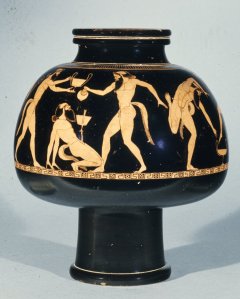
Roodfigurige psykter met uitgelaten saters

Interea pueri florescit pube iuventus
flavaque maturo tumuerunt tempora cornu.
tum primum laetas extendit pampinus uvas:
mirantur Satyri frondes et poma Lyaei.
tum deus ‘o Satyri, maturos carpite fetus’
dixit ‘et ignotos primi calcate racemos.’
vix haec ediderat, decerpunt vitibus uvas
et portant calathis celerique elidere planta
concava saxa super properant: vindemia fervet
collibus in summis, crebro pede rumpitur uva
nudaque purpureo sparguntur pectora musto.
tum Satyri, lasciva cohors, sibi pocula quisque
obvia corripiunt: quae fors dedit, arripit usus.
cantharon hic retinet, cornu bibit alter adunco,
concavat ille manus palmasque in pocula vertit,
pronus at ille lacu bibit et crepitantibus haurit
musta labris; alius vocalia cymbala mergit
atque alius latices pressis resupinus ab uvis
excipit; at potus (saliens liquor ore resultat)
evomit, inque umeros et pectora defluit umor.
(Nemesianus, Ecl. 3.35-54)

Meanwhile the boy’s youth blooms with the coming of manhood, and his yellow temples have swollen with full-grown horns. Then first the tendril outspreads the gladsome grapes. Satyrs are amazed at the leaves and fruitage of the Lyaeus. Then said the god, ‘Pluck the ripe produce, ye Satyrs, be first to tread the bunches whose full power ye know not.’ Scarce had he uttered these words, when they snatched the grapes from the vines, carried them in baskets and hastened to crush them on hollowed stones with nimble foot. On the hill-tops the vintage goes on apace, grapes are burst by frequent tread, and naked breasts are besprinkled with purple must. Then the wanton troop of Satyrs snatched the goblets, each that which comes his way. What chance offers, their need seizes. One keeps hold of a tankard; another drinks from a curved horn; one hollows his hands and makes a cup of his palms; another, stooping forward, drinks of the wine-vat and with smacking lips drains the new wine; another dips therein his sonorous cymbals, and yet another, lying on his back, catches the juice from the squeezed grapes, but when drunk (as the welling liquid leaps back from his mouth) he vomits it out, and the liquor flows over shoulders and breasts. (tr. John Wight Duff & Arnold M. Duff)

Metaphora

3419cf436c2c9d50b27307ec206beab3
Il Postino

Incipiamus igitur ab eo qui cum frequentissimus est tum longe pulcherrimus, translatione dico, quae μεταφορὰ Graece vocatur. quae quidem cum ita est ab ipsa nobis concessa natura ut indocti quoque ac non sentientes ea frequenter utantur, tum ita iucunda atque nitida ut in oratione quamlibet clara proprio tamen lumine eluceat. neque enim vulgaris esse neque humilis nec insuavis apte ac recte modo adscita potest. copiam quoque sermonis auget permutando aut mutuando quae non habet, quodque est difficillimum, praestat ne ulli rei nomen deesse videatur. transfertur ergo nomen aut verbum ex eo loco in quo proprium est in eum in quo aut proprium deest aut tralatum proprio melius est. id facimus aut quia necesse est aut quia significantius est aut, ut dixi, quia decentius. ubi nihil horum praestabit quod transferetur, improprium erit. necessitate rustici gemmam in vitibus (quid enim dicerent aliud?) et sitire segetes et fructus laborare; necessitate nos durum hominem aut asperum: non enim proprium erat quod daremus his affectibus nomen. iam incensum ira et inflammatum cupiditate et lapsum errore significandi gratia; nihil enim horum suis verbis quam his arcessitis magis proprium erit. illa ad ornatum, lumen orationis et generis claritatem et contionum procellas et eloquentiae fulmina, ut Cicero pro Milone Clodium fontem gloriae eius vocat et alio loco segetem ac materiem.
(Quintilian, Inst. Or. 8.6.4-7)

Let us begin, then, with the commonest and by far the most beautiful of tropes, namely, metaphor, the Greek term for our translatio. It is not merely so natural a turn of speech that it is often employed unconsciously or by uneducated persons, but it is in itself so attractive and elegant that however distinguished the language in which it is embedded it shines forth with a light that is all its own. For if it be correctly and appropriately applied, it is quite impossible for its effect to be commonplace, mean or unpleasing. It adds to the copiousness of language by the interchange of words and by borrowing, and finally succeeds in accomplishing the supremely difficult task of providing a name for everything. A noun or a verb is transferred from the place to which it properly belongs to another where there is either no literal term or the transferred is better than the literal. We do this either because it is necessary or to make our meaning clearer or, as I have already said, to produce a decorative effect. When it secures none of these results, our metaphor will be out of place. As an example of a necessary metaphor I may quote the following usages in vogue with peasants when they call a vinebud gemma, a gem (what other term is there which they could use?), or speak of the crops being thirsty or the fruit suffering. For the same reason we speak of a hard or rough man, there being no literal term for these temperaments. On the other hand, when we say that a man is kindled to anger or on fire with greed or that he has fallen into error, we do so to enhance our meaning. For none of these things can be more literally described in its own words than in those which we import from elsewhere. But it is a purely ornamental metaphor when we speak of brilliance of style, splendour of birth, tempestuous public assemblies, thunderbolts of eloquence, to which I may add the phrase employed by Cicero in his defence of Milo where he speaks of Clodius as the fountain, and in another place as the fertile field and material of his client’s glory(tr. Harold Edgeworth Butler)

Flagrantia

unnamed-7
Willem Strijcker, Theseus en Ariadne (1657)

Nam perhibent olim crudeli peste coactam
Androgeoneae poenas exsolvere caedis
electos iuvenes simul et decus innuptarum
Cecropiam solitam esse dapem dare Minotauro.
quis angusta malis cum moenia vexarentur,
ipse suum Theseus pro caris corpus Athenis
proicere optavit potius quam talia Cretam
funera Cecropiae nec funera portarentur.
atque ita nave levi nitens ac lenibus auris
magnanimum ad Minoa venit sedesque superbas.
hunc simul ac cupido conspexit lumine virgo
regia, quam suavis exspirans castus odores
lectulus in molli complexu matris alebat,
quales Eurotae praecingunt flumina myrtus
aurave distinctos educit verna colores,
non prius ex illo flagrantia declinavit
lumina, quam cuncto concepit corpore flammam
funditus atque imis exarsit tota medullis.
heu misere exagitans immiti corde furores
sancte puer, curis hominum qui gaudia misces,
quaeque regis Golgos quaeque Idalium frondosum,
qualibus incensam iactastis mente puellam
fluctibus, in flavo saepe hospite suspirantem!
quantos illa tulit languenti corde timores!
quanto saepe magis fulgore expalluit auri,
cum saevum cupiens contra contendere monstrum
aut mortem appeteret Theseus aut praemia laudis!
(Catullus 64.76-102)

For long ago, the tale goes, in thrall to a pestilential
cruel demand for atonement after Androgeos’ murder,
the city of Cecrops would send the pick of her young men,
the flower of her maidens, as a feast for the Minotaur.
With this evil hanging heavy over her narrow ramparts,
Theseus chose, for the sake of the Athens he loved, to
expose his own body rather than suffer these dead,
these living dead, to be shipped to Crete like cattle.
So trusting to his light vessel and following breezes
he came to haughty Minos and his palatial abode.
Him, the instant that with eyes of desire the royal
virgin spied him, though still confined to a single
sweet-scented bed and her mother’s soft embraces,
like myrtle brought forth by the waters of Eurotas
or the dappled colors that vernal breezes conjure,
she did not lower her smoldering gaze from him till
through the length of her body the flame was kindled
deep at the core, and blazed up in her inmost marrow.
Ah, wretchedly stirring wild passions, ruthless at heart,
Sacred Boy, you who mingle joy with sorrow for mortals,
and you, Lady, ruler of Golgi and leaf-thick Idalium,
on what rough surges you tossed that girl, mind flaring,
as over and over she sighed for the blond stranger:
what looming terrors with heavy heart she suffered,
how often she turned paler than gold’s bright splendor
when Theseus, hot to contend with the savage monster,
courted either death or the rewards of glory!
(tr. Peter Green)

Inviolatam

Nicolas Poussin, La continence de Scipion, 1640
Nicolas Poussin, La continence de Scipion (1640)

Quartum et vicesimum annum agens Scipio, cum in Hispania Carthagine oppressa maioris Carthaginis capiendae sumpsisset auspicia, multosque obsides, quos in ea urbe Poeni clausos habuerant, in suam potestatem redegisset, eximiae inter eos formae virginem aetatis adultae, et iuvenis et caelebs et victor, postquam comperit illustri loco inter Celtiberos natam, nobilissimoque gentis eius Indibili desponsam, arcessitis parentibus et sponso inviolatam tradidit. aurum quoque, quod pro redemptione puellae allatum erat, summae dotis adiecit. qua continentia ac munificentia Indibilis obligatus Celtiberorum animos Romanis applicando meritis eius debitam gratiam rettulit.
(Valerius Maximus, Facta et Dicta Memorabilia 4.3.1)

When Scipio was in his twenty-fourth year he had caputred Carthage in Spain and so taken auspices for the capture of the greater Carthage. He had brought many hostages into his power, whom the Carthaginians had kept shut up in the former city, among them a girl of adult age and exceptional beauty. Learning that she was born in an exalted station among the Celtiberi and betrothed to Indibilis, the noblest of that nation, Scipio, a young man, unmarried, and a victor, summoned her parents and fiancé and handed her over inviolate. He even added the gold which had been brought for the girl’s ransom to the amount of her dowry. Bound by such continence and generosity, Indibilis attached the hearts of the Celtiberi to Rome and so made due repayment to his benefactor. (tr. David Roy Shackleton Bailey)

Emicuit

fire-in-the-sky-5

Livio Druso tr. pl. leges ferente cum bellum Italicum consurgeret, prodigia multa apparuerunt urbi. Sub ortu solis globus ignis a septemtrionali regione cum ingenti sono caeli emicuit. Arretii frangentibus panes cruor e mediis fluxit. in Vestinis per dies septem lapidibus testisque pluit. Aenariae terrae hiatu flamma exorta in caelum emicuit. circa Regium terrae motu pars urbis murique diruta. in Spoletino colore aureo globus ignis ad terram devolutus, maiorque factus e terra ad orientem ferri visus magnitudine solem obtexit. cumis in arce simulacrum Apollinis sudavit. aedis Pietatis in circo Flaminio clausa fulmine icta. Asculo per ludos Romani trucidati. cum ex agris in urbem pecora armentaque Latini agerent, strages hominum passim facta. armenta in tantam rabiem concitata sunt ut vastando suos hostile imaginarentur bellum lacrimantesque canes multis affectibus calamitatem praesagirent suis.
(Julius Obsequens, Liber Prodigiorum 54 (= A.U.C. 663))

When Livius Drusus, tribune of the people, was passing his laws, and the Italian War began, many prodigies appeared in the city. Around sunrise a ball of fire flashed out of the sky with a might sound from the northern regions. At Arretium as they were breaking bread blood flowed from the middle of the loaves. In the territory of the Vestini for seven days it rained stones and potsherds. At Aenaria a flame which came out of a cleft in the earth flashed out to the sky. Around Regium part of the city and the walls were destroyed by an earth tremor. At Spoletum a ball of fire with a golden hue rolled down to earth. It increased in size and after it was seen being carried from the land to the east it covered the sun with its magnitude. At Cumae on the citadel the statue of Apollo perspired. In the Circus Flaminius the temple of Piety which was closed was struck by lightning. At Asculum Romans were killed because of the games. When the Latins drove flocks and herds from the fields into the city, it caused a butchery of men everywhere. The herds were agitated into such a state of madness that by ravaging them they represented the hostile war and tearfully with their many loved ones they foretold the calamitous event to their own people. (translator unidentified)

Recede

seneca1

Quid ista circumspicis quae tibi possunt fortasse evenire sed possunt et non evenire? incendium dico, ruinam, alia quae nobis incidunt, non insidiantur: illa potius vide, illa vita quae nos observant, quae captant. rari sunt casus, etiamsi graves, naufragium facere, vehiculo everti: ab homine homini cotidianum periculum. adversus hoc te expedi, hoc intentis oculis intuere; nullum est malum frequentius, nullum pertinacius, nullum blandius. tempestas minatur antequam surgat, crepant aedificia antequam corruant, praenuntiat fumus incendium: subita est ex homine pernicies, et eo diligentius tegitur quo propius accedit. erras si istorum tibi qui occurrunt vultibus credis: hominum effigies habent, animos ferarum, nisi quod illarum perniciosus est primus incursus: quos transiere non quaerunt. numquam enim illas ad nocendum nisi necessitas incitat; aut fame aut timore coguntur ad pugnam: homini perdere hominem libet. tu tamen ita cogita quod ex homine periculum sit ut cogites quod sit hominis officium; alterum intuere ne laedaris, alterum ne laedas. commodis omnium laeteris, movearis incommodis, et memineris quae praestare debeas, quae cavere. sic vivendo quid consequaris? non te ne noceant, sed ne fallant. quantum potes autem in philosophiam recede: illa te sinu suo proteget, in huius sacrario eris aut tutus aut tutior. non arietant inter se nisi in eadem ambulantes via. ipsam autem philosophiam non debebis iactare; multis fuit periculi causa insolenter tractata et contumaciter: tibi vitia detrahat, non aliis exprobret. non abhorreat a publicis moribus nec hoc agat ut quidquid non facit damnare videatur. licet sapere sine pompa, sine invidia. vale.
(Seneca Minor, Ep. ad Luc. 103)

Why are you keeping a lookout for things that may possibly happen to you, but may very well not happen? I am talking about fires, collapse of buildings, and other things that do come our way but are not intended to do us harm. Keep an eye, rather, on things that do have it in for us and lay traps for us, and avoid those. Although accidents like shipwreck and being thrown from a carriage are serious enough, they are infrequent. It’s the danger that one human can do to another that is a daily occurrence. Equip yourself against this and focus on this. No calamity is more common, none more persistent, none more insidious. Storms threaten before they surge, buildings creak before they collapse, and smoke gives warning of fire; but damage caused by human beings is immediate, and the closer it comes the more carefully it is hidden. It’s a mistake to trust the faces of the people you meet: they have the appearance of human beings but the character of wild animals, except that with animals it is the first attack that is the most dangerous. They don’t pass people by and then turn and pursue them. They are never provoked to do injury except under compulsion, when hunger or fear forces them to fight. One human being, on the other hand, positively likes to destroy another. Still, when you consider what dangers you may be in from other people, you should also be thinking about people’s responsibilities to one another. Keep an eye on one person to avoid being hurt by him, on another to avoid hurting him. You should show pleasure at everyone’s successes, feel for them when their affairs go wrong, remembering when you should be forthcoming and when you should be wary instead. By living like this, what will you gain? You will not necessarily escape harm, but you will avoid being caught unawares. Withdraw into philosophy as much as you can. Philosophy will protect you; you will be safe, or at least safer, in philosophy’s sanctuary. People only knock into one another when they are walking on the same path. But you should not brag about your philosophy. Many people have been put in danger by crassly boasting about it. You should use philosophy to remove your faults, not to criticize other people’s. You should not distance philosophy from the general way of the world, nor let it seem to be condemning everything that it refrains from doing itself. It’s possible to practice wisdom without parade and without incurring resentment. Farewell. (tr. Margaret Graver & Anthony A. Long)

Emungi

photo_006

A naribus absit mucoris purulentia, quod est sordidorum. id quoque vitium Socrati philosopho datum est probro. pileo aut veste emungi, rusticanum; brachio cubitove, salsamentariorum; nec multo civilius id manu fieri, si mox pituitam vesti illinas. strophiolis excipere narium recrementa decorum, idque paulisper averso corpore, si qui adsint honoratiores. si quid in solum deiectum est, emuncto duobus digitis naso, mox pede proterendum est. indecorum est subinde cum sonitu spirare naribus: bilis id indicium est. turpius etiam ducere ronchos, quod est furiosorum, si modo fiat usu. nam spiritosis qui laborant orthopnoea danda est venia. ridiculum, vocem naribus emittere: nam id cornicinum est et elephantorum. crispare nasum irrisorum est et sanniorum. si aliis praesentibus incidat sternutatio, civile est corpus avertere; mox ubi se remiserit impetus, signare os crucis imagine; item sublato pileo resalutatis qui vel salutarunt, vel salutare debuerant (nam sternutatio, quemadmodum oscitatio, sensum aurium prorsus aufert), precari veniam, aut agere gratias. alterum in sternutamento salutare, religiosum: et si plures adsunt natu maiores qui salutant virum aut feminam honorabilem, pueri est aperire caput. porro vocis tinnitum studio intendere, aut data opera sternutamentum iterare, nimirum ad virium ostentationem, nugonum est. reprimere sonitum quem natura fert, ineptorum est, qui plus tribuunt civilitati quam saluti.
(Erasmus, De Civilitate Morum Puerilium 5)

The nostrils should be free from any filthy collection of mucus, as this is disgusting (the philosopher Socrates was reproached for that failing too). It is boorish to wipe one’s nose on one’s cap or clothing; to do so on one’s sleeve or forearm is for fishmongers and it is not much better to wipe it with one’s hand, if you then smear the discharge on your clothing. The polite way is to catch the matter from the nose in a handkerchief, and this should be done by turning away slightly if decent people are present. If, in clearing your nose with two fingers, some matter falls on the ground, it should be immediately ground under foot. It is bad manners to breathe noisily all the time, which is the sign of furious anger. It is even worse to make a habit of snorting like one possessed, although we must make allowance for heavy breathers who are afflicted with asthma. It is ridiculous to trumpet with one’s nose; this is for horn-blowers and elephants. Twitching the nose is for scoffers and buffoons. If you must sneeze while others are present, it is polite to turn away. When the attack has subsided you should cross your face, then, raising your cap and acknowledging the blessings of those who have (or you assume to have) blessed you (for sneezing, like yawning, completely mocks one’s sense of hearing), beg pardon or give thanks. One should be scrupulous in blessing another when he sneezes. If older people are present and bless a high-ranking man or woman, the polite thing for a boy to do is to raise his cap. Again, to imitate or consciously repeat a sneeze—in effect to show off one’s strength—is the sign of a fool. To suppress a sound which is brought on by nature is characteristic of silly people who set more store by ‘good manners’ than good health. (tr. Brian McGregor)