Nemesēton

5021d6ec5a03e_267060b

Τεθνάμεναι γὰρ καλὸν ἐνὶ προμάχοισι πεσόντα
ἄνδρ’ ἀγαθὸν περὶ ᾗ πατρίδι μαρνάμενον,
τὴν δ’ αὐτοῦ προλιπόντα πόλιν καὶ πίονας ἀγροὺς
πτωχεύειν πάντων ἔστ’ ἀνιηρότατον,
πλαζόμενον σὺν μητρὶ φίλῃ καὶ πατρὶ γέροντι
παισί τε σὺν μικροῖς κουριδίῃ τ’ ἀλόχῳ.
ἐχθρὸς μὲν γὰρ τοῖσι μετέσσεται οὕς κεν ἵκηται,
χρησμοσύνῃ τ’ εἴκων καὶ στυγερῇ πενίῃ,
αἰσχύνει τε γένος, κατὰ δ’ ἀγλαὸν εἶδος ἐλέγχει,
πᾶσα δ’ ἀτιμίη καὶ κακότης ἕπεται.
εἰ δ’ οὕτως ἀνδρός τοι ἀλωμένου οὐδεμί’ ὤρη
γίνεται οὔτ’ αἰδὼς οὔτ’ ὀπίσω γένεος,
θυμῷ γῆς πέρι τῆσδε μαχώμεθα καὶ περὶ παίδων
θνήσκωμεν ψυχέων μηκέτι φειδόμενοι.
ὦ νέοι, ἀλλὰ μάχεσθε παρ’ ἀλλήλοισι μένοντες,
μηδὲ φυγῆς αἰσχρῆς ἄρχετε μηδὲ φόβου,
ἀλλὰ μέγαν ποιεῖσθε καὶ ἄλκιμον ἐν φρεσὶ θυμόν,
μηδὲ φιλοψυχεῖτ’ ἀνδράσι μαρνάμενοι·
τοὺς δὲ παλαιοτέρους, ὧν οὐκέτι γούνατ’ ἐλαφρά,
μὴ καταλείποντες φεύγετε, τοὺς γεραιούς.
αἰσχρὸν γὰρ δὴ τοῦτο, μετὰ προμάχοισι πεσόντα
κεῖσθαι πρόσθε νέων ἄνδρα παλαιότερον,
ἤδη λευκὸν ἔχοντα κάρη πολιόν τε γένειον,
θυμὸν ἀποπνείοντ’ ἄλκιμον ἐν κονίῃ,
αἱματόεντ’ αἰδοῖα φίλαις ἐν χερσὶν ἔχοντα—
αἰσχρὰ τά γ’ ὀφθαλμοῖς καὶ νεμεσητὸν ἰδεῖν—
καὶ χρόα γυμνωθέντα· νέοισι δὲ πάντ’ ἐπέοικεν,
ὄφρ’ ἐρατῆς ἥβης ἀγλαὸν ἄνθος ἔχῃ,
ἀνδράσι μὲν θηητὸς ἰδεῖν, ἐρατὸς δὲ γυναιξὶ
ζωὸς ἐών, καλὸς δ’ ἐν προμάχοισι πεσών.
ἀλλά τις εὖ διαβὰς μενέτω ποσὶν ἀμφοτέροισι
στηριχθεὶς ἐπὶ γῆς, χεῖλος ὀδοῦσι δακών.
(Tyrtaeus, fr. 10)

It is a fine thing for a brave man to die when he has fallen among the front ranks while fighting for his homeland, and it is the most painful thing of all to leave one’s city and rich fields for a beggar’s life, wandering about with his dear mother and aged father, with small children and wedded wife. For giving way to need and hateful poverty, he will be treated with hostility by whomever he meets, he brings disgrace on his line, belies his splendid form, and every indignity and evil attend him. If then there is no regard or respect for a man wanders thus, nor yet for his family after him, let us fight with spirit for this land and let us die for our children, no longer sparing our lives. Come, you young men, stand fast at one another’s side and fight, and do not start shameful flight or panic, but make the spirit in your heart strong and valiant, and do not be in love of life when you are fighting men. Do not abandon and run away from elders, whose knees are no longer nimble, men revered. For this brings shame, when an older man lies fallen among the front ranks with the young behind him, his head already white and his beard grey, breathing out his valiant spirit in the dust, clutching in his hands his bloodied genitals—this is a shameful sight and brings indignation to behold—his body naked. But for the young everything is seemly, as long as he has the splendid prime of lovely youth; while alive, men marvel at the sight of him and women feel desire, and when he has fallen among the front ranks, he is fair. Come, let everyone stand fast, with legs set well apart and both feet fixed firmly on the ground, biting his lip with his teeth. (tr. Douglas E. Gerber)

Tyrtaeus

74340_phlx

Interea Messenii, cum virtute non possent, per insidias expugnantur. dein cum per annos octoginta gravia servitutis verbera, plerumque et vincula ceteraque captivitatis mala perpessi essent, post longam poenarum patientiam bellum restaurant. Lacedaemonii quoque eo conspiratius ad arma concurrunt, quod adversus servos dimicaturi videbantur. itaque cum hinc iniuria, inde indignitas animos acueret, Lacedaemonii de belli eventu oraculo Delphis consulto iubentur ducem belli ab Atheniensibus petere. porro Athenienses, cum responsum cognovissent, in contemptum Spartanorum Tyrtaeum, poetam claudum pede, misere, qui tribus proeliis fusos eo usque desperationis Spartanos adduxit, ut servos suos ad supplementum exercitus manumitterent hisque interfectorum matrimonia pollicerentur, ut non numero tantum amissorum civium, sed et dignitati succederent. sed reges Lacedaemoniorum, ne contra fortunam pugnando maiora detrimenta civitati infligerent, reducere exercitum voluerunt ni intervenisset Tyrtaeus, qui composita carmina exercitui pro contione recitavit, in quibus hortamenta virtutis, damnorum solacia, belli consilia conscripserat. itaque tantum ardorem militibus iniecit, ut non de salute, sed de sepultura solliciti tesseras insculptis suis et patrum nominibus dextro bracchio deligarent, ut, si omnes adversum proelium consumpsisset et temporis spatio confusa corporum liniamenta essent, ex indicio titulorum tradi sepulturae possent. cum sic animatum reges exercitum viderent, curant rem hostibus nuntiare; Messeniis autem non timorem res, sed aemulationem mutuam dedit. itaque tantis animis concursum est, ut raro umquam cruentius proelium fuerit. ad postremum tamen victoria Lacedaemoniorum fuit.
(Justinus, Epitome Pompeii Trogi 3.5)

Meantime the Messenians, who could not be conquered by valour, were reduced by stratagem. For eighty years they bore the severe afflictions of slaves, as frequent stripes, and chains, and other evils of subjugation; and then, after so long an endurance of suffering, they proceeded to resume hostilities. The Lacedaemonians, at the same time, ran to arms with the greater ardour and unanimity, because they seemed to be called upon to fight against their own slaves. While ill-treatment, therefore, on the one side, and indignation on the other, exasperated their feelings, the Lacedaemonians consulted the oracle at Delphi concerning the event of the war, and were directed to ask the Athenians for a leader to conduct it. The Athenians, learning the answer of the oracle, sent, to express their contempt of the Spartans a lame poet, named Tyrtaeus; who, being routed in three battles, reduced the Lacedaemonians to so desperate a condition, that, to recruit their army, they liberated a portion of their slaves, promising that they should marry the widows of those who were slain, and thus fill up, not merely the number of the lost citizens, but their offices. The kings of Sparta, however, lest, by contending against fortune, they should bring greater losses on their city, would have drawn off their army, had not Tyrtaeus interposed, and recited to the soldiers, in a public assembly, some verses of his own composition, in which he had comprised exhortations to courage, consolations for their losses, and counsels concerning the war. By this means he inspired the soldiers with such resolution, that, being no longer concerned for their lives, but merely for the rites of burial, they tied on their right arms tickets, inscribed with their names and those of their fathers, that if an unsuccessful battle should cut them off, and their features after a time become indistinct, they might be consigned to burial according to the indication of the inscriptions. When the kings saw the army thus animated, they took care that the state of it should be made known to the enemy; the report, however, raised in the Messenians no alarm, but a correspondent ardour. Both sides accordingly encountered with such fury, that there scarcely ever was a more bloody battle. But at last victory fell to the Lacedaemonians. (tr. John Selby Watson)

Takomai

pederastic_scene

Χρῆν μὲν κατὰ καιρὸν ἐρώ-
των δρέπεσθαι, θυμέ, σὺν ἁλικίᾳ·
τὰς δὲ Θεοξένου ἀκτῖνας πρὸς ὄσσων
μαρμαρυζοίσας δρακείς
ὃς μὴ πόθῳ κυμαίνεται, ἐξ ἀδάμαντος
ἢ σιδάρου κεχάλκευται μέλαιναν καρδίαν

ψυχρᾷ φλογί, πρὸς δ’ Ἀφροδί-
τας ἀτιμασθεὶς ἑλικογλεφάρου
ἢ περὶ χρήμασι μοχθίζει βιαίως
ἢ γυναικείῳ θράσει
†ψυχρὰν† φορεῖται πᾶσαν ὁδὸν θεραπεύων.
ἀλλ’ ἐγὼ τᾶς ἕκατι κηρὸς ὣς δαχθεὶς ἕλᾳ

ἱρᾶν μελισσᾶν τάκομαι, εὖτ’ ἂν ἴδω
παίδων νεόγυιον ἐς ἥβαν·
ἐν δ’ ἄρα καὶ Τενέδῳ
Πειθώ τ’ ἔναιεν καὶ Χάρις
υἱὸν Ἁγησίλα.
(Pindar, fr. 123)

One should pluck the fruits of love at the right time, my heart, in youth. But whoever has seen the rays flashing from Theoxenus’ eyes and is not overwhelmed by desire has a black heart forged from adamant or steel with a cold flame, dishonoured by bright-eyed Aphrodite, or struggles compulsively for wealth, or through a woman’s daring is borne along serving a totally cold path (?). As for me, because of her [sc. Aphrodite] I melt like the sun-bitten wax of holy bees, whenever I look upon the young-limbed youth of boys. Truly even in Tenedos Persuasion and Grace inhabit the son of Hagesilas. (tr. Richard Rawles)

Seraphim

Saint_Francis_of_Assisi_Receiving_the_Stigmata_(Turin)_Seraph-Christ

Faciente ipso moram in eremitorio, quod a loco in quo positum est Alverna nominatur, duobus annis antequam animam redderet caelo, vidit in visione Dei virum unum, quasi Seraphim sex alas habentem, stantem supra se, manibus extensis ac pedibus coniunctis, cruci affixum. duae alae supra caput elevabantur, duae ad volandum extendebantur, duae denique totum velabant corpus. cumque ista videret beatus servus Altissimi, admiratione permaxima replebatur, sed quid sibi vellet haec visio advertere nesciebat. gaudebat quoque plurimum et vehementius laetabatur in benigno et gratioso respectu, quo a Seraphim conspici se videbat, cuius pulchritudo inaestimabilis erat nimis, sed omnino ipsum crucis affixio et passionis illius acerbitas deterrebat. sicque surrexit, ut ita dicatur, tristis et laetus, et gaudium atque maeror suas in ipso alternabant vices. cogitabat sollicitus, quid posset haec visio designare, et ad capiendum ex ea intelligentiae sensum anxiabatur plurimum spiritus eius. cumque liquido ex ea intellectu aliquid non perciperet et multum eius cordi visionis huius novitas insideret, coeperunt in manibus eius et pedibus apparere signa clavorum, quemadmodum paulo ante virum supra se viderat crucifixum. manus et pedes eius in ipso medio clavis confixae videbantur, clavorum capitibus in interiore parte manuum et superiore pedum apparentibus, et eorum acuminibus exsistentibus ex adverso. erant enim signa illa rotunda interius in manibus, exterius autem oblonga, et caruncula quaedam apparebat quasi summitas clavorum retorta et repercussa, quae carnem reliquam excedebat. sic et in pedibus impressa erant signa clavorum et a carne reliqua elevata. dextrum quoque latus quasi lancea transfixum, cicatrice obducta, erat, quod saepe sanguinem emittebat, ita ut tunica eius cum femoralibus multoties respergeretur sanguine sacro.
(Thomas of Celano, Vita Prima S. Francisci 94.1-95.4)

While he dwelt in the hermitage which, from the place in which it is situate, is called Alverna, two years before he gave back his soul to Heaven, he saw in a vision of God a man like a seraph having six wings, standing over him with hands outstretched and feet joined together, fixed to a cross. Two wings were raised above his head, two were spread out for flight, and two veiled the whole body. Now, when the blessed servant of the Most High saw this, he was filled with exceeding great wonder, but he could not understand what this vision might mean. Yet he rejoiced greatly and was filled with vehement delight at the benign and gracious look wherewith he saw that he was regarded by the seraph, whose beauty far exceeded all estimation ; but the crucifixion, and the bitterness of the seraph’s suffering smote him altogether with fear. Thus he arose, so to speak, sorrowful and glad; and joy and grief alternated in him. He anxiously pondered what this vision might portend, and his spirit laboured sore to come at the understanding of it. And while he continued without any clear perception of its meaning, and the strangeness of the vision was perplexing his heart, marks of nails began to appear in his hands and feet, such as he had seen a little while before in the Man crucified who had stood over him. His hands and feet seemed pierced in the midst by nails, the heads of the nails appearing in the inner part of the hands and in the upper part of the feet, and their points over against them. Now those marks were round in the inner side of the hands and elongated on the outer side, and certain small pieces of flesh were seen like the ends of nails bent and driven back, projecting from the rest of the flesh. So also the marks of nails were imprinted in his feet, and raised above the rest of the flesh. Moreover his right side, as it had been pierced by a lance, was overlaid with a scar, and often shed forth blood, so that his tunic and drawers were many times sprinkled with the sacred blood. (tr. Alan George Ferrers Howell)

Excrucior

Xu6YmHUCcDVl

Odi et amo. quare id faciam, fortasse requiris?
nescio, sed fieri sentio et excrucior.
(Catullus 85)

I hate and love. You wonder, perhaps, why I’d do that?
I have no idea. I just feel it. I am crucified.
(tr. Peter Green)

Purior

OLYMPUS DIGITAL CAMERA

Purior hic campis aër Phoebusque sereno
lumine purpureum reserat iam sudus Olympum;
nec iam consertis per mutua vincula ramis
quaeritur exclusum viridi caligine caelum;
sed liquidum iubar et rutilam visentibus aethram
libera perspicui non invidet aura diei.
in speciem tum me patriae cultumque nitentis
Burdigalae blando pepulerunt omnia visu:
culmina villarum pendentibus edita ripis
Et virides Baccho colles et amoena fluenta
subter labentis tacito rumore Mosellae.
(Ausonius, Mosella 12-22)

In these plains the air is purer, and Phoebus, now cloudless, opens glittering Olympus with his untroubled light. The heavens are no longer shut out by a green gloom and to be sought in the tangle of intertwining branches; and the free air of bright day does not begrudge to the beholder a clear radiance and a dazzling sky. Everything moved me in this charming scene by its resemblance to the splendour of shining Burdigala (Bordeaux), my native land: the tops of the villas standing out above the overhanging banks, the hills green with vines, and the pleasant waters of the Mosella flowing beneath with a muted murmur. (tr. Frank Stewart Flint)

Kuniskos

untitled.bmp

Ἦν τίς ποθ’ ἡμῖν ἐν πόλει θηλυδρίας,
Αἰγύπτιον φάντασμα, λυσσῶδες κακόν,
κύων, κυνίσκος, ἀμφόδων ὑπηρέτης,
ἄρις, ἄφωνον πῆμα, κητῶδες τέρας,
ξανθὸς μελάνθριξ, οὖλος ἁπλοῦς τὴν τρίχα—
τὰ μὲν παλαιά, τὰ δ’ ἀρτίως εὑρημένα·
τέχνη γάρ ἐστι δημιουργὸς δευτέρα.
πλεῖστον γυναικῶν ἔργον, εἴτ’ οὖν ἀρρένων,
χρυσοῦν, ἑλίσσειν τὴν φιλόσοφον σισόην.
τὰ τῶν γυναικῶν ἐν προσώποις φάρμακα
σοφοὶ φερόντων· εἰς τί γὰρ μόναι σοφαί
τὴν ἀπρεπῆ τε καὶ κακὴν εὐμορφίαν,
ἣ πρόγραμμ’ ἐστὶ καὶ σιωπῶν τοῦ τρόπου,
ὡς οὐκ ἐχόντων Μαξίμους καὶ ἀρρένων;
ἡ κουρὰ τοῦτ’ ἔδειξε λανθάνον τέως.
τοιαῦτα θαύμαθ’ ἡμὶν ἐκ τῶν νῦν σοφῶν,
διπλοῦν τιν’ εἶναι τὴν φύσιν τὸ σχῆμά τε
ἀμφοῖν μερίζειν τοῖν γενοῖν τρισαθλίως,
κόμην γυναιξίν, ἀνδράσιν βακτηρίαν.
ἐξ ὧν ἐκόμπαζ’ ὥς τι τῇ πόλει δοκῶν,
ὤμους σκιάζων βοστρύχοις ἀεὶ φίλοις,
πέμπων λογισμοὺς σφενδονωμέναις κόμαις,
πᾶσαν φέρων παίδευσιν ἐν τῷ σώματι.
(Gregory of Nazianzus, Poëm. 2.1.11.750-772)

There was amongst us in the city at that time an effeminate creature,
a phantom from Egypt, a pestilential fanatic,
a dog*, a puppy, a street-walker,
a disaster with no sense of smell, no bark, a great hulking monster,
a raven-haired blond, his hair both straight and curled,
(the one his original state, the other recently acquired,
for art is a second creator).
To dye the philosopher’s curls gold and curl them
is usually women’s work, but now it became men’s.
Let these wise men wear women’s cosmetics
on their faces, for why should wise women alone
possess this unseemly and foul beauty
(which offers a silent indication of their character),
as if men did not have their Maximuses too?
This was revealed by his curls, hitherto concealed.
Such are the wonders we owe to our present-day sages—
that a person is ambiguous as to nature and shape,
having thrice-wretchedly a share of both sexes,
in hairstyle like women but like men in carrying a staff**.
He liked to show these things off, as if he were of some importance in the city,
with his darling curls falling over his shoulders,
shooting forth his clever ideas with swinging locks
and wearing all his learning on his body.

* This term of abuse is also a reference to Maximus’ Cynic beliefs, for the term Cynic was derived from this adjective meaning ‘dog-like’. In the following passage Gregory plays constantly with this double meaning.
** This was one of the marks of a Cynic.

(tr. Carolinne White)

Discrimina

800px-Bébé_Ex-voto_gallo-romain_Musée_Saint-Remi_120208

This is part 3 of 3. Part 1 is here. Part 2 is here.

Omnibus his illud gravius, si forte carentem
caelesti lavacro tenerum mors invida natum
praeripiat dura generatum sorte gehennae.
quique, genitricis cessat cum filius esse,
perditionis erit; tristes tunc edita nolint,
quae flammis tantum genuerunt, membra parentes.
quis memorare queat tanti discrimina casus,
in quae pertrahitur dilectae gloria carnis?
at late longeque tuam discernere sortem
libertas cum lege potest, qua necteris, ut te
impia fallentis non stringant vincula mundi.
tu Mariam sequeris, dono cui contigit alto
virginis et matris gemina gaudere corona,
conciperet cum carne Deum, caelique creator
intraret clausum reserans mysteria ventrem.
(Avitus of Vienne, De Virginitate 190-204)

Much more serious than all these things is if envious death by chance
Snatches the young child away prematurely, before it has been washed
In the heavenly waters, born only for the harsh fate of hell.
Such a child, when he ceases to be the son of his mother
Will be the son of perdition; then the grieving parents regret
Giving birth to this body which they brought forth only for the flames.
Who could recount the risks of such a terrible event,
Dangers to which pride in the beloved body is exposed?
But under the law by which you are now bound
Your extensive freedom can offer you a different fate
So that the wicked chains of this treacherous world do not bind you.
You are following in Mary’s footsteps to whom the Almighty granted
That she should rejoice in the double crown of virgin and mother
When she conceived God in the flesh, and the Creator of heaven
Entered the womb through closed doors, unlocking the mysteries.
(tr. Carolinne White)

Distenditur

130262

This is part 2 of 3. Part 1 is here. Part 3 is here.

At cum longa decem tulerint fastidia menses,
perfectoque gravis fetu distenditur alvus,
semina quae patris fuerant, haec pondera matri
infligunt duros utero turgente dolores.
nam cum luctato solvuntur viscera partu,
una luit, tanto carnis discrimine pendens,
quod coiere duo. spes palpat forte dolentem,
editus in lucem si vivat filius; atqui
contingit plerumque, gemens ut mortua fundat.
saepe etiam soboli nec mortis tempore natae
dant geminum matris commortua membra sepulcrum.
illud iam levius quotiens intervenit, ipsa
ut pereat tum sola parens, ac pondere fuso
emittat cum prole animam? quid forte levatum
nutritumque diu rapitur si funere pignus,
unica quod crebro spes respicit, et perit omne
quod sibi conceptis spondebant gaudia votis?
(Avitus of Vienne, De Virginitate 173-189)

When ten months have brought continuous sickness
And her stomach is heavy, swollen with the fully-formed foetus,
The seeds which came from the father become a burden to the mother
Inflicting unbearable pains as the uterus swells.
For when, in the struggle of giving birth, the womb contracts,
The woman alone pays the price, with such great physical danger,
For what the two of them created together; perhaps hope alleviates the pain,
If the son that is born lives; and yet it very often happens
That with her groans she brings forth a dead child.
Often the mother also dies at the same time, providing a double tomb
For the child that was not even born at the time of its death.
How often does this slightly less terrible event occur,
That the mother alone dies in childbirth? As she brings forth her burden
When the child leaves her, so does her soul. What if the child
Raised and fed for a long time is snatched away by death,
The child viewed as the sole hope, and she loses everything
That her joy promised, all that she was looking forward to?
(tr. Carolinne White)

Coniugis

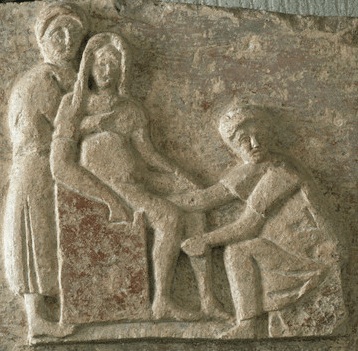
giving-birth-e1400311426947

This is part 1 of 3. Part 2 is here. Part 3 is here.

Non orbata gemes fecundae pignora vitae,
nec viduam sponso metues superesse perenni,
expers ipsa mali; nec te sententia tanget
qua prolis mortisque parens percellitur Eva,
occisam pariens subolem vivente reatu.
quae subiecta viro dominum passura cubilis,
Servit in obsceno tolerans conubia lecto.
sic captiva tori, cum portet nomen inane
coniugis et vana dicatur imagine consors,
sola iugo premitur non aequam ducere sortem.
(Avitus of Vienne, De Virginitate 163-172)

You will not grieve for the loss of your children, the proofs of your fruitfulness,
Nor will you fear to survive as a widow the husband you thought would live for ever:
You will be free from misfortune and will not be affected by the sentence
Imposed on Eve, the mother of offspring and of death,
Who brought forth a child that was killed*, while the punishment lived on.
A woman subject to her husband has to bear him as master of their marriage:
Enduring wedlock she is just a slave in a disgusting bed;
She is but a captive of the bed, bearing the empty name of wife,
And called her husband’s consort in a hollow charade,
Oppressed by the yoke, forced to bear an unequal burden on her own.

* Avitus is referring to Eve’s son Abel: Genesis 4:8.

(tr. Carolinne White, with her note)