
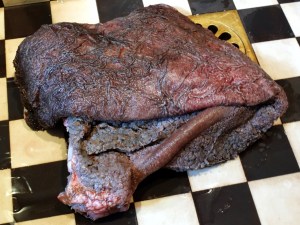
Porcaria

dscf4453

Vulva eiecto partu melior quam edito; eiecticia vocatur illa, haec porcaria. primiparae suis optima, contra effetis. a partu, praeterquam eodem die suis occisae, livida ac macra; nec novellarum suum praeter primiparas probatur, potiusque veterum, dum ne effetarum, nec biduo ante partum aut post partum aut quo eiecerint die. proxima ab eiecticia est occisae uno die post partum; huius et sumen optimum, si modo fetus non hauserit; eiecticiae deterrimum.
(Pliny the Elder, Nat. Hist. 11.210-211)

Sow’s paunch is a better dish after a miscarriage than after a succesful delivery; in the former case it is called ‘miscarryings’ and in the latter ‘farrowings.’ That of a sow farrowing for the first time is best, and the contrary with those exhausted with breeding. After farrowing the paunch is a bad colour and lacking in fat, unless the sow was killed the same day; nor is that of young sows thought much of, except from those farrowing for the first time, and the paunch of old sows is preferable provided they are not quite worn out, and not killed on the actual day of farrowing or the day before or the day after. The paunch next best to miscarryings is that of a sow slaughtered the day after farrowing; also its paps are the best, provided it has not yet suckled the litter; the paps of a sow that has had a miscarriage are the worst. (tr. Harris Rackham)

Iubatorum

71

Leonum simul plurium pugnam Romae princeps dedit Q. Scaevola P. f. in curuli aedilitate, centum autem iubatorum primus omnium L. Sulla, qui postea dictator fuit, in praetura; post eum Pompeius Magnus in circo DC, in iis iubatorum CCCXV, Caesar dictator CCCC. capere eos ardui erat quondam operis, foveisque maxime. principatu Claudii casus rationem docuit pudendam paene talis ferae nomine pastorem Gaetuliae, sago contra ingruentis impetum obiecto, quod spectaculum in harenam protinus translatum est, vix credibili modo torpescente tanta illa feritate quamvis levi iniectu operto capite, ita ut devinciatur non repugnans. videlicet omnis vis constat in oculis, quo minus mirum fit a Lysimacho Alexandri iussu simul incluso strangulatum leonem.
(Pliny the Elder, Nat. Hist. 8.53-54)

A fight with several lions at once was first bestowed on Rome by Quintus Scaevola, son of Publius, when consular aedile, but the first of all who exhibited a combat of 100 maned lions was Lucius Sulla, later dictator, in his praetorship. After Sulla Pompey the Great showed in the Circus 600, including 315 with manes, and Caesar when dictator 400. Capturing lions was once a difficult task, chiefly effected by means of pitfalls. In the principate of Claudius accident taught a Gaetulian shepherd a method that was almost one to be ashamed of in the case of a wild animal of this nature: when it charged he flung a cloak against its onset – a feat that was immediately transferred to the arena as a show, – the creature’s great ferocity abating in an almost incredible manner when its head is covered with even a light wrap, with the result that it is vanquished without showing fight. The fact is that all its strength is concentrated in its eyes, which makes it less remarkable that when Lysimachus by order of Alexander was shut up in a lion’s cage he succeeded in strangling it. (tr. Harris Rackham)

Cacumini

Luxor07(js)
Obelisk of Ramesses II in Luxor. (Not the one mentioned in the text.)

Opus id fecisse dicuntur CXX hominum. ipse rex, cum surrecturus esset verereturque, ne machinae ponderi non sufficerent, quo maius periculum curae artificum denuntiaret, filium suum adalligavit cacumini, ut salus eius apud molientes prodesset et lapidi. hac admiratione operis effectum est, ut, cum oppidum id expugnaret Cambyses rex ventumque esset incendiis ad crepidines obelisci, extingui iuberet molis reverentia qui nullam habuerat urbis.
(Pliny the Elder, Nat. Hist. 36.66)

It is said that one hundred and twenty thousand men were employed upon this work;* and that the king, when it was on the point of being elevated, being apprehensive that the machinery employed might not prove strong enough for the weight, with the view of increasing the peril that might be entailed by due want of precaution on the part of the workmen, had his own son fastened to the summit; in order that the safety of the prince might at the same time ensure the safety of the mass of stone. It was in his admiration of this work, that, when King Cambyses took the city by storm, and the conflagration had already reached the very foot of the obelisk, he ordered the fire to be extinguished; he entertaining a respect for this stupendous erection which he had not entertained for the city itself.

* This, Hardouin says, was the same obelisk that was afterwards erected by Constantius, son of Constantine the Great, in the Circus Maximus at Rome; whence it was removed by Pope Sextus V., in the year 1588, to the Basilica of the Lateran.

(tr. John Bostock & H.T. Riley, with their note)