
Scurra

Nec semel inrisus triviis

And he who has once been fooled (tr. Henry Rushton Fairclough)

Hoc exemplo significat numquam postea crediturum quem esse etiam vera dicenti ei, qui falsis rebus omnia fidei argumenta consumpserit. hinc etiam proverbium natum est “qui semel scurra, numquam pater familias.”
(Porphyrius, Comm. in Hor. Epist. 1.17.58)

By this example [Horace] shows that one will never be believed in the future, even if he is telling the truth, if he has wasted his credibility in telling lies. Hence the proverb has arisen: “Once a scurra*, never a pater familias.”

* A scurra is a fashionable city idler, a man-about-town.

(tr. Christopher Francese, with his note)
Iterabimus

Teucer Salamina patremque
cum fugeret, tamen uda Lyaeo
tempora populea fertur vinxisse corona,
sic tristis adfatus amicos:
“quo nos cumque feret melior fortuna parente,
ibimus, o socii comitesque.
nil desperandum Teucro duce et auspice Teucro.
certus enim promisit Apollo
ambiguam tellure nova Salamina futuram.
o fortes peioraque passi
mecum saepe viri, nunc vino pellite curas;
cras ingens iterabimus aequor.”
(Horace, Carm. 1.7.21-32)

Teucer, even when he had to flee into exile from Salamis and his father, is said to have put a garland of white poplar round his head (which was well moistened by the Loosener*) and to have spoken thus to his dejected friends: “Fortune is kinder than my father. Wherever she takes us, my comrades and companions, there will we go. As long as Teucer is your leader and Teucer watches over you, there is no need for despair. Apollo is never wrong, and he has promised there will be another Salamis (the same but different) in a new land. My brave fellows! You have often suffered worse things at my side. Banish your worries now with wine. Tomorrow we shall set out once more over the boundless sea.”

* Bacchus, who brings release from care.

(tr. Niall Rudd, with his note)

Mendax

Desiderantem quod satis est neque
tumultuosum sollicitat mare
nec saevus Arcturi cadentis
impetus aut orientis Haedi,

non verberatae grandine vineae
fundusque mendax, arbore nunc aquas
culpante, nunc torrentia agros
sidera, nunc hiemes iniquas.

(Horace, Carm. 3.1.25-32)

The one who desires what is enough is not worried by a stormy sea or by the fierce onslaught of Arcturus as he sets, or the Kid as he rises; not by hail lashing his vineyards or by a farm that has broken its promise. (The orchard blames now the torrential rain, now the dog star for scorching the fields, now the winter’s harshness.) (tr. Niall Rudd)

Grassare

Tips for aspiring fortune-hunters:

Obsequio grassare; mone, si increbruit aura,
cautus uti velet carum caput; extrahe turba
oppositis umeris; aurem substringe loquaci.
importunus amat laudari: donec ‘ohe iam!’
ad caelum manibus sublatis dixerit, urge,
crescentem tumidis infla sermonibus utrem.
(Horace, Serm. 2.5.93-98)

With flattery make your advances; warn him, if the breeze stiffens, carefully to cover up his precious pate; shoulder a way and draw him out of a crowd; make a trumpet of your ear when he is chattering. Does he bore you with his love of praise? Then ply him with it till with hands uplifted to heaven he cry “enough!” and blow up the swelling bladder with turgid phrases. (tr. Henry Rushton Fairclough)

Repetita

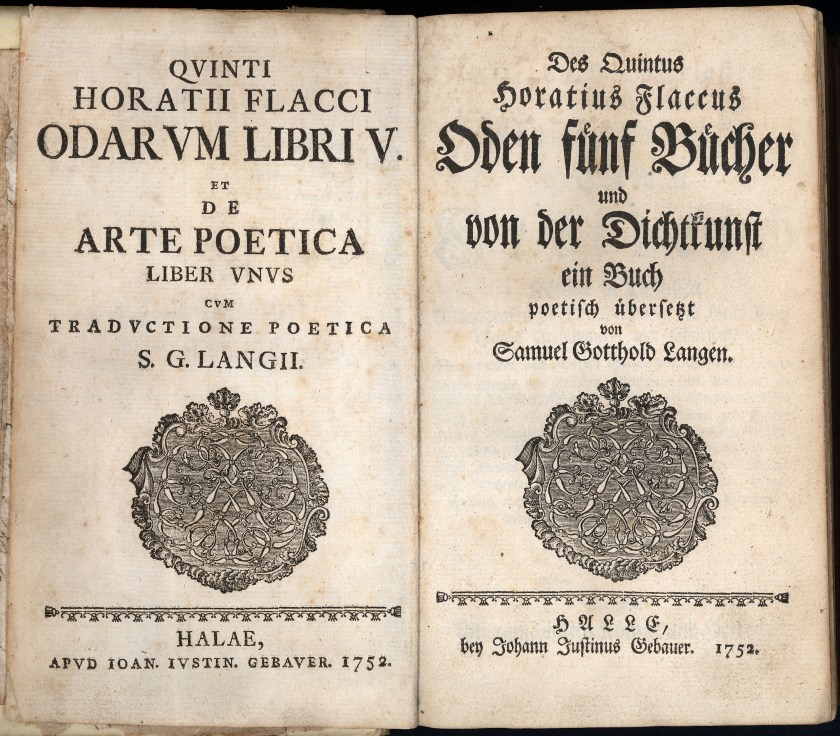
Samuel_Gotthold_Lange,_Horaz_(1752),_ii-iii

Vt pictura poesis: erit quae, si propius stes,
te capiat magis, et quaedam, si longius abstes.
haec amat obscurum, volet haec sub luce videri,
iudicis argutum quae non formidat acumen;
haec placuit semel, haec deciens repetita placebit.
(Horace, Ep. 2.3.361-5)

A poem is like a picture: one strikes your fancy more, the nearer you stand; another, the farther away. This courts the shade, that will wish to be seen in the light, and dreads not the critic insight of the judge. This pleased but once; that, though ten times called for, will always please. (tr. H. Rushton Fairclough)