Iniquitas

piggybank-spaarvarken-op-een-berg-geld_1

“Simul imprudens et insipiens peribunt.” quis est “imprudens”? qui non sibi prospicit in futurum. quis est “insipiens”? qui non intellegit in quo malo sit. tu vero intellege in quo malo sis modo, et prospice ut in bonis sis in posterum. intellegendo in quo malo sis, non eris insipiens: prospiciendo tibi in futurum, non eris imprudens. quis est qui sibi prospicit? servus ille cui dedit Dominus suus quod erogaret, et postea dixit ei: “non potes mihi agere, redde rationem actus tui.” et ille: “quid facio? fodere non possum, mendicare confundor.” sed et de re domini sui fecit sibi amicos, qui illum reciperent, cum de actu proiceretur. et ille fraudem fecit domino suo, ut compararet sibi amicos qui illum susciperent: tu noli timere ne fraudem facias; ipse Dominus hortatur ut facias, ipse tibi dicit: “fac tibi amicos de mammona iniquitatis”. fortassis ea quae acquisisti, de iniquitate acquisisti; aut fortasse ea ipsa est iniquitas, quia tu habes et alter non habet, tu abundas et alter eget. de ista mammona iniquitatis, de divitiis istis quas iniqui vocant divitias, fac tibi amicos et prudens eris: comparas tibi, non fraudaris. modo enim videris perdere. numquid perdes in thesaurario ponens? nam pueri, fratres, unde sibi emant nescio quid simul inveniunt nummos, et ponunt in thesaurario, et non aperiunt nisi postea: numquid quia non vident quod colligunt, ideo perdiderunt? noli timere: ponunt pueri in thesaurario, et securi sunt; ponis tu in manu Christi, et times! esto prudens, et prospice tibi in posterum in coelo. esto ergo prudens, imitare formicam, sicut dicit Scriptura; “reconde aestate, ne esurias in hieme”: hiems est dies novissimus, dies tribulationis; hiems est dies scandalorum et amaritudinis: collige quod ibi tibi sit in posterum; si autem non facis, simul imprudens et insipiens peribis.
(Augustine, Enarr. in Ps. 48 1.12)

“The imprudent and unwise shall perish together.” Who is “the imprudent”? He that looketh not out for himself for the future. Who is “the unwise”? He that perceiveth not in what evil case he is. But do thou perceive in what evil case thou art now, and look out that thou be in a good case for the future. By perceiving in what evil case thou art, thou wilt not be unwise: by looking out for thyself for the future, thou wilt not be imprudent. Who is he that looketh out for himself? That servant to whom his master gave what he should expend, and afterwards said to him, “Thou canst not be my steward, give an account of thy stewardship;” and who answered, “What shall I do? I cannot dig, to beg I am ashamed;” [Luke 16.1, 2] had, nevertheless, by even his master’s goods made to himself friends, who might receive him when he was put out of his stewardship. Now he cheated his master in order that he might get to himself friends to receive him: fear not thou lest thou be cheating, the Lord Himself exhorteth thee to do so: He saith Himself to thee, “Make to thyself friends of the mammon of unrighteousness” [Luke 16.9]. Perhaps what thou hast got, thou hast gotten of unrighteousness: or perhaps this very thing is unrighteousness, that thou hast and another hath not, thou aboundest and another needeth. Of this mammon of unrighteousness, of these riches which the unrighteous call riches, make to thyself friends, and thou shalt be prudent: thou art gaining for thyself, and art not cheating. For now thou seemest to lose it. Wilt thou lose it if thou place it in a treasury? For boys, my brethren, no sooner find some money, wherewith to buy something, than they put it in a money-box, which they open not until afterwards: do they, because they see not what they have got, on that account lose it? Fear not: boys put in a money-box, and are secure: dost thou place it in the hand of Christ, and fear? Be prudent, and provide for thyself against the future in Heaven. Be therefore prudent, copy the ant, as saith the Scripture [cf. Prov. 6.6; 30.25]: “Store in summer, lest thou hunger in winter;” the winter is the last day, the day of tribulation; the winter is the day of offences and of bitterness: gather what may be there for thee for the future: but if thou doest not so, thou wilt perish both imprudent and unwise. (tr. Arthur Cleveland Coxe)
Viriliter

ren_donatello_david
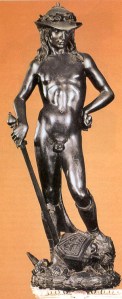
Donatello’s David

Vasti membris animisque Gethei
corpore non animo parvus de sanguine mixto
Iesseius torta lapidem in cava tempora funda
misit; qui lapsus tremefacto pectore lata
ilice glandifera texit productior arva.
cum caderet, tellus tremuit magnamque ruinam
corporis inmensi moles dedit, ut diuturno
dilabens aevo, quae caelum vertice pulsat,
impete praecipitis Circi petit infima turris.
accurrit victor strictoque viriliter ense
amputat obnixe lentissima colla precantis.
nec mirum dextra tantum cecidisse gigantem
Iesseii; qui cum puer esset, tristibus ursis
intulit atque lupis mortem domuitque leones.
(Eupolemius 2.395-408)

Jesse’s son, small in body but not in spirit, of mixed ancestry, whirled a sling and shot a stone against the hollow temples of the Gittite, Goliath, who was awesome in both limbs and courage. After Goliath’s heart was made to tremble with fear and he fell, he stretched out, longer than an acorn-producing holm oak, and covered broad fields. When he fell, the earth trembled and the mass of his huge body caused great ruin, just as a tower, which strikes the heavens with its peak but which is collapsing from extreme age, topples down to the lowest point from the onset of a rushing northwest wind. The victor ran up and, with sword manfully drawn, resolutely severs Goliath’s very tough neck as he pleads for mercy. No wonder that so great a giant fell by the right hand of Jesse’s son; when David was a boy, he inflicted death upon grim bears and wolves, and he subdued lions. (tr. Jan M. Ziolkowski)

Monstra

a372f863bb6702157ebeac3f64d4234a

Hic quoque monstra domat, rutili quibus arce cerebri
ad frontem coma tracta iacet nudataque cervix
saetarum per damna nitet, tum lumine glauco
albet aquosa acies ac vultibus undique rasis
pro barba tenues perarantur pectine cristae.
strictius assutae vestes procera cohercent
membra virum, patet his altato tegmine poples,
latus et angustam suspendit balteus alvum.
excusisse citas vastum per inane bipennes
et plagae praescisse locum clipeosque rotare
ludus et intortas praecedere saltibus hastas
inque hostem venisse prius; puerilibus annis
est belli maturus amor.
(Sidonius Apollinaris, Panegyricus Maiorani 238-250)

…for this youth* likewise subdues monsters, on the crown of whose red pates lies the hair that has been drawn towards the front, while the neck, exposed by the loss of its covering, shows bright. Their eyes are faint and pale, with a glimmer of greyish blue. Their faces are shaven all round, and instead of beards they have thin moustaches which they run through with a comb. Close-fitting garments confine the tall limbs of the men; they are drawn up high so as to expose the knees, and a broad belt supports their narrow middle. It is their sport to send axes hurtling through the vast void and know beforehand where the blow will fall, to whirl their shields, to outstrip with leaps and bounds the spears they have hurled and reach the enemy first. Even in boyhood’s years the love of fighting is full-grown.

* Emperor Maiorianus

(tr. William Blair Anderson)

Pothos

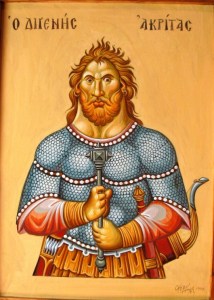
Digenis Akritas

Καὶ εὐθὺς περὶ ἔρωτος ὑμᾶς ἀναμιμνῄσκω·
ῥίζα γὰρ οὗτος καὶ ἀρχὴ καθέστηκεν ἀγάπης,
ἐξ ἧς φιλία τίκτεται, εἶτα γεννᾶται πόθος,
ὃς αὐξηθεὶς κατὰ μικρὸν φέρει καρπὸν τοιοῦτον,
μερίμνας μὲν διηνεκεῖς, ἐννοίας καὶ φροντίδας,
εὐθὺς κινδύνους παμπληθεῖς καὶ χωρισμὸν γονέων.
νεότης γὰρ ἀκμάζουσα καρδίας ἀνασπάει,
εἶτα πάντα κατατολμᾷ τῶν ἀνεπιχειρήτων,
θαλάττης μὲν ἐφίκεσθαι, πῦρ μηδόλως πτοεῖσθαι·
δράκοντας δὲ καὶ λέοντας καὶ τὰ λοιπὰ θηρία
οὐδοτιοῦν λογίζεται στερεωθεὶς ὁ πόθος
καὶ τοὺς λῃστὰς τοὺς τολμηροὺς ἀντ’ οὐδενὸς ἡγεῖται,
νύκτας ἡμέρας προσδοκᾷ καὶ τὰς κλεισούρας κάμπους,
ἀγρυπνίαν ἀνάπαυσιν καὶ τὰ μακρὰν πλησίον·
πολλοὶ καὶ πίστιν τὴν αὐτῶν ἀρνοῦνται διὰ πόθον.
καὶ τοῦτο μηδεὶς ἄπιστον ἐξ ὑμῶν λογισθήτω,
μάρτυρα γὰρ ἐπαινετὸν εἰς μέσον παραστήσω
ἀμιρᾶν τὸν πανεύγενον καὶ πρῶτον τῆς Συρίας,
ὃς εἶχε κάλλη πάντερπνα καὶ τόλμην θηριώδη
καὶ μέγεθος πανθαύμαστον, ἰσχὺν γενναιοτάτην,
καὶ μᾶλλον δεύτερος Σαμψὼν αὐτὸς ἐπενοήθη·
ἐκεῖνος γὰρ ἠρίστευσε χερσὶ λέοντα σχίσας,
οὗτος δὲ πλῆθος ἄπειρον ἀπέκτεινε λεόντων.
παύσασθε γράφειν Ὅμηρον καὶ μύθους Ἀχιλλέως
ὡσαύτως καὶ τοῦ Ἕκτορος, ἅπερ εἰσὶ ψευδέα.
(Digenes Akrites (Grottaferrata version) 4.4-28)

And immediately I remind you about passion,
for this is established as the root and beginning of love,
from which affection is begotten, then desire is born,
which as it increases gradually bears such fruit
as constant anxieties, worries and concerns,
and immediately brings abundant dangers and separation from parents.
For youth in its prime breaks hearts,
then dares every deed that has never been ventured,
to reach the sea and have no fear at all of fire;
ogres and lions and other wild beasts
desire, once established, considers as trifles,
and it regards bold brigands as worth nothing;
it reckons night as day and mountain passes as plains,
sleeplessness as rest and what is far off as near.
And many renounce their faith because of desire.
And let none of you consider this incredible,
for I shall set before you a renowned witness,
the most high-born emir and first man of Syria,
who possessed the most handsome grace and savage daring,
and quite amazing stature, most noble strength,
and indeed was thought to be a second Samson.
For Samson achieved distinction by rending a lion with his bare hands,
but the emir killed a boundless host of lions.
Cease writing of Homer and the legends of Achilles
and likewise of Hektor: these are false.
(tr. Elizabeth Jeffreys)

Hortos

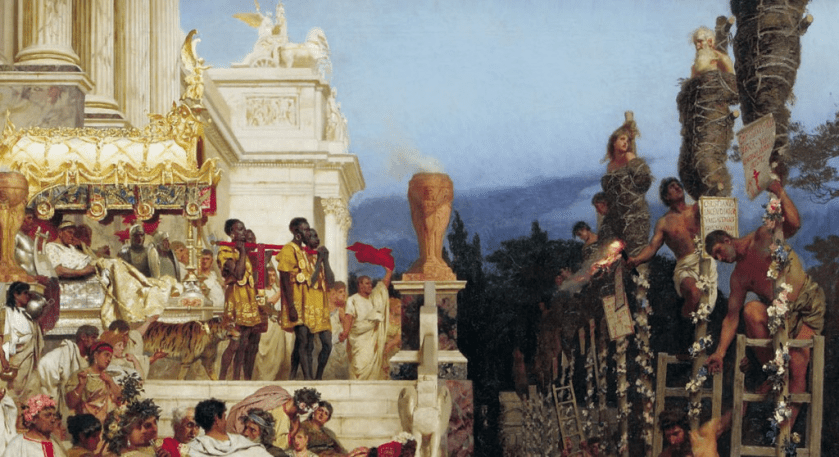
Nero's Torches - Henryk Siemiradzki
Henryk Siemiradzki – Nero’s Torches

Sed non ope humana, non largitionibus principis aut deum placamentis decedebat infamia, quin iussum incendium crederetur. ergo abolendo rumori Nero subdidit reos et quaesitissimis poenis adfecit, quos per flagitia invisos vulgus Chrestianos appellabat. auctor nominis eius Christus Tibero imperitante per procuratorem Pontium Pilatum supplicio adfectus erat; repressaque in praesens exitiabilis superstitio rursum erumpebat, non modo per Iudaeam, originem eius mali, sed per urbem etiam, quo cuncta undique atrocia aut pudenda confluunt celebranturque. igitur primum correpti qui fatebantur, deinde indicio eorum multitudo ingens haud proinde in crimine incendii quam odio humani generis convicti sunt. et pereuntibus addita ludibria, ut ferarum tergis contecti laniatu canum interirent †aut crucibus adfixi aut flammandi† atque, ubi defecisset dies, in usum nocturni luminis urerentur. hortos suos ei spectaculo Nero obtulerat, et circense ludicrum edebat, habitu aurigae permixtus plebi vel curriculo insistens. unde quamquam adversus sontes et novissima exempla meritos miseratio oriebatur, tamquam non utilitate publica, sed in saevitiam unius absumerentur.
(Tacitus, Ann. 15.44.2-5)

But neither human resourcefulness nor the emperor’s largesse nor appeasement of the gods could stop belief in the nasty rumour that an order had been given for the fire. To dispel the gossip Nero therefore found culprits on whom he inflicted the most exotic punishments. These were people hated for their shameful offences whom the common people called Christians. The man who gave them their name, Christus, had been executed during the rule of Tiberius by the procurator Pontius Pilatus. The pernicious superstition had been temporarily suppressed, but it was starting to break out again, not just in Judaea, the starting point of that curse, but in Rome, as well, where all that is abominable and shameful in the world flows together and gains popularity. And so, at first, those who confessed were apprehended, and subsequently, on the disclosures they made, a huge number were found guilty—more because of their hatred of mankind than because they were arsonists. As they died they were further subjected to insult. Covered with hides of wild beasts, they perished by being torn to pieces by dogs; or they would be fastened to crosses and, when daylight had gone, burned to provide lighting at night. Nero had offered his gardens as a venue for the show, and he would also put on circus entertainments, mixing with the plebs in his charioteer’s outfit or standing up in his chariot. As a result, guilty though these people were and deserving exemplary punishment, pity for them began to well up because it was felt that they were being exterminated not for the public good, but to gratify one man’s cruelty. (tr. John C. Yardley)

Stravere

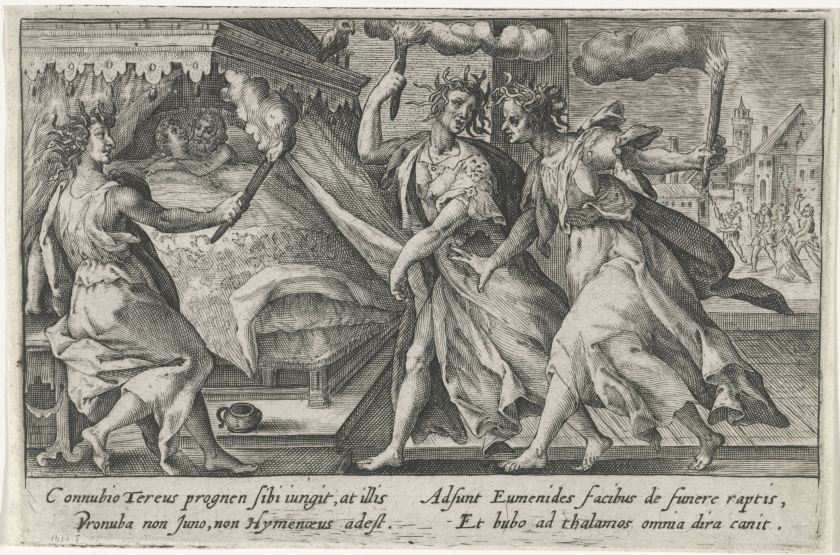
Furiën bij huwelijksnacht Tereus en Procne
Crispijn van de Passe, De Furiën bezoeken Theseus en Procne tijdens hun huwelijksnacht

Non pronuba Iuno,
non Hymenaeus adest, non illi Gratia lecto:
Eumenides tenuere faces de funere raptas,
Eumenides stravere torum, tectoque profanus
incubuit bubo thalamique in culmine sedit.
hac ave coniuncti Procne Tereusque, parentes
hac ave sunt facti; gratata est scilicet illis
Thracia, disque ipsi grates egere; diemque,
quaque data est claro Pandione nata tyranno
quaque erat ortus Itys, festum iussere vocari:
usque adeo latet utilitas.
(Ovid, Met. 6.428-438)

But neither Juno, who presides
at weddings, nor the wedding god himself,
Hymenaeus, nor the required Graces
attended theirs. Instead, the Furies shook
the torches they had snatched from funerals,
and turned down the coverlet upon their bed;
and all night long, an evil owl perched
and brooded on the roof of their bedchamber.
Under these omens, Tereus and Procne
are wed; and under them, their child is born;
and naturally all of Thrace is one
in its felicitations to the parents,
who offer up their own thanks to the gods.
That day is now proclaimed a festival
on which the king of Athens gave his daughter
to the distinguished ruler, and the day
as well on which Itys, their son, was born.
What does us good is to a great extent
concealed from us.
(tr. Charles Martin)

Chelidōn

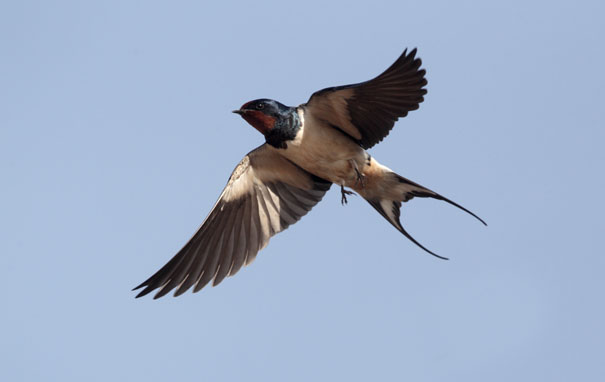
swallow6

Εἰ δὴ οὕτως, ἀνθρώπου δὲ τίθεμεν ἔργον ζωήν τινα, ταύτην δὲ ψυχῆς ἐνέργειαν καὶ πράξεις μετὰ λόγου, σπουδαίου δ’ ἀνδρὸς εὖ ταῦτα καὶ καλῶς, ἕκαστον δ’ εὖ κατὰ τὴν οἰκείαν ἀρετὴν ἀποτελεῖται· εἰ δὴ οὕτω, τὸ ἀνθρώπινον ἀγαθὸν ψυχῆς ἐνέργεια γίνεται κατ’ ἀρετήν, εἰ δὲ πλείους αἱ ἀρεταί, κατὰ τὴν ἀρίστην καὶ τελειοτάτην. ἔτι δ’ ἐν βίῳ τελείῳ· μία γὰρ χελιδὼν ἔαρ οὐ ποιεῖ, οὐδὲ μία ἡμέρα· οὕτω δὲ οὐδὲ μακάριον καὶ εὐδαίμονα μία ἡμέρα οὐδ ὀλίγος χρόνος.
(Aristotle, Eth. Nic. 1.7.14-161098a12-20)

If this is so, and if we declare that the function of man is a certain form of life, and define that form of life as the exercise of the soul’s faculties and activities in association with rational principle, and say that the function of a good man is to perform these activities well and rightly, and if a function is well performed when it is performed in accordance with its own proper excellence—from these premises it follows that the Good of man is the active exercise of his soul’s faculties in conformity with excellence or virtue, or if there be several human excellences or virtues, in conformity with the best and most perfect among them. Moreover, to be happy takes a complete lifetime; for one swallow does not make spring, nor does one fine day; and similarly one day or a brief period of happiness does not make a man supremely blessed and happy. (tr. Harris Rackham)

Straphōsin

Michelangelo,_profeti,_Isaiah_01

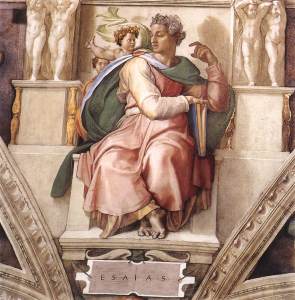
Ταῦτα ἐλάλησεν Ἰησοῦς, καὶ ἀπελθὼν ἐκρύβη ἀπ’ αὐτῶν. τοσαῦτα δὲ αὐτοῦ σημεῖα πεποιηκότος ἔμπροσθεν αὐτῶν οὐκ ἐπίστευον εἰς αὐτόν, ἵνα ὁ λόγος Ἠσαΐου τοῦ προφήτου πληρωθῇ ὃν εἶπεν· “Κύριε, τίς ἐπίστευσεν τῇ ἀκοῇ ἡμῶν; καὶ ὁ βραχίων κυρίου τίνι ἀπεκαλύφθη;” διὰ τοῦτο οὐκ ἠδύναντο πιστεύειν ὅτι πάλιν εἶπεν Ἠσαΐας· “Τετύφλωκεν αὐτῶν τοὺς ὀφθαλμοὺς καὶ ἐπώρωσεν αὐτῶν τὴν καρδίαν, ἵνα μὴ ἴδωσιν τοῖς ὀφθαλμοῖς καὶ νοήσωσιν τῇ καρδίᾳ καὶ στραφῶσιν, καὶ ἰάσομαι αὐτούς.” ταῦτα εἶπεν Ἠσαΐας ὅτι εἶδεν τὴν δόξαν αὐτοῦ, καὶ ἐλάλησεν περὶ αὐτοῦ. ὅμως μέντοι καὶ ἐκ τῶν ἀρχόντων πολλοὶ ἐπίστευσαν εἰς αὐτόν, ἀλλὰ διὰ τοὺς Φαρισαίους οὐχ ὡμολόγουν ἵνα μὴ ἀποσυνάγωγοι γένωνται, ἠγάπησαν γὰρ τὴν δόξαν τῶν ἀνθρώπων μᾶλλον ἤπερ τὴν δόξαν τοῦ θεοῦ.
(John 12:36-43)

These things spake Jesus, and departed, and did hide himself from them. But though he had done so many miracles before them, yet they believed not on him: “That the saying of Esaias the prophet might be fulfilled, which he spake, Lord, who hath believed our report? and to whom hath the arm of the Lord been revealed?” Therefore they could not believe, because that Esaias said again, “He hath blinded their eyes, and hardened their heart; that they should not see with their eyes, nor understand with their heart, and be converted, and I should heal them.” These things said Esaias, when he saw his glory, and spake of him. Nevertheless among the chief rulers also many believed on him; but because of the Pharisees they did not confess him, lest they should be put out of the synagogue: For they loved the praise of men more than the praise of God. (King James Version)

Apodusōmetha

st-nilus

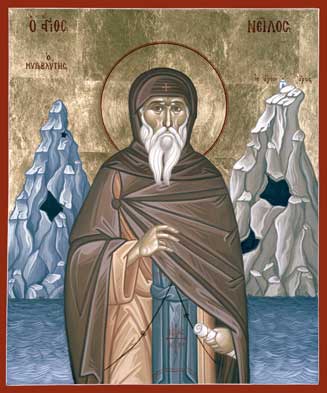
Ἀποδυσώμεθα, παρακαλῶ, πάντα· γυμνὸς γὰρ ἕστηκεν ὁ ἀντίπαλος· μὴ γὰρ οἱ ἀθλοῦντες ἐνδεδυμένοι ἀθλοῦσι; γυμνοὺς αὐτοὺς εἰς τὸ στάδιον ὁ ἀθλητικὸς εἰσάγει νόμος· κἂν θάλπος, ἢ κἂν κρυμός, οὕτως εἰσέρχονται τὰς ἐσθῆτας ἔξω καταλιμπάνοντες· εἰδέ τις αὐτῶν παραιτήσεται τὴν γύμνωσιν, καὶ τὸν ἀγῶνα παρῃτήσατο· ἡμεῖς δὲ ἀθλεῖν ἐπαγγελλόμενοι, καὶ πρὸς ἀντιπάλους πολὺ τῶν αἰσθητῶν ἐντρεχεστέρους ἀγωνιζόμενοι, οὐ μόνον οὐκ ἀπεδυσάμεθα, ἀλλὰ καὶ μυρία κατὰ τῶν ὤμων φορτία φέροντες ἐπιχειροῦμεν ἀθλεῖν, πολλὰς τοῖς ἀντιπάλοις καθ’ ἑαυτῶν παρέχοντες τὰς λαβάς. πῶς γὰρ πυκτεύσει πρὸς “τὰ πνευματικὰ τῆς πονηρίας”, ὁ κτημάτων ἀντιποιούμενος πάντοθεν εὐχερῶς κονδυλιζόμενος; πῶς δὲ τῷ τῆς φιλαργυρίας παλαίσει πνεύματι, ὁ περικεχωσμένος τοῖς χρήμασι; πῶς δὲ δραμεῖται πρὸς τοὺς πάσης μερίμνης γυμνοὺς δαίμονας ὁ μυρίαις φροντίσιν ἐνδεδυμένος; τῆς θείας λεγούσης Γραφῆς, “ὁ γυμνὸς διώξεται ἐν ἐκείνῃ τῇ ἡμέρᾳ”· ὁ γυμνος, οὐχ ὁ κτημάτων καὶ χρημάτων πολυΰλοις πρὸς τὸν δρόμον ἐμποδιζόμενος λογισμοῖς· δυσάλωτος γάρ, ἢ καὶ ἀνάλωτος, τοῖς ἐπιβουλεύουσιν ἐστὶν ὁ γυμνός.
(Nilus the Elder, Logos Asketikos p. 135 (Philokalia ed. 1893))

Let us strip ourselves of everything, since our adversary stands before us stripped. Do athletes compete with their clothes on ? No, the rules require them to enter the stadium naked. Whether it is warm or cold, that is how they enter, leaving their clothes outside; and if anyone refuses to strip, he excludes himself from the contest. Now we too claim to be athletes, and we are struggling against opponents far more skilful than any that are visible. Yet, instead of stripping ourselves, we try to engage in the contest while carrying countless burdens on our shoulders, thus giving our opponents many chances of getting a grip on us. How can someone encumbered with material possessions contend against ‘spiritual wickedness’ (Eph. 6 : 12), since he is vulnerable from every angle? How can someone weighed down with wealth wrestle with the demon of avarice? How can someone clothed in worldly preoccupations race against demons stripped of every care? Holy Scripture says, ‘The naked shall run swiftly in that day’ (Amos 2 : 16. LXX) – the naked, not the one who is hindered in running by thoughts about money and material possessions. A naked person is hard or even impossible to catch.
(tr. G.E.H. Palmer, Philip Sherrard and Kallistos Ware)

Tharsei

Ἐπιρρητέον δὲ καὶ τῷ τοῦ Αἰσχύλου
θάρσει· πόνου γὰρ ἄκρον οὐκ ἔχει χρόνον [fr. 352]
ὅτι τοῦτ’ ἐστὶ τὸ παρ’ Ἐπικούρου θρυλούμενον ἀεὶ καὶ θαυμαζόμενον, ὡς “οἱ μεγάλοι πόνοι συντόμως ἐξάγουσιν, οἱ δὲ χρόνιοι μέγεθος οὐκ ἔχουσιν.” ὧν τὸ μὲν εἴρηκεν ὁ Αἰσχύλος ἐναργῶς, τὸ δὲ τῷ εἰρημένῳ παρακείμενόν ἐστιν· εἰ γὰρ ὁ μέγας καὶ σύντονος οὐ παραμένει πόνος, οὐκ ἔστι μέγας ὁ παραμένων οὐδὲ δυσκαρτέρητος.
(Plutarch, Pōs dei ton neon poiēmatōn akouein 36B)

And on the words of Aeschylus,
Fear not; great stress of pain is not for long,
we ought to remark that this is the oft repeated and much admired statement originating with Epicurus, namely “that great pains have no magnitude.” Of these two ideas Aeschylus has perspicuously stated the one and the other is a corollary thereto; for if great and intense pain is not lasting, then that which does not last is not great or hard to endure. (tr. Frank Cole Babbitt)