Purior

OLYMPUS DIGITAL CAMERA

Purior hic campis aër Phoebusque sereno
lumine purpureum reserat iam sudus Olympum;
nec iam consertis per mutua vincula ramis
quaeritur exclusum viridi caligine caelum;
sed liquidum iubar et rutilam visentibus aethram
libera perspicui non invidet aura diei.
in speciem tum me patriae cultumque nitentis
Burdigalae blando pepulerunt omnia visu:
culmina villarum pendentibus edita ripis
Et virides Baccho colles et amoena fluenta
subter labentis tacito rumore Mosellae.
(Ausonius, Mosella 12-22)

In these plains the air is purer, and Phoebus, now cloudless, opens glittering Olympus with his untroubled light. The heavens are no longer shut out by a green gloom and to be sought in the tangle of intertwining branches; and the free air of bright day does not begrudge to the beholder a clear radiance and a dazzling sky. Everything moved me in this charming scene by its resemblance to the splendour of shining Burdigala (Bordeaux), my native land: the tops of the villas standing out above the overhanging banks, the hills green with vines, and the pleasant waters of the Mosella flowing beneath with a muted murmur. (tr. Frank Stewart Flint)

Kuniskos

untitled.bmp

Ἦν τίς ποθ’ ἡμῖν ἐν πόλει θηλυδρίας,
Αἰγύπτιον φάντασμα, λυσσῶδες κακόν,
κύων, κυνίσκος, ἀμφόδων ὑπηρέτης,
ἄρις, ἄφωνον πῆμα, κητῶδες τέρας,
ξανθὸς μελάνθριξ, οὖλος ἁπλοῦς τὴν τρίχα—
τὰ μὲν παλαιά, τὰ δ’ ἀρτίως εὑρημένα·
τέχνη γάρ ἐστι δημιουργὸς δευτέρα.
πλεῖστον γυναικῶν ἔργον, εἴτ’ οὖν ἀρρένων,
χρυσοῦν, ἑλίσσειν τὴν φιλόσοφον σισόην.
τὰ τῶν γυναικῶν ἐν προσώποις φάρμακα
σοφοὶ φερόντων· εἰς τί γὰρ μόναι σοφαί
τὴν ἀπρεπῆ τε καὶ κακὴν εὐμορφίαν,
ἣ πρόγραμμ’ ἐστὶ καὶ σιωπῶν τοῦ τρόπου,
ὡς οὐκ ἐχόντων Μαξίμους καὶ ἀρρένων;
ἡ κουρὰ τοῦτ’ ἔδειξε λανθάνον τέως.
τοιαῦτα θαύμαθ’ ἡμὶν ἐκ τῶν νῦν σοφῶν,
διπλοῦν τιν’ εἶναι τὴν φύσιν τὸ σχῆμά τε
ἀμφοῖν μερίζειν τοῖν γενοῖν τρισαθλίως,
κόμην γυναιξίν, ἀνδράσιν βακτηρίαν.
ἐξ ὧν ἐκόμπαζ’ ὥς τι τῇ πόλει δοκῶν,
ὤμους σκιάζων βοστρύχοις ἀεὶ φίλοις,
πέμπων λογισμοὺς σφενδονωμέναις κόμαις,
πᾶσαν φέρων παίδευσιν ἐν τῷ σώματι.
(Gregory of Nazianzus, Poëm. 2.1.11.750-772)

There was amongst us in the city at that time an effeminate creature,
a phantom from Egypt, a pestilential fanatic,
a dog*, a puppy, a street-walker,
a disaster with no sense of smell, no bark, a great hulking monster,
a raven-haired blond, his hair both straight and curled,
(the one his original state, the other recently acquired,
for art is a second creator).
To dye the philosopher’s curls gold and curl them
is usually women’s work, but now it became men’s.
Let these wise men wear women’s cosmetics
on their faces, for why should wise women alone
possess this unseemly and foul beauty
(which offers a silent indication of their character),
as if men did not have their Maximuses too?
This was revealed by his curls, hitherto concealed.
Such are the wonders we owe to our present-day sages—
that a person is ambiguous as to nature and shape,
having thrice-wretchedly a share of both sexes,
in hairstyle like women but like men in carrying a staff**.
He liked to show these things off, as if he were of some importance in the city,
with his darling curls falling over his shoulders,
shooting forth his clever ideas with swinging locks
and wearing all his learning on his body.

* This term of abuse is also a reference to Maximus’ Cynic beliefs, for the term Cynic was derived from this adjective meaning ‘dog-like’. In the following passage Gregory plays constantly with this double meaning.
** This was one of the marks of a Cynic.

(tr. Carolinne White)

Discrimina

800px-Bébé_Ex-voto_gallo-romain_Musée_Saint-Remi_120208

This is part 3 of 3. Part 1 is here. Part 2 is here.

Omnibus his illud gravius, si forte carentem
caelesti lavacro tenerum mors invida natum
praeripiat dura generatum sorte gehennae.
quique, genitricis cessat cum filius esse,
perditionis erit; tristes tunc edita nolint,
quae flammis tantum genuerunt, membra parentes.
quis memorare queat tanti discrimina casus,
in quae pertrahitur dilectae gloria carnis?
at late longeque tuam discernere sortem
libertas cum lege potest, qua necteris, ut te
impia fallentis non stringant vincula mundi.
tu Mariam sequeris, dono cui contigit alto
virginis et matris gemina gaudere corona,
conciperet cum carne Deum, caelique creator
intraret clausum reserans mysteria ventrem.
(Avitus of Vienne, De Virginitate 190-204)

Much more serious than all these things is if envious death by chance
Snatches the young child away prematurely, before it has been washed
In the heavenly waters, born only for the harsh fate of hell.
Such a child, when he ceases to be the son of his mother
Will be the son of perdition; then the grieving parents regret
Giving birth to this body which they brought forth only for the flames.
Who could recount the risks of such a terrible event,
Dangers to which pride in the beloved body is exposed?
But under the law by which you are now bound
Your extensive freedom can offer you a different fate
So that the wicked chains of this treacherous world do not bind you.
You are following in Mary’s footsteps to whom the Almighty granted
That she should rejoice in the double crown of virgin and mother
When she conceived God in the flesh, and the Creator of heaven
Entered the womb through closed doors, unlocking the mysteries.
(tr. Carolinne White)

Distenditur

130262

This is part 2 of 3. Part 1 is here. Part 3 is here.

At cum longa decem tulerint fastidia menses,
perfectoque gravis fetu distenditur alvus,
semina quae patris fuerant, haec pondera matri
infligunt duros utero turgente dolores.
nam cum luctato solvuntur viscera partu,
una luit, tanto carnis discrimine pendens,
quod coiere duo. spes palpat forte dolentem,
editus in lucem si vivat filius; atqui
contingit plerumque, gemens ut mortua fundat.
saepe etiam soboli nec mortis tempore natae
dant geminum matris commortua membra sepulcrum.
illud iam levius quotiens intervenit, ipsa
ut pereat tum sola parens, ac pondere fuso
emittat cum prole animam? quid forte levatum
nutritumque diu rapitur si funere pignus,
unica quod crebro spes respicit, et perit omne
quod sibi conceptis spondebant gaudia votis?
(Avitus of Vienne, De Virginitate 173-189)

When ten months have brought continuous sickness
And her stomach is heavy, swollen with the fully-formed foetus,
The seeds which came from the father become a burden to the mother
Inflicting unbearable pains as the uterus swells.
For when, in the struggle of giving birth, the womb contracts,
The woman alone pays the price, with such great physical danger,
For what the two of them created together; perhaps hope alleviates the pain,
If the son that is born lives; and yet it very often happens
That with her groans she brings forth a dead child.
Often the mother also dies at the same time, providing a double tomb
For the child that was not even born at the time of its death.
How often does this slightly less terrible event occur,
That the mother alone dies in childbirth? As she brings forth her burden
When the child leaves her, so does her soul. What if the child
Raised and fed for a long time is snatched away by death,
The child viewed as the sole hope, and she loses everything
That her joy promised, all that she was looking forward to?
(tr. Carolinne White)

Coniugis

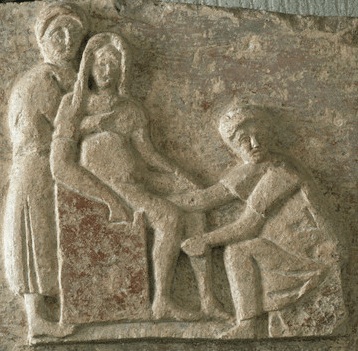
giving-birth-e1400311426947

This is part 1 of 3. Part 2 is here. Part 3 is here.

Non orbata gemes fecundae pignora vitae,
nec viduam sponso metues superesse perenni,
expers ipsa mali; nec te sententia tanget
qua prolis mortisque parens percellitur Eva,
occisam pariens subolem vivente reatu.
quae subiecta viro dominum passura cubilis,
Servit in obsceno tolerans conubia lecto.
sic captiva tori, cum portet nomen inane
coniugis et vana dicatur imagine consors,
sola iugo premitur non aequam ducere sortem.
(Avitus of Vienne, De Virginitate 163-172)

You will not grieve for the loss of your children, the proofs of your fruitfulness,
Nor will you fear to survive as a widow the husband you thought would live for ever:
You will be free from misfortune and will not be affected by the sentence
Imposed on Eve, the mother of offspring and of death,
Who brought forth a child that was killed*, while the punishment lived on.
A woman subject to her husband has to bear him as master of their marriage:
Enduring wedlock she is just a slave in a disgusting bed;
She is but a captive of the bed, bearing the empty name of wife,
And called her husband’s consort in a hollow charade,
Oppressed by the yoke, forced to bear an unequal burden on her own.

* Avitus is referring to Eve’s son Abel: Genesis 4:8.

(tr. Carolinne White, with her note)

Teleutēsantas

Gela_Painter_-_Black-Figure_Pinax_(Plaque)_-_Walters_48225

Ἀνδρὶ δὴ τὸ μετὰ τοῦτο γεννηθέντι καὶ ἐκτραφέντι, καὶ γεννήσαντι καὶ ἐκθρέψαντι τέκνα καὶ ξυμμίξαντι ξυμβόλαια μετρίως, διδόντι τε δίκας εἴ τινα ἠδικήκει καὶ παρ’ ἑτέρου ἐκλαβόντι, σὺν τοῖς νόμοις ἐν μοίρᾳ γηράσαντι τελευτὴ γίγνοιτ’ ἂν κατὰ φύσιν. περὶ τελευτήσαντας δή, εἴτε τις ἄρρην εἴτε τις θῆλυς ᾖ, τὰ μὲν περὶ τὰ θεῖα νόμιμα τῶν τε ὑπὸ γῆς θεῶν καὶ τῶν τῇδε, ὅσα προσήκει τελεῖσθαι, τοὺς ἐξηγητὰς γίγνεσθαι κυρίους φράζειν· τὰς θήκας δ’ εἶναι τῶν χωρίων ὁπόσα μὲν ἐργάσιμα μηδαμοῦ, μήτε τι μέγα μήτε τι σμικρὸν μνῆμα, ἃ δὲ ἡ χώρα πρὸς τοῦτ’ αὐτὸ μόνον φύσιν ἔχει, τὰ τῶν τετελευτηκότων σώματα μάλιστα ἀλυπήτως τοῖς ζῶσι δεχομένη κρύπτειν, ταῦτα ἐκπληροῦν· τοῖς δὲ ἀνθρώποις ὅσα τροφὴν μήτηρ οὖσα ἡ γῆ πρὸς ταῦτα πέφυκε βούλεσθαι φέρειν, μήτε ζῶν μήτε τις ἀποθανὼν στερείτω τὸν ζῶνθ’ ἡμῶν. χῶμα δὲ μὴ χοῦν ὑψηλότερον πέντε ἀνδρῶν ἔργον, ἐν πένθ’ ἡμέραις ἀποτελούμενον· λίθινα δὲ ἐπιστήματα μὴ μείζω ποιεῖν ἢ ὅσα δέχεσθαι τῶν τοῦ τετελευτηκότος ἐγκώμια βίου, μὴ πλείω τεττάρων ἡρωϊκῶν στίχων. τὰς δὲ προθέσεις πρῶτον μὲν μὴ μακρότερον χρόνον ἔνδον γίγνεσθαι τοῦ δηλοῦντος τόν τε ἐκτεθνεῶτα καὶ τὸν ὄντως τεθνηκότα, εἴη δ’ ἂν σχεδόν ὡς τἀνθρώπινα μέτρον ἔχουσα τριταία πρὸς τὸ μνῆμα ἐκφορά.
(Plato, Nomoi 12.958c-959a)

After this, for a man who has been born and brought up, and has begotten and brought up children, and has mingled in business transactions with due measure – paying judicial penalties if he has done someone an injustice and receiving the same from another – for a man who has aged according to destiny in the company of the laws, the end would come, according to nature. Now as regards those who have died, whether it be a male or a female, the legal customs concerning the divine things that belong to the gods beneath the earth and here – concerning whatever rites are appropriately celebrated – are to be authoritatively explained by the Interpreters. Graves, however, are not to be located on any land that is cultivable, whether the monument be great or small, but only where the nature of the land is suitable for this alone: to receive and hide, in a way that is the most painless to the living, the bodies of those who have died – these are the areas that should be filled. But with respect to those areas which Mother Earth by nature intends to produce food for human beings, no one either living or dead is to deprive those among us who are living of them. And they shall not heap up a mound higher than wat can be completed by the work of five men in five days; nor shall they make stone markers larger than are required to contain at most four heroic lines of encomia on the life of the deceased. As for the laying out, first, it is not to be for a longer time than that which shows whether a man has fallen into a death-like swoon or has really died, and in dealing with human beings, the third day would be just about a well-measured time to carry the body out to the monument. (tr. Thomas L. Pangle)

Paralytice

mosai051-large

Pervigil excubiis commissi Petrus ovilis
postquam cuncta videns lustravit in ordine sanctos,
per Lyddae tulit arva gradus, ubi moenibus adstans
respicit Aeneam defunctis vivere membris,
atque anima, nodis laxata mole solutis,
non moriente mori. “surgens, paralytice,” dixit,
“vectorem compone tuum, nec reddere tardes
officium, portate diu.” quo munere vocis
stringitur in solidum qui fluxerat antea nervis.
tunc iterum formatus homo, longique cadaver
temporis exstinctos ad vitam surrigit artus,
seque levans vacui linquit monumenta cubilis,
quod misero pars mortis erat. plebs cuncta per illam
coepit stare viam, multisque supervenit ampla
unius languore salus tactoque liquore
expulit inclusi sua mox contagia morbi
fonte lavans animas alieno robore firmas.
(Arator, De Actibus Apostolorum 1.754-770)

When Peter, ever watchful on guard over his entrusted flock and seeing all, had illumined all the saints one after another, he advanced through the fields of Lydda, where, standing near the walls, he realized that Aeneas, though his limbs were defunct, was alive and that, though his soul was not dying, he was dying, his weight enfeebled by his slackened joints. ‘Get up, paralytic!’ he said. ‘Make your bed and do not be slow in rendering your duty: you have been carried long enough.’ When he had received the gift of these words, with all his strength he drew together into something solid what had previously fallen away. Then, once more made man, he who had been a corpse for such a long time raises his dried up limbs to life, and lifting himself up leaves the tomb of his empty bed, which had been an aspect of death for the wretched man. All the people began to stand along that street and from the weakness of one man there came to many an abundant salvation, which at the touch of the water soon cast out the pollution of their internal sickness and washing their souls in the spring rendered them powerful with another man’s strength. (tr. Richard Hillier)

Mendicatio

f9d433e12610ea179dd38f165acb39d6

Ideo propera, Lucili mi, vivere, et singulos dies singulas vitas puta. Qui hoc modo se aptavit, cui vita sua cotidie fuit tota, securus est; in spem viventibus proximum quodque tempus elabitur, subitque aviditas et miserrimus ac miserrima omnia efficiens metus mortis. inde illud Maecenatis turpissimum votum, quo et debilitatem non recusat et deformitatem et novissime acutam crucem, dummodo inter haec mala spiritus prorogetur:
debilem facito manu, debilem pede coxo,
tuber adstrue gibberum, lubricos quate dentes:
vita dum superest, benest. hanc mihi, vel acuta
si sedeam cruce, sustine… [Maecenas fr. 4 Courtney]
quod miserrimum erat si incidisset optatur, et tamquam vita petitur supplici mora. contemptissimum putarem, si vivere vellet usque ad crucem: ‘tu vero’ inquit ‘me debilites licet, dum spiritus in corpore fracto et inutili maneat. depraves licet, dum monstroso et distorto temporis aliquid accedat. suffigas licet et acutam sessuro crucem subdas.’ est tanti vulnus suum premere et patibulo pendere districtum, dum differat id, quod est in malis optimum, supplicii finem? est tanti habere animam, ut agam? quid huic optes nisi deos faciles? quid sibi vult ista carminis effeminati turpitudo? quid timoris dementissimi pactio? quid tam foeda vitae mendicatio?
(Seneca Minor, Ep. ad Luc. 101.10-13)

So make haste to live, my dear Lucilius and think of each single day as a single life. The man who has equipped himself like this, who has had a whole life each day, is free of care: for those who live in hope each coming instant slips away and greed advances on him with the fear of death, itself most wretched and making all things wretched. Hence that disgraceful prayer of Maecenas in which he does not jib at feebleness and ugliness and finally the sharpened stake, so long as his life is prolonged among these evils:
Make me feeble in hand, feeble with limping foot,
Impose a hunchbacked swelling, loosen my slippery teeth;
While there is life I am fine; keep it going for me
Even if I sit impaled on a sharpened stake.
He is wishing for what would be most wretched if it came upon him, and asking for a prolongation of his torment as if it were life. I would think him beneath contempt if he wanted to live on up to the moment of the stake. He says: ‘You can make me weak, so long as my breath persist in a broken and useless body; you can corrupt me, so long as some time is added to my repellent and distorted life; you may crucify me and put a sharpened stake beneath for me to sit on.’ Is it worth so much to drive in one’s own wound and hang stretched from a cross, so long as it postpones the best part of all misfortunes, the end of one’s torment? Is my living breath worth so much that I am ready to give it up? What would you wish for this fellow if not obliging gods? What is the meaning of this disgraceful and unmanly poem? What is the object bargained by this crazy fear? What the aim of such vile begging for life? (tr. Elaine Fantham)

Hadion

Creiddylad-featured-image

Ἅδιον οὐδὲν ἔρωτος· ἃ δ’ ὄλβια, δεύτερα πάντα
ἐστίν· ἀπὸ στόματος δ’ ἔπτυσα καὶ τὸ μέλι.
τοῦτο λέγει Νοσσίς· τίνα δ’ ἁ Κύπρις οὐκ ἐφίλασεν,
οὐκ οἶδεν τήνας τἄνθεα, ποῖα ῥόδα.
(Nossis, Anth. Gr. 5.170)

Nothing is sweeter than love; all good things come second: even honey I spat from my mouth. Nossis says this, and whomever Cypris has not kissed does not know what roses her flowers are. (tr. William Roger Paton, revised by Michael A. Tueller)

Amet

Abraham Janssens II, Allegorie van de lente
Abraham Janssens, Allegorie van de lente

Cras amet qui numquam amavit, quique amavit cras amet!
ver novum, ver iam canorum; vere natus orbis est,
vere concordant amores, vere nubunt alites,
et nemus comam resolvit de maritis imbribus.
cras amorum Copulatrix inter umbras arborum
implicat casas virentes de flagello myrteo;
cras Dione iura dicit fulta sublimi throno.
cras amet qui numquam amavit, quique amavit cras amet!
(Pervigilium Veneris 1-8)

Let him love tomorrow who has never loved and let he who has loved love tomorrow.
New spring, singing spring! The world is born in spring!
Loves harmonize in spring, birds marry in spring,
And the forest releases a marriage shower of leaves.
Tomorrow the union of loves among arboreal shades
interweaves lively youths in a cottage with her myrtle vine:
Tomorrow Dione, propped upon her lofty throne, declares the laws.
Let him love tomorrow who has never loved and let he who has loved love tomorrow.
(tr. David Camden)