Contra talpas prodest cattos frequenter habere in mediis carduetis. mustelas habent plerique mansuetas. aliqui foramina earum rubrica et suco agrestis cucumeris impleverunt. nonnulli iuxta cubilia talparum plures cavernas aperiunt, ut illae territae fugiant solis admissu. plerique laqueos in aditu earum setis pendentibus ponunt.
(Palladius, Opus Agriculturae 4.9.4)
It is of service against moles, to have cats in the middle of the plantation. Many have tame weasels. Some fill the holes with ruddle and the juice of the wild cucumber. Some lay open their haunts in many places, that they may take to flight, being terrified by the introduction of light. Many place traps for them, set with coarse hair. (tr. T. Owen)
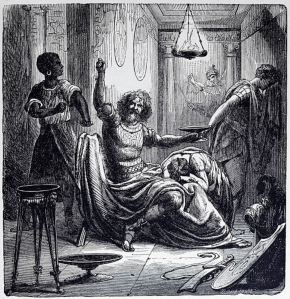
Patres conscripti, qui Hannibale vivo numquam se sine insidiis futuros existimarent, legatos in Bithyniam miserunt, in eis Flamininum, qui ab rege peterent, ne inimicissimum suum secum haberet sibique dederet. his Prusia negare ausus non est; illud recusavit, ne id a se fieri postularent, quod adversus ius hospitii esset: ipsi, si possent, comprehenderent: locum, ubi esset, facile inventuros. Hannibal enim uno loco se tenebat, in castello quod ei a rege datum erat muneri, idque sic aedificarat, ut in omnibus partibus aedificii exitus haberet, scilicet verens ne usu veniret, quod accidit. huc cum legati Romanorum venissent ac multitudine domum eius circumdedissent, puer ab ianua prospiciens Hannibali dixit plures praeter consuetudinem armatos apparere. qui imperavit ei, ut omnes fores aedificii circumiret ac propere sibi nuutiaret, num eodem modo undique obsideretur. puer cum celeriter, quid vidisset, renuntiasset omnesque exitus occupatos ostendisset, sensit id non fortuito factum, sed se peti neque sibi diutius vitam esse retinendam. quam ne alieno arbitrio dimitteret, memor pristinarum virtutum venenum, quod semper secum habere consuerat, sumpsit. sic vir fortissimus, multis variisque perfunctus laboribus, anno acquievit septuagesimo.
(Cornelius Nepos, Hannibal 12.2-13.1)
The conscript fathers, who thought that they would never be free from plots as long as Hannibal was alive, sent ambassadors to Bithynia, and among them Flamininus, to request the king not to keep their bitterest enemy with him, but to deliver him up to them. To this embassy Prusias did not dare to give a refusal; he made some opposition, however, to one point, begging them not to require of him what was contrary to the rights of hospitality, saying that they themselves might make Hannibal prisoner, if they could, as they would easily find out the place where he was. Hannibal indeed confined himself to one place, living in a fortress which had been given him by the king; and this he had so constructed that it had outlets on every side of the building, always fearing lest that should happen which eventually came to pass. When the Roman ambassadors had gone thither, and had surrounded his house with a number of men, a slave, looking out at a gate, told Hannibal that several armed men were to be seen, contrary to what was usual. Hannibal desired him to go round to all the gates of the castle, and bring him word immediately whether it was beset in the same way on all sides. The slave having soon reported how it was, and informed him, that all the passages were secured, he felt certain that it was no accidental occurrence, but that his person was menaced, and that his life was no longer to be preserved. That he might not part with it, however, at the pleasure of another, and dwelling on the remembrance of his past honours, he took poison, which he had been accustomed always to carry with him. Thus this bravest of men, after having gone through many and various labours, found repose in the seventieth year of his age. (tr. John Selby Watson)
Who, in fact, must exercise greater wisdom than he who is concerned with the weightiest matters; who, a keener sense of justice than he who is above the law; who, a more rigorous self-control than he to whom all things are permissible; who, a stouter courage than he upon whom the safety of everything depends? And who takes greater delight in the works of virtue than he who has all men as spectators and witnesses of his own soul? — so that nothing he may do can ever be hidden any more than the sun can run its course in darkness; for, in bringing all other things to light, it reveals itself first. (tr. James Wilfred Cohoon)
Haec fuit a Romulo annua ordinata dimensio, qui, sicut supra iam diximus, annum decem mensium, dierum vero quattuor et trecentorum habendum esse constituit, mensesque ita disposuit ut quattuor ex his tricenos singulos, sex vero tricenos haberent dies. sed cum is numerus neque solis cursui neque lunae rationibus conveniret, non numquam usu veniebat ut frigus anni aestivis mensibus et contra calor hiemalibus proveniret, quod ubi contigisset, tantum dierum sine ullo mensis nomine patiebantur absumi quantum ad id anni tempus adduceret quo caeli habitus instanti mensi aptus inveniretur. sed secutus Numa, quantum saeculo rudi et adhuc impolito solo ingenio magistro comprehendere potuit, vel quia Graecorum observatione forsan instructus est, quinquaginta dies addidit, ut in trecentos quinquaginta quattuor dies quibus duodecim lunae cursus confici credidit annus extenderetur. atque his quinquaginta a se additis adiecit alios sex retractos illis sex mensibus qui triginta habebant dies, id est de singulis singulos, factosque quinquaginta et sex dies in duos novos menses pari ratione divisit. ac de duobus priorem Ianuarium nuncupavit primumque anni esse voluit, tamquam bicipitis dei mensem, respicientem ac prospicientem transacti anni finem futurique principia; secundum dicavit Februo deo, qui lustrationum potens creditur. lustrari autem eo mense civitatem necesse erat, quo statuit ut iusta dis Manibus solverentur.
(Macrobius, Sat. 1.12.38-1.13.3)
This was the measure of the year set in order by Romulus, who, as I said above, established that the year should be reckoned at ten months or 304 days, and arranged the months so that four of them had thirty-one days, while six had thirty. But since that number matched neither the revolution of the sun nor the phases of the moon, it sometimes happened that the cold season fell out in the summer months and, conversely, the hot season in the winter months: when that happened, they let pass as many days—assigned to no particular month—as were needed to bring them to the time of year when the condition of the heavens matched the month they were in. But Numa followed Romulus. With all the understanding he could muster, following his wits alone in an age still uncouth and unrefined—or perhaps because he learned from the Greeks—he added fifty days, extending the year to the 354 days he thought comprised twelve lunar cycles. To these additional fifty days he added another six taken from the months that had thirty days—that is, one day from each—and divided the resulting fifty-six days into two months of equal length. The first of these he named January and decided it should be the first month of the year, the month of the two-headed god, looking back to the end of the year past and ahead to the start of the year to come. The second he dedicated to the god Februus, who is believed to control rites of purification: the community had to be purified in that month, when he determined that the Good Gods be paid the offerings due to them. (tr. Robert A. Kaster)
Rogo vos, fratres karissimi, et cum grandi humilitate admoneo, ut intentis animis auscultare iubeatis, quae vobis pro salute vestra suggerere volo.
ante omnia autem illud denuntio atque contestor, ut nullas paganorum sacrilegas consuetudines observetis, non caraios, non divinos, non sortilegos, non praecantatores; nec pro ulla causa aut infirmitate eos consulere vel interrogare praesumatis; quia qui facit hoc malum, statim perdit baptismi sacramentum. similiter et auguria, vel sternutationes nolite observare, nec in itinere positi aliquas aviculas cantantes attendatis, sed sive iter, seu quodcunque operis arripitis, signate vos in nomine Christi, et symbolum, et orationem Dominicam cum fide et devotione dicite, et nihil vobis nocere poterit inimicus. nullus Christianus observet qua die domum exeat, vel qua die revertatur, quia omnes dies Deus fecit: nullus ad inchoandum opus diem vel lunam attendat: nullus in Kalendis Ianuarii nefanda et ridiculosa, vetulas, aut cervulos, aut iotticos faciat, neque mensas super noctem componat, neque strenas, aut bibitiones superfluas exerceat. nullus Christianus in puras credat, neque in cantu sedeat, quia opera diabolica sunt: nullus in festivitate sancti Ioannis, vel quibuslibet sanctorum solemnitatibus, solstitia, aut vallationes, vel saltationes, aut caraulas, aut cantica diabolica exerceat: nullus nomina daemonum, aut Neptunum, aut Orcum, aut Dianam, aut Minervam, aut Geniscum, aut caeteras huiusmodi ineptias credere, aut invocare praesumat. nullus diem Iovis absque festivitatibus sanctis, nec in Maio, nec ullo tempore in otio observet, neque dies tiniarum, vel murorum, aut vel unum omnino diem, nisi tantum Dominicum. nullus Christianus ad fana, vel ad petras, vel ad fontes, vel ad arbores, aut ad cellos, vel per trivia luminaria faciat, aut vota reddere praesumat: nullus ad colla vel hominis, vel cuiuslibet animalis ligamina dependere praesumat, etiamsi a clericis fiant, et si dicatur quod res sancta sit, et lectiones divinas contineat, quia non est in eis remedium Christi, sed venenum diaboli. nullus praesumat lustrationes facere nec herbas incantare, neque pecora per cavam arborem, vel per terram foratam transire, quia per haec videtur diabolo ea consecrare. nulla mulier praesumat succinos ad collum dependere, nec in tela vel in tinctura, sive quolibet opere Minervam, vel infaustas caeteras personas nominare, sed in omni opere Christi gratiam adesse optare, et in virtute nominis eius toto corde confidere. nullus, si quando luna obscuratur, vociferare praesumat, quia Deo iubente certis temporibus obscuratur; nec luna nova quisquam timeat aliquid operis arripere, quia Deus ad hoc lunam fecit ut tempora designet, et noctium tenebras temperet, non ut alicuius opus impediat, aut dementem faciat hominem, sicut stulti putant, qui a daemonibus invasos a luna pati arbitrantur. nullus dominos solem aut lunam vocet, neque per eos iuret; quia creatura Dei sunt, et necessitatibus hominum iussu Dei inserviunt: nullus sibi proponat fatum vel fortunam, aut genesim, quod vulgo nascentia dicitur, ut dicat, qualem nascentia attulit, taliter erit; quia Deus omnes homines vult salvos fieri, et ad agnitionem veritatis venire [I Tim. II, 4] , atque omnia in sapientia dispensat, sicut disposuit ante constitutionem mundi. praeterea quoties aliqua infirmitas supervenerit, non quaerantur praecantatores, non divini, non sortilegi, non caragi, nec per fontes aut arbores, vel bivios diabolica phylacteria exerceantur; sed qui aegrotat, in sola Dei misericordia confidat, et Eucharistiam corporis et sanguinis Christi cum fide ac devotione accipiat, oleumque benedictum fideliter ab ecclesia petat, unde corpus suum in nomine Christi ungat, et secundum apostolum oratio fidei salvabit infirmum, et allevabit eum Dominus; et non solum corporis, sed etiam animae sanitatem recipiet, complebiturque in illo quod Dominus in Evangelio promisit, dicens: “omnia enim quaecunque petieritis in oratione credentes, accipietis” [Iacob. 5.15; Matth. 21.22].
(Audoenus Rothomagensis, Vita Sancti Eligii 2.16)
I ask you dearest brothers and admonish you with great humility to command your intent spirit to listen to what I wish to suggest to you for your salvation.
Before all else, I denounce and contest, that you shall observe no sacrilegious pagan customs. For no cause or infirmity should you consult magicians, diviners, sorcerers or incantators, or presume to question them because any man who commits such evil will immediately lose the sacrament of baptism. Do not observe auguries or violent sneezing or pay attention to any little birds singing along the road. If you are distracted on the road or at any other work, make the sign of the cross and say your Sunday prayers with faith and devotion and nothing inimical can hurt you. No Christian should be concerned about which day he leaves home or which day he returns because God has made all days. No influence attaches to the first work of the day or the [phase of the] moon; nothing is ominous or ridiculous about the Calends of January. [Do not] make [figures of?] vetulas, little deer or iotticos or set tables at night or exchange New Years’ gifts or supply superfluous drinks. No Christian believes impurity or sits in incantation, because the work is diabolic. No Christian on the feast of Saint John or the solemnity of any other saint performs solestitia [solstice rites?] or dancing or leaping or diabolical chants. No Christian should presume to invoke the name of a demon, not Neptune or Orcus or Diana or Minerva or Geniscus or believe in these inept beings in any way. No one should observe Jove’s day in idleness without holy festivities not in May or any other time, not days of larvae or mice or any day but Sunday. No Christian should make or render any devotion to the gods of the trivium, where three roads meet, to the fanes or the rocks, or springs or groves or corners. None should presume to hang any phylacteries from the neck of man nor beast, even if they are made by priests and it is said that they contain holy things and divine scripture because there is no remedy of Christ in these things but only the devil’s poison. None should presume to make lustrations or incantations with herbs, or to pass cattle through a hollow tree or ditch because this is to consecrate them to the devil. No woman should presume to hang amber from her neck or call upon Minerva or other ill-starred beings in their weaving or dyeing but in all works give thanks only to Christ and confide in the power of his name with all your hearts. None should presume to shout when the moon is obscured, for by God’s order eclipses happen at certain times. Nor should they fear the new moon or abandon work because of it. For God made the moon for this, to mark time and temper the darkness of night, not impede work nor make men mad as the foolish imagine, who believe lunatics are invaded by demons from the moon. None should call the sun or moon lord or swear by them because they are God’s creatures and they serve the needs of men by God’s order. No one should tell fate or fortune or horoscopes by them as those do who believe that a person must be what he was born to be. For God wills all men to be saved and come to the knowledge of truth and dispenses wisdom to all as he disposed it before the constitution of the world. Above all, should any infirmity occur, do not seek incantators or diviners or sorcerers or magicians, do not use diabolic phylacteries through springs and groves or crossroads. But let the invalid confide solely in the mercy of God and take the body and blood of Christ with faith and devotion and ask the church faithfully for blessing and oil, with which he might anoint his body in the name of Christ and, according to the apostle, “the prayer of faith will save the infirm and the Lord will relieve him.” And he will not only receive health for the body but for the soul and what the Lord promised in the Gospel will be fulfilled saying: “For whatever you shall ask, you will receive through believing prayer.” (tr. Jo Ann McNamara)
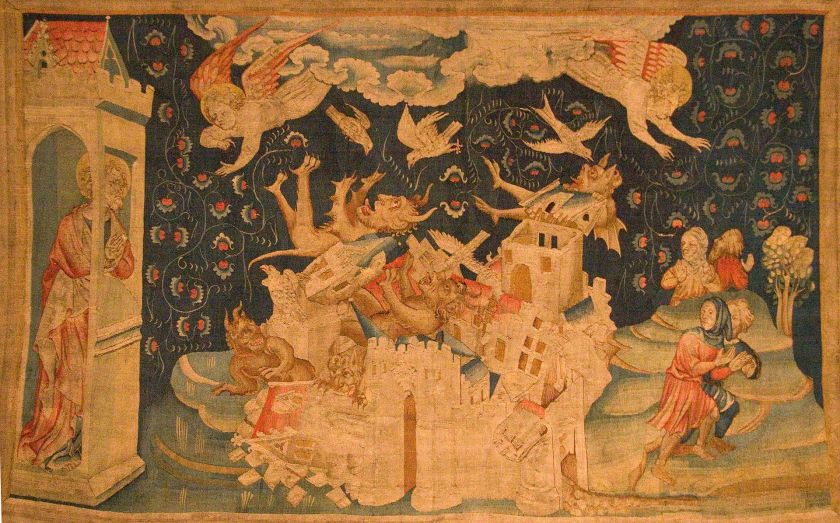
Rejoice over her, thou heaven, and ye holy apostles and prophets; for God hath avenged you on her. And a mighty angel took up a stone like a great millstone, and cast it into the sea, saying, “Thus with violence shall that great city Babylon be thrown down, and shall be found no more at all. And the voice of harpers, and musicians, and of pipers, and trumpeters, shall be heard no more at all in thee; and no craftsman, of whatsoever craft he be, shall be found any more in thee; and the sound of a millstone shall be heard no more at all in thee; and the light of a candle shall shine no more at all in thee; and the voice of the bridegroom and of the bride shall be heard no more at all in thee: for thy merchants were the great men of the earth; for by thy sorceries were all nations deceived. And in her was found the blood of prophets, and of saints, and of all that were slain upon the earth.” (King James Version)
And the kings of the earth, who have committed fornication and lived deliciously with her, shall bewail her, and lament for her, when they shall see the smoke of her burning, standing afar off for the fear of her torment, saying, “Alas, alas, that great city Babylon, that mighty city! for in one hour is thy judgment come.” And the merchants of the earth shall weep and mourn over her; for no man buyeth their merchandise any more: the merchandise of gold, and silver, and precious stones, and of pearls, and fine linen, and purple, and silk, and scarlet, and all thyine wood, and all manner vessels of ivory, and all manner vessels of most precious wood, and of brass, and iron, and marble, and cinnamon, and odours, and ointments, and frankincense, and wine, and oil, and fine flour, and wheat, and beasts, and sheep, and horses, and chariots, and slaves, and souls of men. And the fruits that thy soul lusted after are departed from thee, and all things which were dainty and goodly are departed from thee, and thou shalt find them no more at all. The merchants of these things, which were made rich by her, shall stand afar off for the fear of her torment, weeping and wailing, and saying, “Alas, alas, that great city, that was clothed in fine linen, and purple, and scarlet, and decked with gold, and precious stones, and pearls! For in one hour so great riches is come to nought.” And every shipmaster, and all the company in ships, and sailors, and as many as trade by sea, stood afar off, and cried when they saw the smoke of her burning, saying, “What city is like unto this great city!” And they cast dust on their heads, and cried, weeping and wailing, saying, “Alas, alas, that great city, wherein were made rich all that had ships in the sea by reason of her costliness! for in one hour is she made desolate.” (King James Version)
And after these things I saw another angel come down from heaven, having great power; and the earth was lightened with his glory. And he cried mightily with a strong voice, saying, “Babylon the great is fallen, is fallen, and is become the habitation of devils, and the hold of every foul spirit, and a cage of every unclean and hateful bird. For all nations have drunk of the wine of the wrath of her fornication, and the kings of the earth have committed fornication with her, and the merchants of the earth are waxed rich through the abundance of her delicacies.” And I heard another voice from heaven, saying, “Come out of her, my people, that ye be not partakers of her sins, and that ye receive not of her plagues. For her sins have reached unto heaven, and God hath remembered her iniquities. Reward her even as she rewarded you, and double unto her double according to her works: in the cup which she hath filled fill to her double. How much she hath glorified herself, and lived deliciously, so much torment and sorrow give her: for she saith in her heart, I sit a queen, and am no widow, and shall see no sorrow. Therefore shall her plagues come in one day, death, and mourning, and famine; and she shall be utterly burned with fire: for strong is the Lord God who judgeth her.” (King James Version)
Metus remitte, prospero regnum in statu est
domusque florens sorte felici viget.
sed tu beatis mitior rebus veni!
namque anxiam me cura sollicitat tui,
quod te ipse poenis gravibus infestus domas.
quem fata cogunt, ille cum venia est miser;
at si quis ultro se malis offert volens
seque ipse torquet, perdere est dignus bona
quis nescit uti. potius annorum memor
mentem relaxa: noctibus festis facem
attolle, curas Bacchus exoneret graves.
aetate fruere: mobili cursu fugit.
nunc facile pectus, grata nunc iuveni Venus:
exultet animus. cur toro viduo iaces?
tristem iuventam solve; nunc cursus rape,
effunde habenas, optimos vitae dies
effluere prohibe. propria descripsit deus
officia et aevum per suos ducit gradus:
laetitia iuvenem, frons decet tristis senem.
Quid te coërces et necas rectam indolem?
seges illa magnum fenus agricolae dabit
quaecumque laetis tenera luxuriat satis,
arborque celso vertice evincet nemus
quam non maligna caedit aut resecat manus:
ingenia melius recta se in laudes ferunt,
si nobilem animum vegeta libertas alit.
truculentus et silvester ac vitae inscius
tristem iuventam Venere deserta coles?
hoc esse munus credis indictum viris,
ut dura tolerent, cursibus domitent equos
et saeva bella Marte sanguineo gerant?
(Seneca Minor, Phaedra 436-465)
[NURSE]
Have no fear, the kingdom prospers and the house is flourishing vigorously amidst good fortune. But you should meet your blessings with more geniality! I am troubled by anxious cares about you, because you subdue yourself like an enemy with heavy ordeals. A person coerced by fate may be forgiven for unhappiness; but if someone willingly volunteers for suffering and tortures himself, he deserves to lose the good things he is incapable of using. Instead, remember your years, and let your mind relax: raise a torch in nighttime celebrations, let Bacchus lighten your heavy cares. Enjoy your time of life: it runs swiftly away. Now your heart is free and easy, now your youth welcomes Venus. Let your spirit run riot! Why lie in a solitary bed? Unfetter your joyless youth. Now make all speed, let go the reins, and prevent the best days of life from slipping away. God has prescribed appropriate duties, and leads life through its proper stages: happiness suits the young, gloomy brows the old. Why inhibit yourself and strangle your natural disposition? That crop will pay the farmer great interest, whose plants when young grow lush and exultant; and that tree will overtop the grove with its towering crown, that is not cut or pruned back by a niggard hand: upright dispositions grow better to renown, if a lively freedom nourishes the noble spirit. As a truculent backwoodsman who knows nothing of life, will you pass your youth in gloom and abandon Venus? Do you think men have this obligation imposed on them, to endure hardships, tame horses by running them, and wage savage wars amid martial bloodshed? (tr. John G. Fitch)
Make it rather your serious endeavour not only to acquire accurate book-knowledge of each bone but also to examine assiduously with your own eyes the human bones themselves. This is quite easy at Alexandria because the physicians there employ ocular demonstration in teaching osteology to students. For this reason, if for no other, try to visit Alexandria. But if you cannot, it is still possible to see something of human bones. I, at least, have done so often on the breaking open of a grave or tomb. Thus once a river, inundating a recent hastily made grave, broke it up, washing away the body. The flesh had putrefied, though the bones still held together in their proper relations. It was carried down a stadium and, reaching marshy ground, drifted ashore. This skeleton was as though deliberately prepared for such elementary teaching. And on another occasion we saw the skeleton of a brigand, lying on rising ground a little off the road. He had been killed by some traveller repelling his attack. The inhabitants would not bury him, glad enough to see his body consumed by the birds which, in a couple of days, ate his flesh, leaving the skeleton as if for demonstration. (tr. Charles Singer)







 Crambe Repetita