Caducum

Paul Gauguin, D'où venons-nous, que sommes-nous, où allons-nous, 1897
Paul Gauguin, D’où venons-nous ? Que sommes-nous ? Où allons-nous ? (1897-98)

Nimis caducum simul ac superbum animal est homo, nimis alte fragilibus superedificat fundamentis. e tanta sodalium turba ad quem redacti numerum sumus, vides; et ecce, dum loquimur, ipsi etiam fugimus atque umbre in morem evanescimus, momentoque temporis abiisse alter alterum accipiet, et ipse mox previum secuturus. quid ergo sumus, frater optime? quid sumus? nec desinimus superbire. suis angoribus consternatus Cicero, in epystola quadam ad Athicum, “Ipsi” inquit “quid sumus aut quandiu hec curaturi sumus?” brevis quidem sed bona, ni fallor, questio, et salutaris et gravida atque utilibus plena sententiis, sub qua multum vere humilitatis ac modestie multumque contemptus rerum fugitivarum vigil fossor inveniet. “quid sumus?” inquam; quam gravi, quam tardo, quam fragili corpore, quam ceco, quam turbido, quam inquieto animo, quam varia quamque incerta volubilique fortuna! “qut quandiu hec curaturi sumus?” profecto perbreviter. nempe non aliud sonat, quam si diceret: “ipsi quid sumus, et hoc ipsum quandiu futuri sumus?” utique hercle non diu, cum hoc idem nostrum esse, ut diuturnum esse non potest, sic nunc possit inter verba desinere, neque si accidat, miri aliquid acciderit. utrunque igitur bene et graviter queris, Marce Tulli; sed, queso te, ubinam tertium reliquisti, et eventu periculosius et quesitu dignius? postquam hic esse desierimus, quid futuri sumus? o rem magnam et ambiguam, sed neglectam! vale.
(Petrarca, Epist. Fam. 8.7.23-26)

Man is both too mortal and too proud a creature, and builds too high on brittle foundations. YOu see the small number to which we have been reduced from so great a group of friends, and even as we talk we ourselves are fleeting and disappearing like a shadow, and in a moment of time one of us will learn that the other has departed, destined himself soon to follow his predecessor. O best of brothers, what are we? What? And yet we do not abandon our pride. Cicero once, overwhelmed by anxieties, wrote in a letter to Atticus: “Who are we, really, or for how long will we concern ourselves over these woes?” A short question, but a good one, if I am not mistaken, one beneficial and loaded with useful thoughts, that will force the wakeful investigator to find much true humility and modesty and much contempt for fleeting affairs. I say again, what are we? How heavy, slow and fragile is our body, how blind, how troubled, how disturbed our mind, how shifting and unsure and mobile is Fortune. Or how long shall we care for these troubles? Surely only for a very brief time. To me this does not sound any different than if Cicero were saying: “Who are we, really? And how long shall we be the same person?” In any case, not for long, since our identities cannot last for long and can come to an end now as we speak, and if it happened this would be nothing strange. So you do well and wisely to ask both questions, Marcus Tullius; but I ask you, where did you leave that third possibility, more dangerous in outcome and more worthy of investigation? After we have ceased to exist here, what shall we become? What a great and problematic issue, but one overlooked! Farewell. (tr. Elaine Fantham)

Tolerabilia

Pieter Claesz, Vanitas, 1630
Pieter Claesz, Vanitas (1630)

Male de Seio. sed omnia humana tolerabilia ducenda. ipsi enim quid sumus aut quam diu haec curaturi sumus? ea videamus quae ad nos magis pertinent, nec tamen multo. quid agamus de senatu? et ut ne quid praetermittam, Caesonius ad me litteras misit Postumiam Sulpici domum ad se venisse. de Pompei Magni filia tibi rescripsi me nihil hoc tempore cogitare; alteram vero illam quam tu scribis, puto, nosti: nihil vidi foedius. sed adsum. coram igitur.
obsignata epistula accepi tuas. Atticae hilaritatem libenter audio. commotiunculis συμπάσχω.
(Cicero, Ep. ad Att. 249 (=12.11))

I am so sorry about Seius. But we must resign ourselves to the lot of mankind and all that is part of it. What after all are we, and how long shall we be taking these things to heart? Let us look at matters which concern us more directly, though not much more. What am I to do about the Senate? And, not to leave anything out, Caesonius has sent me a letter to say that Postumia, Sulpicius’ wife, has been to see him at his house. I wrote to you in answer to your remark about Pompeius Magnus’ daughter that I had no such thought at present. As for the other lady you mention, I think you know her. She is quite remarkably ugly. However I am nearly home, and we shall talk of it* together.
After sealing my letter I received yours. Glad to hear of Attica’s good spirits. I sympathize with her little upsets.

* I.e., of a new wife for Ciero, who had divorced Terentia earlier in the year. The ‘other lady’ may have been Hirtius’ sister, whom according to St. Jerome (Adversus Iovinianum, 1.48) Cicero declined to mary on the ground that he coul not devote himself equally to a wife and to philosophy.

(tr. David Roy Shackleton Bailey, with his note)

Kuniska

Sophie de Renneville, Cynisca, voor 1823

Σπάρτας μὲν [βασιλῆες ἐμοὶ] πατέρες καὶ ἀδελφοί,
ἅ[ρματι δ’ ὠκυπόδων ἵππων] νικῶσα Κυνίσκα
εἰκόνα τάνδ’ ἔστασε. μόν[αν] δ’ ἐμέ φαμι γυναικῶν
Ἑλλάδος ἐκ πάσας τό[ν-]δε λαβν στέφανον.
Ἀπελλέας Καλλικλέος ἐπόησε.
(IG V.1.1564a)

[Kings] of Sparta were [my] fathers and brothers.
Having been victorious with a c[hariot of swift-footed horses,] I,
Cynisca, set up this statue. I declare that alone amongst the women
of all Greece, I took this crown.
Apelles the son of Callicles made this.
(tr. Sarah Brown Ferrario)

Ἀρχιδάμου δὲ ὡς ἐτελεύτα, καταλιπόντος παῖδας, Ἆγίς τε πρεσβύτερος ἦν ἡλικίᾳ, καὶ παρέλαβεν ἀντὶ Ἀγησιλάου τὴν ἀρχήν. ἐγένετο δὲ Ἀρχιδάμῳ καὶ θυγάτηρ, ὄνομα μὲν Κυνίσκα, φιλοτιμότατα δὲ ἐς τὸν ἀγῶνα ἔσχε τὸν Ὀλυμπικὸν, καὶ πρώτη τε ἱπποτρόφησε γυναικῶν, καὶ νίκην ἀνείλετο Ὀλυμπικὴν πρώτη. Κυνίσκας δὲ ὕστερον γυναιξὶ καὶ ἄλλαις, καὶ μάλιστα ταῖς ἐκ Μακεδονίας, γεγόνασιν Ὀλυμπικαὶ νῖκαι, ὧν ἡ ἐπιφανεστέρα ἐς τὰς νίκας ἐστὶν αὐτῆς. δοκοῦσι δὲ οἱ Σπαρτιᾶταί μοι ποίησιν καὶ ἔπαινον τὸν ἀπ’ αὐτῆς ἥκιστα ἀνθρώπων θαυμάσαι. ὅτι γὰρ μὴ τῇ Κυνίσκᾳ τὸ ἐπίγραμμα ἐποίησεν ὅστις δή, καὶ ἔτι πρότερον Παυσανίᾳ τὸ ἐπὶ τῷ τρίποδι Σιμωνίδης τῷ ἀνατεθέντι ἐς Δελφούς, ἄλλο δή γε παρὰ ἀνδρὸς ποιητοῦ Λακεδαιμονίων τοῖς βασιλεῦσιν οὐδέν ἐστιν ἐς μνήμην.
(Pausanias 3.8.1-2)

Archidamus left sons when he died, of whom Agis was the elder and inherited the throne instead of Agesilaus. Archidamus had also a daughter, whose name was Cynisca; she was exceedingly ambitious to succeed at the Olympic games, and was the first woman to breed horses and the first to win an Olympic victory. After Cynisca other women, especially women of Lacedaemon, have won Olympic victories, but none of them was more distinguished for their victories than she. The Spartans seem to me to be of all men the least moved by poetry and the praise of poets. For with the exception of the epigram upon Cynisca, of uncertain authorship, and the still earlier one upon Pausanias that Simonides wrote on the tripod dedicated at Delphi, there is no poetic composition to commemorate the doings of the royal houses of the Lacedaemonians. (tr. Henry Arderne Ormerod)

Asellus

asellus

Rex erat ignote quondam regionis et urbis
sed nomen regis pagina nulla docet.
hic sibi consortem regni thalamique sodalem
sortitus fuerat nobilitate parem.
quos licet imperii maiestas alta bearet
amplaque congeries nobilitaret opum,
hic tamen adversa parum Lucina negaret
gratis enim Veneris excoluere iocos.
hinc dolor, hinc gemitus ambos vexabat,
heredem regni non habuere sui.
denique regina misero compassa marito
tali sive pari voce frequenter ait:
“quid facimus? nil proficimus: iam vivere tedet
nocturnisque piget sepe vacasse iocis.
femina sum misera sterilique simillima terre
qui sine spe messis semina iacta vorat.
pertuso sacco iuste me comparo, qui quod
ore patente capit hoc aliunde vomit.
heu, quid nobilitas, quid opes, quid gloria regni
prosunt, heredem si michi fata negant?”
continuis igitur precibus pia numina pulsans,
ut mater fiat nocte dieque rogat.
quod petit assequitur et fit mater sed aselli!
eius enim partus pulcher asellus erat.
o qualis partus, ubi femina gignit asellum!
o res miranda, plus miseranda tamen!
hoc fetu viso mater, que plauserat olim
se concepisse, iam peperisse dolet.
ergo non esse mater quam mater aselli
mallet, et ut detur piscibus esca iubet.
(Asinarius 1-30)

Once upon a time there was a king of an unknown region and city, and, what is more, no page tells the king’s name. This king had acquired for himself as consort of his realm and companion of his bedchamber a woman who was his peer in nobility. Although the high majesty of an empire blessed them, and an ample mass of wealth ennobled them, all the same Lucina was hostile to them and had denied offspring; for they practiced the games of Venus to no effect. Hence grief and moans afflicted both of them, for the reason that they had no heir for their realm. In the end the queen, taking pity upon her unfortunate husband, said repeatedly in such a speech or one like it: “What are we doing? We are accomplishing nothing. It has become dreary now to live and it is tiresome to have been intent so often on nighttime games. I am an unfortunate woman, most similar to a barren land that without hope of a harvest swallows the seeds that are cast. Rightly do I compare myself to a punctured sack, which spews out elsewhere what it receives with open mouth. Alas, what does nobility avail, what does wealth, what does the glory of the realm, if the fates deny me an heir?” Therefore, entreating the faithful gods with uninterrupted prayers, she asks by night and day that she be made a mother. What she seeks, she obtains and she becomes a mother—but of a little donkey, for her offspring was a beautiful little donkey! O what a delivery, when a woman gives birth to a little donkey! O what a marvelous, yet rather miserable, thing! Having seen this newborn, the mother, who had earlier applauded that she had conceived, now grieves at having given birth. Therefore, rather than to be the mother of a little donkey, she prefers not to be a mother and orders that he be given as food to fishes. (tr. Jan M. Ziolkowski, slightly adapted)

Stimulis

Paul Mercuri, Medieval nun, ca. 1850-70

In Anglia vir quidam religiosus monasterio praefuit sanctimonialium. erat autem staturae procerae, decorus aspectu, genas habens rubicundas, oculos laetos, ita ut vix aliquis aliquid in eo religiositatis esse crederet, qui virtutes animi illius ignoraret. in cuius contemplatione iuvencula quaedam illius congregationis adeo coepit tentari, et tam gravissime stimulis carnis agitari, ut verecundia postposita passionem suam illi aperiret. expavit vir sanctus, et quia timor Dei ante oculos eius fuit, coepit virginem, in quantum potuit, avertere, dicens: “Christi sponsa es, et si Domini mei sponsam corrupero, non patietur impune transire, neque homines diu poterit latere.” dicente illa, “si non consenseris mihi, moriar” respondit ille: “ex quo aliter esse non potest, fiat ut vis. in quo ergo loco conveniemus?” respondit illa: “ubicumque tibi placuerit, ego in hac nocte veniam ad te.” ad quod ille: “oportet ut in die fiat” ostenditque virgini domum in pomerio, monens et praecipiens, ut nemine sciente, nemine vidente, tali hora illuc veniret. quae cum venisset, dixit vir Dei ad eam: “domina, dignum est et vobis expedit, ut corpus meum, quod tam ardenter concupiscitis, prius inspiciatis, et si tunc placuerit, desiderio vestro per illud satisfaciatis.” hoc dicto, illa tacente, vestimenta sua exuit, cilicium asperrimum quo indutus erat, ad carnem deposuit, corpusque nudum vermibus corrosum, cilicio attritum, scabiosum atque nigerrimum illi ostendens, ait: “en quod amas, exple nunc si placet voluptatem tuam. videns haec illa, expavit, et nunc in pallorem, nunc in ruborem versa, ad pedes eius ruens, veniam postulavit. cui ille: “revertere secrete in monasterium tuum, et vide ne me vivente prodas secretum meum.” ab illa hora tentatio, quam visus incautus in virgine excitaverat, conquievit.
(Caesarius of Heisterbach, Dialogus Miraculorum 4.103)

In England there was a certain spiritually-minded man who was set to preside over a convent of nuns. Now he was of tall stature, and comely to look upon, with ruddy cheeks and bright eyes, so that scarcely any, who were ignorant of his spiritual qualities, would have guessed at the depth of his religion. One of the younger nuns of that community, by often gazing upon him, began to be so tempted and so grievously troubled by the stings of the flesh, that at last she put away all modesty and opened to him her passion. The holy man, having the fear of God before his eyes, was horrified, and tried by all means in his power to divert the maiden’s thoughts, saying: “You are the spouse of Christ; if I were to corrupt the spouse of my Lord, He would not suffer it to pass with impunity; neither could such a crime long lied hidden from the eyes of men.” Then she said that if he would not consent, she would die; and he replied: “Since it cannot be otherwise, let it be as you wish. Where then shall we meet?” She answered: “This night I will come to you wherever you may appoint.” Then he said: “No, it must take place in daylight”; and he showed the maiden a shed in the orchard, solemnly charging her to come thither at a certain hour without anyone seeing or knowing. She came, and the man of God said to her: “Lady, it is right and expedient for you that you should first see this body of mine, which you so eagerly desire, and then if it still pleases you, you can satisfy yourself with it.” When he had thus spoken and she remained silent, he put off his garments, took off the rough hair shirt which he wore next his person, and showed her his naked body, eaten with vermin, scarred with the hair shirt, covered with sores, and black with grime, and said: “See what it is that you love, and take your pleasure if you still desire it.” When she saw this proof of his austerity, her heart sank within her, and turning now red and now pale, she cast herself at his feet and besought pardon. Then he: “Go back secretly into your convent, and see that you do not betray my secret till after my death.” From that hour the temptation, which had been aroused in the virgin by the wantonness of unbridled eyes, departed from her for ever. (tr. G.G. Coulton & Eileen Power)

Nerthe

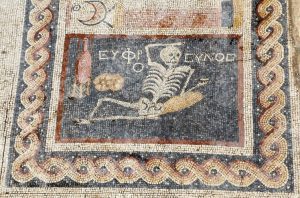
Wees vrolijk (doodsmozaïek)

“Ἦ ῥ’ ὑπὸ σοὶ Χαρίδας ἀναπαύεται;” — “εἰ τὸν Ἀρίμμα
τοῦ Κυρηναίου παῖδα λέγεις, ὑπ’ ἐμοί.”
“ὦ Χαρίδα, τί τὰ νέρθε;” — “πολὺ σκότος.” — “αἱ δ’ ἄνοδοι τί;”
“ψεῦδος.” — “ὁ δὲ Πλούτων;” — “μῦθος.” — “ἀπωλόμεθα.”
“οὗτος ἐμὸς λόγος ὔμμιν ἀληθινός, εἰ δὲ τὸν ἡδύν
βούλει, Πελλαίου βοῦς μέγας εἰν Ἀΐδῃ.”
(Callimachus, Ep. 15 = Anth. Gr. 7.524)

‘Art thou the grave of Charidas?’ ‘If for Arimmas’ son,
The Cyrenaean, you inquire, I am the very one.’
‘How goes it, Charidas, below?’ ‘Much gloom.’ ‘And the way back?’
‘A lie, there is none.’ ‘Pluto, then?’ ‘Pluto’s a myth.’ ‘Alack!’
‘I’m telling you the truth. If you want fairy tales instead,
The market price of oxen here is half a crown a head.’
(tr. G.M. Young)

Ius

Heautontimorumenos

[CHREMES. SYRVS]

CHR. At ego illi neque do neque despondeo.
SYR. non? quam ob rem?
CHR. quam ob rem? me rogas? homini—
SYR. ut lubet.
non ego dicebam in perpetuom ut illam illi dares,
verum ut simulares.
CHR. non meast simulatio:
ita tu istaec tua misceto, ne me admisceas.
egon quoi daturus non sum, ut ei despondeam?
SYR. credebam.
CHR. minume.
SYR. scite poterat fieri;
et ego hoc, quia dudum tu tanto opere suaseras
eo coepi.
CHR. credo.
SYR. ceterum equidem istuc, Chremes,
aequi bonique facio.
CHR. atqui quam maxume
volo te dare operam ut fiat, verum alia via.
SYR. fiat, quaeratur aliquid. sed illud quod tibi
dixi de argento quod ista debet Bacchidi,
id nunc reddendumst illi: neque tu scilicet
illuc confugies: “quid mea? num mihi datumst?
num iussi? num illa oppignerare filiam
meam me invito potuit?” verum illud, Chremes,
dicunt: “ius summum saepe summast malitia.
CHR. haud faciam.
(Terence, Heaut. 779-797)

[CHREMES. SYRVS]

CHR. But I won’t marry her to him! I won’t engage her to
him!
SYR. Won’t you? Why not?
CHR. Why not?! Are you asking me that? A man who—
SYR. (interrupting) As you like. I wasn’t saying that you should give her to him permanently, but that you should pretend.
CHR. It’s not my style to pretend: you cook up those schemes of yours without mixing me up in them! Me engage her to a man I’m not going to marry her to?!
SYR. I thought you would.
CHR. Certainly not!
SYR. It could have been done cleverly; and the only reason I embarked on this was because you’d urged me earlier so insistently.
CHR. I believe you.
SYR. But that really doesn’t bother me in the slightest, Chremes.
CHR. But I do want you to work as hard as you can to make it happen, only some other way!
SYR. All right, let me think of something.—But do you remember what I told you about the money that the girl owes Bacchis? That’s got to be paid over to her now. And I’m sure you won’t fall back on saying ‘What’s it got to do with me? It wasn’t given to me, was it? Was it on my orders? Could she offer my daughter as security without my consent?’ It’s true what they say, Chremes: the highest legalism is often the lowest cunning.
CHR. I won’t do that!
(tr. Peter Brown)


Pupula

CIL IV 5296

O utinam liceat collo complexa tenere
braciola et teneris oscula ferre labe(l)lis
i nunc ventis tua gaudia, pupula, crede
crede mihi, levis est natura virorum
saepe ego cu(m) media vigilare(m) perdita nocte
haec mecum medita(n)s: multos Fortuna quos supstulit alte
hos modo proiectos subito praecipitesque premit
sic Venus ut subito coiunxit corpora amantum
dividit lux et se (paries? quid? ama?)
(CIL IV.5296)

Oh, if only I (fem.) could hold my gentle arms around you
and press my kisses on your tender lips. Go now, girl, confide your
joys to the winds:
believe me, flighty is the nature of men. These things I’ve often
meditated
lying awake in despair in the middle of the night: many has Fortune
raised on high
then suddenly let fall headlong, oppressing them with worst trouble.
Likewise, though Venus in a moment unites the bodies of lovers,
the first light divides them and [you (Venus) would separate their love.]
(tr. John G. Younger)

Note: I don’t know on what reconstruction of the text the last few words of Mr. Younger’s translation are based.

Philopatris

Antoine Caron (navolger van), Le massacre du Triumvirat, ca. 1560-70
Circle of Antoine Caron, Les massacres du Triumvirat, ca. 1560-70

This is part 3 of 3. Part 1 is here. Part 2 is here.

Τῶν δ’ ἀκρωτηρίων εἰς Ῥώμην κομισθέντων ἔτυχε μὲν ἀρχαιρεσίας τελῶν ὁ Ἀντώνιος, ἀκούσας δὲ καὶ ἰδὼν ἀνεβόησεν ὡς νῦν αἱ προγραφαὶ τέλος ἔχοιεν. τὴν δὲ κεφαλὴν καὶ τάς χεῖρας ἐκέλευσεν ὑπὲρ τῶν ἐμβόλων ἐπὶ τοῦ βήματος θεῖναι, θέαμα Ῥωμαίοις φρικτόν, οὐ τὸ Κικέρωνος ὁρᾶν πρόσωπον οἰομένοις, ἀλλὰ τῆς Ἀντωνίου ψυχῆς εἰκόνα, πλὴν ἕν γέ τι φρονήσας μέτριον ἐν τούτοις Πομπωνίᾳ τῇ Κοΐντου γυναικὶ τὸν Φιλόλογον παρέδωκεν. ἡ δὲ κυρία γενομένη τοῦ σώματος ἄλλαις τε δειναῖς ἐχρήσατο τιμωρίαις, καὶ τάς σάρκας ἀποτέμνοντα τάς αὐτοῦ κατὰ μικρὸν ὀπτᾶν, εἶτ’ ἐσθίειν ἠνάγκασεν. οὕτω γὰρ ἔνιοι τῶν συγγραφέων ἱστορήκασιν· ὁ δ’ αὐτοῦ τοῦ Κικέρωνος ἀπελεύθερος Τίρων τὸ παράπαν οὐδὲ μέμνηται τῆς τοῦ Φιλολόγου προδοσίας. πυνθάνομαι δὲ Καίσαρα χρόνοις πολλοῖς ὕστερον εἰσελθεῖν πρὸς ἕνα τῶν θυγατριδῶν· τὸν δὲ βιβλίον ἔχοντα Κικέρωνος ἐν ταῖς χερσίν ἐκπλαγέντα τῷ ἱματίῳ περικαλύπτειν· ἰδόντα δὲ Καίσαρα λαβεῖν καὶ διελθεῖν ἑστῶτα μέρος πολὺ τοῦ βιβλίου, πάλιν δ’ ἀποδιδόντα τῷ μειρακίῳ φάναι· “λόγιος ἁνὴρ, ὦ παῖ, λόγιος καὶ φιλόπατρις.” ἐπεὶ μέντοι τάχιστα κατεπολέμησεν Ἀντώνιον ὑπατεύων αὐτὸς εἵλετο συνάρχοντα τοῦ Κικέρωνος τὸν υἱόν, ἐφ’ οὗ τάς τ’ εἰκόνας ἡ βουλὴ καθεῖλεν Ἀντωνίου καὶ τάς ἄλλας ἠκύρωσε τιμάς καὶ προσεψηφίσατο μηδενὶ τῶν Ἀντωνίων ὄνομα Μάρκον εἶναι. οὕτω τὸ δαιμόνιον εἰς τὸν Κικέρωνος οἶκον ἐπανήνεγκε τὸ τέλος τῆς Ἀντωνίου κολάσεως.
(Plutarch, Bios Kikerōnos 49)

When Cicero’s extremities were brought to Rome, it chanced that Antony was conducting an election, but when he heard of their arrival and saw them, he cried out, “Now let our proscriptions have an end.” Then he ordered the head and hands to be placed over the ships’ beaks on the rostra, a sight that made the Romans shudder; for they thought they saw there, not the face of Cicero, but an image of the soul of Antony. However, he showed at least one sentiment of fair dealing in the case when he handed over Philologus to Pomponia, the wife of Quintus. And she, having got the man into her power, besides other dreadful punishments which she inflicted upon him, forced him to cut off his own flesh bit by bit and roast it, and then to eat it. This, indeed, is what some of the historians say; but Cicero’s own freedman, Tiro, makes no mention at all of the treachery of Philologus. I learn that Caesar, a long time after this, paid a visit to one of his daughter’s sons; and the boy, since he had in his hands a book of Cicero’s, was terrified and sought to hide it in his gown; but Caesar saw it, and took the book, and read a great part of it as he stood, and then gave it back to the youth, saying: “A learned man, my child, a learned man and a lover of his country.” Moreover, as soon as he had finally defeated Antony, and when he was himself consul, he chose Cicero’s son as his colleague in the office, and it was in his consulship that the senate took down the statues of Antony, made void the other honours that had been paid him, and decreed besides that no Antony should have the name of Marcus. Thus the heavenly powers devolved upon the family of Cicero the final steps in the punishment of Antony. (tr. Bernadotte Perrin)

Esphagē

Death_of_Cicero

This is part 2 of 3. Part 1 is here. Part 3 is here.

Ἐν τούτῳ δ’ οἱ σφαγεῖς ἐπῆλθον, ἑκατοντάρχης Ἑρέννιος καὶ Ποπίλλιος χιλίαρχος, ᾧ πατροκτονίας ποτὲ δίκην φεύγοντι συνεῖπεν ὁ Κικέρων, ἔχοντες ὑπηρέτας. ἐπεὶ δὲ τὰς θύρας κεκλεισμένας εὑρόντες ἐξέκοψαν, οὐ φαινομένου τοῦ Κικέρωνος οὐδὲ τῶν ἔνδον εἰδέναι φασκόντων, λέγεται νεανίσκον τινὰ τεθραμμένον μὲν ὑπὸ τοῦ Κικέρωνος ἐν γράμμασιν ἐλευθερίοις καὶ μαθήμασιν, ἀπελεύθερον δὲ Κοΐντου τοῦ ἀδελφοῦ, Φιλόλογον τοὔνομα, φράσαι τῷ χιλιάρχῳ τὸ φορεῖον κομιζόμενον διὰ τῶν καταφύτων καὶ συσκίων περιπάτων ἐπὶ τὴν θάλατταν. ὁ μὲν οὖν χιλίαρχος ὀλίγους ἀναλαβὼν μεθ’ ἑαυτοῦ περιέθει πρὸς τὴν ἔξοδον, τοῦ δ’ Ἑρεννίου δρόμῳ φερομένου διὰ τῶν περιπάτων ὁ Κικέρων ᾔσθετο, καὶ τοὺς οἰκέτας ἐκέλευσεν ἐνταῦθα καταθέσθαι τὸ φορεῖον. αὐτός δ’, ὥσπερ εἰώθει, τῇ ἀριστερᾷ χειρὶ τῶν γενείων ἁπτόμενος ἀτενὲς ἐνεώρα τοῖς σφαγεῦσιν, αὐχμοῦ καὶ κόμης ἀνάπλεως καὶ συντετηκὼς ὑπὸ φροντίδων τὸ πρόσωπον, ὥστε τοὺς πλείστους ἐγκαλύψασθαι τοῦ Ἑρεννίου σφάζοντος αὐτόν, ἐσφάγη δὲ τὸν τράχηλον ἐκ τοῦ φορείου προτείνας, ἔτος ἐκεῖνο γεγονὼς ἑξηκοστὸν καί τέταρτον, τὴν δὲ κεφαλὴν ἀπέκοψεν αὐτοῦ καὶ τὰς χεῖρας, Ἀντωνίου κελεύσαντος, αἷς τοὺς Φιλιππικοὺς ἔγραψεν. αὐτός τε γὰρ ὁ Κικέρων τοὺς κατ’ Ἀντωνίου λόγους Φιλιππικοὺς ἐπέγραψε καὶ μέχρι νῦν τὰ βιβλία Φιλιππικοὶ καλοῦνται.
(Plutarch, Bios Kikerōnos 48)

But meantime his assassins came to the villa, Herennius a centurion, and Popillius a tribune, who had once been prosecuted for parricide and defended by Cicero; and they had helpers. After they had broken in the door, which they found closed, Cicero was not to be seen, and the inmates said they knew not where he was. Then, we are told, a youth who had been liberally educated by Cicero, and who was a freedman of Cicero’s brother Quintus, Philologus by name, told the tribune that the litter was being carried through the wooded and shady walks towards the sea. The tribune, accordingly, taking a few helpers with him, ran round towards the exit, but Herennius hastened on the run through the walks, and Cicero, perceiving him, ordered the servants to set the litter down where they were. Then he himself, clasping his chin with his left hand, as was his wont, looked steadfastly at his slayers, his head all squalid and unkempt, and his face wasted with anxiety, so that most of those that stood by covered their faces while Herennius was slaying him. For he stretched his neck forth from the litter and was slain, being then in his sixty-fourth year. Herennius cut off his head, by Antony’s command, and his hands — the hands with which he wrote the Philippics. For Cicero himself entitled his speeches against Antony “Philippics,” and to this day the documents are called Philippics. (tr. Bernadotte Perrin)