Arserat Aeneae Dido miserabilis igne,
arserat exstructis in sua fata rogis;
compositusque cinis, tumulique in marmore carmen
hoc breve, quod moriens ipsa reliquit, erat:
“praebuit Aeneas et causam mortis et ensem.
ipsa sua Dido concidit usa manu.”
protinus invadunt Numidae sine vindice regnum,
et potitur capta Maurus Iärba domo,
seque memor spretum, “thalamis tamen” inquit “Elissae
en ego, quem totiens reppulit illa, fruor.”
diffugiunt Tyrii, quo quemque agit error, ut olim
amisso dubiae rege vagantur apes.
pellitur Anna domo lacrimansque sororia linquit
moenia: germanae iusta dat ante suae.
mixta bibunt molles lacrimis unguenta favillae,
vertice libatas accipiuntque comas;
terque “vale!” dixit, cineres ter ad ora relatos
pressit, et est illis visa subesse soror.
(Ovid, Fast. 3.545-564)
Wretched Dido burned with love for Aeneas,
She burned on the pyre built for her funeral:
Her ashes were gathered, and this brief couplet
Which she left, in dying, adorned her tomb:
AENEAS THE REASON, HIS THE BLADE EMPLOYED.
DIDO BY HER OWN HAND WAS DESTROYED.
The Numidians immediately invaded the defenceless
Realm, and Iarbas the Moor captured and held the palace.
Remembering her scorn, he said: ”See, I, whom she
So many times rejected, now enjoy Elissa’s marriage bed.”
The Tyrians scattered, as each chanced to stray, as bees
Often wander confusedly, having lost their Queen.
Anna, was driven from her home, weeping on leaving
Her sister’s city, after first paying honour to that sister.
The loose ashes drank perfume mixed with tears,
And received an offering of her shorn hair:
Three times she said: “Farewell!” three times lifted
And pressed the ashes to her lips, seeing her sister there. (tr. Tony Kline)
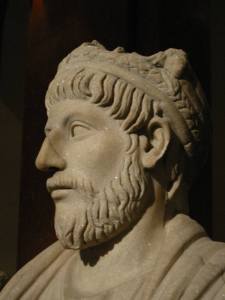
Julian was at this time staying at Parisium, a little town in Germany. The soldiers, ready to march, were supping late at night near the imperial quarters. They were totally unaware of the plot against Caesar* until certain military tribunes discovered the truth about the designs against him and unobtrusively distributed anonymous notes among the troops. In these they described how Caesar, whose generalship had enabled virtually everyone to win victories against the barbarians, and who always fought like a private soldier without privilege, was in grave danger from the emperor**, who was gradually stealing away his troops, unless they combined to prevent the soldiers’ departure. When some of the soldiers read the notes and informed the rest of what was happening, all were inflamed with rage. Thereupon they rose from their drinking in uproar, and going to the imperial quarters with the cups still in their hands, they burst open the doors without ceremony and led Caesar forth. Raising him aloft on a shield, they declared him Imperator Augustus and forced a crown onto his head. Julian was indeed distressed at what had happened, but realised there was no safety in undoing it, since Constantius did not abide by oaths or agreements or any other human pledge. Nevertheless, he decided to try him, so he sent ambassadors saying that his elevation had been contrary to his own wishes and judgement, and that if he would pardon him, he was content to have the honour of Caesar alone and to put aside his diadem. Constantius flew into such a fit of rage and arrogance that he told the ambassadors that, if Julian wanted to
live, he must renounce the rank of Caesar as well as the emperorship, and, thus degraded to private rank, submit himself to the emperor’s pleasure: only in this way would he escape the terrible punishment his audacity deserved. When Julian heard this from the envoys, he openly showed his religious opinions by declaring outright in the hearing of all that he would rather entrust himself and his life to the gods than to Constantius’ assurances. Henceforth Constantius’ enmity to Julian was clear to everyone and he prepared for a civil war. Julian, however, was displeased at how things had turned out, realising that if he fought the man who had given him the position of Caesar, he would gain a reputation with many people for being ungrateful. While he was thus engrossed in considering every possibility in his anxiety to avoid a civil war, the gods revealed the future to him in a dream; for while staying at Vienna he dreamed that the Sun showed him the stars and spoke these verses:
‘When Jupiter reaches the edge of noble Aquarius, and
Saturn comes to Virgo’s twenty-fifth degree, then emperor Constantius, king of Asia, will reach the hateful, painful end of sweet life.’
Heartened by this dream, he devoted himself as usual to public business, and since it was winter time, took the necessary precautions with the barbarians, so that if he should have to undertake any other business, Gaul would be quite secure; at the same time, while Constantius was still in the East, he prepared to anticipate his attack.
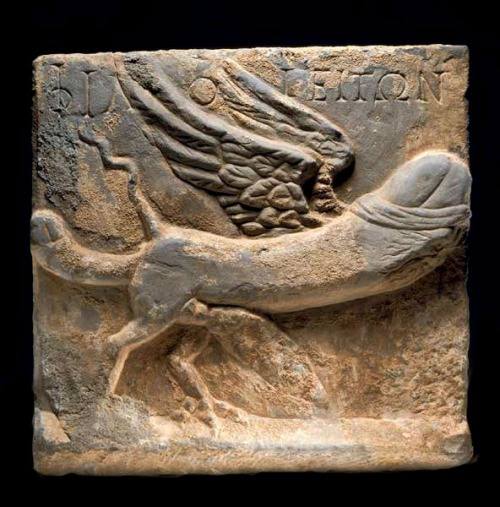
Quando venit tempus ut misereretur Deus, venit Agnus. qualis Agnus quem lupi timent? qualis Agnus est qui leonem occisus occidit? dictus est enim diabolus leo circumiens et rugiens, quaerens quem devoret [1 Petr. 5.8]: sanguine Agni victus est leo. Ecce spectacula Christianorum. et quod est amplius, illi oculis carnis vident vanitatem, nos cordis oculis veritatem. ne putetis, fratres, quod sine spectaculis nos dimisit Dominus Deus noster: nam si nulla sunt spectacula, cur hodie convenistis? ecce quod diximus, vidistis, et exclamastis: non exclamaretis, nisi vidissetis. et magnum est hoc spectare per totum orbem terrarum, victum leonem sanguine Agni, educta de dentibus leonum membra Christi, et adiuncta corpori Christi. ergo nescio quid simile imitatus est quidam spiritus, ut sanguine simulacrum suum emi vellet, quia noverat pretioso sanguine quandocumque redimendum esse genus humanum. fingunt enim spiritus mali umbras quasdam honoris sibimet ipsis, ut sic decipiant eos qui sequuntur Christum. usque adeo, fratres mei, ut illi ipsi qui seducunt per ligaturas, per praecantationes, per machinamenta inimici, misceant praecantationibus suis nomen Christi: quia iam non possunt seducere Christianos, ut dent venenum, addunt mellis aliquid, ut per id quod dulce est, lateat quod amarum est, et bibatur ad perniciem. usque adeo ut ego noverim aliquo tempore illius Pilleati sacerdotem solere dicere: “et ipse Pilleatus christianus est.” ut quid hoc, fratres, nisi quia aliter non possunt seduci Christiani?
(Augustine, In Joh. Evang. Tract. 7.1.6)
When the time came for God to have mercy, the Lamb came. What sort of a Lamb whom wolves fear? What sort of a Lamb is it who, when slain, slew a lion? For the devil is called a lion, going about and roaring, seeking whom he may devour. By the blood of the Lamb the lion was vanquished. Behold the spectacles of Christians. And what is more: they with the eyes of the flesh behold vanity, we with the eyes of the heart behold truth. Do not think, brethren, that our Lord God has dismissed us without spectacles; for if there are no spectacles, why have ye come together today? Behold, what we have said you saw, and you exclaimed; you would not have exclaimed if you had not seen. And this is a great thing to see in the whole world, the lion vanquished by the blood of the Lamb: members of Christ delivered from the teeth of the lions, and joined to the body of Christ. Therefore some spirit or other contrived the counterfeit that His image should be bought for blood, because he knew that the human race was at some time to be redeemed by the precious blood. For evil spirits counterfeit certain shadows of honor to themselves, that they may deceive those who follow Christ. So much so, my brethren, that those who seduce by means of amulets, by incantations, by the devices of the enemy, mingle the name of Christ with their incantations: because they are not now able to seduce Christians, so as to give them poison they add some honey, that by means of the sweet the bitter may be concealed, and be drunk to ruin. So much so, that I know that the priest of that Pilleatus was sometimes in the habit of saying, “Pilleatus himself also is a Christian.” Why so, brethren, unless that they were not able otherwise to seduce Christians? (tr. John Gibb)
This is part 3 of 3. Part 1 is here. Part 2 is here.
‘Mentula, festorum cultrix operosa dierum,
quondam deliciae divitiaeque meae,
quo te deiectam lacrimarum gurgite plangam,
quae de tot meritis carmina digna feram?
tu mihi flagranti succurrere saepe solebas
atque aestus animi ludificare mei.
tu mihi per totam custos gratissima noctem
consors laetitiae tristitiaeque meae,
conscia secreti semper fidissima nostri,
astans internis pervigil obsequiis:
quo tibi fervor abit per quem feritura placebas,
quo tibi cristatum vulnificumque caput?
nempe iaces nullo, ut quondam, perfusa rubore,
pallida demisso vertice nempe iaces.
nil tibi blandities, nil dulcia carmina prosunt,
non quicquid mentem sollicitare solet.
hic velut exposito meritam te funere plango:
occidit, assueto quod caret officio.’
hanc ego cum lacrimis deducta voce canentem
irridens dictis talibus increpui:
‘dum defles nostri languorem, femina, membri,
ostendis morbo te graviore premi.’
illa furens: ‘nescis, ut cerno, perfide, nescis:
non fleo privatum, set generale chaos.
haec genus humanum, pecudum, volucrumque, ferarum
et quicquid toto spirat in orbe, creat.
hac sine diversi nulla est concordia sexus,
hac sine coniugii gratia summa perit.
haec geminas tanto constringit foedere mentes,
unius ut faciat corporis esse duo.
pulcra licet pretium, si desit, femina perdit,
et si defuerit, vir quoque turpis erit.
haec si gemma micans rutilum non conferat aurum
aeternum fallax mortiferumque genus.
tecum pura fides secretaque certa loquuntur,
o vere nostrum fructiferumque bonum!’
(Maximianus, El. 5.88-122)
“Prick, busy celebrator of the holidays,
and old delight and treasure that was mine,
with what fierce flood of tears should I lament your fall?
What songs worth such great service should I bring?
You often were inclined to help me while aroused
and tease me for my spirit’s sultriness.
You were my dearest guardian all through the night,
and partner in my happiness and sadness,
always most trustworthy when privy to our secrets,
standing tall on watch in private rites.
Where did the heat, by which you pleased in foreplay, go?
Where is your crested, wound-inflicting head?
Of course, no longer do you lie engorged with red.
Of course, you lie pale with your drooping crown.
No flattery, no charming songs encourage you,
nothing that tends to stimulate the mind.
I mourn for you here as befits a laid-out corpse;
what lacks its customary use has died.”
As she was singing this in tears, her voice subdued,
I mockingly derided her with these words:
“Woman, while you lament the slackness of my prick,
you show you suffer from a worse disease.”
She raged, “You’re clueless, traitor! Clueless, as I see it!
I mourn a public, not a private, hell.
It makes the human race, the herds, the birds, the beasts
and everything that breathes throughout the world.
Without it there’s no union of the different sexes;
the highest grace of marriage dies without it.
It brings together coupled minds with its strong bond
so that the pair combine to be one flesh.
Though pretty, if it goes, a woman loses value,
and, if it’s gone, a man will be grotesque too.
If this bright gem does not embellish ruddy gold,
a birth is fake and moribund forever.
With you, pure vows and trusted secrets are declared,
O truly fruitful benefit of mine!” (tr. A.M. Juster)
This is part 2 of 3. Part 1 is here. Part 3 is here.
Erubui, stupui. quia tunc verecundia mentem
abstulit et blandum terror ademit opus,
contrectare manu coepit flagrantia membra
meque etiam digitis sollicitare suis.
nil mihi torpenti vel tactus profuit ignis:
perstitit in medio frigus ut ante foco.
‘quae te crudelis rapuit mihi femina?’ dixit,
‘cuius ab amplexu fessus ad arma redis?’
iurabam curis animum mordacibus uri
nec posse ad luxum tristia corda trahi.
illa dolum credens ‘non’ inquit ‘fallis amantem:
plurima certus amor lumina semper habet.
quin potius placido noli’ inquit ‘parcere ludo:
proice tristitias et renovare ioco.
obtundunt siquidem curarum pondera sensus:
intermissa minus sarcina pondus habet.’
tunc egomet toto nudatus corpore lecto
effusis lacrimis talia verba dedi:
‘cogimur, heu, senes crimen vitiumque fateri,
ne meus extinctus forte putetur amor.
me miserum, cuius non est culpanda voluptas!
vindicor infelix debilitatis ope.
en longo confecta situ tibi tradimus arma,
arma ministeriis quippe dicata tuis.
fac quodcumque potes, nos cessimus. hoc tamen ipso
grandior est hostis, quod minus ardet amor.’
protinus argutas admovit turpiter artes
meque cupit flammis vivificare suis.
ast ubi dilecti persensit funera membri
nec velut expositum surgere vidit opus,
erigitur viduoque toro laniata recumbens
vocibus his luctus et sua damna fovet:
(Maximianus, El. 5.55-87)
I blushed, I froze. Since shame then made me lose my mind
and panic cut off the alluring task,
she started fondling my burning prick by hand
and she aroused me with her fingers too.
Even the strokes of passion did not help my numbness;
frost stayed within the hearth, as in the past.
“What bitch has stolen you from me?” she said, “From whose
grasp do you come back tired to my arms?”
I swore my spirit was inflamed by gnawing cares;
sad hearts cannot be drawn to easy living.
Sensing a trick, she says, “You do not fool your lover!
Constant love always has its many eyes.”
She says, “What’s more, do not reject our pleasing play!
Give up your frowns and be restored by fun!
Indeed, if loads of burdens make your senses dull,
‘some easing of the weight’ relieves the load.”
Then, with my body fully naked on the bed,
I spoke with streaming tears some words like these:
“Alas, old men are forced to cop to blame and guilt,
in case it’s thought, perhaps, my love is quenched.
I am a wretch whose appetite is not to blame!
Jinxed, I’m excused by virtue of my weakness.
Look! I give you these arms weak from long disuse—
the arms assigned, of course, for your deployments.
Do what you can; I’ve yielded. For this reason, though,
the foe is stronger since love simmers less.”
She shamefully applied her cunning arts at once
and wanted to revive me with her lusts,
but when she recognized the cherished member’s death,
and saw the tool not rise, as if laid out,
and torn—prone on her widowed bed—she grew aroused
and nursed her grief and damage with these words:
(tr. A.M. Juster)
This is part 1 of 3. Part 2 is here. Part 3 is here.
Illam Sirenis stupefactus cantibus aequans
efficior demens alter Ulixes ego,
et qui non poteram tantas evadere moles
nescius in scopulos et vada caeca feror.
quis referat gressus certa sub lege moventes
suspensosque novis plausibus ire pedes?
grande erat inflexos gradibus numerare capillos,
grande erat in niveo pulla colore coma.
urebant oculos stantes duraeque papillae
et quas astringens clauderet una manus.
ah, quantum mentem stomachi iunctura movebat
atque sub exhausto pectore pingue femur!
terrebar teneros astringere fortiter artus:
visa per amplexus ossa sonare meos.
‘grandia’ clamabat ‘tua nunc me brachia laedunt:
non tolerant pondus subdita membra tuum.’
dirigui, quantusque fuit calor ille recessit
et nata est venae causa pudenda meae.
non lac sic durum permixta coagula reddunt
nec liquidi mollis spuma liquoris erit.
succubui, fateor, Graiae tunc nescius artis,
succubui Tusca simplicitate senex.
qua defensa suo superata est Hectore Troia
unum non poterat fraus superare senem?
muneris iniuncti curam studiumque reliqui
deditus imperiis, saeve Cupido, tuis.
nec memorare pudet tali me vulnere victum:
subditus his flammis Iuppiter ipse fuit.
set mihi prima quidem nox affuit ac sua solvit
munera, grandaevo vix subeunda viro;
proxima destituit vires vacuusque recessit
ardor et in Venerem segnis ut ante fui.
illa velut proprium repetens infesta tributum
instat et increpitat: ‘debita redde mihi!’
sed nihil hic clamor, nil sermo mitis agebat:
quod natura negat, reddere nemo potest.
(Maximianus, El. 5.19-54)
Stunned by her songs, I would compare her to the Sirens,
and while mad I became the new Ulysses,
and I, who was unable to evade such reefs,
was borne off-guard to unseen shoals and rocks.
Who can describe steps moving to a steady beat
that went with fresh applause and arching feet?
It was intense to count her layered waves of hair;
it was intense—dark hair on snowy skin…
Her breasts were standing firm and burning up my eyes,
and with one hand each could be cupped while squeezed.
Ah, how her stomach (joined below by fleshy thighs…)
and her exhausted chest aroused my spirit!
I was scared squeezing her frail limbs aggressively;
bones seemed to crack because of my embraces.
She shouted, “Now your massive arms are hurting me!
My limbs can’t stand to be beneath your bulk!”
I froze, and what had been great lust for her receded,
and my old pecker was a cause for shame.
The well-stirred rennet does not make so firm a curd,
nor will there be light foam on flowing fluid.
I yielded, I confess, unschooled about Greek tricks;
I yielded, an old man with Tuscan dullness.
Couldn’t deceit, through which Hector-guarded Troy
was beaten, triumph over one old man?
I lost concern and fondness for the ordered duties,
cruel Cupid, while enthralled by your commands.
It’s no disgrace recalling loss from such a wound—
Jove was himself subjected to these lusts.
Though my first night had come and paid its pending debt
(one barely handled by an ancient man),
the next one sapped my strength, and hollow passion shrank,
and I was sluggish, as before, at sex.
The hostile girl, as if demanding her own tax,
pursues and snarls, “Return what’s owed to me!”
But here no bluster, no sweet talk was motivating;
what nature cancels, no one can restore.
(tr. A.M. Juster)
Some men, once they had been incarnated, lived unmanly or immoral lives, and it’s plausible to suggest that they were reborn in their next incarnation as women. That, therefore, was when the gods invented sexual desire,* a living being that they formed, though different in men and in women, and endowed with a soul. Here’s how they made each of these creatures. At the point where the channel for drink receives liquid (once it has passed through the lung, behind the kidneys, and into the bladder) and discharges it under pressure from air, they bored a channel into the marrow they had constructed, that extends from the head, down through the neck, and through the spine — that is, the marrow we described earlier as seed. The marrow, as something endowed with soul and now granted an outlet, generated, in the part where the outlet is, a lively appetite for emission and the result was the male yearning for procreation. And this is why men’s sex organs, like a creature which is incapable of listening to reason, are disobedient and headstrong, and, goaded by their frantic appetites, try to have everything their way. To turn to women and the ‘womb’ or ‘uterus’ they possess: there exists inside the womb, for the same purpose, a living being with an appetite for child-making, and so if it remains unproductive long past puberty, it gets irritated and fretful. It takes to wandering all around the body and generating all sorts of ailments, including potentially fatal problems, if it blocks up the air-channels and makes breathing impossible. This goes on until a woman’s appetite for childbearing and a man’s yearning for procreation bring the two of them together and they strip the fruit from the tree, so to speak. They sow in the field of the womb tiny creatures, too small to be seen. At first not fully formed, these creatures then become articulated, while the womb nourishes them until they’ve grown enough to emerge into the light of day. The result of this process, then, is the creation of living creatures. So this is how women and females of any species were created. (tr. Robin Waterfield)
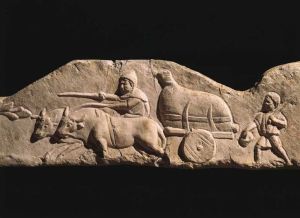
Quae viae in u(rbem) R(omam) sunt erunt intra ea loca, ubi continenti habitabitur, nequis in ieis vieis post k(alendas) Ianuar(ias) primas plostrum interdiu post solem ortum, neve ante horam decimam diei ducito agito, nisi quod aedium sacrarum deorum inmortalium caussa aedificandarum, operisue publice faciumdei causa, adv<e>hei portari oportebit, aut quod ex urbe exve ieis loceis earum rerum, quae publice demolienda<e> loca<tae> erunt, publice exportarei oportebit, et quarum rerum caussa plostra h(ac) l(ege) certeis hominibus certeis de causeis agere ducere licebit.
quibus diebus virgines Vestales regem sacrorum, flamines plostreis in urbe sacrorum publicorum p(opuli) R(omani) caussa vehi oportebit, quaeque plostra triumphi caussa, quo die quisque triumphabit, ducei oportebit, quaeque plostra ludorum, quei Romae <p(ropius) p(assus) mille> publice feient, inve pompam ludeis circiensibus ducei agei opus erit, quo minus earum rerum caussa eisque diebus plostra interdiu in urbe ducantur agantur, e(ius) h(ac) l(ege) n(ihil) r(ogatur).
quae plostra noctu in urbem inducta erunt, quo minus ea plostra inania aut stercoris exportandei caussa, post solem ortum h(oris) (decimis) diei bubus iumenteisve iuncta in u(rbe) R(oma) et ab u(rbe) R(oma) p(assus) mille esse liceat, e(ius) h(ac) l(ege) n(ihil) r(ogatur).
(Lex Iulia Municipalis, CIL I2.593.56-67)
After January 1 next no one shall drive a wagon along the streets of Rome or along those streets in the suburbs where there is continuous housing after sunrise or before the tenth hour of the day, except whatever will be proper for the transportation and the importation of material for building temples of the immortal gods, or for public works, or for removing from the city rubbish from those buildings for whose demolition public contracts have been let. For these purposes permission shall be granted by this law to specified persons to drive wagons for the reasons stated. Whenever it is proper for the vestal virgins, the king of the sacrifices, or the flamens to ride in the city for the purpose of official sacrifices of the Roman people; whatever wagons are proper for a triumphal procession when any one triumphs; whatever wagons are proper for public games within Rome or within one mile of Rome or for the procession held at the time of the games in the Circus Maximus, it is not the intent of this law to prevent the use of such wagons during the day within the city for these occasions and at these times. It is not the intent of this law to prevent ox wagons or donkey wagons that have been driven into the city by night from going out empty or from carrying out dung from within the city of Rome or within one mile of the city after sunrise until the tenth hour of the day. (tr. Allan Chester Johnson, Paul Robinson Coleman-Norton & Frank Card Bourne)
So Belisarius led his army from Naples by the Latin Way, leaving on the left the Appian Way, which Appius, the consul of the Romans, had made nine hundred years before and to which he had given his name. Now the Appian Way is in length a journey of five days for an unencumbered traveller; for it extends from Rome to Capua. And the breadth of this road is such that two waggons going in opposite directions can pass one another, and it is one of the noteworthy sights of the world. For all the stone, which is mill-stone and hard by nature, Appius quarried in another place far away and brought there; for it is not found anywhere in this district. And after working these stones until they were smooth and flat, and cutting them to a polygonal shape, he fastened them together without putting concrete or anything else between them. And they were fastened together so securely and the joints were so firmly closed, that they give the appearance, when one looks at them, not of being fitted together, but of having grown together. And after the passage of so long a time, and after being traversed by many waggons and all kinds of animals every day, they have neither separated at all at the joints, nor has any one of the stones been worn out or reduced in thickness,—nay, they have not even lost any of their polish. Such, then, is the Appian Way. (tr. Henry Bronson Dewing)
Provolutus denique ante conspectum deae et facie mea diu detersis vestigiis eius, lacrimis obortis, singultu crebro sermonem interficiens et verba devorans aio: “tu quidem, sancta et humani generis sospitatrix perpetua, semper fovendis mortalibus munifica, dulcem matris affectionem miserorum casibus tribuis. nec dies nec quies ulla ac ne momentum quidem tenue tuis transcurrit beneficiis otiosum, quin mari terraque protegas homines et depulsis vitae procellis salutarem porrigas dexteram, qua fatorum etiam inextricabiliter contorta retractas licia et Fortunae tempestates mitigas et stellarum noxios meatus cohibes. te superi colunt, observant inferi. tu rotas orbem, luminas solem, regis mundum, calcas Tartarum. tibi respondent sidera, redeunt tempora, gaudent numina, serviunt elementa. tuo nutu spirant flamina, nutriunt nubila, germinant semina, crescunt germina. tuam maiestatem perhorrescunt aves caelo meantes, ferae montibus errantes, serpentes solo latentes, beluae ponto natantes. at ego referendis laudibus tuis exilis ingenio et adhibendis sacrificiis tenuis patrimonio; nec mihi vocis ubertas ad dicenda quae de tua maiestate sentio sufficit, nec ora mille linguaeque totidem vel indefessi sermonis aeterna series. ergo quod solum potest religiosus quidem, sed pauper alioquin, efficere curabo: divinos tuos vultus numenque sanctissimum intra pectoris mei secreta conditum perpetuo custodiens imaginabor.”
(Apuleius, Met. 11.24.7-25)
Finally I prostrated myself before the goddess and wiped her feet for a long time with my face. Tears welled up in me. My voice broke with frequent sobs and I gulped my words as I spoke to her. “O holy and eternal saviour of mankind, you who ever bountifully nurture mortals, you apply the sweet affection of a mother to the misfortunes of the wretched. Neither a day nor a night nor even a tiny moment passes empty of your blessings: you protect men on sea and land, and you drive away the storm-winds of life and stretch forth your rescuing hand, with which you unwind the threads of the Fates even when they are inextricably twisted, you calm the storms of Fortune, and you repress harmful motions of the stars. The spirits above revere you, the spirits below pay you homage. You rotate the earth, light the sun, rule the universe, and tread Tartarus beneath your heel. The stars obey you, the seasons return at your will, deities rejoice in you, and the elements are your slaves. At your nod breezes breathe, clouds give nourishment, seeds sprout, and seedlings grow. Your majesty awes the birds travelling in the sky, the beasts wandering upon the mountains, the snakes lurking in the ground, and the monsters that swim in the deep. But my talent is too feeble to speak your praises and my inheritance too meagre to bring you sacrifices. The fullness of my voice is inadequate to express what I feel about your majesty; a thousand mouths and as many tongues would not be enough, nor even an endless flow of inexhaustible speech. I shall therefore take care to do the only thing that a devout but poor man can: I shall store your divine countenance and sacred godhead in the secret places of my heart, forever guarding it and picturing it to myself.” (tr. John Arthur Hanson)






 Crambe Repetita