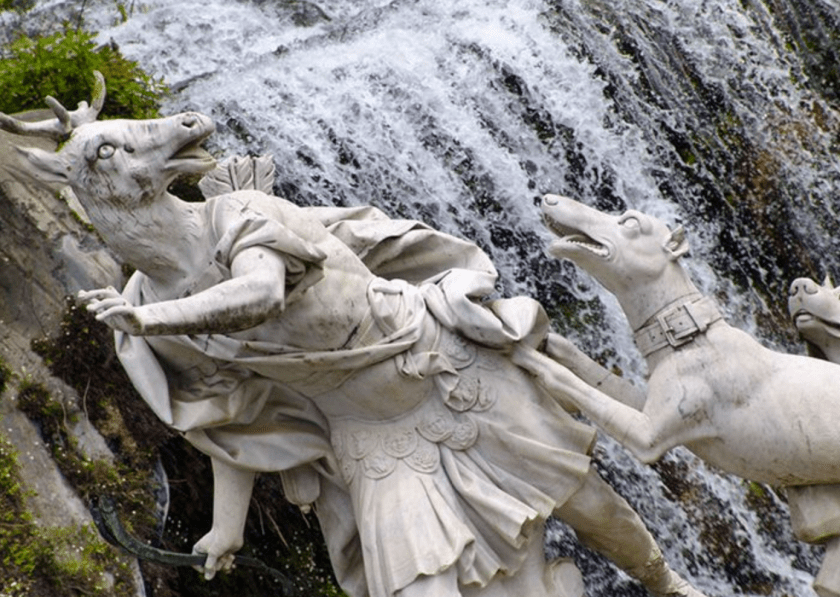
Dilacerant

Paolo Persico, Pietro Solari & Angelo Brunelli, Actaeonfontein, Caserta (detail)
The Actaeon fountain at Caserta

This is part 3 of 3. Part 1 is here. Part 2 is here.

Ille fugit, per quae fuerat loca saepe secutus,
heu famulos fugit ipse suos! clamare libebat:
‘Actaeon ego sum, dominum cognoscite vestrum!’
verba animo desunt; resonat latratibus aether.
prima Melanchaetes in tergo vulnera fecit,
proxima Therodamas, Oresitrophos haesit in armo:
tardius exierant, sed per compendia montis
anticipata via est; dominum retinentibus illis,
cetera turba coit confertque in corpore dentes.
iam loca vulneribus desunt; gemit ille sonumque,
etsi non hominis, quem non tamen edere possit
cervus, habet maestisque replet iuga nota querellis
et genibus pronis supplex similisque roganti
circumfert tacitos tamquam sua bracchia vultus.
at comites rapidum solitis hortatibus agmen
ignari instigant oculisque Actaeona quaerunt
et velut absentem certatim Actaeona clamant
(ad nomen caput ille refert) et abesse queruntur
nec capere oblatae segnem spectacula praedae.
vellet abesse quidem, sed adest; velletque videre,
non etiam sentire canum fera facta suorum.
undique circumstant, mersisque in corpore rostris
dilacerant falsi dominum sub imagine cervi,
nec nisi finita per plurima vulnera vita
ira pharetratae fertur satiata Dianae.
(Ovid, Met. 3.228-252)

…and he flees the hunt
he has so often led, longing to cry out
to the pack behind him “It’s me! Actaeon!
Recognize your master!” But the words
betray him and the air resounds with baying.
Now Brownie and Buster leap onto his back
while Mountain Climber dangles from one shoulder;
they’d started late but figured out a shortcut
across the hilltop; now he’s held at bay
until the pack can gather and begin
to savage him: torn by their teeth, he makes
a sound no man would make and no stag either,
a cry that echoes through those well-known heights;
and kneeling like a suppliant at prayer,
he turns toward them, pleading with his eyes,
as a man would with his hands.
But his companions
loudly encourage the ferocious pack,
all unaware: they look around for him,
call out to him as though he weren’t there;
“Actaeon!” “Pity he’s not here with us!”
And hearing his own name, he turns his head:
he might wish to be elsewhere, but he’s present,
and might wish merely to be watching this,
rather than feeling the frenzy of his dogs
who press around him, thrusting pointed snouts
into the savaged body of their master,
convinced that he’s a stag.
And it is said
he did not die until his countless wounds
had satisfied Diana’s awful wrath.
(tr. Charles Martin)

Cornua

Öèôðîâàÿ ðåïðîäóêöèÿ íàõîäèòñÿ â èíòåðíåò-ìóçåå Gallerix.ru
Giuseppe Cesari, Diana e Atteone (ca. 1606)

This is part 2 of 3. Part 1 is here. Part 3 is here.

Dumque ibi perluitur solita Titania lympha,
ecce nepos Cadmi dilata parte laborum
per nemus ignotum non certis passibus errans
pervenit in lucum: sic illum fata ferebant.
qui simul intravit rorantia fontibus antra,
sicut erant, nudae viso sua pectora nymphae
percussere viro subitisque ululatibus omne
implevere nemus circumfusaeque Dianam
corporibus texere suis; tamen altior illis
ipsa dea est colloque tenus supereminet omnes.
qui color infectis adversi solis ab ictu
nubibus esse solet aut purpureae Aurorae,
is fuit in vultu visae sine veste Dianae.
quae, quamquam comitum turba est stipata suarum,
in latus obliquum tamen adstitit oraque retro
flexit et, ut vellet promptas habuisse sagittas,
quas habuit, sic hausit aquas vultumque virilem
perfudit spargensque comas ultricibus undis
addidit haec cladis praenuntia verba futurae:
‘nunc tibi me posito visam velamine narres,
si poteris narrare, licet!’ nec plura minata
dat sparso capiti vivacis cornua cervi,
dat spatium collo summasque cacuminat aures,
cum pedibusque manus, cum longis bracchia mutat
cruribus et velat maculoso vellere corpus;
additus et pavor est. fugit Autonoeius heros
et se tam celerem cursu miratur in ipso.
ut vero vultus et cornua vidit in unda,
‘me miserum!’ dicturus erat: vox nulla secuta est;
ingemuit: vox illa fuit, lacrimaeque per ora
non sua fluxerunt; mens tantum pristina mansit.
(Ovid, Met. 3.173-203)

And while Diana bathes as usual,
see where Actaeon on a holiday,
wandering clueless through the unfamiliar
forest, now finds his way into her grove,
for so Fate had arranged.
At sight of him
within the misty precincts of their grotto,
the naked nymphs began to beat their breasts
and filled the grove with shrill and startled cries;
in their concern, they poured around Diana,
attempting to conceal her with a screen
of their own bodies, but to no avail,
for the goddess towered over all of them.
The color taken from the setting sun
by western clouds, so similar to that
which rosy-tinted Dawn so often shows,
was the same color on Diana’s face
when she was seen undressed. And even though
her virgin comrades squeezed themselves around her,
she managed to turn sideways and look back
as if she wished she had her arrows handy—
but making do with what she had, scooped up
water and flung it in Actaeon’s face,
sprinkling his hair with the avenging droplets,
and adding words that prophesied his doom:
“Now you may tell of how you saw me naked,
tell it if you can, you may!”
No further warning:
the brow which she has sprinkled jets the horns
of a lively stag; she elongates his neck,
narrows his eartips down to tiny points,
converts his hands to hooves, his arms to legs,
and clothes his body in a spotted pelt.
Lastly, the goddess endows him with trembling fear:
that heroic son of Autonoe flees,
surprised to find himself so swift a runner.
But when he stopped and looked into a pool
at the reflection of his horns and muzzle—
“Poor me!” he tried to say, but no words came,
only a groaning sound, by which he learned
that groaning was now speech; tears streamed down cheeks
that were no longer his: only his mind
was left unaltered by Diana’s wrath.
(tr. Charles Martin)

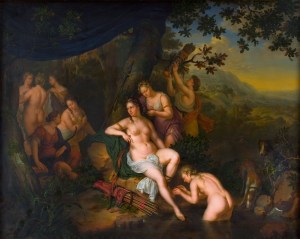
Nemorale

Willem van Mieris, Diana en haar nimfen, 1702
Willem van Mieris, Diana en haar nimfen (1702)

This is part 1 of 3. Part 2 is here. Part 3 is here.

Vallis erat piceis et acuta densa cupressu,
nomine Gargaphie, succinctae sacra Dianae,
cuius in extremo est antrum nemorale recessu
arte laboratum nulla: simulaverat artem
ingenio natura suo; nam pumice vivo
et levibus tofis nativum duxerat arcum.
fons sonat a dextra tenui perlucidus unda,
margine gramineo patulos incinctus hiatus.
hic dea silvarum venatu fessa solebat
virgineos artus liquido perfundere rore.
quo postquam subiit, nympharum tradidit uni
armigerae iaculum pharetramque arcusque retentos,
altera depositae subiecit bracchia pallae,
vincla duae pedibus demunt; nam doctior illis
Ismenis Crocale sparsos per colla capillos
colligit in nodum, quamvis erat ipsa solutis.
excipiunt laticem Nepheleque Hyaleque Rhanisque
et Psecas et Phiale funduntque capacibus urnis.
(Ovid, Met. 3.155-172)

There is a grove of pine and cypresses
known as Gargraphie, a hidden place
most sacred to the celibate Diana;
and deep in its recesses is a grotto
artlessly fabricated by the genius
of Nature, which, in imitating Art,
had shaped a natural organic arch
out of the living pumice and light tufa.
Before this little grotto, on the right,
a fountain burbles; its pellucid stream
widens to form a pool edged round with turf;
here the great goddess of the woods would come
to bathe her virgin limbs in its cool waters,
when hunting wearied her.
She is here today;
arriving, she hands the Armoress of Nymphs
her spear, her quiver, and her unstrung bow;
and while one nymph folds her discarded robe
over an arm, two more remove her sandals,
and that accomplished Theban nymph, Crocale,
gathers the stray hairs on Diana’s neck
into a knot (we cannot help but notice
that her own hair is left in careless freedom!);
five other nymphs, whose names are Nephele,
Hyale, Rhanis, Psecas, and Phiale,
fetch and pour water from enormous urns.
(tr. Charles Martin)

Dialuesthai

marriage-420x420

Λύεται ὁ ἀνὴρ ἀπὸ γυναικὸς διὰ τοιαύτας αἰτίας· ἐὰν ἡ γυνὴ πορνεύσῃ· ἐὰν ἐπιβουλεύσηται οἱῳδήποτε τρόπῳ τῇ ζωῇ αὐτοῦ, ἢ ἐπισταμένη ἑτέρους ἐπιβουλεύοντας, μὴ καταμηνύσῃ αὐτῷ· καὶ ἐὰν λωβή ἐστιν. ὁμοίως δὲ λύεται καὶ γυνὴ ἀπὸ τοῦ ἀνδρὸς διὰ τοιαύτας αἰτίας· ἐὰν ἀδυνατήσῃ ὁ ἀνὴρ ἐπὶ τριετίᾳ ἀπὸ καιροῦ τοῦ συναλλάγματος τοῦ γαμικοῦ τῇ οἰκείᾳ μιγῆναι γυναικί· ἐὰν ἐπιβουλεύσηται οἱῳδήτινι τρόπῳ τῇ ζωῇ αὐτῆς, ἢ ἐπιστάμενος ἑτέρους ἐπιβουλεύοντας, μὴ καταμηνύσῃ αὐτῇ, καὶ ἐὰν λωβός ἐστιν· εἰ δὲ συμβῇ ἐξ αὐτῶν ἕνα μετὰ τὸν γάμον ἢ πρὸ τοῦ γάμου ὑπὸ δαίμονος κυριευθῆναι, τούτους ἐκ τῆς τοιαύτης αἰτίας ἀπ’ ἀλλήλων μὴ χωρίζεσθαι· ἄνευ τε τῶν αἰτιῶν τούτων τῶν γνωριζομένων, μὴ δύνασθαι ἀνδρόγυνον διαλύεσθαι κατὰ τὸ γεγραμμένον ὅτι, οὓς ὁ θεὸς ἔζευξεν, ἄνθρωπος μὴ χωριζέτω.
(Ecloga 2.9.2-4)

A husband may divorce his wife on the following grounds: if his wife commits fornication; if she plots in any way against his life, or knows another who plots against him and does not inform him; and if she is a leper. Likewise, a wife may be separated from her husband on these grounds: if within three years of the marriage the husband is unable to have intercourse with his wife; if he plots in any way against her life, or knows another who plots against her and does not inform her; and if he is a leper. And if it should happen that either of them should after the marriage be possessed by a demon, they shall not be separated from one another due to such a cause. Except on these known grounds it is not possible to dissolve a marriage, for as it is written, ‘those whom God has joined let no man put asunder.’ [Matthew 19:6; Mark 10:9] (tr. Mike Humphreys)

Mentimur

romulusvultures1

This is part 3 of 3. Part 1 is here. Part 2 is here.

Vulturis ut primum laevo fundata volatu
Romulus infami complevit moenia luco,
usque ad Thessalicas servisses, Roma, ruinas.
de Brutis, Fortuna, queror. quid tempora legum
egimus aut annos a consule nomen habentes?
felices Arabes Medique Eoaque tellus,
quam sub perpetuis tenuerunt fata tyrannis.
ex populis qui regna ferunt sors ultima nostra est,
quos servire pudet. sunt nobis nulla profecto
numina: cum caeco rapiantur saecula casu,
mentimur regnare Iovem. spectabit ab alto
aethere Thessalicas, teneat cum fulmina, caedes?
scilicet ipse petet Pholoën, petet ignibus Oeten
immeritaeque nemus Rhodopes pinusque Mimantis,
Cassius hoc potius feriet caput? astra Thyestae
intulit et subitis damnavit noctibus Argos:
tot similes fratrum gladios patrumque gerenti
Thessaliae dabit ille diem? mortalia nulli
sunt curata deo. cladis tamen huius habemus
vindictam, quantam terris dare numina fas est:
bella pares superis facient civilia divos,
fulminibus manes radiisque ornabit et astris
inque deum templis iurabit Roma per umbras.
(Lucan, Bell. Civ. 7.437-459)

Ever since Romulus founded his city by the flight of a vulture on the left, and peopled it with the criminals of the Asylum, down to the catastrophe of Pharsalia, Rome ought to have remained in slavery. I have a grudge against Fortune on the score of the Bruti*. Why did we enjoy a period of lawful government, or years named after the consuls? Fortunate are the Arabs and Medes and Eastern nations, whom destiny has kept continuously under tyrants. Of all the nations that endure tyranny our lot is the worst, because we blush for our slavery. In very truth there are no gods who govern mankind: though we say falsely that Jupiter reigns, blind chance sweeps the world along. Shall Jupiter, though he grasps the thunderbolt, look on idly from high heaven at the slaughter of Pharsalia? Shall he forsooth aim his fires at Pholoe and Oeta, at the pines of Mimas and the innocent forest of Rhodope, and shall Cassius, rather than he, strike Caesar down ? He brought night upon Thyestes and doomed Argos to premature darkness; will he then grant daylight to Pharsalia that sees the guilt as great, of so many swords wielded by brothers and fathers? Man’s destiny has never been watched over by any god. Yet for this disaster
we have revenge, so far as gods may give satisfaction to mortals: civil war shall make dead Caesars the peers of gods above; and Rome shall deck out dead men with thunderbolts and haloes and constellations, and in the temples of the gods shall swear by ghosts.

* He refers to the Brutus who expelled the Tarquins.

(tr. James Duff Duff, with his note)

Funesta

civil war

This is part 2 of 3. Part 1 is here. Part 3 is here.

Pro tristia fata!
aëra pestiferum tractu morbosque fluentes
insanamque famem permissasque ignibus urbes
moeniaque in praeceps laturos plena tremores
hi possunt explere viri, quos undique traxit
in miseram Fortuna necem, dum munera longi
explicat eripiens aevi, populosque ducesque
constituit campis, per quos tibi, Roma, ruenti
ostendat quam magna cadas. quae latius orbem
possedit, citius per prospera fata cucurrit?
omne tibi bellum gentes dedit, omnibus annis
te geminum Titan procedere vidit in axem;
haud multum terrae spatium restabat Eoae,
ut tibi nox, tibi tota dies, tibi curreret aether,
omniaque errantes stellae Romana viderent.
sed retro tua fata tulit par omnibus annis
Emathiae funesta dies. hac luce cruenta
effectum, ut Latios non horreat India fasces,
nec vetitos errare Dahas in moenia ducat
Sarmaticumque premat succinctus consul aratrum,
quod semper saevas debet tibi Parthia poenas,
quod fugiens civile nefas redituraque numquam
Libertas ultra Tigrim Rhenumque recessit
ac, totiens nobis iugulo quaesita, vagatur
Germanum Scythicumque bonum, nec respicit ultra
Ausoniam, vellem, populis incognita nostris.
(Lucan, Bell. Civ. 7.411-436)

O cruel destiny! Air fatal to inhale, and epidemic disease; maddening famine, cities consigned to the flames, and earthquakes that could bring to ruin populous cities—all these might be glutted by the men whom Fortune drew from every quarter to premature death, snatching away the gifts of long ages even while she displayed them, and arraying nations and chiefs upon the battle-field; by them she wished to show to collapsing Rome, what greatness fell with her. What city ever possessed a wider empire, or ran more quickly from success to success? Each war added nations to Rome; each year the sun saw her move forward towards either pole; a small part of the East excepted, night, and day from beginning to end, and all the sky revolved for Rome, and the stars in their courses saw nothing that was not hers. But the fatal day of Pharsalia reversed her destiny and undid the work of all the past. Thanks to that bloody field, India dreads not the Roman rods, no Roman consul arrests the nomad Dahae and makes them dwell in cities, or leans on the plough* in Sarmatia with his robe looped up; it is owing to Pharsalia that Parthia still owes us stern retribution, and that Freedom, banished by civil war, has retreated beyond the Tigris and the Rhine, never to return; often as we have wooed her with our life-blood, she wanders afar, a blessing enjoyed by Germans and Scythians, and never turns an eye on Italy: would that our nation had never known her!

* In ancient times it was the business of the consul to trace out with the plough the limits of a colony planted in a conquered country. The Dahae were nomads who wandered over the plains to the East of the Caspian.

(tr. James Duff Duff, with his note)

Pharsalia

pharsalia2

This is part 1 of 3. Part 2 is here. Part 3 is here.

Ergo utrimque pari procurrunt agmina motu
irarum; metus hos regni, spes excitat illos.
hae facient dextrae, quidquid nona explicat aetas,
ut vacet a ferro. gentes Mars iste futuras
obruet et populos aevi venientis in orbem
erepto natale feret. tunc omne Latinum
fabula nomen erit; Gabios Veiosque Coramque
pulvere vix tectae poterunt monstrare ruinae
Albanosque lares Laurentinosque penates,
rus vacuum, quod non habitet nisi nocte coacta
invitus questusque Numam iussisse senator.
non aetas haec carpsit edax monimentaque rerum
putria destituit: crimen civile videmus
tot vacuas urbes. generis quo turba redacta est
humani! toto populi qui nascimur orbe
nec muros inplere viris nec possumus agros;
urbs nos una capit. vincto fossore coluntur
Hesperiae segetes, stat tectis putris avitis
in nullos ruitura domus, nulloque frequentem
cive suo Romam sed mundi faece repletam
cladis eo dedimus, ne tanto in corpore bellum
iam possit civile geri. Pharsalia tanti
causa mali. cedant, feralia nomina, Cannae
et damnata diu Romanis Allia fastis.
tempora signavit leviorum Roma malorum,
hunc voluit nescire diem.
(Lucan, Bell. Civ. 7.385-411)

Therefore the armies rushed forward, each inspired with the same passionate ardour, the one eager to escape a tyranny, the other to gain it. These hands will bring it to pass that, whatever the ninth century* unfolds, it shall be free from warfare. This battle will destroy nations yet unborn; it will deprive of their birthtime and sweep away the men of the generation coming into the world. Then all the Latin race will be a legend; dust-covered ruins will scarce be able to indicate the site of Gabii and Veii and Cora, the houses of Alba and the dwellings of Laurentum—a depopulated country, where no man dwells except the senators who are forced to spend one night there by Numa’s law which they resent**. It is not the tooth of time that has wrought this destruction and consigned to decay the memorials of the past: in all these uninhabited cities we see the guilt of civil war. How far reduced are the numbers of the human race! All the people born on earth cannot supply inhabitants for town or country; a single city contains us all. The corn-fields of Italy are tilled by chained labourers; the ancient roof-tree is rotten and ready to fall, but none dwell beneath it; Rome is not peopled by her own citizens but swarms with the refuse of mankind, and we have sunk her so low, that civil war, for all her many inmates, is no longer possible. Pharsalia is the cause of so great a mischief. The fatal names of Cannae and of Allia, cursed long ago by the Roman Calendar, must give place to Pharsalia. Rome has marked the date of lighter calamities, but has decided to ignore this day.

* Lucan lived in the ninth century from the foundation of Rome. The lack of men in that age was due, he says, to the slaughter of Pharsalia.
** The Roman consuls had to be present at Alba for the celebration of the Latin Festival.

(tr. James Duff Duff, with his notes)

Athēnaion

greece-schools
Ἐγένετο δὲ καὶ Λακεδαιμονίοις μάντευμα ἐκ Δελφῶν τὸν Ἀθηναῖον ἐπάγεσθαι σύμβουλον. ἀποστέλλουσιν οὖν παρὰ τοὺς Ἀθηναίους τόν τε χρησμὸν ἀπαγγελοῦντας καὶ ἄνδρα αἰτοῦντας παραινέσοντα ἃ χρή σφισιν. Ἀθηναῖοι δὲ οὐδέτερα θέλοντες, οὔτε Λακεδαιμονίους ἄνευ μεγάλων κινδύνων προσλαβεῖν μοῖραν τῶν ἐν Πελοποννήσῳ τὴν ἀρίστην οὔτε αὐτοὶ παρακοῦσαι τοῦ θεοῦ, πρὸς ταῦτα ἐξευρίσκουσι καὶ—ἦν γὰρ Τυρταῖος διδάσκαλος γραμμάτων νοῦν τε ἥκιστα ἔχειν δοκῶν καὶ τὸν ἕτερον τῶν ποδῶν χωλός—τοῦτον ἀποστέλλουσιν ἐς Σπάρτην. ὁ δὲ ἀφικόμενος ἰδίᾳ τε τοῖς ἐν τέλει καὶ συνάγων ὁπόσους τύχοι καὶ τὰ ἐλεγεῖα καὶ τὰ ἔπη σφίσι τὰ ἀνάπαιστα ᾖδεν.
(Pausanias 4.15.6)
The Lacedaemonians received an oracle from Delphi to procure the Athenian as counsellor. They therefore despatched messengers to the Athenians to announce the oracle and asked for a man to advise them what they should do. The Athenians, unwilling either that the Lacedaemonians should annex the best part of the Peloponnese without great risk or that they themselves should take no heed of the god, devised accordingly. There was a schoolmaster, Tyrtaeus, who seemed to have little sense and who was lame in one foot, and they sent him to Sparta. Upon his arrival he sang his elegiac and anapaestic verses, both privately to those in office and to as many as he could gather together. (tr. Douglas E. Gerber)

Lutetia

ile de la cite
Île de la Cité, Paris

Musarum sedes, regina Lutetia, salve!
Francigenae tu metropolis pulcherrima gentis,
hospitio regem grato regisque ministros
excipis, et reliquas das iura suprema per urbes.
quis cives, populosa, tuos? quis condita iussu,
Carole magne, tuo, doctis collegia Musis?
aut iuvenes numerare queat, legumque peritos
causidicos? recitare loci quis commoda possit?
ipse bipartito rapidus te Sequana cursu
dividit, et gemino circumdatur insula tractu,
insula mirandis adeo quae pontibus urbi
iungitur, ut nisi praemonitus, disgnoscere pontes
a vicis nequeas reliquis, sic omnia miris
aedificata modis: sic ceu tellure locatae
stant utrimque domus, gemmis auroque repletae.
Sequana sed tacitis has subterlabitur undis.
omnibus in magnae strepitum quid partibus urbis,
obstantesque adeo turbas, gressusque morantem,
sint completa licet totis habitacula vicis,
commemorem? obstupui, fateor, quando omnia vidi
totis plena foris, et proclamata subinde
hic quaecumque velis cornu tam divite fundi.
quae si cuncta canam, quot habet Sorbona sophistas,
aut citius monachos totam numerabo per urbem.
(Nathan Chytraeus, Hodoeporica: Iter Parisiense 453-476)

Hail to you, queen Lutetia, abode of the Muses, you magnificent capital of the French people! In a pleasant environment you shelter the king and the king’s servants, and you dictate the supreme law to the other cities. O populous one, who could count your inhabitants, or the colleges founded for the learned Muses by your order, Charlemagne? Who could keep a tally of all the students or all the lawyers, experts in legislation? Who could enumerate the advantages of your location? The swift Seine’s flow divides you into two parts, and surrounded by its two branches there is an island—an island that is joined to the city by such spectacular bridges that for the uninformed it’s impossible to distinguish them from the other streets: in such impressive ways is every part of them constructed. It’s as if the houses on both sides, overflowing with jewels and gold, are erected on solid earth, while in reality the Seine glides underneath with its silent waves. Why should I tell of the hubbub in every quarter of this great city? Why speak of the throngs that block one’s way and hamper one’s progress even though in every street the houses are packed? I admit, I was amazed to see all the markets with all things in abundance, immediately peddled to the shoppers; amazed to see anything one could wish for poured out here from such a horn of plenty. If I were to sing of all that, I could sooner count how many sophists there are at the Sorbonne, or the number of monks in the entire city! (tr. David Bauwens)

Aufugit

roman gays

Aufugit mi animus; credo, ut solet, ad Theotimum
devenit. sic est; perfugium illud habet.
quid si non interdixem ne illunc fugitivum
mitteret ad se intro, sed magis eiceret?
ibimus quaesitum. verum, ne ipsi teneamur,
formido. quid ago? da, Venus, consilium.
(Catulus, fr. 1)

My soul has run away; to Theotimus, I think, as usual, it has fled. So it is: it always has him as sanctuary. It’s not as if I hadn’t forbidden him to admit that runaway to his home, but to throw him out. We shall go in search. But I’m afraid we’ll be caught as well. What to do? Venus, advise. (tr. Peter E. Knox)