Ensiferos

Giovanni Battista Cipriani, Chiron leert Achilles boogschieten, 1776
Giovanni Battista Cipriani, Chiron instructing Achilles in the bow (1776)

This is part 2 of 3. Part 1 is here. Part 3 is here.

‘Vix mihi bissenos annorum torserat orbes
vita rudis, volucris cum iam praevertere cervos
et Lapithas cogebat equos praemissaque cursu
tela sequi; saepe ipse gradu me praepete Chiron,
dum velox aetas, campis admissus agebat
omnibus, exhaustumque vago per gramina passu
laudabat gaudens atque in sua terga levabat.
saepe etiam primo fluvii torpore iubebar
ire supra glaciemque levi non frangere planta.
hoc puerile decus. quid nunc tibi proelia dicam
silvarum et saevo vacuos iam murmure saltus?
numquam ille imbelles Ossaea per avia dammas
sectari aut timidas passus me cuspide lyncas
sternere, sed tristes turbare cubilibus ursos
fulmineosque sues, et sicubi maxima tigris
aut seducta iugis fetae spelunca leaenae.
ipse sedens vasto facta exspectabat in antro,
si sparsus nigro remearem sanguine; nec me
ante nisi inspectis admisit ad oscula telis.
iamque et ad ensiferos vicina pube tumultus
aptabar, nec me ulla feri Mavortis imago
praeteriit. didici, quo Paeones arma rotatu,
quo Macetae sua gaesa citent, quo turbine contum
Sauromates falcemque Getes arcumque Gelonus
tenderet et flexae Balearicus actor habenae
quo suspensa trahens libraret vulnera tortu
inclusumque suo distingueret aëra gyro.
vix memorem cunctos, etsi bene gessimus, actus.’
(Statius, Ach. 110-137)

‘Scarce had my raw life turned twice six years when he had me run faster than the swift stags and Lapith horses and chase the darts I flung. Often would Chiron himself, while his age ran swift, pursue me at gallop all over the plains in headlong career, and when I was exhausted in my wanderings through the meads he would joyfully praise me and hoist me onto his back. Often too at the first freezing of the river he would bid me walk over it nor break the ice with lightsome foot. Such was my boyish glory. Why tell you of forest fights and glens now empty of savage growls? He would never let me chase unwarlike deer through Ossa’s wilds or lay timid lynxes low with my spear; I must rouse grim bears from their dens and boars like thunderbolts or mayhap a mighty tigress’ lair or a hidden cavern on the mountain that housed a lioness and her cubs. Himself would sit in his vast cave and wait for my exploits: would I return splashed with black blood? Nor did he admit me to his kiss until he had inspected my weapons. And now I was making ready for affrays of the sword with my neighbour folk; no aspect of fierce Mavors passed me by. I learned how the Paeonians whirl their arms, how the Macetae speed their javelins, with what a spin the Sarmatian plies his stake, the Gete his falchion, the Gelonian his bow, how the Balearic driver of the twisted sling swings his missile aloft with balanced pull, marking out the air he comprises in its circle. I could scarce recall all I did, though I did it well.’ (tr. David Roy Shackleton-Bailey)

Invia

James Barry, The education of Achilles, ca. 1772
James Barry, The education of Achilles (ca. 1772)

This is part 1 of 3. Part 2 is here. Part 3 is here.

Excipit Oenides: “Quin, o dignissima caeli
progenies, ritusque tuos elementaque primae
indolis et, valida mox accedente iuventa,
quae solitus laudum tibi semina pandere Chiron
virtutisque aditus, quas membra augere per artes,
quas animum, sociis multumque faventibus edis?
sit pretium longas penitus quaesisse per undas
Scyron et his primum me arma ostendisse lacertis.”
quem pigeat sua facta loqui? tamen ille modeste
incohat, ambiguus paulum propiorque coacto:
“dicor et in teneris et adhuc reptantibus annis,
Thessalus ut rigido senior me monte recepit,
non ullos ex more cibos hausisse nec almis
uberibus satiasse famem, sed spissa leonum
viscera semianimisque lupae traxisse medullas.
haec mihi prima Ceres, haec laeti munera Bacchi,
sic dabat ille pater. mox ire per invia secum
lustra gradu maiore trahens visisque docebat
adridere feris nec fracta ruentibus undis
saxa nec ad vastae trepidare silentia silvae.
iam tunc arma manu, iam tunc cervice pharetrae,
et ferri properatus amor durataque multo
sole geluque cutis; tenero nec fluxa cubili
membra, sed ingenti saxum commune magistro.”
(Statius, Ach. 86-109)

Oeneus’ son takes over: ‘Nay, most worthy scion of heaven, why not tell your right favouring comrades of your ways, the rudiments of earliest anture and what Chrion showed you as presently strong manhood came on; the seeds of glory, the path to valour, the arts to make your body grow and your mind. Let it be worth while that I have sought Scyros over the length of waves and been the first to show weapons to these arms of yours.’
Whom would it irk to tell of his own deeds? Yet he begins modestly, a little hesitant, rather as if constrained: ‘They say that in my tender years, still crawling, when the old man of Thessaly received me on his stark mountain, I took no ordinary food nor satisfied hunger from nurturing breasts, but tore at the tough flesh of lions and offal of a she-wolf still half alive. This was my first bread, this the gift of happy Bacchus*, thus that father of mine used to feed me. Presently he taught me to go with him through the trackless wilderness, drawing me on with his wider stride, and to laugh when I saw wild beasts and not to fear rocks shattered by rushing torrents and the silences of the vast forest. Even then arms were in my hand, even then a quiver at my neck, precocious love of steel, skin hardened by sun and frost in plenty, limbs not loosened by soft bedding, but a rock shared with my huge master.’

* But nothing has been said about what Achilles had to drink – unless a line has fallen out after 100.

(tr. David Roy Shackleton-Bailey, with his note)

Luditur

OLYMPUS DIGITAL CAMERA

Scholae dictae sunt, non ab otio ac vacatione omni, sed quod, ceteris rebus omissis, vacare liberalibus studiis pueri debent; ut etiam ludi appellantur, in quibus minime luditur, ne tristi aliquo nomine fug<iunt pueri suo fungi mu>nere.
(Festus, De Verborum Significatu p. 470 Lindsay)

Schools are called scholae (lit. spare time), not because one enjoys leisure or freedom from all work there, but because children should set all else aside and invest their ‘free time’ in the liberal studies. Likewise they are called ludi (lit. games), even though there’s no ‘playing’ (ludere) whatsoever in them, lest a less cheerful name would discourage children from doing their duty. (tr. David Bauwens)

Militem: Aelius a mollitia κατὰ ἀντίφρασιν dictum putat, eo, quod nihil molle, sed potius asperum quid gerat; sic ludum dicimus, in quo minime luditur.
(Paulus Diaconus, Epitoma Festi p. 109 Lindsay)

Soldier: Aelius thinks the world for soldier (miles) is derived by antiphrasis from mollitia (weakness), because they do nothing that is weak, on the contrary: they do what is rough. Likewise we say ludus (school), even though there’s no ‘playing’ (ludere) there. (tr. David Bauwens)

Lucus quia umbra opacus parum luceat et ludus quia sit longissime a lusu et Ditis quia minime dives.
(Aelius Stilo fr. 59 Funaioli)

A grove is called lucus because on account of all the shadows there’s hardly any light (lux) there; a school is called ludus because it’s very far from any kind of play (lusus); and we call Pluto Dis or Ditis because he’s hardly rich (dives). (tr. David Bauwens)

Voadicia

boudicca_watercolor-57e8172d3df78c690f26e8af

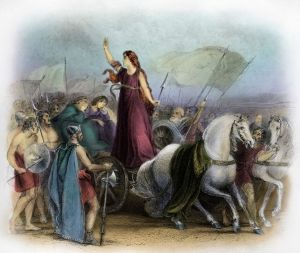
Sed Voadicia cum primis animos incedebat, questa iniurias quas a Romanis accepisset, et quia ipsa ante alios acerrimo erat in hostes odio, igitur ea duce (non enim in imperiis sexum discernebant) factum est ut magna populi pars, commotis etiam ad alienationem officii Trinobantibus, repente a Romanis defecerit, armaque in suos praecipitanter sumpserit. primo itaque insulanorum motu veterani perculsi templum quoddam occuparunt, ubi omnes ad unum interfecti sunt. inde legio nova, quae Peti Cerealis legati ductu iis subsidio venerat, fusa caesaque est. Catus Decianus Britanniae procurator media trepidatione delapsus in Galliam transiit. pervagatus inde est furor Britannorum usque Verulamium municipium per Romanorum civium ac sociorum capita, occisaque dicuntur ex multitudine imbelli ad septuaginta hominum milia. nec multo post Paulinus adfuit Londinumque perrexit, ambiguus an illam sedem bello deligeret. qui tamen inde degressus locum coepit arctis faucibus, et a tergo silva clausum ita ut sine insidiarum metu esset, certo sciens non posse nisi a fronte invadi, qui secum circiter armatorum milia decem habebat, quibus fretus cum multitudine hostium immensa conflixit. Britanni longe maiore bellatorum numero praestabant, qui idcirco tam certa spe victoriae pugnam pugnare coeperunt ut mulieres curribus stantes sint spectaculo admotae. certatum est loco angusto, et ob id Romanorum paucitati perutili, fuitque pugna ab initio atrox. postremo Britanni, qui sese proeliando impediebant, propter loci angustiam impetum hostium minime sustinentes fusi, ac multa caede passim disiecti sunt. triginta fere Britannorum milia interfecta sunt. Voadicia dux belli ne in hostium potestate venirent vitam veneno sibi ademit.
(Polydore Vergil, Angl. Hist. 2.6)

But Boadicia in particular set their minds ablaze, complaining of the injuries she had received at the Romans’ hands, and because she surpassed everyone else in her hated of the enemy, therefore under generalship (forin choosing leaders they do not discriminate between the sexes) it came about that a great part of the people — even the Trinobantes were stirred to mutiny — suddenly revolted against the Romans and hastily snatched up arms against them. And so at their first uprising the amazed veterans occupied a certain temple, where they were cut down to a man. Then the Ninth Legion, which had come to their rescue under the command of Petus Cerealis, was routed and slaughtered. Amidst this panic, Catus Decianus, the procurator of Britain, fled to Gaul. Then the Britons’ fury ranged as far as the municipality of Verulamium, running through the persons of the Romans and their allies, and up to 70,000 souls are said to have been massacred out of that helpless multitude. Not long thereafter Paulinus was at hand and marched towards London, unsure whether he should choose it as his seat for the war. Then, abandoning it, he selected a place protected by narrow passes, assured he was free from frontal assault. He had with him about 10,000 soldiers, and, relying on them, joined battle with an immense horde of enemies. The Britons were far greater in number, and hence were so sure of victory that they began to fight the battle in such a way that women standing in chariots were driven up to view the spectacle. They fought in a narrow space, useful for the Romans in their small numbers, and it was a savage battle from the beginning. Finally the Britons, who obstructed each other as they fought, could not withstand the Roman assault because of the restricted space, and were scattered with much loss of life. About 30,000 Britons were killed. Their commander Boadicia killed herself by poison lest she fall into enemy hands. (tr. Dana F. Sutton)

Divinius

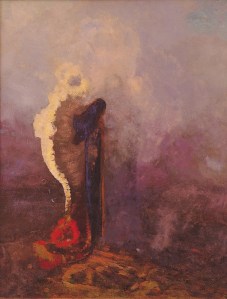
odilon redon, le rêve, 1904
Odilon Redon, Le rêve (1904)

Quid? illa duo somnia, quae creberrime commemorantur a Stoicis, quis tandem potest contemnere? unum de Simonide: qui cum ignotum quendam proiectum mortuum vidisset eumque humavisset haberetque in animo nave conscendere, moneri visus est, ne id faceret, ab eo quem sepultura affecerat; si navigavisset, eum naufragio esse periturum; itaque Simonidem redisse, perisse ceteros, qui tum navigassent. alterum ita traditum clarum admodum somnium: cum duo quidam Arcades familiares iter una facerent et Megaram venissent, alterum ad cauponem devertisse, ad hospitem alterum. qui ut cenati quiescerent, concubia nocte visum esse in somnis ei qui erat in hospitio illum alterum orare ut subveniret, quod sibi a caupone interitus pararetur; eum primo, perterritum somnio, surrexisse; dein, cum se collegisset idque visum pro nihilo habendum esse duxisset, recubuisse; tum ei dormienti eundem illum visum esse rogare, ut, quoniam sibi vivo non subvenisset, mortem suam ne inultam esse pateretur; se interfectum in plaustrum a caupone esse coniectum et supra stercus iniectum; petere, ut mane ad portam adesset, prius quam plaustrum ex oppido exiret. hoc vero eum somnio commotum mane bubulco praesto ad portam fuisse, quaesisse ex eo, quid esset in plaustro; illum perterritum fugisse, mortuum erutum esse, cauponem re patefacta poenas dedisse. quid hoc somnio dici potest divinius?
(Cicero, De Divinatione 1.56-57)

And who, pray, can make light of the two following dreams which are so often recounted by Stoic writers? The first one is about Simonides, who once saw the dead body of some unknown man lying exposed and buried it. Later, when he had it in mind to go on board a ship he was warned in a vision by the person to whom he had given burial not to do so and that if he did he would perish in a shipwreck. Therefore he turned back and all the others who sailed were lost. The second dream is very well known and is to this effect: Two friends from Arcadia who were taking a journey together came to Megara, and one traveller put up at an inn and the second went to the home of a friend. After they had eaten supper and retired, the second traveller, in the dead of the night, dreamed that his companion was imploring him to come to his aid, as the innkeeper was planning to kill him. Greatly frightened at first by the dream he arose, and later, regaining his composure, decided that there was nothing to worry about and went back to bed. When he had gone to sleep the same person appeared to him and said: ‘Since you would not help me when I was alive, I beg that you will not allow my dead body to remain unburied. I have been killed by the innkeeper, who has thrown my body into a cart and covered it with dung. I pray you to be at the city gate in the morning before the cart leaves the town.’ Thoroughly convinced by the second dream he met the cart-driver at the gate in the morning, and, when he asked what he had in the cart, the driver fled in terror. The Arcadian then removed his friend’s dead body from the cart, made complaint of the crime to the authorities, and the innkeeper was punished. What stronger proof of a divinely inspired dream than this can be given? (tr. William Armistead Falconer)

Breve

animal-friendship-18

[LEO. VRSVS.]

[LEO] Explana, quaeso, crassius, quo sono discernatur natura longa vocalis a brevi.
[VRS.] id ne putes rem novam, dilucide patet in linguis vulgaribus, quae et sono et scriptura discernunt longam a brevi, longam aut geminata vocali scribentes aut addita vocali vertentes in diphthongum. dic Batavice album, sentis unicum i; dic latum, sentis geminum, cum tamen dictio sit monosyllaba. audis apud machinas quibus onera tolluntur e navibus, quoties iubent volvi rotam, simplex i; quoties vinum postulant, geminum. rursum dic Batavice lagenam, audis unicum e; dic Flandrice carnem, audis geminum. idem discrimen in optimo et bestia, ultimo et forma calcearia. dic Batavice pellem, audis unicum e; dic multum Brabantice, audis duo. item Batavice puteum, audis v simplex; dic extra, audis geminum, nisi mavis hic esse peculiarem diphthongum. item dic Anglice panem, audis e breve; dic Batavice latum, audis ee geminum. dic obesum Batavice, audis e breve; dic simultatem, audis porrectum. dic Batavice rotam, audis a breve; dic consilium, audis diphthongum ae. idem fit in foramine et vadite, in balneo et lucro.
[LEO] iam mihi succurrunt istius generis exempla innumera.
[VRS.] quo magis mirum est nos haec omnia confundere, seu Graece seu Latine loquentes. θὴρ vox natura longa excepta prima littera quid aliud sonat hodie quam apud Latinos vir? quae natura brevis est. item πῦρ nos secuti Graecos male pronuntiamus, cum Germani vocem eam a Graecis sumptam recte sonent, nisi quod tenuem vertunt in aspiratam, Batavi in v consonans. πᾶς nos male sonamus, Galli recte, cum humile dicunt aut passum.
[LEO] sic est profecto.
[VRS.] iam in θήρ, quod ipsum ad nos fluxit a Graecis, Batavica lingua, dum sonat dier, θ mutato in δ declarat quid sonuerit apud Graecos θήρ. ad haec quid aliud sonat syllaba mus in animante longa quam in dictione mimus brevis?
[LEO] nihil prorsus.
[VRS.] atqui discrimen docet Batavus sonans animantis vocabulum, in quo audis geminum v; si sones simplex, nullus quid velis intelliget Latine nesciens. tantum est discriminis in mora syllabae, quod nos, perinde ac si nullius sit momenti, plane negligimus.
(Erasmus, De recta Latini Graecique sermonis pronuntiatione 946-947 LB)

[LION. BEAR.]

[LION] Can you give me an elementary explanation of the difference in pronunciation between a long vowel and a short one?
[BEAR] There is nothing strange about it. The difference exists clearly enough in the vernacular languages that distinguish long from short syllables in both speech and script, writing the long vowel either by duplicating the character or by adding another vowel to form a diphthong. If you say the Dutch word for ‘white’ (wit), you perceive a single i, if you say ‘broad’ the is duplicated, but the word remains monosyllabic (wijt). The order for turning a ship’s capstan to unload cargo, ‘wind’ (win) has one i; the word you say if you want a drink, ‘wine’ (wijn), has two. Say the dutch for ‘bottle’ (vles), and you hear a single e, whereas the Flemish word for ‘meat’ (vlees) has a double e. There is the same distinction in ‘best’ and ‘beast’ (best, beest), in ‘last’ and ‘a cobbler’s last’ (lest, leest). Say ‘pelt’ (vel) in Dutch, you hear one e, ‘much’ in Flemish (veel) and you hear two. Again, ‘well’ in Dutch (put) has one u, say ‘outside’ (uut) and you hear two, unless you like to call it a special kind of diphthong. Say the English word for ‘bread’ (bret) and you have a short e, but say the Dutch word for ‘broad’ (breet) and you have a double one. You hear a short in the Dutch for ‘fat’ (vet), but a long one in ‘strife’ (veet). ‘Wheel’ in Dutch has a short (rat), ‘counsel’ has a diphthongal ae (raet). The same with the words for ‘hole’ and ‘go’ (gat, gaet), ‘bath’ and ‘profit’ (bat, baet).
[LION] Endless examples of the kind you are describing now occur to me.
[BEAR] All the more surprising then is our total refusal to make the requisite distinctions when speaking Latin or Greek. The vowel in θήρ [thḗr] ‘animal’ is naturally long: yet except for the first letter it is today pronounced exactly like that Latin vir ‘man’ where the is short by nature. πῦρ [pȳr] ‘fire’ is another word which in the fashion of the modern Greeks we pronounce wrong. The Germans, who have borrowed the word from Greek, pronounce it right except for changing the original smooth consonant for an aspirate [feuer]. The Dutch change it to a [vuur]. πᾶς [pās] ‘all’ is another word we vocalize wrong, but the French have it right in their words for ‘low’ [bas] and ‘step’ [pas].
[LION] Yes.
[BEAR] To come back to θήρ [thḗr] ‘animal.’ The word has been taken over into Dutch from Greek, and our form of it, dier—the initial θ having been changed to d—shows what the ancient Greek pronunciation must have been like. Again consider how we pronounce the long syllable in mus, ‘a mouse,’ in exactly the same way as we do the short syllable at the end of the word mimus ‘actor.’
[LION] We do, in exactly the same way.
[BEAR] Yet any Dutchman saying the animal’s name with its doubled [muus] can teach us the distinction we ought to make. If you were to pronounce the Dutch word with a single u, nobody, unless he knew Latin, would have any idea what you meant. That is the measure of importance of syllabic lenght. Yet we neglect it altogether as quite immaterial.
(tr. Maurice Pope)

Selaenoneoaeia

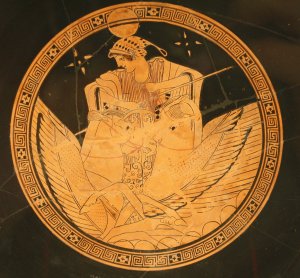
Brygosschilder, Selene in haar wagen, rood-figurige kylix (Volsci), ca. 490
Brygos Painter, Selene in her chariot (ca. 490 B.C.)

[ΣΩΚΡΑΤΗΣ. ῾ΕΡΜΟΓΕΝΗΣ]

[ΣΩΚΡ.] Συχνὰ μέν μοι προστάττεις, ὅμως δέ, εἴπερ σοι κεχαρισμένον ἔσται, ἐθέλω.
[ἙΡΜ.] καὶ μὴν χαριῇ.
[ΣΩΚΡ.] τί δὴ οὖν πρῶτον βούλει; ἢ ὥσπερ εἶπες τὸν ἥλιον διέλθωμεν;
[ἙΡΜ.] πάνυ γε.
[ΣΩΚΡ.] ἔοικε τοίνυν κατάδηλον γενόμενον ἂν μᾶλλον, εἰ τῷ Δωρικῷ τις ὀνόματι χρῷτο· ἅλιον γὰρ καλοῦσιν οἱ Δωριῆς· ἅλιος οὖν εἴη μὲν ἂν κατὰ τὸ ἁλίζειν εἰς ταὐτὸν τοὺς ἀνθρώπους ἐπειδὰν ἀνατείλῃ, εἴη δ’ ἂν καὶ τῷ περὶ τὴν γῆν ἀεὶ εἱλεῖν ἰών, ἐοίκοι δ’ ἂν καὶ ὅτι ποικίλλει ἰὼν τὰ γιγνόμενα ἐκ τῆς γῆς· τὸ δὲ ποικίλλειν καὶ αἰολεῖν ταὐτόν.
[ἙΡΜ.] τί δὲ ἡ σελήνη;
[ΣΩΚΡ.] τοῦτο δὲ τὸ ὄνομα φαίνεται τὸν Ἀναξαγόραν πιέζειν.
[ἙΡΜ.] τί δή;
[ΣΩΚΡ.] ἔοικε δηλοῦντι παλαιότερον ὃ ἐκεῖνος νεωστὶ ἔλεγεν, ὅτι ἡ σελήνη ἀπὸ τοῦ ἡλίου ἔχει τὸ φῶς.
[ἙΡΜ.] πῶς δή;
[ΣΩΚΡ.] τὸ μέν που σέλας καὶ τὸ φῶς ταὐτόν.
ἙΡΜ. ναί.
[ΣΩΚΡ.] νέον δέ που καὶ ἕνον ἀεί ἐστι περὶ τὴν σελήνην τοῦτο τὸ φῶς, εἴπερ ἀληθῆ οἱ Ἀναξαγόρειοι λέγουσιν· κύκλῳ γάρ που ἀεὶ αὐτὴν περιιὼν νέον ἀεὶ ἐπιβάλλει, ἕνον δὲ ὑπάρχει τὸ τοῦ προτέρου μηνός.
ἙΡΜ. πάνυ γε.
[ΣΩΚΡ.] σελαναίαν δέ γε καλοῦσιν αὐτὴν πολλοί.
[ἙΡΜ.] πάνυ γε.
[ΣΩΚΡ.] ὅτι δὲ σέλας νέον καὶ ἕνον ἔχει ἀεί, Σελαενονεοάεια μὲν δικαιότατ᾽ ἂν τῶν ὀνομάτων καλοῖτο, συγκεκροτημένον δὲ σελαναία κέκληται.
[ἙΡΜ.] διθυραμβῶδές γε τοῦτο τοὔνομα, ὦ Σώκρατες. ἀλλὰ τὸν μῆνα καὶ τὰ ἄστρα πῶς λέγεις;
[ΣΩΚΡ.] ὁ μὲν μεὶς ἀπὸ τοῦ μειοῦσθαι εἴη ἂν μείης ὀρθῶς κεκλημένος, τὰ δ’ ἄστρα ἔοικε τῆς ἀστραπῆς ἐπωνυμίαν ἔχειν. ἡ δὲ ἀστραπή, ὅτι τὰ ὦπα ἀναστρέφει, ἀναστρωπὴ ἂν εἴη, νῦν δὲ ἀστραπὴ καλλωπισθεῖσα κέκληται.
[ἙΡΜ.] τί δὲ τὸ πῦρ καὶ τὸ ὕδωρ;
[ΣΩΚΡ.] τὸ πῦρ ἀπορῶ· καὶ κινδυνεύει ἤτοι ἡ τοῦ Εὐθύφρονός με μοῦσα ἐπιλελοιπέναι, ἢ τοῦτό τι παγχάλεπον εἶναι.
(Plato, Cratylus 408e-409d)

[SOCRATES. HERMOGENES]

[SOCR.] You are imposing a good many tasks upon me; however, if it will give you pleasure, I am willing.
HERM. It will give me pleasure.
[SOCR.] What, then, do you wish first? Shall we discuss the sun (Ἥλιος), as you mentioned it first?
[HERM.] By all means.
[SOCR.] I think it would be clearer if we were to use the Doric form of the name. The Dorians call it Ἅλιος. Now ἅλιος might be derived from collecting (ἁλίζειν) men when he rises, or because he always turns (ἀεὶ εἱλεῖν) about the earth in his course, or because he variegates the products of the earth, for variegate is identical with αἰολεῖν.
[HERM.] And what of the moon, Selene?
[SOCR.] That name appears to put Anaxagoras in an uncomfortable position.
[HERM.] How so?
[SOCR.] Why, it seems to have anticipated by many years the recent doctrine of Anaxagoras, that the moon receives its light from the sun.
[HERM.] How is that?
[SOCR.] Σέλας (gleam) and φῶς (light) are the same thing.
HERM. Yes.
[SOCR.] Now the light is always new and old about the moon, if the Anaxagoreans are right; for they say the sun, in its continuous course about the moon, always sheds new light upon it, and the light of the previous month persists.
[HERM.] Certainly.
[SOCR.] The moon is often called Σελαναία.
[HERM.] Certainly.
[SOCR.] Because it has always a new and old gleam (σέλα νέον τε καὶ ἕνον) the very most fitting name for it would be Σελαενονεοάεια, which has been compressed into Σελαναία.
[HERM.] That is a regular opéra bouffe name, Socrates. But what have you to say of the month (μήν) and the stars?
[SOCR.] The word “month” (μείς) would be properly pronounced μείης, from μειοῦσθαι, “to grow less,” and I think the stars (ἄστερα) get their name from ἀστραπή (lightning). But ἀστραπή, because it turns our eyes upwards (τὰ ὦπα ἀναστρέφει), would be called ἀναστρωπή, which is now pronounced more prettily ἀστραπή.
[HERM.] And what of πῦρ (fire) and ὕδωρ (water)?
[SOCR.] Πῦρ is too much for me. It must be that either the muse of Euthyphro has deserted me or this is a very difficult word.
(tr. Harold North Fowler)

Etumotēta

Tom Lavell, A recreation of ancient wrestling
Tom Lavell, Referee watches Greek wrestlers in ancient Olympic games

“Ἄλλως δὲ πῶς” ἔφην “λόγον ἔχει τεχνικώτατον καὶ πανουργότατον τῶν ἀθλημάτων τὴν πάλην οὖσαν ἅμα καὶ πρεσβύτατον εἶναι; τὸ γὰρ ἁπλοῦν καὶ ἄτεχνον καὶ βίᾳ μᾶλλον ἢ μεθόδῳ περαινόμενον αἱ χρεῖαι πρῶτον ἐκφέρουσιν.” ἐμοῦ δὲ ταῦτ’ εἰπόντος, ὁ Σωσικλῆς· “ὀρθῶς” ἔφη “λέγεις, καὶ συμβάλλομαί σοι πίστιν ἀπὸ τοῦ ὀνόματος· ἡ γὰρ πάλη μοι δοκεῖ τῷ παλεύειν, ὅπερ ἐστὶ δολοῦν καὶ καταβάλλειν δι’ ἀπάτης, κεκλῆσθαι.” καὶ ὁ Φιλῖνος “ἐμοὶ δ'” εἶπεν “ἀπὸ τῆς παλαιστῆς· τούτῳ γὰρ μάλιστα τῷ μέρει τοῖν χεροῖν ἐνεργοῦσιν οἱ παλαίοντες, ὥσπερ οἱ πυκτεύοντες αὖ πάλιν τῇ πυγμῇ· διὸ κἀκεῖνο πυγμὴ καὶ τοῦτο πάλη προσηγόρευται τὸ ἔργον. οὐ μὴν ἀλλὰ καὶ τὸ συμπάσαι τῶν ποιητῶν καὶ καταπάσαι ‘παλῦναι’ λεγόντων, ᾧ μάλιστα χρωμένους τοὺς παλαιστὰς ὁρῶμεν, ἔστι καὶ ταύτῃ προσάγειν τὴν ἐτυμότητα τοῦ ὀνόματος. σκόπει δ’ ἔτι” εἶπεν “μὴ τοῖς μὲν δρομεῦσιν ἔργον ἐστὶν ὅτι πλεῖστον ἀπολιπεῖν καὶ πορρωτάτω διαστῆναι, τοὺς δὲ πύκτας οὐδὲ πάνυ βουλομένους ἐῶσιν οἱ βραβευταὶ συμπλέκεσθαι· μόνους δὲ τοὺς παλαιστὰς ὁρῶμεν ἀλλήλους ἀγκαλιζομένους καὶ περιλαμβάνοντας· καὶ τὰ πλεῖστα τῶν ἀγωνισμάτων, ἐμβολαί, παρεμβολαί, συστάσεις, παραθέσεις, συνάγουσιν αὐτοὺς καὶ ἀναμιγνύουσιν ἀλλήλοις. διὸ τῷ πλησιάζειν μάλιστα καὶ γίνεσθαι πέλας οὐκ ἄδηλόν ἐστι τὴν πάλην ὠνομάσθαι.”
(Plutarch, Symposiaka 2.4.638d-f)

“And besides,” I said, “how does it make sense that wrestling, which is the most skillful and strategic of sports, is at the same time the oldest too? For necessity produces first what is simple, artless, and accomplished by force rather than systematic skill.” When I had spoken, Sosicles said, “You are right, and I’ll offer you confirmation with an etymology: ‘wrestling’ (palê), seems to me to be derived from paleuein, which means ‘to trick,’ or ‘to overthrow by deceit.'” And Philinus said, “It seems to me to be derived from palaistê, ‘palm,’ for it is principally with this part of the hand that wrestlers operate, as, on the contrary, boxers do with the fist, (pugmê); so the one activity is called ‘boxing’ (pugmê), the other ‘wrestling’ (palê). And there is another possibility: since the poets say ‘besprinkle’ (palunai) for ‘dusting’ and ‘powdering,’ of which we see wrestlers (palaistai) make much used, it is possible also in this way to derive the true meaning of the word. Consider again,” he said, “is it not the goal of runners to distance each other as much as possible, to put the maximum amount of space between each other? And boxers are not allowed by referees to clinch, however eager they may be; it is only the wrestlers we see laying hold of each other and embracing each other,—most parts of the contest, frontal and lateral stances, bring them together and mix them up with each other. Clearly the inference is that wrestlin (palê) got its name from ‘draw near’ (plêsiazein) and ‘be close’ (pelas).*”

* The true etymology is unknown; see Boisacq, s.v. παλαίω.

(tr. Paul A. Clement & Herbert B. Hoffleit, with one of their notes)

Faustum

31908515355_981ccd4939_h

Domino meo.
annum novum faustum tibi et ad omnia, quae recte cupis, prosperum cum tibi tum domino nostro patri tuo et matri et uxori et filiae ceterisque omnibus quos merito diligis, precor. metui ego invalido adhuc corpore turbae et impressioni me committere. si dei iuvabunt, perendie vos vota nuncupantis videbo.
vale, mi domine dulcissime. dominam saluta.
(Fronto, Ep. ad M. Caesarem 5.45)

A happy New Year and a prosperous in all things that you rightly desire to you and our Lord your Father and your mother and your wife and daughter, and to all others who deservedly share your affection—that is my prayer! In my still feeble state of health I was afraid to trust myself to the crowd and crush. I shall see you, please God, the day after to-morrow offering up your vows. Farewell, my most sweet Lord. Greet my Lady. (tr. Charles Reginald Haines)


Novitas

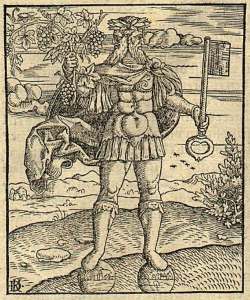
Sebastian Münster, Janus, 1550
Sebastian Münster, Janus (1550)

Dixerat: et vultu, si plura requirere vellem,
difficilem mihi se non fore pactus erat.
sumpsi animum, gratesque deo non territus egi,
verbaque sum spectans plura locutus humum:
“dic, age, frigoribus quare novus incipit annus,
qui melius per ver incipiendus erat?
omnia tunc florent, tunc est nova temporis aetas,
et nova de gravido palmite gemma tumet,
et modo formatis operitur frondibus arbor,
prodit et in summum seminis herba solum,
et tepidum volucres concentibus aera mulcent,
ludit et in pratis luxuriatque pecus.
tum blandi soles, ignotaque prodit hirundo
et luteum celsa sub trabe figit opus:
tum patitur cultus ager et renovatur aratro.
haec anni novitas iure vocanda fuit.”
quaesieram multis; non multis ille moratus
contulit in versus sic sua verba duos:
“bruma novi prima est veterisque novissima solis:
principium capiunt Phoebus et annus idem.”
(Ovid, Fast. 1.145-164)

Thus spake the god*, and by a look promised that, were I fain to ask him more, he would not grudge reply. I plucked up courage, thanked the god composedly, and with eyes turned to the ground I spoke in few: “Come, say, why doth the new year begin in the cold season? Better had it begun in spring. Then all things flower, then time renews his age, and new from out the teeming vine-shoot swells the bud; in fresh-formed leaves the tree is draped, and from earth’s surface sprouts the blade of corn. Birds with their warblings winnow the warm air; the cattle frisk and wanton in the meads. Then suns are sweet, forth comes the stranger swallow and builds her clayey structure under the lofty beam. Then the field submits to tillage and is renewed by the plough. That is the season which rightly should have been called New Year.” Thus questioned I at length; he answered prompt and tersely, throwing his words into twain verses, thus: “Midwinter is the beginning of the new sun and the end of the old one. Phoebus and the year take their start from the same point.”

* Janus.

(tr. James George Frazer, revised by George Patrick Goold)