
Ira

Tum vero apparuit ab ira et ab odio urbem oppugnatam esse. nemo capiendi vivos, nemo patentibus ad direptionem omnibus praedae memor est; trucidant inermes iuxta atque armatos, feminas pariter ac viros; usque ad infantium caedem ira cruelis pervenit. ignem deinde tectis iniciunt ac diruunt quae incendio absumi nequeunt; adeo vestigia quoque urbis exstinguere ac delere memoriam hostium sedis cordi est.
(Livy 28.20.6-7)

It was then in truth evident that the city had been attacked out of anger and hatred. No one thought of taking men alive, no one thought of booty, although every place was open for plunder. They slaughtered the unarmed and the armed alike, women as well as men; cruel anger went even so far as to slay infants. Then they threw firebrands into houses and demolished what could not be consumed by the flames. So delighted were they to destroy even the traces of the city and to blot out the memory of their enemies’ abode. (tr. Frank Gardner Moore)
Exsuctus

Tertius eorum est ordo, qui ut in professione turbulenta clarescant, ad expugnandam veritatem ora mercenaria procudentes, per prostitutas frontes vilesque latratus, quo velint aditus sibi patefaciunt crebros: qui inter sollicitudines iudicum per multa distentas, irresolubili nexu vincientes negotia, laborant, ut omnis quies litibus implicetur, et nodosis quaestionibus de industria iudicia circumscribunt, quae cum recte procedunt, delubra sunt aequitatis: cum depravantur, foveae fallaces et caecae: in quas si captus ceciderit quisquam, non nisi per multa exsiliet lustra, ad usque ipsas medullas exsuctus.
(Ammianus Marcellinus, Res Gestae 30.4.13)

A third group* consists of those who, in order to gain glory by their troublous profession, sharpen their venal tongues to attack the truth, and with shameless brow and base yelping often gain entrance wherever they wish. When the anxious judges are distracted by many cares, they tie up the business in an inexplicable tangle, and do their best to involve all peace and quiet in lawsuits and purposely by knotty inquisitions they deceive the courts, which, when their procedure is right, are temples of justice, when corrupted, are deceptive and hidden pits: and if anyone is deluded and falls into those pits, he will not get out except after many a term of years, when he has been sucked dry to his very marrow.

* of the “powerful and rapacious classes of men flitting from one forum to another, besieging the homes of the wealthy” (30.4.8).

(tr. John C. Rolfe)

Gemitus

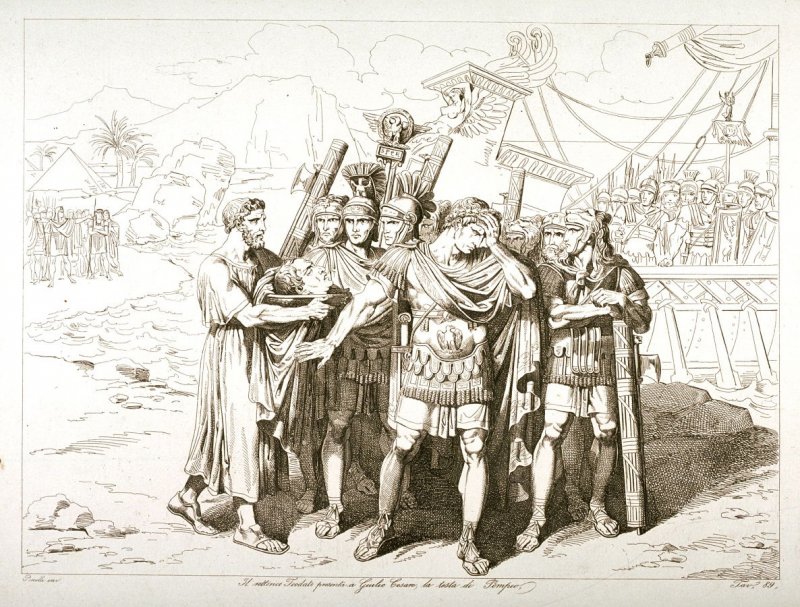
bartolomeo pinelli
Bartolomeo Pinelli, The head of Pompey offered to Caesar by the rhetorician Teodato.

Sic fatus opertum
detexit tenuitque caput. iam languida morte
effigies habitum noti mutaverat oris.
non primo Caesar damnavit munera visu
avertitque oculos; voltus, dum crederet, haesit;
utque fidem vidit sceleris tutumque putavit
iam bonus esse socer, lacrimas non sponte cadentes
effudit gemitusque expressit pectore laeto,
non aliter manifesta potens abscondere mentis
gaudia quam lacrimis, meritumque immane tyranni
destruit et generi mavolt lugere revolsum
quam debere caput. qui duro membra senatus
calcarat voltu, qui sicco lumine campos
viderat Emathios, uni tibi, Magne, negare
non audet gemitus.
(Lucan, Bell. Civ. 9.1032-1046)

With these words he took off the covering from the head, and held it in his hands. By now the features, relaxed by death, had changed the aspect of that familiar face. When Caesar first saw it, he did not condemn the gift nor turn away: his eyes were fixed upon the face till he could be sure. Then, when he saw the proof of the crime, and thought it safe at last to be the loving kinsman, he shed crocodile tears and forced out groans while his heart rejoiced. By tears alone was he able to hide his obvious delight; and thus he belittles the king’s horrid service, preferring to mourn the severed head of his kinsman rather than owe obligation for it. Though he had trampled on corpses of senators with face unmoved, and had beheld dry-eyed the field of Pharsalia, to Magnus alone he dares not deny the tribute of tears. (tr. James Duff Duff)

Kroteisthō

squeeze

Ἤν τινα καλὸν ἴδῃς, εὐθὺς τὸ πρῆγμα κροτείσθω·
βάζ’ ἃ φρονεῖς· ὄρχεων δράσσεο χερσὶν ὅλαις·
ἢν δ’ εἴπῃς, “Τίω σε, καὶ ἔσσομαι οἷά τ’ ἀδελφός,”
αἰδώς σου κλείσει τὴν ἐπὶ τοὔργον ὁδόν.
(Addaeus, Anth. Gr. 10.20)

If you see someone beautiful
hammer it out right then.
Say what you think; put your hands full
on his bollocks: be a man.
But if ‘I admire you’ is what you say
and ‘I’ll be a brother to you’ –
shame will bar the only way
to all you want to do
(tr. Alistair Elliot)

Obtigerit

Qua re, patres conscripti, consulite vobis, prospicite patriae, conservate vos, coniuges, liberos fortunasque vestras, populi Romani nomen salutemque defendite; mihi parcere ac de me cogitare desinite. nam primum debeo sperare omnis deos qui huic urbi praesident pro eo mihi ac mereor relaturos esse gratiam; deinde, si quid obtigerit, aequo animo paratoque moriar. nam neque turpis mors forti viro potest accidere neque immatura consulari nec misera sapienti.
(Cicero, In Catilinam 4.3)

Take thought for yourselves, therefore, gentlemen; look to the preservation of your fatherland, save yourselves, your wives, your children and your fortunes, defend the name of the Roman people and their very existence; stop protecting me and cease your concern for me. Firstly, I am bound to hope that all the gods who watch over this city will recompense me as I deserve; and secondly, if anything happens to me, I shall die calm and resigned. A brave man’s death cannot bring dishonour, a consul’s cannot be before its time, a philosopher’s cannot bring sorrow. (tr. Coll Macdonald)

Neiphomenai

a.baa-cow-in-the-snow

Αὐτόμαται δείλῃ ποτὶ ταὔλιον αἱ βόες ἦλθον
ἐξ ὄρεος, πολλῇ νειφόμεναι χιόνι·
αἰαῖ, Θηρίμαχος δὲ παρὰ δρυὶ τὸν μακρὸν εὕδει
ὕπνον· ἐκοιμήθη δ’ ἐκ πυρὸς οὐρανίου.

(Diotimus or Leonidas, Anth. Gr. 7.173)

Unherded at evenfall the cattle came to the farmyard from the hill, snowed on with heavy snow; alas, and Therimachus sleeps the long sleep beside an oak, stretched there by fire from heaven. (tr. J.W. Mackail)

Insperata

[SCAPHA. PHILEMATIVM]

SCA.                                                                               Stulta es plane
quae illum tibi aeternum putes fore amicum et benevolentem.
moneo ego te: te ille deseret aetate et satietate.
PHI.       non spero.
SCA.                     insperata accidunt magis saepe quam quae speres.
(Plautus, Mostellaria 194-197)

SCA.     You’re plain stupid for believing that he’ll remain your friend and benefactor for ever. I remind you: he’ll leave you when you’re older and he’s colder.
PHI.     I hope not.
SCA.     Things you don’t hope for happen more often than things you do hope for.
(tr. Wolfgang De Melo)

Nihil

Sedlec Ossuary - skulls

Post mortem nihil est, ipsaque mors nihil,
velocis spatii meta novissima.
spem ponant avidi, solliciti metum:
tempus nos avidum devorat et chaos.
mors individua est, noxia corpori
nec parcens animae. Taenara et aspero
regnum sub domino limen et obsidens
custos non facili Cerberus ostio
rumores vacui verbaque inania
et par sollicito fabula somnio.
quaeris quo iaceas post obitum loco?
quo non nata iacent.
(Seneca, Troades 397-408)

After death is nothing, and death itself is nothing,
the finishing line of a swiftly run circuit.
Let the greedy lay down their hopes, the anxious their fears:
greedy time and Chaos devour us.
Death is indivisible, destructive to the body
and not sparing the soul. Taenarus, and the kingdom
under its harsh lord, and Cerberus guarding
the entrance with its unyielding gate
– hollow rumours, empty words,
a tale akin to a troubled dream.
You ask where you lie after death?
Where unborn things lie.
(tr. John G. Fitch)

Hēsuchian

Μειράκιον Ἐρετρικὸν προσεφοίτησε Ζήνωνι πλείονος χρόνου, ἔστ’ εἰς ἄνδρας ἀφίκετο. ὕστερον οὖν εἰς τὴν Ἐρετρίαν ἐπανῆλθεν, καὶ αὐτὸν ὁ πατὴρ ἤρετο ὅ τι ἄρα μάθοι σοφὸν ἐν τῇ τοσαύτῃ διατριβῇ τοῦ χρόνου. ὁ δὲ ἔφη δείξειν, καὶ οὐκ εἰς μακρὰν ἔδρασε τοῦτο. χαλεπήναντος γὰρ αὐτῷ τοῦ πατρὸς καὶ τέλος πληγὰς ἐκτείναντος, ὁ δὲ τὴν ἡσυχίαν ἀγαγὼν καὶ ἐγκαρτερήσας τοῦτο ἔφη μεμαθηκέναι, φέρειν ὀργὴν πατέρων καὶ μὴ ἀγανακτεῖν.
(Aelian, Var. Hist. 9.33b)

A boy from Eretria attended Zeno’s school over quite a long period, until reaching maturity. After that he returned to Eretria and his father asked him what wisdom he had learned in such a long time. The boy said he would show him, and soon did so. When his father became annoyed and finally beat him, he remained calm and patient and said that what he had learned was to endure the anger of parents and not to lose his temper. (tr. Nigel G. Wilson)

Ouranēn

piss pot

[ΟΔΥΣΣΕΥΣ]

Ὅδ’ ἐστίν, ὅς ποτ’ ἀμφ’ ἐμοὶ βέλος
γελωτοποιὸν, τὴν κάκοσμον οὐράνην,
ἔρριψεν οὐδ’ ἥμαρτε· περὶ δ’ ἐμῷ κάρᾳ
πληγεῖσ’ ἐναυάγησεν ὀστρακουμένη,
χωρὶς μυρηρῶν τευχέων πνέουσ’ ἐμοί

(Aeschylus, fr. 180)

[ODYSSEUS]

This* is the man who once threw in my direction an object designed to make me a laughing-stock, the evil-smelling chamber-pot, and he did not miss his aim; it struck me on the head and smashed into fragments, wafting over me an odour very unlike that of perfume-jars.

* Not certainly identifiable, but most likely Ctesippus, in the Odyssey (20.287-302) the only suitor other than Antinous and Eurymachus who throws an object (a cow’s hoof) at the disguised Odysseus; later he is appropriately killed by the oxherd Philoetius.

(tr. Alan H. Sommerstein, with his note)