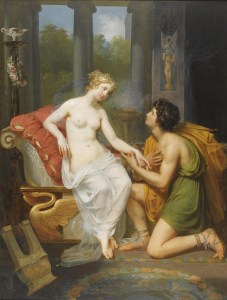
Calfacienda

albundy_shoes

Ipse tene distenta suis umbracula virgis,
ipse fac in turba, qua venit illa, locum.
nec dubita tereti scamnum producere lecto,
et tenero soleam deme vel adde pedi.
saepe etiam dominae, quamvis horrebis et ipse,
algenti manus est calfacienda sinu.
nec tibi turpe puta (quamvis sit turpe, placebit),
ingenua speculum sustinuisse manu.
ille, fatigata praebendo monstra noverca
qui meruit caelum, quod prior ipse tulit,
inter Ioniacas calathum tenuisse puellas
creditur, et lanas excoluisse rudes.
paruit imperio dominae Tirynthius heros:
i nunc et dubita ferre, quod ille tulit.
(Ovid, Ars Am. 2.209-222)

Do you yourself hold her parasol outstretched upon its rods, yourself make room for her in the crowd, where she is coming. Nor hesitate to place the footstool for her trim couch; take off her slipper from her dainty foot, or put it on. Often too when she is cold, though you are shivering too, you must warm your lady’s hand in your own lap. Nor think it base (though base, it will give pleasure) to hold a mirror in your freeborn hand. He who won the heaven which first he bore himself, when his step-mother was wearied of sending monsters, is believed to have held a basket among Ionian maidens, and to have spun fine the unworked wool*. The Tirynthian hero obeyed a mistress’ command: go, shrink from enduring what he endured!

* The reference is to Hercules and his servitude to the Lydian queen Omphale. His stepmother was of course Juno.

(tr. John Henry Mozley)
Offenso

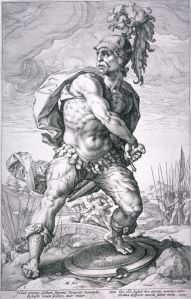
titus manlius torquatus
T. Manlius Torquatus

Cum consulis vocem subsecuta patrum indignatio esset, proditur memoriae adversus crebram implorationem deum, quos testes foederum saepius invocabant consules, vocem Anni spernentis numina Iovis Romani auditam. certe, cum commotus ira se a vestibulo templi citato gradu proriperet, lapsus per gradus capite graviter offenso impactus imo ita est saxo ut sopiretur. exanimatum auctores quoniam non omnes sunt, mihi quoque in incerto relictum sit, sicut inter foederum ruptorum testationem ingenti fragore caeli procellam effusam; nam et vera esse et apte ad repraesentandam iram deum ficta possunt. Torquatus missus ab senatu ad dimittendos legatos cum iacentem Annium vidisset, exclamat, ita ut populo patribusque audita vox pariter sit: ‘bene habet: di pium movere bellum. est caeleste numen; es, magne Iuppiter; haud frustra te patrem deum hominumque hac sede sacravimus. quid cessatis, Quirites, vosque patres conscripti, arma capere deis ducibus? sic stratas legiones Latinorum dabo, quemadmodum legatum iacentem videtis.’
(Livy 8.6.1-7)

The consul’s speech having been warmly seconded by the indignant senators, it is recorded that in answer to the numerous supplications of the gods, whom the consuls repeatedly invoked as the witnesses of treaties, the voice of Annius was heard spurning the power of the Roman Jupiter. At all events, as he hurried, beside himself with rage, from the entrance of the temple, he slipped on the stairs, and struck his head so hard on the lowest stone that he lost consciousness. That he was killed is not asserted by all writers, wherefore I, too, may leave the question undecided, as also the tradition that while men were calling on the gods to witness the breaking of the treaty, there was a loud crash in the heavens, and a hurricane burst forth: for these things may be true, or they may be apt inventions to express in a lively manner the wrath of Heaven. Torquatus, who had been sent by the senate to dismiss the envoys, saw Annius lying there, and exclaimed in a voice that was heard alike by the people and the senators: “It is well; the gods have begun a righteous war. There is a heavenly power; thou dost exist, great Jupiter: not in vain have we established thee in this holy seat, the Father of gods and men. Why do you hesitate to arm, Quirites, and you Conscript Fathers, with the gods to lead you? As you behold their ambassador brought low, even so will I cast down the Latin legions.” (tr. Benjamin Oliver Foster)

Oligai

perdue2-800x430

Κατάστησον ἐπ᾿ αὐτὸν ἁμαρτωλόν, καὶ διάβολος στήτω ἐκ δεξιῶν αὐτοῦ· ἐν τῷ κρίνεσθαι αὐτὸν ἐξέλθοι καταδεδικασμένος, καὶ ἡ προσευχὴ αὐτοῦ γενέσθω εἰς ἁμαρτίαν. γενηθήτωσαν αἱ ἡμέραι αὐτοῦ ὀλίγαι, καὶ τὴν ἐπισκοπὴν αὐτοῦ λάβοι ἕτερος· γενηθήτωσαν οἱ υἱοὶ αὐτοῦ ὀρφανοὶ καὶ ἡ γυνὴ αὐτοῦ χήρα· σαλευόμενοι μεταναστήτωσαν οἱ υἱοὶ αὐτοῦ καὶ ἐπαιτησάτωσαν, ἐκβληθήτωσαν ἐκ τῶν οἰκοπέδων αὐτῶν. ἐξερευνησάτω δανειστὴς πάντα, ὅσα ὑπάρχει αὐτῷ, διαρπασάτωσαν ἀλλότριοι τοὺς πόνους αὐτοῦ· μὴ ὑπαρξάτω αὐτῷ ἀντιλήμπτωρ, μηδὲ γενηθήτω οἰκτίρμων τοῖς ὀρφανοῖς αὐτοῦ· γενηθήτω τὰ τέκνα αὐτοῦ εἰς ἐξολέθρευσιν, ἐν γενεᾷ μιᾷ ἐξαλειφθήτω τὸ ὄνομα αὐτοῦ. ἀναμνησθείη ἡ ἀνομία τῶν πατέρων αὐτοῦ ἔναντι κυρίου, καὶ ἡ ἁμαρτία τῆς μητρὸς αὐτοῦ μὴ ἐξαλειφθείη· γενηθήτωσαν ἔναντι κυρίου διὰ παντός, καὶ ἐξολεθρευθείη ἐκ γῆς τὸ μνημόσυνον αὐτῶν. ἀνθ᾿ ὧν οὐκ ἐμνήσθη τοῦ ποιῆσαι ἔλεος καὶ κατεδίωξεν ἄνθρωπον πένητα καὶ πτωχὸν καὶ κατανενυγμένον τῇ καρδίᾳ τοῦ θανατῶσαι.
(Psalms 109:6-16)

When he shall be judged, let him be condemned: and let his prayer become sin. Let his days be few; and let another take his office. Let his children be fatherless, and his wife a widow. Let his children be continually vagabonds, and beg: let them seek their bread also out of their desolate places. Let the extortioner catch all that he hath; and let the strangers spoil his labour. Let there be none to extend mercy unto him: neither let there be any to favour his fatherless children. Let his posterity be cut off; and in the generation following let their name be blotted out. Let the iniquity of his fathers be remembered with the Lord; and let not the sin of his mother be blotted out. Let them be before the Lord continually, that he may cut off the memory of them from the earth. Because that he remembered not to shew mercy, but persecuted the poor and needy man, that he might even slay the broken in heart. (King James Version)

Aporrembesthai

Μὴ κατατρίψῃς τὸ ὑπολειπόμενον τοῦ βίου μέρος ἐν ταῖς περὶ ἑτέρων φαντασίαις, ὁπόταν μὴ τὴν ἀναφορὰν ἐπί τι κοινωφελὲς ποιῇ. ἤτοι γὰρ ἄλλου ἔργου στέρῃ, τουτέστι φανταζόμενος τί ὁ δεῖνα πράσσει καὶ τίνος ἕνεκεν καὶ τί λέγει καὶ τί ἐνθυμεῖται καὶ τί τεχνάζεται καὶ ὅσα τοιαῦτα ποιεῖ ἀπορρέμβεσθαι τῆς τοῦ ἰδίου ἡγεμονικοῦ παρατηρήσεως.
(Marcus Aurelius, Ta eis heauton 3.4.1)

Don’t waste the rest of your time here worrying about other people – unless it affects the common good. It will keep you from doing anything useful. You’ll be too preoccupied with what so-and-so is doing, and why, and what they’re saying, and what they’re thinking, and what they’re up to, and all the other things that throw you off and keep you from focusing on your own mind. (tr. Gregory Hays)

Proteus

proteus
Proteus

Iam rapidus torrens sitientis Sirius Indos
ardebat caelo, et medium sol igneus orbem
hauserat; arebant herbae, et cava flumina siccis
faucibus ad limum radii tepefacta coquebant,
cum Proteus consueta petens e fluctibus antra
ibat: eum vasti circum gens umida ponti
exsultans rorem late dispergit amarum.
sternunt se somno diversae in litore phocae;
ipse velut stabuli custos in montibus olim,
Vesper ubi e pastu vitulos ad tecta reducit
auditisque lupos acuunt balatibus agni,
considit scopulo medius, numerumque recenset.
(Vergil, Georg. 4.425-436)

Now the Dog Star blazed in the sky, fiercely parching
the thirsty Indians, and the fiery sun had consumed
half his course: the grass withered, and deep rivers were heated
and baked, by the rays at their parched sources, down to the mud,
when Proteus came from the sea, to find his customary cave.
Round him the moist race of the vast sea frolicked,
scattering the salt spray far and wide.
The seals lay down to sleep here and there on the shore:
he himself sat on the rock in the middle, as the guardian
of a sheepfold on the hills sometimes sits, when Vesper brings
the calves home from pasture, and the bleating of lambs rouses
the wolf, hearing them, and the shepherd counts his flock.
(tr. A.S. Kline)

Hupischnei

Ἐνταῦθα Γαυλίτης παρὼν φυγὰς Σάμιος, πιστὸς δὲ Κύρῳ, εἶπε· “καἱ μήν, ὦ Κῦρε, λέγουσί τινες ὅτι πολλὰ ὑπισχνεῖ νῦν διὰ τὸ ἐν τοιούτῳ εἶναι τοῦ κινδύνου προσιόντος, ἂν δὲ εὖ γένηταί τι, οὐ μεμνήσεσθαί σέ φασιν· ἔνιοι δὲ οὐδ’ εἰ μεμνῇό τε καὶ βούλοιο δύνασθαι ἂν ἀποδοῦναι ὅσα ὑπισχνεῖ.” ἀκούσας ταῦτα ἔλεξεν ὁ Κῦρος· “Ἀλλ’ ἔστι μὲν ἡμῖν, ὦ ἄνδρες, ἡ ἀρχὴ ἡ πατρῴα πρὸς μὲν μεσημβρίαν μέχρι οὗ διὰ καῦμα οὐ δύνανται οἰκεῖν ἄνθρωποι, πρὸς δὲ ἄρκτον μέχρι οὗ διὰ χειμῶνα· τὰ δ’ ἐν μέσῳ τούτων ἅπαντα σατραπεύουσιν οἱ τοῦ ἐμοῦ ἀδελφοῦ φίλοι. ἢν δ’ ἡμεῖς νικήσωμεν, ἡμᾶς δεῖ τοὺς ἡμετέρους φίλους τούτων ἐγκρατεῖς ποιῆσαι. ὥστε οὐ τοῦτο δέδοικα, μὴ οὐκ ἔχω ὅ τι δῶ ἑκάστῳ τῶν φίλων, ἂν εὖ γένηται, ἀλλὰ μὴ οὐκ ἔχω ἱκανοὺς οἷς δῶ.”
(Xenophon, Anab. 1.7.6-7)

Hereupon Gaulites, a Samian exile who was there and was in the confidence of Cyrus, said: “And yet, Cyrus, there are those who say that your promises are big now because you are in such a critical situation—for the danger is upon you—but that if any good fortune befall, you will fail to remember them; and some say that even if you should remember and have the will, you would not have the means to make good all your promises.” Upon hearing these words Cyrus said: “Well, gentlemen, my father’s realm extends towards the south to a region where men cannot dwell by reason of the heat, and to the north to a region where they cannot dwell by reason of the cold; and all that lies between these limits my brother’s friends rule as satraps. Now if we win the victory, we must put our friends in control of these provinces. I fear, therefore, not that I shall not have enough to give to each of my friends, if success attends us, but that I shall not have enough friends to give to.” (tr. Carleton L. Brownson, revised by John Dillery)

Malthakon

Οὐκοῦν ὅταν μέν τις μουσικῇ παρέχῃ καταυλεῖν καὶ καταχεῖν τῆς ψυχῆς διὰ τῶν ὤτων ὥσπερ διὰ χώνης ἃς νῦν δὴ ἡμεῖς ἐλέγομεν τὰς γλυκείας τε καὶ μαλακὰς καὶ θρηνώδεις ἁρμονίας, καὶ μινυρίζων τε καὶ γεγανωμένος ὑπὸ τῆς ᾠδῆς διατελῇ τὸν βίον ὅλον, οὗτος τὸ μὲν πρῶτον, εἴ τι θυμοειδὲς εἶχεν, ὥσπερ σίδηρον ἐμάλαξε καὶ χρήσιμον ἐξ ἀχρήστου καὶ σκληροῦ ἐποίησεν· ὅταν δ’ ἐπέχων μὴ ἀνίῃ ἀλλὰ κηλῇ, τὸ μετὰ τοῦτο ἤδη τήκει καὶ λείβει, ἕως ἂν ἐκτήξῃ τὸν θυμὸν καὶ ἐκτέμῃ ὥσπερ νεῦρα ἐκ τῆς ψυχῆς καὶ ποιήσῃ μαλθακὸν αἰχμητήν.
(Plato, Politeia 411a-b)

And, when a man allows music to play upon him and to pour into his soul through the funnel of his ears those sweet and soft and melancholy airs of which we were just now speaking, and his whole life is passed in warbling and the delights of song; in the first stage of the process the passion or spirit which is in him is tempered like iron, and made useful, instead of brittle and useless. But, if he carries on the softening and soothing process, in the next stage he begins to melt and waste, until he has wasted away his spirit and cut out the sinews of his soul; and he becomes a feeble warrior. (tr. Benjamin Jowett)

Urticae

urtica-dioica-11_68792_1

De sacerdote, qui pro illusione nocturna psalmum in confessione iniunctum negligens, in locis genitalibus punitus est.

Sacerdos quidam in domo nostra, sicut ab eius ore audivi, die quadam confessionem fecit de illusione nocturna. iniunctus est ei psalmus unus pro satisfactione. quem cum per oblivionem negligeret, eadem die, circa loca genitalia tantum coepit pruritum et ardorem sentire, ac si carni eius ardentes urticae essent appositae. qui cum territus tactu exploraret quid esset, et nihil ibidem inveniret, recordatus est psalmi iniuncti et neglecti. imputansque immissam poenam eidem transgressioni, psalmum dixit, et dolor conquievit. confitens fugere debet oblivionem.

(Caesarius of Heisterbach, Dialogus Miraculorum 3.4)

Of a priest, who neglected the penance assigned him in confession for a nocturnal emission, and was punished in the genital area.

A priest, who was a monk in our house, and told me the story, confessed one day to a nocturnal emission, and a single psalm was assigned to him as a penance. He forgot to perform this small duty, and on the same day began to feel so great an irritation and burning in the genital area, as if glowing nettles were being applied to his skin, that he was somewhat alarmed. Unable to discover any outward cause for this, he suddenly remembered the psalm he had forgotten to say; and inferring that this had been sent as a punishment for his forgetfulness, he recited the psalm, and found the pain gone. The penitent ought to be very watchful against forgetfulness. (tr. G.G. Coulton & Eileen Power, debowdlerized by David Bauwens)

Muia

cluster-fly1

Οὕτω δὲ ἰσχυρά ἐστιν*, ὥσθ’ ὁπόταν τι δάκνῃ, τιτρώσκει οὐκ ἀνθρώπου δέρμα μόνον, ἀλλὰ καὶ βοὸς καὶ ἵππου, καὶ ἐλέφαντα λυπεῖ ἐς τὰς ῥυτίδας αὐτοῦ παρεισδυομένη καὶ τῇ αὑτῆς προνομαίᾳ κατὰ λόγον τοῦ μεγέθους ἀμύσσουσα. μίξεως δὲ καὶ ἀφροδισίων καὶ γάμων πολλὴ αὐταῖς ἡ ἐλευθερία, καὶ ὁ ἄρρην οὐ κατὰ τοὺς ἀλεκτρυόνας ἐπιβὰς εὐθὺς ἀπεπήδησεν, ἀλλ’ ἐποχεῖται τῇ θηλείᾳ ἐπὶ πολύ, κἀκείνη φέρει τὸν νυμφίον, καὶ συμπέτονται τὴν ἐναέριον ἐκείνην μῖξιν τῇ πτήσει μὴ διαφθείρουσαι. ἀποτμηθεῖσα δὲ τὴν κεφαλὴν μυῖα ἐπὶ πολὺ ζῇ τῷ σώματι καὶ ἔμπνους ἐστίν.

* sc. ἡ μυῖα

(Lucian, Muias Enkōmion 6)

So strong is the fly that when she bites she wounds the skin of the ox and the horse as well as that of man. She even torments the elephant by entering his wrinkles and lancing him with her proboscis as far as its length allows. In mating, love, and marriage they are very free and easy. The male is not on and off again in a moment, like the cock; he covers the female a long time. She carries her spouse, and they take wing together, mating uninterruptedly in the air, as everyone knows. A fly with her head cut off keeps alive a long time with the rest of her body, and still retains the breath of life. (tr. Austin Morris Harmon)

Ekmaneisa

015-helen-and-paris-theredlist
Charles Meynier, Hélène et Pâris

κἈλένας ἐν στήθ[ε]σιν [ἐ]πτ[όαισε
θῦμον Ἀργείας, Τροΐω δ’ ὐ]π’ ἄν[δρος
ἐκμάνεισα ξ[εν]ναπάτα ‘πὶ π[όντον
ἔσπετο νᾶι,

παῖδά τ’ ἐν δόμ[ο]ισι λίποισ’ [ἐρήμαν
κἄνδρος εὔστρωτον [λ]έχος ὤ[ς Ϝ’ ὐπείκην
πεῖθ’ ἔρωι θῦμο[ς διὰ τὰν Διώνας
παῖ]δα Δ[ίο]ς τε

]πιε . . μανι[
κ]ασιγνήτων πόλεας μ[έλαινα
γα]ῖ ἔχει Τρώων πεδίωι δά[μεντας
ἔν]νεκα κήνας,

πόλ]λα δ’ ἄρματ’ ἐν κονίαισι[
ἤρι]πεν, πό[λ]λοι δ’ ἐλίκωπε[ς ἄνδρες
ὔπτι]οι ‘στείβοντο. φόνωι δ’ [ἔχαιρε
δῖος Ἀ]χί[λλ]ευς.

(Alcaeus fr. 283)

…and fluttered the heart of Argive Helen in her breast; driven mad by the man from Troy, who betrayed his host, she followed in a ship over the sea, leaving her child desolate at home, and her husband’s richly decked bed, since her heart persuaded her to yield to love because of the son of Dione and Zeus. . . . Many of his brothers the dark earth holds, laid low on the Trojan plain for her sake, and many chariots fell in the dust . . . and many dark-eyed men were trampled as they lay on their backs, and god-like Achilles delighted in the slaughter. (tr. Cecil Maurice Bowra)