Dormiant

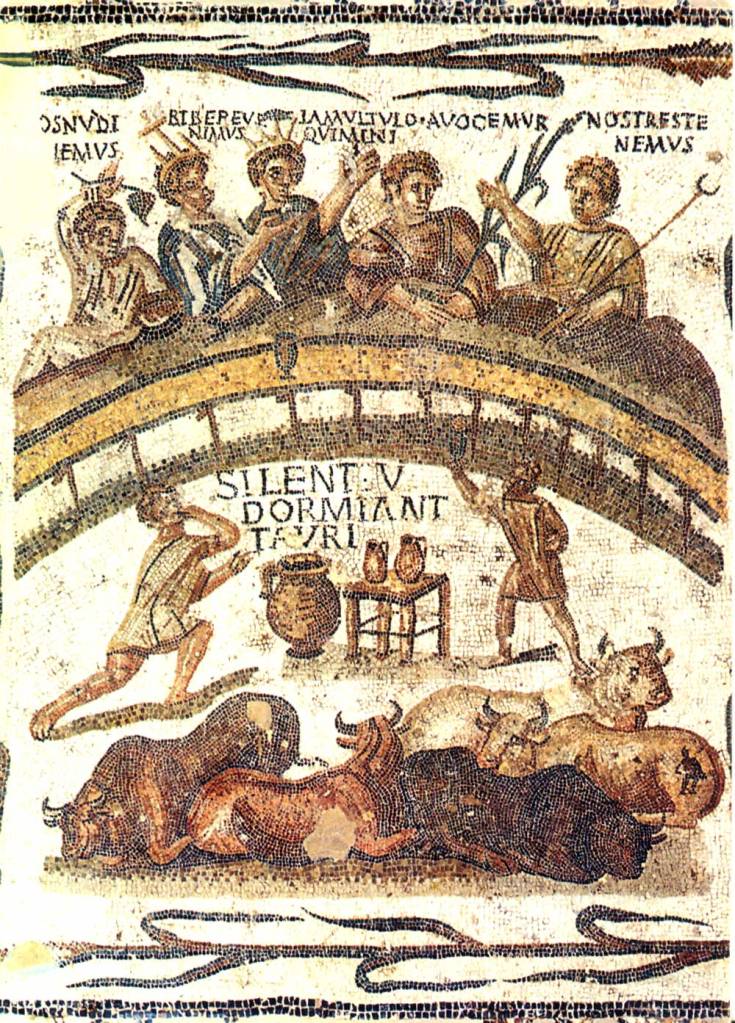
Bestiaires_festoyant_arène_Thysdrus_Musée_Bardo
Mosaic from El Djem (ancient Thysdrus), Tunesia, ca. 220-250 AD

[N]os nudi [f]iemus.
bibere venimus.
ia[m] multu[m] loquimini.
avocemur.
nos tres tenemus.

silentiu[m] dormiant tauri.

(Tunis, Musée National du Bardo, 3361)

We’re going to be (= drink ourselves?) naked.
We’re here to drink.
You’re all talking a lot.
We may get called away.
We’re having three [glasses].

Silence! Let the bulls sleep.

(tr. by anonymous)

Emundanda

Xylospongium

Nuper in ludo bestiariorum unus e Germanis, cum ad matutina spectacula pararetur, secessit ad exonerandum corpus; nullum aliud illi dabatur sine custode secretum. ibi lignum id quod ad emundanda obscena adhaerente spongia positum est, totum in gulam farsit et interclusis faucibus spiritum elisit. hoc fuit morti contumeliam facere. ita prorsus; parum munde et parum decenter; quid est stultius quam fastidiose mori? o virum fortem, o dignum cui fati daretur electio! quam fortiter ille gladio usus esset, quam animose in profundam se altitudinem maris aut abscisae rupis immisisset! undique destitutus invenit quemadmodum et mortem sibi deberet et telum, ut scias ad moriendum nihil aliud in mora esse quam velle. existimetur de facto hominis acerrimi, ut cuique visum erit, dum hoc constet, praeferendam esse spurcissimam mortem servituti mundissimae.
(Seneca Minor, Ep. ad Luc. 70.20-21)

Recently at the wild-animal games, one of the Germans went off to the latrine during the preparations for the morning show—it was the only private moment he had without a guard—and there took the stick with a sponge attached that is put there for cleaning the unmentionables and stuffed the entire thing down his throat, closing off his airway. That was indeed offering insult to death. He went right ahead, unsanitary and indecent as it was: how stupid to be fussy about one’s way of dying! What a brave man! He was worthy to be granted a choice in his fate. How boldly he would have used a sword; how courageously he would have thrown himself over some jagged cliff, or into the depths of the sea! With no resources from anywhere, he still found a way to provide his own death, his own weapon. From this you may know that there is but one thing that can delay our dying: the willingess. Each of us may decide for himself as to the merits of this ferocious man’s deed—so long as we all agree that death, even the most disgusting, is preferable to slavery, even the cleanest slavery. (tr. Margaret Graver & Anthony A. Long)

Dedicata

47a8d12ed35aa187afc3e54cbb6deb10_preview_featured

Bene vero quod Mens, Pietas, Virtus, Fides consecrantur, quarum omnium Romae dedicata publice templa sunt, ut illa qui habeant (habent autem omnes boni) deos ipsos in animis suis collocatos putent. nam illud vitiosum Athenis, quod Cylonio scelere expiato, Epimenide Crete suadente, fecerunt Contumeliae fanum et Impudentiae; virtutes enim, non vitia consecrari decet. araque vetusta in Palatio Febris, et altera Esquiliis Malae Fortunae, detestanda, atque omnia eius modi repudianda sunt. quod si fingenda nomina, Vicae Potae potius vincendi atque potiundi, Statae standi, cognominaque Statoris et Invicti Iovis, rerumque expetendarum nomina, Salutis, Honoris, Opis, Victoriae, quoniamque exspectatione rerum bonarum erigitur animus, recte etiam Spes a Caiatino consecrata est; Fortunaque sit, vel Huiusce Diei (nam valet in omnes dies), vel Respiciens ad opem ferendam, vel Fors in quo incerti casus significantur magis, vel Primigenia a gignendo.
(Cicero, De Legibus 2.28)

It is right that ‘Good Sense, Devotion, Moral Excellence, and Good Faith’ should be deified; and in Rome temples have long been publicly dedicated to those qualities, so that those who possess them (and all good people do) should believe that actual gods have been set up within their souls. At Athens, after atoning for the crime against Cylon, on the advice of the Cretan Epimenides they built a shrine to Insult and Shamelessness. That was a misguided act; for virtues, not vices, should be deified. The ancient altar to Fever on the Palatine, and the other to Evil Fortune on the Esquiline must be refused recognition, and all things of that kind are to be rejected. If we have to devise names, we should choose rather ones like Conquering Power and Protectress, and titles like Jove the Stopper and the Invincible, and names of desirable things like Safety, Honour, Help, and Victory. Because the spirit is raised by the expectation of good things, Hope was rightly deified by Calatinus*. And let Today’s Fortune be acknowledged as a deity, for it has influence over every day, or Fortune the Heedful, that she may send help, or Chance Fortune in cases where uncertain events are particularly indicated, or First-born Fortune from giving birth.

* rather than Caiatinus (ed.).

(tr. Niall Rudd)

Sedabit

shut up

Nunc quid petam mea causa aequo animo attendite.
Hecyram ad vos refero, quam mihi per silentium
numquam agere licitumst; ita eam oppressit calamitas.
eam calamitatem vostra intellegentia
sedabit, si erit adiutrix nostrae industriae.
quom primum eam agere coepi, pugilum gloria
(funambuli eodem accessit exspectatio),
comitum conventus, strepitus, clamor mulierum
fecere ut ante tempus exirem foras.
vetere in nova coepi uti consuetudine
in experiundo ut essem; refero denuo.
primo actu placeo; quom interea rumor venit
datum iri gladiatores, populus convolat,
tumultuantur, clamant, pugnant de loco.
ego interea meum non potui tutari locum.
nunc turba nulla est: otium et silentiumst:
agendi tempus mihi datumst; vobis datur
potestas condecorandi ludos scaenicos.
nolite sinere per vos artem musicam
recidere ad paucos: facite ut vostra auctoritas
meae auctoritati fautrix adiutrixque sit.
si numquam avare pretium statui arti meae
et eum esse quaestum in animum induxi maxumum
quam maxume servire vostris commodis,
sinite impetrare me, qui in tutelam meam
studium suom et se in vostram commisit fidem,
ne eum circumventum inique iniqui irrideant.
mea causa causam accipite et date silentium,
ut lubeat scribere aliis mihique ut discere
novas expediat posthac pretio emptas meo.
(Terence, Hecyra 28-57)

Now for my sake listen to my request with open minds. I am presenting “The Mother-in-Law” to you again, which I have never been allowed to play in silence; it has been so dogged by disaster. But your good sense, allied to my efforts, can mitigate the disaster. The first time I tried to perform the play, I was forced off the stage early; there was talk of boxers—and added to that a promise of a tightrope walker—crowds of supporters, general uproar, and women screaming. I decided to use my old practice on this new play and continue the experiment: I put it on a second time. The first act went well. But then a rumour arose that there was going to be a gladiatorial show: crowds rushed in, with much confusion, shouting, and fighting for places, and in these circumstances I couldn’t preserve my place. Now there is no disturbance; all is peace and quiet. I have the chance to perform the play, and you the opportunity to add lustre to the dramatic festivals. Do not allow the dramatic art to fall into the hands of a few through your negligence. Make sure that your influence aids and abets my influence. I have never priced my art on the basis of greed; I have adopted the principle that the greatest reward for me is to serve your interests the best. So let me prevail on you not to allow an author who has entrusted his career to my keeping and himself to your protection to be cheated and unfairly derided by unfair critics. For my sake listen to my plea and grant me silence, so that other authors may be encouraged to write and it may be worth my while in the future to put on new plays bought at my own expense. (tr. John Barsby)

Vaniverbosus

grandpa-simpson

Loquitur, loquitur, senex famosus,
garrulus, aridus, vaniverbosus.
ecce qui temporis impetu
paulos post annos eris et tu.
(Johannes Gaertner, In congressu scholastico)

He talks, he talks, that famous old man,
babbling, boring, he talks all that he can.
But beware, in a few years,
it will be you who pains people’s ears.
(tr. Demmy Verbeke)

Pilositate

3672f49f481e5879054f4c061445e2d6

Duvenaldus, rex Limericensis, mulierem habebat umbilico tenus barbatam. Quae et cristam habuit a collo superius per spinam deorsum, in modum pulli annui, crine vestitam. mulier ista, duplici prodigio monstruosa, non hermaphrodita tamen, sed alias muliebri natura tantum emollita, ad intuentium tam risum quam stuporem, curiam assidue sequebatur. in spinae quidem pilositate, neutri; in barbae vero prolixitate, morem gerens patriae non naturae. nostris quoque diebus visa est in Connactia curiam sequens mulier, utriusque sexus naturam praeferens, et hermaphrodita. quae barbam a dextris per labri utriusque et menti medium, more virili, densam nimis et longam habebat; faciem vero sinistram, cum labri et menti parte, muliebriter planam, et omni pilositate carentem.
(Giraldus Cambrensis, Topographia Hibernica 2.20)

Duvenald, king of Limerick, had a woman with a beard down to her navel, and, also, a crest like a colt of a year old, which reached from the top of her neck down her backbone, and was covered with hair. The woman, thus remarkable for two monstrous deformities, was, however, not an hermaphrodite, but in other respects had the parts of a woman; and she constantly attended the court, an object of ridicule as well as of wonder. The fact of her spine being covered with hair neither determined her gender to be male or female; and in wearing a long beard she followed the customs of her country, though it was unnatural in her. Also, within our time, a woman was seen attending the court in Connaught, who partook of the nature of both sexes, and was an hermaphrodite. On the right side of her face she had a long and thick beard, which covered both sides of her lips to the middle of her chin, like a man; on the left, her lips and chin were smooth and hairless, like a woman. (tr. Thomas Forester, revised by Thomas Wright)

Oinos

kykeon greece psychedelics

Οἶνός τοι χαρίεντι πέλει ταχὺς ἵππος ἀοιδῷ·
ὕδωρ δὲ πίνων οὐδὲν ἂν τέκοις σοφόν. [Cratinus, fr. 203]
τοῦτ’ ἔλεγεν, Διόνυσε, καὶ ἔπνεεν οὐχ ἑνὸς ἀσκοῦ
Κρατῖνος, ἀλλὰ παντὸς ὠδώδει πίθου.
τοιγὰρ ὑπὸ στεφάνοις μέγας ἔβρυεν, εἶχε δὲ κισσῷ
μέτωπον ὥσπερ καὶ σὺ κεκροκωμένον.
(Nicaenetus(?), Anth. Gr. 13.29)

‘Wine, you know, is a fast horse for a poet with grace. You’d produce nothing clever by drinking water!’* Cratinus used to say this, Dionysus, and he smelled not of a single wineskin, but stank of the whole jar. Therefore he flourished great under garlands, and just like you he kept his brow yellowed with ivy. (tr. Alexander Sens)

* It is uncertain whether the quote extends to v. 1 or is limited to v. 2.

Leges

Twelve_Tables_Engraving

Et quidem initio civitatis nostrae populus sine lege certa, sine iure certo primum agere instituit omniaque manu a regibus gubernabantur. postea aucta ad aliquem modum civitate ipsum Romulum traditur populum in triginta partes divisisse, quas partes curias appellavit propterea quod tunc reipublicae curam per sententias partium earum expediebat. et ita leges quasdam et ipse curiatas ad populum tulit: tulerunt et sequentes reges. quae omnes conscriptae exstant in libro sexti Papirii, qui fuit illis temporibus, quibus superbus Demarati Corinthii filius, ex principalibus viris. is liber, ut diximus, appellatur ius civile Papirianum, non quia Papirius de suo quicquam ibi adiecit, sed quod leges sine ordine latas in unum composuit. exactis deinde regibus lege tribunicia omnes leges hae exoleverunt iterumque coepit populus Romanus incerto magis iure et consuetudine aliqua uti quam per latam legem, idque prope viginti annis passus est. postea ne diutius hoc fieret, placuit publica auctoritate decem constitui viros, per quos peterentur leges a Graecis civitatibus et civitas fundaretur legibus: quas in tabulas eboreas perscriptas pro rostris composuerunt, ut possint leges apertius percipi: datumque est eis ius eo anno in civitate summum, uti leges et corrigerent, si opus esset, et interpretarentur neque provocatio ab eis sicut a reliquis magistratibus fieret. qui ipsi animadverterunt aliquid deesse istis primis legibus ideoque sequenti anno alias duas ad easdem tabulas adiecerunt: et ita ex accedenti appellatae sunt leges duodecim tabularum. quarum ferendarum auctorem fuisse decemviris Hermodorum quendam Ephesium exulantem in Italia quidam rettulerunt.
(Pomponius, Encheiridion fr. 178 Lenel (partim)Digesta 1.2.2.1-4)

The fact is that at the outset of our civitas, the citizen body decided to conduct its affairs without fixed statute law or determinate legal rights; everything was governed by the kings under their own hand. When the civitas subsequently grew to a reasonable size, then Romulus himself, according to the tradition, divided the citizen body into thirty parts, and called them curiae on the ground that he improved his curatorship of the commonwealth through the advice of these parts. And accordingly, he himself enacted for the people a number of statutes passed by advice of the curiae [leges curiatae]; his successor kings legislated likewise. All these statutes have survived written down in the book by Sextus Papirius, who was a contemporary of Superbus, son of Demeratus the Corinthian, and was one of the leading men of his time. That book, as we said, is called The Papirian Civil Law, not because Papirius put a word of his own in it, but because he compiled in unitary form laws passed piecemeal. Then, when the kings were thrown out under a Tribunician enactment, these statutes all fell too, and for a second time, the Roman people set about working with vague ideas of right and with customs of a sort rather than with legislation, and they put up with that for nearly twenty years. After that, to put an end to this state of affairs, it was decided that there be appointed, on the authority of the people, a commission of ten men by whom were to be studied the laws of the Greek city states and by whom their own city was to be endowed with laws. They wrote out the laws in full on ivory tablets and put the tablets together in front of the rostra, to make the laws all the more open to inspection. They were given during that year sovereign right in the civitas, to enable them to correct the laws, if there should be a need for that, and to interpret them without liability to any appeal such as lay from the rest of the magistracy. They themselves discovered a deficiency in that first batch of laws, and accordingly, they added two tablets to the original set. It was from this addition that the laws of the Twelve Tables got their name. Some writers have reported that the man behind the enactment of these laws by the Ten Men was one Hermodorus from Ephesus, who was then in exile in Italy. (tr. Alan Watson)

Sublimitas

650x350_ebola

Hoc denique inter nos et ceteros interest qui Deum nesciunt, quod illi in adversis queruntur et murmurant, nos adversa non avocant a virtutis et fidei veritate, sed corroborant in dolore. hoc quod nunc corporis vires solutus in fluxum venter eviscerat, quod in faucium vulnera conceptus medullitus ignis exaestuat, quod assiduo vomitu intestina quatiuntur, quod oculi vi sanguinis inardescunt, quod quorundam vel pedes vel aliquae membrorum partes contagio morbidae putredinis amputantur, quod per iacturas et damna corporum prorumpente languore vel debilitatur incessus, vel auditus obstruitur, vel caecatur aspectus, ad documentum proficit fidei. contra tot impetus vastitatis et mortis inconcussi animi virtutibus congredi quanta pectoris magnitudo est? quanta sublimitas inter ruinas generis humani stare erectum, nec cum eis, quibus spes in Deum nulla est, iacere prostratum? gratulari magis oportet et temporis munus amplecti, quod, dum nostram fidem fortiter promimus, et labore tolerato ad Christum per angustam Christi viam pergimus, praemium vitae eius et fidei ipso iudicante capiamus.
(Cyprian, De Mortalitate 10)

This, in short, is the difference between us and others who know not God, that in misfortune they complain and murmur, while adversity does not call us away from the truth of virtue and faith, but strengthens us by its suffering. This trial, that now the bowels, relaxed into a constant flux, discharge the bodily strength; that a fire originated in the marrow ferments into wounds of the fauces; that the intestines are shaken with a continual vomiting; that the eyes are on fire with the injected blood; that in some cases the feet or some parts of the limbs are taken off by the contagion of diseased putrefaction; that from the weakness arising by the maiming and loss of the body, either the gait is enfeebled, or the hearing is obstructed, or the sight darkened;—is profitable as a proof of faith. What a grandeur of spirit it is to struggle with all the powers of an unshaken mind against so many onsets of devastation and death! what sublimity, to stand erect amid the desolation of the human race, and not to lie prostrate with those who have no hope in God; but rather to rejoice, and to embrace the benefit of the occasion; that in thus bravely showing forth our faith, and by suffering endured, going forward to Christ by the narrow way that Christ trod, we may receive the reward of His life and faith according to His own judgment!  (tr. Ernest Wallis)

Ignoramus

winter_cold_vinter_frost_rime_rimfrost_kallt_skateholm-452377.jpg!d

Quid ergo? Nos soli ignoramus, nescimus, quisnam sit animarum conditor, quisnam constitutor, quae causa hominem finxerit, mala unde proruperint, vel cur ea rex summus et esse patiatur et confici neque ab rebus propellat humanis? vos enim horum quicquam exploratum habetis et cognitum? si suspicionum exponere volueritis audaciam, potestis explicare ac promere, mundus iste qui nos habet utrumne sit ingenitus an tempore in aliquo constitutus? si constitutus et factus est, quonam operis genere aut rei cuius ob causam? potestis inducere atque expedire rationem, cur non fixus atque immobilis maneat sed orbito semper circumferatur in motus sua ipse se sponte et voluntate circumagat an virtutis alicuius inpulsionibus torqueatur? locus ipse ac spatium, in quo situs est ac volutatur, quid sit? infinitus, finitus, inanis an solidus? quis eum sustineat extremis cardinibus nitens an ipse se potius vi propria sufferat et spiritu interiore suspendat? potestis interrogati planum facere scientissimeque monstrare, quid nivem in plumeas subaperiat crustulas? quidnam fuerit rationis et causae, ut non ab occiduis partibus dies primus exsurgeret et lucem in oriente finiret? quemadmodum sol ipse uno eodemque contactu tam varias res efficiat, quinimmo contrarias? quid sit luna? quid stellae? cur una specie aut illa non maneat, aut per omne mundi corpus frustilla haec ignea convenerit atque oportuerit figi? cur alia ex his parva, ampliora et maiora sint alia, obtunsi haec luminis, acutioris illa et fulgidae claritatis?
(Arnobius, Adversus Nationes 2.58)

What, then, are we alone ignorant? Do we alone not know who is the creator, who the former of souls, what cause fashioned man, whence ills have broken forth, or why the Supreme Ruler allows them both to exist and be perpetrated, and does not drive them from the world? Have you, indeed, ascertained and learned any of these things with certainty? If you chose to lay aside audacious conjectures, can you unfold and disclose whether this world in which we dwell was created or founded at some time? If it was founded and made, by what kind of work, pray, or for what purpose? Can you bring forward and disclose the reason why it does not remain fixed and immoveable, but is ever being carried round in a circular motion? Whether it revolves of its own will and choice, or is turned by the influence of some power? What the place, too, and space is in which it is set and revolves, boundless, bounded, hollow, or solid? Whether it is supported by an axis resting on sockets at its extremities, or rather itself sustains by its own power, and by the spirit within it upholds itself? Can you, if asked, make it clear, and show most skilfully, what opens out the snow into feathery flakes? What was the reason and cause that day did not, in dawning, arise in the west, and veil its light in the east? How the sun, too, by one and the same influence, produces results so different, nay, even so opposite? What the moon is, what the stars? Why, on the one hand, it does not remain of the same shape, or why it was right and necessary that these particles of fire should be set all over the world? Why some of them are small, others large and greater,—these have a dim light, those a more vivid and shining brightness? (tr. Hamilton Bryce & Hugh Campbell)