Stauroisin

Diego Velázquez, Cristo crucificado, 1632
Diego Velázquez, Cristo crucificado (1632)

This is part 1 of 2. Part 2 is here.

Οἱ δ’ ἐπεὶ ἐκ πόλιος κατέβαν, τάχα δ’ ἀγρὸν ἵκοντο,
τείχεος ἔκτοσθεν· μέγα δέ σφισι φαίνετο ἔργον.
ἕστηκε ξύλον αὖον ὅσον τ’ ὄργυι’ ὑπὲρ αἴης,
οἷον δὲ τρέφει ἔρνος ἀνὴρ ἐριθηλὲς ἐλαίης·
τόσσον ἔην μῆκος, τόσσον πάχος εἰσοράασθαι.
σειρὴν δὲ πλεκτὴν ἐξ αὐτοῦ πειρήσαντες
εἴρυσαν ἠνορέῃ πίσυνοι καὶ κάρτεϊ χειρῶν
δήμιοι, οἳ κατ’ ἀγῶνας ἐϋπρήσεσκον ἕκαστα·
ἐς μέσσον δ’ ἀνάγοντ’, ἐκ δ’ ἄμφω χεῖρας ἀνέσχον,
σὺν δὲ πόδας χεῖράς τε δέον θυμαλγέϊ δεσμῷ.
πλείοσιν ἐν δεσμοῖσι δέον, μᾶλλον δ’ ἐπίεζον·
ἐν δ’ αὐτὸς κίεν ᾗσι προθυμίῃσι πεποιθώς·
“ἀλλὰ τί κεν ῥέξαιμι; θεὸς διὰ πάντα τελευτᾷ.”
ἐκ μέν οἱ χλαῖνάν τε χιτῶνά τε εἵματ’ ἔδυσαν
παῖδες ὑπέρθυμοι καὶ καὶ ἐπὶ κλήρους ἐβάλοντο.
δεξάμενοι δ’ ἄρα τοί γε διαστάντες τανύουσι
πέπληγόν θ’ ἱμᾶσιν, ὁμόκλησάν τ’ ἐπέεσσι,
κίονα δ’ ὑψηλὴν ἔρυσαν πέλασάν τέ μιν αὐτὸν
ὀρθὸν ἐν ἱστοπέδῃ, ἐκ δ’ αὐτοῦ πείρατ’ ἀνῆψαν
σταυροῖσιν πυκινοῖσι διαμπερὲς ἔνθα καὶ ἔνθα.
ἀρνειῷ μιν ἔγωγε ἐΐσκω πηγεσιμάλλῳ
ὅν ῥά τε ποιμὴν ἀγρῷ ἐπ’ εἰροπόκοις ὀΐεσσι
συμμάρψας δόνακας μυρίκης τ’ ἐριθηλέας ὄζους
κείρει· ἀνὴρ δέ κεν οὔ τι θεοῦ νόον εἰρύσσαιτο.
ὣς ὁ μὲν αὖθι λέλειπτο, ταθεὶς ὀλοῷ ἐνὶ δεσμπῷ,
ὥρῃ ἐν εἰαρινῇ, ὅτε τ’ ἤματα μακρὰ πέλονται·
οὐδέ τι κινῆσαι μελέων ἦν οὐδ’ ἀναεῖραι,
οὐδὲ στηρίξαι ποσὶν ἔμπεδον, οὐδ’ ἐπιβῆναι.
οἱ δ’ ἐπελώβευον καὶ ἐκερτόμεον ἐπέεσσι,
μάψ, ἀτὰρ οὐ κατὰ κόσμον, ἐς ἠέλιον καταδύντα.
αὐτὰρ ὃ θυμὸν ἔχων ὃν καρτερόν, ὡς τὸ πάρος περ,
τρὶς μὲν ἔπειτ’ ἤϋσεν ὅσον κεφαλὴ χάδε φωτός,
στεῦτο δὲ διψάων, πιέειν δ’ οὐκ εἶχεν ἑλέσθαι·
τρὶς δὲ μεθῆκε βίη· τὸ δὲ τέτρατον ἤθελε θυμός,
ἀλλ’ οὐ γάρ οἱ ἔτ’ ἦν ἲς ἔμπεδος οὐδέ τι κῖκυς.
(Patricius(?), Homerocentones 44.18-52)

When they had gone down from the city, quickly they came to the field, outside the wall; and there appeared to them a great work. There stands, about a fathom’s height above the ground, a dry stump, as when a man rears a lusty sapling of an olive; so huge it was in length, so huge in breadth to look upon. They made fast* to his body a twisted rope and drew him up, trusting in their valor and the strength of their hands, men from the community, who at the games arranged everything properly; and they led him into the middle and put up both his hands, and bound his feet and hands with galling bonds. They bound him with yet more bonds and drew them tighter; and he himself moved among them, confident in his zeal: “But what could I do? It is God who brings all things to their end.” They stripped him of his garments, his cloak and tunic, these proud sons, and cast lots for them. And when they had taken him they stood in a circle and stretched him and struck him with reins, and eagerly scolded him with words, and hoisted him up the tall pillar and drew him closer, upright in the step of the mast, and made fast the ropes from it to the stout pole**, this way and that. To a ram I liken him, a ram of thick fleece that a shepherd in the field, guarding his woolly sheep and gathering handfuls of reeds and luxuriant branches of tamarisk, shaves: but a man will in no way thwart the purpose of God. So he was left there, stretched in his horrible bindings, in the season of spring, when the long days come; and he could in no way stir his limbs or raise them up, nor plant his feet firmly or gain purchase. They mocked and jeered at him in their talk, recklessy and without shame, at sunset. But he with his mighty heart, just as before, thrice then uttered a shout as great as his head could hold, pressing forward eagerly in his thirst, but he had no way to drink. Thrice he gave up the effort; the fourth time he was eager, but no longer had he anything of strength or might remaining.

* The author seems to have confused two Homeric verbs; he ought to have written πειρήναντες.
** Σταυρός, rare in Homer and signifying a ‘stake’ or ‘pole’, in later Greek became the word for the cross of the crucifixion.

(tr. David Bauwens, with his notes; based on August Taber Murray’s translation of the Iliad as revised by George E. Dimock)

Peras

phaedriaugustica00phae_0335

Peras imposuit Iuppiter nobis duas:
propriis repletam vitiis post tergum dedit,
alienis ante pectus suspendit gravem.
hac re videre nostra mala non possumus;
alii simul delinquunt, censores sumus.
(Phaedrus, Fab. 4.10)

Jupiter has given us two sacks to carry. He put one sack, filled with our own faults, on our back, and he suspended a sack heavy with the faults of others in front of us. This is the reason why we are blind to our own bad habits but we sit in judgment as soon as others make a mistake. (tr. Laura Gibbs)

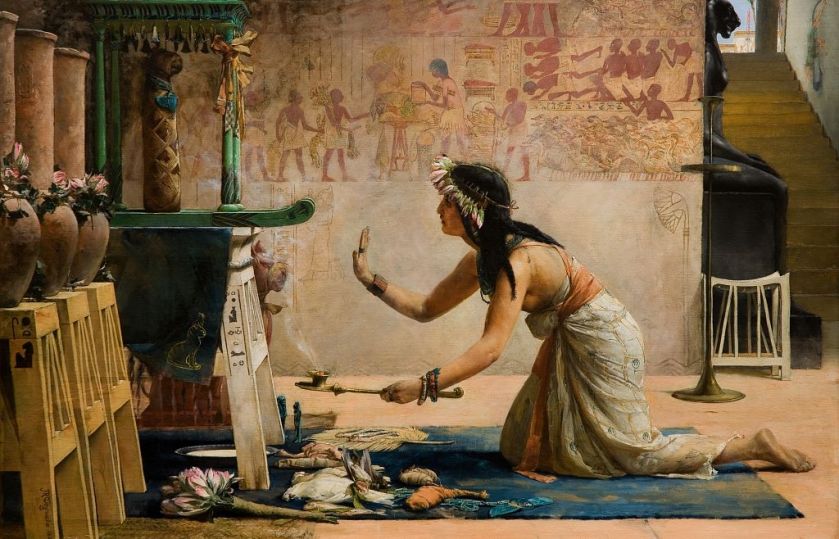
Aielouroi

John Reinhard Weguelin, The obsequies of an Egyptian cat, 1886
John Reinhard Weguelin, The obsequies of an Egyptian cat (1886)

Πολλῶν δὲ ἐόντων ὁμοτρόφων τοῖσι ἀνθρώποισι θηρίων πολλῷ ἂν ἔτι πλέω ἐγίνετο, εἰ μὴ κατελάμβανε τοὺς αἰελούρους τοιάδε· ἐπεὰν τέκωσι αἱ θήλεαι, οὐκέτι φοιτέουσι παρὰ τοὺς ἔρσενας· οἳ δὲ διζήμενοι μίσγεσθαι αὐτῇσι οὐκ ἔχουσι. πρὸς ὦν ταῦτα σοφίζονται τάδε· ἁρπάζοντες ἀπὸ τῶν θηλέων καὶ ὑπαιρεόμενοι τὰ τέκνα κτείνουσι, κτείναντες μέντοι οὐ πατέονται· αἳ δὲ στερισκόμεναι τῶν τέκνων, ἄλλων δὲ ἐπιθυμέουσαι, οὕτω δὴ ἀπικνέονται παρὰ τοὺς ἔρσενας· φιλότεκνον γὰρ τὸ θηρίον. πυρκαϊῆς δὲ γενομένης θεῖα πρήγματα καταλαμβάνει τοὺς αἰελούρους· οἱ μὲν γὰρ Αἰγύπτιοι διαστάντες φυλακὰς ἔχουσι τῶν αἰελούρων, ἀμελήσαντες σβεννύναι τὸ καιόμενον, οἱ δὲ αἰέλουροι διαδύνοντες καὶ ὑπερθρώσκοντες τοὺς ἀνθρώπους ἐσάλλονται ἐς τὸ πῦρ. ταῦτα δὲ γινόμενα πένθεα μεγάλα τοὺς Αἰγυπτίους καταλαμβάνει. ἐν ὁτέοισι δ’ ἂν οἰκίοισι αἰέλουρος ἀποθάνῃ ἀπὸ τοῦ αὐτομάτου, οἱ ἐνοικέοντες πάντες ξυρῶνται τὰς ὀφρύας μούνας, παρ’ ὁτέοισι δ’ ἂν κύων, πᾶν τὸ σῶμα καὶ τὴν κεφαλήν. ἀπάγονται δὲ οἱ αἰέλουροι ἀποφανόντες ἐς ἱρὰς στέγας, ἔνθα θάπτονται ταριχευθέντες, ἐν Βουβάστιπόλι· τὰς δὲ κύνας ἐν τῇ ἑωυτῶν ἕκαστοι πόλι θάπτουσι ἐν ἱρῇσι θήκῃσι. ὣς δὲ αὕτως τῇσι κυσὶ οἱ ἰχνευταὶ θάπτονται. τὰς δὲ μυγαλᾶς καὶ τοὺς ἴρηκας ἀπάγουσι ἐς Βουτοῦν πόλιν, τὰς δὲ ἴβις ἐς Ἑρμέω πόλιν. τὰς δὲ ἄρκτους ἐούσας σπανίας καὶ τοὺς λύκους οὐ πολλῷ τεῳ ἐόντας ἀλωπέκων μέζονας αὐτοῦ θάπτουσι τῇ ἂν εὑρεθέωσι κείμενοι.
(Herodotus, Hist. 2.66-67)

Although there are plenty of domestic animals in Egypt, there would be many more if it were not for what happens to the cats. When female cats give birth, they stop having intercourse with the males. However much the toms want to mate with them, they are unable to do so. The toms have therefore come up with a clever solution. They sneak in and steal the kittens away from their mothers, and then kill them (but not for food). The females, deprived of their young, long to have some more, because the feline species is very fond of its young, and so they go to the males. If a house catches fire, what happens to the cats is quite extraordinary. The Egyptians do not bother to try to put the fire out, but position themselves at intervals around the house and look out for the cats. The cats slip between them, however, and even jump over them, and dash into the fire. This plunges the Egyptians into deep grief. In households where a cat dies a natural death, all the people living there shave off their eyebrows—nothing more. In households where a dog dies, they shave their whole bodies, head and all. After their death, the cats are taken to sacred chambers in the city of Bubastis where they are mummified and buried. Dogs are buried by each householder in his own community in sanctified tombs, and mongooses receive the same form of burial as well. Shrews and hawks are taken to the city of Buto, and ibises to Hermepolis. Bears (which are rare) and wolves (which are not much larger than foxes) are buried wherever they are found lying. (tr. Robin Waterfield)

Gigni

huge-pregnant-belly1

Praeterea ego de partu humano, praeterquam quae scripta in libris legi, hoc quoque usu venisse Romae comperi: feminam bonis atque honestis moribus, non ambigua pudicitia, in undecimo mense post mariti mortem peperisse, factumque esse negotium propter rationem temporis, quasi marito mortuo postea concepisset, quoniam decemviri in decem mensibus gigni hominem, non in undecimo scripsissent; sed divum Hadrianum causa cognita decrevisse in undecimo quoque mense partum edi posse; idque ipsum eius rei decretum nos legimus. in eo decreto Hadrianus id statuere se dicit requisitis veterum philosophorum et medicorum sententiis.
(Aulus Gellius, Noct. Att. 3.16.12)

Furthermore, besides what I have read in books about human gestation, I also heard of the following case, which occurred in Rome: A woman of good and honourable character, of undoubted chastity, gave birth to a child in the eleventh month after her husband’s death, and because of the reckoning of the time the accusation was made that she had conceived after the death of her husband, since the decemvirs had written* that a child is born in ten months and not in the eleventh month. The deified Hadrian, however, having heard the case, decided that birth might also occur in the eleventh month, and I myself have read the actual decree with regard to the matter. In that decree Hadrian declares that he makes his decision after looking up the views of the ancient philosophers and physicians.

* XII Tab. iv. 4, Schöll. The fragment is not extant, but it is cited also by Ulpian, Dig. xxxviii. 16. 3. 11: post decem menses mortis natus non admittetur ad legitimam hereditatem.

(tr. John C. Rolfe, with his note)

Arpinas

Cicero-009

Quid, Catilina, tuis natalibus atque Cethegi
inveniet quisquam sublimius? arma tamen vos
nocturna et flammas domibus templisque paratis,
ut bracatorum pueri Senonumque minores,
ausi quod liceat tunica punire molesta.
sed vigilat consul vexillaque vestra coërcet.
hic novus Arpinas, ignobilis et modo Romae
municipalis eques, galeatum ponit ubique
praesidium attonitis et in omni monte laborat.
tantum igitur muros intra toga contulit illi
nominis ac tituli, quantum sibi Leucade, quantum
Thessaliae campis Octavius abstulit udo
caedibus assiduis gladio; sed Roma parentem,
Roma patrem patriae Ciceronem libera dixit.
(Juvenal, Sat. 8.231-244)

What ancestry more exalted than yours, Catiline, or that of Cethegus can be found? Yet you plotted to attack homes and temples at night and set them on fire, like the sons of trousered Gauls and descendants of the Senones, committing an outrage which could lawfully be punished by the “uncomfortable shirt”. But the consul is alert: he halts your banners. He—a “new man” from Arpinum, of humble origin, a municipal knight new to Rome—posts helmeted troops all around to protect the terrified people and is busy on every hill. So without stepping outside the walls, his peacetime toga brought him as much titled distinction as Octavius grabbed for himself at Leucas and on the fields of Thessaly with his sword wet from nonstop slaughter. The difference is that Rome was still free when she called Cicero the Parent and Father of his Native Land. (tr. Susanna Morton Braund)

Loutra

John Reinhard Weguelin, The bath, 1884
John Reinhard Weguelin, The bath (1884)

Οἷα δὲ καὶ τὰ λουτρὰ αὐταῖς· οἶκοι τεχνητοί, συμπαγεῖς καὶ περιφορητοί, διαφανεῖ σινδόνι καλυπτόμενοι, καθέδραι τε ἐπίχρυσοι, ἀργυρόηλοι καὶ σκεύη μυρία χρυσοῦ τε καὶ ἀργύρου, τὰ μὲν εἰς προπόσεις, τὰ δὲ εἰς τροφάς, τὰ δὲ εἰς τὸ λούσασθαι περιφερόμενα· ναὶ μὴν καὶ ἐσχαρίδες ἀνθράκων· εἰς τοσοῦτον γὰρ ἀκρασίας ἥκουσιν ὡς δειπνεῖν καὶ μεθύειν ἔτι λουομένας· τά τε ἀργυρώματα, μεθ’ ὧν ἐμπομπεύουσιν, ἀπειροκάλως ἐν τοῖς βαλανείοις προτιθέασι· τάχα μέν που καὶ τὸν πλοῦτον δι’ ἀλαζονείαν περιττήν, μάλιστα δὲ τὴν αὐτεξούσιον ἀπαιδευσίαν, καθ’ ἣν κατηγοροῦσιν ἀνάνδρων ἀνδρῶν πρὸς γυναικῶν κεκρατημένων, ἐπιδεικνύμεναι ἐλέγχουσαί τε ἁμῇ γέ πῃ σφᾶς αὐτὰς μὴ οἵας τε εἶναι συνεῖναι καὶ δίχα τῶν σκευῶν τῶν πολλῶν ἱδροῦν δύνασθαι· καὶ γὰρ αἱ πενόμεναι τῆς πομπῆς μὴ μεταλαμβάνουσαι τῶν ἴσων κοινωνοῦσι λουτρῶν. ἔχει δὲ ἄρα ὁ ῥύπος τῆς περιουσίας βλασφημίας περιβολὴν πολλήν. τούτῳ καθάπερ δελέατι ἀγκιστρεύουσιν τοὺς ἀθλίους κεχηνότας ἐπὶ τὰς μαρμαρυγὰς τοῦ χρυσίου· καὶ γὰρ ἐκπλήττουσαι τούτῳ τοὺς ἀπειροκάλους θαυμάζειν σφᾶς τεχνῶνται τοὺς ἐραστάς, οἳ μετ’ ὀλίγον αὐταῖς ἐνυβρίζουσι γυμναῖς. καὶ δὴ τοῖς μὲν ἀνδράσι τοῖς σφῶν οὐκ ἂν ἀποδύσαιντο προσποίητον αἰσχύνης ἀξιοπιστίαν μνώμεναι, ἔξεστι δὲ τοῖς βουλομένοις τῶν ἄλλων τὰς οἴκοι κατακλείστους γυμνὰς ἐν τοῖς βαλανείοις θεάσασθαι· ἐνταῦθα γὰρ ἀποδύσασθαι τοῖς θεαταῖς ὥσπερ καπήλοις σωμάτων οὐκ αἰσχύνονται. ἀλλ’ ὁ μὲν Ἡσίοδος “μηδὲ γυναικείῳ λουτρῷ χρόα φαιδρύνεσθαι” παραινεῖ. κοινὰ δὲ ἀνέῳκται ἀνδράσιν ὁμοῦ καὶ γυναιξὶ τὰ βαλανεῖα, κἀντεῦθεν ἐπὶ τὴν ἀκρασίαν ἀποδύονται· ἐκ τοῦ γὰρ εἰσορᾶν γίνεται ἀνθρώποις ἐρᾶν, ὥσπερ ἀποκλυζομένης τῆς αἰδοῦς αὐτοῖς κατὰ τὰ λουτρά. αἳ δὲ μὴ εἰς τοσοῦτον ἀπερυθριῶσαι τοὺς μὲν ὀθνείους ἀποκλείουσιν, ἰδίοις δὲ οἰκέταις συλλούονται καὶ δούλοις ἀποδύονται γυμναὶ καὶ ἀνατρίβονται ὑπ’ αὐτῶν, ἐξουσίαν δοῦσαι τῷ κατεπτηχότι τῆς ἐπιθυμίας τὸ ἀδεὲς τῆς ψηλαφήσεως· οἱ γὰρ παρεισαγόμενοι παρὰ τὰ λουτρὰ ταῖς δεσποίναις γυμναῖς μελέτην ἴσχουσιν ἀποδύσασθαι πρὸς τόλμαν ἐπιθυμίας ἔθει πονηρῷ περιγράφοντες τὸν φόβον. καὶ οἱ μὲν παλαιοὶ τῶν ἀθλητῶν γυμνὸν δεικνύναι τὸν ἄνδρα αἰδούμενοι ἐν διαζώσμασι τὴν ἀγωνίαν ἐκτελοῦντες τὸ αἰδῆμον ἐφύλαττον· αἳ δὲ ἀποδυσάμεναι ἅμα τῷ χιτῶνι καὶ τὴν αἰδῶ φαίνεσθαι μὲν βούλονται καλαί, ἄκουσαι δ’ ὅμως ἐλέγχονται κακαί· καὶ γὰρ δι’ αὐτοῦ καταφαίνεται μάλιστα τοῦ σώματος τὸ μάχλον τῆς ἐπιθυμίας, καθάπερ τοῖς ὑδεριῶσιν τὸ περιστεγόμενον τῆς ἐπιφανείας ὑγρόν· τὸ νοσοῦν δὲ ἀμφοῖν ἐκ τῆς ὄψεως γνωρίζεται. χρὴ τοίνυν τοὺς ἄνδρας γενναῖον ἀληθείας ὑπόδειγμα ταῖς γυναιξὶ γινομένους αἰσχύνεσθαι τὰς μετ’ αὐτῶν ἀποδύσεις καὶ φυλάττεσθαι τὰς ὄψεις τὰς ὀλισθηράς· ὁ γὰρ ἐμβλέψας, φησί, περιεργότερον ἤδη ἥμαρτεν. οἴκοι μὲν οὖν τοὺς γονεῖς καὶ τοὺς οἰκέτας αἰδεῖσθαι χρή, ἐν δὲ ταῖς ὁδοῖς τοὺς ἀπαντῶντας, ἐν δὲ τοῖς λουτροῖς τὰς γυναῖκας, ἐν δὲ ταῖς ἐρημίαις ἑαυτούς, πανταχοῦ δὲ τὸν λόγον, ὅς ἐστι πανταχοῦ, καὶ ἐγένετο ἄνευ αὐτοῦ οὐδὲ ἕν. οὕτως γὰρ μόνως ἀπτώς τις διαμενεῖ, εἰ πάντοτε αὐτῷ συμπαρεῖναι νομίζοι τὸν θεόν.
(Clement of Alexandria, Paed. 3.31-33)

And of what sort are their baths? Houses skilfully constructed, compact, portable, transparent, covered with fine linen. And gold-plated chairs, and silver ones, too, and ten thousand vessels of gold and silver, some for drinking, some for eating, some for bathing, are carried about with them. Besides these, there are even braziers of coals; for they have arrived at such a pitch of self-indulgence, that they sup and get drunk while bathing. And articles of silver with which they make a show, they ostentatiously set out in the baths, and thus display perchance their wealth out of excessive pride, but chiefly the capricious ignorance, through which they brand effeminate men, who have been vanquished by women; proving at least that they themselves cannot meet and cannot sweat without a multitude of vessels, although poor women who have no display equally enjoy their baths. The dirt of wealth, then, has an abundant covering of censure. With this, as with a bait, they hook the miserable creatures that gape at the glitter of gold. For dazzling thus those fond of display, they artfully try to win the admiration of their lovers, who after a little insult them naked. They will scarce strip before their own husbands affecting a plausible pretence of modesty; but any others who wish, may see them at home shut up naked in their baths. For there they are not ashamed to strip before spectators, as if exposing their persons for sale. But Hesiod advises
“Not to wash the skin in the women’s bath.” [Erga kai Hēmerai 753]
The baths are opened promiscuously to men and women; and there they strip for licentious indulgence (for from looking, men get to loving [Agathon, fr. 29]), as if their modesty had been washed away in the bath. Those who have not become utterly destitute of modesty shut out strangers; but bathe with their own servants, and strip naked before their slaves, and are rubbed by them; giving to the crouching menial liberty to lust, by permitting fearless handling. For those who are introduced before their naked mistresses while in the bath, study to strip themselves in order to audacity in lust, casting off fear in consequence of the wicked custom. The ancient athletes, ashamed to exhibit a man naked, preserved their modesty by going through the contest in drawers; but these women, divesting themselves of their modesty along with their tunic, wish to appear beautiful, but contrary to their wish are simply proved to be wicked. For through the body itself the wantonness of lust shines clearly; as in the case of dropsical people, the water covered by the skin. Disease in both is known from the look. Men, therefore, affording to women a noble example of truth, ought to be ashamed at their stripping before them, and guard against these dangerous sights; for he who has looked curiously, it is said, has sinned already [Mt. 5:28]. At home, therefore, they ought to regard with modesty parents and domestics; in the ways, those they meet; in the baths, women; in solitude, themselves; and everywhere the Word, who is everywhere, and without Him was not anything [John 1:3]. For so only shall one remain without falling, if he regard God as ever present with him. (tr. William Wilson)

Sumbiōsin

Beach.Love_.Couple.1

Ὁ Ῥωμαῖος ὑπὸ τῶν φίλων νουθετούμενος ὅτι σώφρονα γυναῖκα καὶ πλουσίαν καὶ ὡραίαν ἀπεπέμψατο, τὸν κάλτιον αὐτοῖς προτείνας; ‘ καὶ γὰρ οὗτος’ ἔφη ‘ καλὸς ἰδεῖν καὶ καινός, ἀλλ᾽ οὐδεὶς οἶδεν ὅπου με θλίβει.’ δεῖ τοίνυν μὴ προικὶ μηδὲ γένει μηδὲ κάλλει τὴν γυναῖκα πιστεύειν, ἀλλ᾽ ἐν οἷς ἅπτεται μάλιστα τοῦ ἀνδρός, ὁμιλίᾳ τε καὶ ἤθει καὶ συμπεριφορᾷ, ταῦτα μὴ σκληρὰ μηδ᾽ ἀνιῶντα καθ᾽ ἡμέραν ἀλλ᾽ εὐάρμοστα καὶ ἄλυπα καὶ προσφιλῆ παρέχειν. ὥσπερ γὰρ οἱ ἰατροὶ τοὺς ἐξ αἰτιῶν ἀδήλων καὶ κατὰ μικρὸν συλλεγομένων γεννωμένους [p. 345] πυρετοὺς μᾶλλον δεδοίκασιν ἢ τοὺς ἐμφανεῖς καὶ μεγάλας προφάσεις ἔχοντας, οὕτω τὰ λανθάνοντα τοὺς πολλοὺς μικρὰ καὶ συνεχῆ καὶ καθημερινὰ προσκρούματα γυναικὸς καὶ ἀνδρὸς μᾶλλον διίστησι καὶ λυμαίνεται τὴν συμβίωσιν.
(Plutarch, Gamika Parangelmata 22)

The Roman, on being admonished by his friends because he had put away a virtuous, wealthy, and lovely wife, reached out his shoe and said, “Yes, this is beautiful to look at, and new, but nobody knows where it pinches me.” A wife, then, ought not to rely on her dowry or birth or beauty, but on things in which she gains the greatest hold on her husband, namely conversation, character, and comradeship, which she must render not perverse or vexatious day by day, but accommodating, inoffensive, and agreeable. For, as physicians have more fear of fevers that originate from obscure causes and gradual accretion than of those which may be accounted for by manifest and weighty reasons, so it is the petty, continual, daily clashes between man and wife, unnoticed by the great majority, that disrupt and mar married life. (tr. Frank Cole Babbitt)

Novissima

Fighting men friends

Sit tibi coniugii nox prima novissima vitae:
Eupolis hoc periit et nova nupta modo.
utque coturnatum periisse Lycophrona narrant,
haereat in fibris fixa sagitta tuis.
aut lacer in silva manibus spargare tuorum,
sparsus ut est Thebis angue creatus avo.
perque feros montes tauro rapiente traharis,
ut tracta est coniunx imperiosa Lyci.
quodque suae passa est paelex invita sororis,
excidat ante pedes lingua resecta tuos.
conditor ut tardae, laesus cognomine, Myrrhae,
urbis in innumeris inveniare locis.
inque tuis opifex, vati quod fecit Achaeo,
noxia luminibus spicula condat apis.
fixus et in duris carparis viscera saxis,
ut cui Pyrrha sui filia fratris erat.
ut puer Harpagides referas exempla Thyestae,
inque tui caesus viscera patris eas.
trunca geras saevo mutilatis partibus ense,
qualia Mamertae membra fuisse ferunt.
utve Syracosio praestricta fauce poëtae,
sic animae laqueo sit via clausa tuae.
nudave derepta pateant tua viscera pelle,
ut Phrygium cuius nomina flumen habet.
saxificae videas infelix ora Medusae,
Cephenum multos quae dedit una neci.
Potniadum morsus subeas, ut Glaucus, equarum,
inque maris salias, Glaucus ut alter, aquas.
utque duobus idem dictis modo nomen habenti,
praefocent animae Cnosia mella viam.
sollicitoque bibas, Anyti doctissimus olim
imperturbato quod bibit ore reus.
nec tibi, si quid amas, felicius Haemone cedat:
utque sua Macareus, sic potiare tua.
vel videas quod, iam cum flammae cuncta tenerent,
Hectoreus patria vidit ab arce puer.
sanguine probra luas, ut avo genitore creatus,
per facinus soror est cui sua facta parens.
ossibus inque tuis teli genus haereat illud,
traditur Icarii quo cecidisse gener.
utque loquax in equo est elisum guttur acerno,
sic tibi claudatur pollice vocis iter.
(Ovid, Ibis 529-570)

May the first night of your marriage be the last
of your life: so Eupolis and his new bride died.
And as they say the tragedian Lycophron ended,
may an arrow pierce you, and cling to your entrails.
Or be torn apart and scattered in the woods by your kin,
as Pentheus at Thebes, grandson of the serpent, Cadmus.
May you be caught by a raging bull, dragged over wild
mountains, as Lycus’s imperial wife Dirce was dragged.
May your severed tongue lie there, before your feet,
as Philomela, her own sister’s unwilling rival, suffered.
And like dull Myrrha’s author, Cinna, harmed by his name,
may you be found scattered about throughout the city.
And may that artisan, the bee, bury his venomous
sting in your eye, as he did to the Achaean poet.
And, on the harsh cliff, may your entrails be torn
like Prometheus, whose brother’s daughter was Pyrrha.
May you follow Thyestes’ example, like Harpagus’s son,
and, carved in pieces, enter your father’s gut.
May the cruel sword maim your trunk, and mutilate
the parts, as they say Mamertas’s limbs were maimed.
Or may a noose close the passage of your breath
as the Syracusan poet’s throat was stopped.
Or may your naked entrails be revealed by stripping
your skin, like Marsyas who named a Phrygian river.
Unhappy, may you see Medusa’s petrifying face,
that dealt death to many of the Cephenes.
Like Glaucus, be bitten by the horses of Potniae,
or like the other Glaucus, leap into the sea’s waves.
Or may Cretan honey choke your windpipe, like one
who had the same name as the two I’ve mentioned.
May you drink anxiously, where Socrates, wisest of men,
accused by Anytus, once drank with imperturbable lips.
Nor may you be happier than Haemon in your love:
or may you possess your sister as Macareus did his.
Or see what Hector’s son, Astyanax, saw from his
native citadel, when all was gripped by flames.
May you pay for infamies in your offspring, as for his grandfather,
that father’s son, by whose crime his sister became a mother.
And may that kind of weapon cling to your bones, with which
they say Ulysses, the son-in-law of Icarius, was killed.
And as that noisy throat was crushed in the wooden Horse,
so may your vocal passage be closed off with a thumb.
(tr. Tony Kline)

Enkephalos

d305ec2a-9f5a-4894-8cd3-a7c43bb0756b-brain-640

Εἰδέναι δὲ χρὴ τοὺς ἀνθρώπους, ὅτι ἐξ οὐδενὸς ἡμῖν αἱ ἡδοναὶ γίνονται καὶ αἱ εὐφροσύναι καὶ γέλωτες καὶ παιδιαὶ ἢ ἐντεῦθεν καὶ λῦπαι καὶ ἀνίαι καὶ δυσφροσύναι καὶ κλαυθμοί. καὶ τούτῳ φρονεῦμεν μάλιστα καὶ νοεῦμεν καὶ βλέπομεν καὶ ἀκούομεν καὶ γινώσκομεν τά τε αἰσχρὰ καὶ τὰ καλὰ καὶ τὰ κακὰ καὶ ἀγαθὰ καὶ ἡδέα καὶ ἀηδέα, τὰ μὲν νόμῳ διακρίνοντες, τὰ δὲ τῷ ξυμφέροντι αἰσθανόμενοι, τῷ δὲ καὶ τὰς ἡδονὰς καὶ τὰς ἀηδίας τοῖσι καιροῖσι διαγινώσκοντες, καὶ οὐ ταὐτὰ ἀρέσκει ἡμῖν. τῷ δὲ αὐτῷ τούτῳ καὶ μαινόμεθα καὶ παραφρονέομεν, καὶ δείματα καὶ φόβοι παρίστανται ἡμῖν τὰ μὲν νύκτωρ, τὰ δὲ μεθ’ ἡμέρην, καὶ ἐνύπνια καὶ πλάνοι ἄκαιροι, καὶ φροντίδες οὐχ ἱκνεύμεναι, καὶ ἀγνωσίη τῶν καθεστεώτων καὶ ἀηθίη καὶ ἀπειρίη. καὶ ταῦτα πάσχομεν ἀπὸ τοῦ ἐγκεφάλου πάντα, ὅταν οὗτος μὴ ὑγιαίνῃ, ἀλλ’ ἢ θερμότερος τῆς φύσιος γένηται ἢ ψυχρότερος ἢ ὑγρότερος ἢ ξηρότερος, ἤ τι ἄλλο πεπόνθῃ πάθος παρὰ τὴν φύσιν ὃ μὴ ἐώθει. καὶ μαινόμεθα μὲν ὑπὸ ὑγρότητος· ὅταν γὰρ ὑγρότερος τῆς φύσιος ᾖ, ἀνάγκη κινεῖσθαι, κινευμένου δὲ μήτε τὴν ὄψιν ἀτρεμίζειν μήτε τὴν ἀκοήν, ἀλλ’ ἄλλοτε ἄλλα ὁρᾶν καὶ ἀκούειν, τήν τε γλῶσσαν τοιαῦτα διαλέγεσθαι οἷα ἂν βλέπῃ τε καὶ ἀκούῃ ἑκάστοτε· ὅσον δ’ ἂν ἀτρεμήσῃ ὁ ἐγκέφαλος χρόνον, τοσοῦτον καὶ φρονεῖ ὁ ἄνθρωπος.
(Hippocrates, Peri Hierēs Nousou 14)

And men ought to know that from nothing else but (from the brain) come joys, delights, laughter and sports, and sorrows, griefs, despondency, and lamentations. And by this, in an especial manner, we acquire wisdom and knowledge, and see and hear, and know what are foul and what are fair, what are bad and what are good, what are sweet, and what unsavory; some we discriminate by habit, and some we perceive by their utility. By this we distinguish objects of relish and disrelish, according to the seasons; and the same things do not always please us. And by the same organ we become mad and delirious, and fears and terrors assail us, some by night, and some by day, and dreams and untimely wanderings, and cares that are not suitable, and ignorance of present circumstances, desuetude, and unskilfulness. All these things we endure from the brain, when it is not healthy, but is more hot, more cold, more moist, or more dry than natural, or when it suffers any other preternatural and unusual affection. And we become mad from humidity (of the brain). For when it is more moist than natural, it is necessarily put into motion, and the affection being moved, neither the sight nor hearing can be at rest, and the tongue speaks in accordance with the sight and hearing. As long as the brain is at rest, the man enjoys his reason… (tr. Charles Darwin Adams)

Titillatio

wet dream

Itaque hic est integritatis finis ac perfecta probatio, si quiescentibus nobis titillatio voluptatis nulla subrepserit, ac pro necessitate naturae nobis inconsciis concretiones egerantur obscenae. quas sicut abscindere per omnia et in perpetuum amputare super naturam est: ita revocare ad inevitabilem rarissimamque naturae necessitatem summae virtutis est, quae pulsare monachum duobus interpositis mensibus solet. quod tamen dictum sit secundum nostram experientiam, non secundum sententiam seniorum, a quibus etiam hae memorati temporis induciae admodum iudicabantur angustae, ne si hoc modo quo ab ipsis percepimus voluerimus exponere, his forte, qui pro negligentia sua, vel remissiore studio puritatem hanc minus experti sunt, incredibilia vel impossibilia descripsisse credamur. quem statum ita tenere perpetuo poterimus, ac numquam naturalem modum, nec tempus excedere superius comprehensum, si Deum non solum secretorum actuum nostrorum, verum etiam cogitationum cunctarum diurnum pariter nocturnumque inspectorem esse et conscium cogitemus, ac pro omnibus, quae in nostro corde versantur, sicut pro factis et operibus nostris rationem nos ei reddituros esse credamus. hucusque igitur festinandum est nobis, et eo usque adversus animi motus vel carnis incentiva pugnandum, donec ista carnis conditio necessitatem naturae expleat, non suscitet voluptatem, concretam exuberantiam sine ullo pruritu noxaque propellens, non pugnam suscitans castitati. ceterum mens dum adhuc dormiens imaginum visione deluditur, noverit se necdum ad integram perfectionem castitatis excoctam. igitur ut illusiones hae ne dormientibus quidem nobis subrepere valeant, aequale moderatumque semper tenendum est ieiunium. quisquis enim mensuram districtionis excesserit, necesse est ut modum quoque remissionis excedat. qua inaequali tate detentus ab hoc tranquillitatis planissimo statu sine dubio revocabitur: nunc quidem nimia inanitate defectus, nunc autem cibo propensiore distentus. cum immutatione siquidem refectionis qualitatem quoque puritatis nostrae necesse est immutari. deinde iugis humilitas ac patientia cordis adhibenda perpetuo est, atque intenta adversus iram vel ceteras passiones per diem cautio. ubi enim furoris insidet virus, libidinis quoque necesse est incendium penetrare. ante omnia vero pervigil necessaria est sollicitudo nocturna. nam sicut puritas et custodia diei nocturnam praeparant castitatem, ita nocturnae vigiliae cordi pariter et observationi diurnae statum solidissimum roburque praemittunt.
(John Cassian, Inst. 6.20-23)

Therefore, this is the goal of integrity and its perfect proof: that no movement of the flesh creeps up on us while asleep, and that while unconscious we have no impure emissions [except those?] to which nature is subject. While it is beyond nature to avoid these completely and definitively, it is proper to exalted virtue to restrict them to the least frequent and naturally inevitable cases, which for a monk would occur every two months. But we have stated this according to our own experience and not according to the teaching of the elders, who judge that the periods of cessation stated here are still too short. We are afraid that if we expound this as we heard it from them, we might be thought, by those who have experienced a lesser purity due to negligence and less effort, to have described the impossible and the incredible. We can maintain this condition continually and never exceed the natural time-limit set down above if we recall that God is not only the observer of our secret actions but also of our thoughts day and night; we must render him an account for everything that transpires in our heart as well as for our works and acts. Therefore we must struggle to attain this point and we must battle against the movements of the mind and the urgings of the flesh to such a degree that the flesh satisfies its natural demands without arousing desire and can rid itself of superfluous humors without any harmful prurience and without necessitating a struggle for chastity. Otherwise, the mind will know that it has not yet attained perfect chastity since it is still subject to fantasies in sleep. Therefore, we must always maintain a balanced and moderate fast, so that these delusions not even come upon us while asleep. For whoever exceeds the proper measure of fasting will then also need an immoderate relaxation. Whoever is subject to these ups and downs will doubtless not attain that very even state of tranquility, whether from too little or too much food. Finally, we need to have profound humility and a constantly patient heart, and we also must remain cautious against anger and other passions. For when anger burns, the fire of passion will penetrate us as well. But above all, we must remain vigilant during the night. For just as daytime purity and watchfulness prepare us for nighttime chastity, likewise nightly vigils provide a solid and strong basis for our hearts in their daytime watchfulness. (tr. Jerome Bertram)