While they were still taking stock there was an actual fracas involving Astyochus. The Syracusan and Thurian sailors were for the most part free men (more so than in other contingents), and so were particularly forthright in besieging Astyochus with demands for pay. He gave them a somewhat dismissive answer accompanied by threats, and even raised his stick against Dorieus when he supported the claims of his own men. At this the crowd of troops saw red, as sailors will, and surged forward to strike Astyochus down. He saw it coming and ran for refuge at a nearby altar. In the end he was not hurt, and the confrontation was dissipated. Another incident was a surprise assault made by the Milesians on the fort which Tissaphernes had built in Miletus: they captured it and expelled the guards he had posted there. This action met with the approval of the other allies, especially the Syracusans. Lichas, though, was not pleased. He said that the Milesians and the others living in the King’s territory should pay all reasonable deference to Tissaphernes and keep on good terms with him until they brought the war to a successful conclusion. This and other similar pronouncements caused much resentment among the Milesians, and when Lichas subsequently died of disease they refused to allow the Spartans present at the time to bury him where they wanted. (tr. Martin Hammond)
Etenim percensere insignia priscorum in his moribus convenit. Cassius Hemina ex antiquissimis auctor est primum e medicis venisse Romam Peloponneso Archagathum Lysaniae filium L. Aemilio M. Livio cos. anno urbis DXXXV, eique ius Quiritum datum et tabernam in compito Acilio emptam ob id publice. vulnerarium eum fuisse egregium, mireque gratum adventum eius initio, mox a saevitia secandi urendique transisse nomen in carnificem et in taedium artem omnesque medicos, quod clarissime intellegi potest ex M. Catone, cuius auctoritati triumphus atque censura minimum conferunt; tanto plus in ipso est. quam ob rem verba eius ipsa ponemus: ‘dicam de istis Graecis suo loco, M. fili, quid Athenis exquisitum habeam et quod bonum sit illorum litteras inspicere, non perdiscere. vincam nequissimum et indocile genus illorum, et hoc puta vatem dixisse: quandoque ista gens suas litteras dabit, omnia corrumpet, tum etiam magis, si medicos suos hoc mittet. iurarunt inter se barbaros necare omnes medicina, sed hoc ipsum mercede faciunt, ut fides iis sit et facile disperdant. nos quoque dictitant barbaros et spurcius nos quam alios opicon appellatione foedant. interdixi tibi de medicis.’
(Pliny the Elder, Nat. Hist. 29.12-14)
In fact this is the time to review the outstanding features of medical practices in the days of our fathers. Cassius Hemina, one of our earliest authorities, asserts that the first physician to come to Rome was Archagathus, son of Lysanias, who migrated from the Peloponnesus in the year of the city 535, when Lucius Aemilius and Marcus Livius were consuls. He adds that citizen rights were given him, and a surgery at the crossway of Acilius was bought with public money for his own use. They say that he was a wound specialist, and that his arrival at first was wonderfully popular, but presently from his savage use of the knife and cautery he was nicknamed ‘Executioner,’ and his profession, with all physicians, became objects of loathing. The truth of this can be seen most plainly in the opinion of Marcus Cato, whose authority is very little enhanced by his triumph and censorship; so much more comes from his personality. Therefore I will lay before my readers his very words. ‘I shall speak about those Greek fellows in can their proper place, son Marcus, and point out the result of my enquiries at Athens, and convince you what benefit comes from dipping into their literature, and not making a close study of it. They are a quite worthless people, and an intractable one, and you must consider my words prophetic. When that race gives us its literature it will corrupt all things, and even all the more if it sends hither its physicians. They have conspired together to murder all foreigners with their physic, but this very thing they do for a fee, to gain credit and to destroy us easily. They are also always dubbing us foreigners, and to fling more filth on us than on others they give us the foul nickname of Opici. I have forbidden you to have dealings with physicians.’ (tr. William Henry Samuel Jones)
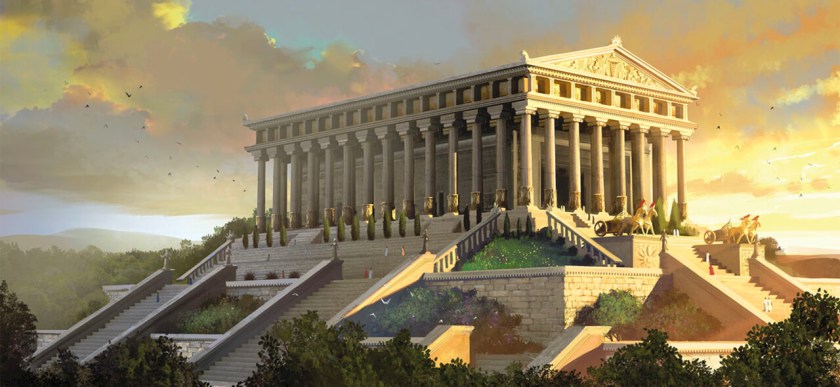
Be that as it may, Alexander was born early in the month Hecatombaeon, the Macedonian name for which is Loüs, on the sixth day of the month, and on this day the temple of Ephesian Artemis was burnt. It was apropos of this that Hegesias the Magnesian made an utterance frigid enough to have extinguished that great conflagration. He said, namely, it was no wonder that the temple of Artemis was burned down, since the goddess was busy bringing Alexander into the world. But all the Magi who were then at Ephesus, looking upon the temple’s disaster as a sign of further disaster, ran about beating their faces and crying aloud that woe and great calamity for Asia had that day been born. To Philip, however, who had just taken Potidaea, there came three messages at the same time: the first that Parmenio had conquered the Illyrians in a great battle, the second that his race-horse had won a victory at the Olympic games, while a third announced the birth of Alexander. These things delighted him, of course, and the seers raised his spirits still higher by declaring that the son whose birth coincided with three victories would be always victorious. (tr. Bernadotte Perrin)
If a myth is needed too, I am rather afraid that some comic poet may say that I am laying myself open to prosecution by the old wives for illegal occupation of their property. Nevertheless, what I am going to tell you will not be just an idle myth that begins and ends with itself; it too will be supported by the evidence of the facts, so that I really will give Amphion’s speech in reply and remember to answer Zethus—even if it will not be one person who is responsible for both speeches, as with Euripides, but we divide them between those two. When mankind and the other animals had only just come into existence, there was uproar and confusion on earth. Human beings did not know what to do with themselves, because in the absence of anything to unite them the stronger harried the weaker, and they were unable to put up any resistance against other creatures, because utterly inferior to all of them, in different respects in different cases: in speed they were inferior to all creatures with wings—so what Homer said the cranes did to the Pygmies was in this period done to the whole human race by birds of prey collectively—and again in strength they were far inferior to lions and boars and many other kinds of creature. As a result they perished unknown. Moreover in the way their bodies were equipped they were worse off not only than sheep but even than snails, because none of them was self-sufficient. Seeing that the human race was being worn down like this and wasting away little by little, Prometheus, who was always something of a friend to them, went up to heaven as an ambassador on their behalf, not because they had sent him, since at this stage they could not yet know about sending ambassadors, but on his own initiative. Impressed by the justice of Prometheus’ words, but also because he had thought the matter through for himself, Zeus ordered Hermes from among his own sons to go to mankind with the gift of oratory. Prometheus had previously fashioned the senses and the other parts of the body for all of them individually, but Zeus told Hermes not to distribute oratory like this, as if it were a handout from the festival fund, so that everyone without exception should have some oratorical ability, as with eyes and hands and feet, but instead to pick out the best and the most noble and those with the strongest constitutions, and to entrust the gift to them, so that they could keep both themselves and other people safe. When oratory had thus arrived among men, they were enabled by the gift of the gods to escape their harsh life among the animals, ceased from the reciprocal hostility that made all enemies to all, and invented the beginnings of sociability. Descending from the hills they banded together in different parts of the inhabited world. They did so in the open air at first; then subsequently, when reasoned argument won through, they founded cities and distributed themselves not randomly as before but into organized communities, and made laws to guide their cities, and took on the practice of having magistrates and a settled constitution, and began to make thank offerings to the gods. The very first offerings they made were in the form of words, in which to this day the gods take the greatest pleasure, as stands to reason, since this was the means by which men were first able to recognize them. It was in this way that human kind rose to greatness from its weak and defective beginnings, and from having previously been despised as of no consequence has since this time become master of the earth, to make use of as it sees fit; and it is oratory that it has taken as its shield in preference to any other form of protection. (tr. Michael Trapp)
“I will tell you of another harsh affliction, Simonides, which the tyrants have. For although they are acquainted with the decent, the wise, and the just, no less than private men [the tyrants] fea rather than admire them. They fear the brave because they might dare something for the sake of freedom; the wise, because they might contrive something; and the just, because the multitude might desire to be ruled by them. When, because of their fear, they do away secretly with such men, who is left for them to use save the unjust, the incontinent, and the slavish? The unjust are trusted because they are afraid, just as the tyrants are, that some day the cities, becoming free, will become their masters. The incontinent are trusted because they are at liberty for the present, and the slavish because not even they deem themselves worthy to be free. This affliction, then, seems harsh to me: to think some men are good, and yet to be compelled to make use of the others. Moreover, the tyrant also is compelled to be a lover of the city; for without the city he would not be able either to preserve himself or to be happy. Yet tyranny compels to give trouble to even their own fatherlands. For they do not rejoice in making the citizens either brave or well-armed. Rather they take pleasure in making strangers more formidable than the citizens, and these strangers they use as bodyguards. Furthermore, when good seasons come and there is an abundance of good things, not even then does the tyrant rejoice with them. For [tyrants] think that as men are more in want, they are more submissive for being used.” (tr. Marvin Kendrick & Seth Bernardete)
Since the Athenians viewed with alarm the rising power of Philip, they came to the assistance of any people who were attacked by the king, by sending envoys to the cities and urging them to watch over their independence and punish with death those citizens who were bent on treason, and they promised them all that they would fight as their allies, and, after publicly declaring themselves the king’s enemies, engaged in an out-and-out war against Philip. The man who more than any other spurred them on to take up the cause of Hellas was the orator Demosthenes, the most eloquent of the Greeks of those times. Even his city was, however, unable to restrain its citizens from their urge toward treason, such was the crop, as it were, of traitors that had sprung up at that time throughout Hellas. Hence the anecdote that when Philip wished to take a certain city with unusually strong fortifications and one of the inhabitants remarked that it was impregnable, he asked if even gold could not scale its walls. For he had learned from experience that what could not be subdued by force of arms could easily be vanquished by gold. So, organizing bands of traitors in the several cities by means of bribes and calling those who accepted his gold “guests” and “friends,” by his evil communications he corrupted the morals of the people. (tr. Charles L. Sherman)
Can it be that you are unaware of the shame which attaches to this practice, and how ridiculous you make yourselves by this deception practised by your state, and that too so openly? For instance, in your decrees you propose ‘to erect a statue of So-and so.’ “But just how,” someone might ask you, “do you propose, men of Rhodes, to ‘erect’ the statue that has been erected possibly for the last five hundred years?” After doing that, can you adjudge those women who palm off other women’s children as their own to be wicked and regard their deception as a horrible thing, while you yourselves are not ashamed of doing the same thing with your images by saying that the statues belong to those to whom they do not belong, and that too when you cannot help hearing of the jests with which your city is reviled? For instance, many people assert that the statues of the Rhodians are like actors. For just as every actor makes his entrance as one character at one time and at another as another, so likewise your statues assume different rôles at different times and stand almost as if they were acting a part. For instance, one and the same statue, they say, is at one time a Greek, at another time a Roman, and later on, if it so happens, a Macedonian or a Persian; and what is more, with some statues the deception is so obvious that the beholder at once is aware of the deceit. For in fact, clothing, foot-gear, and everything else of that kind expose the fraud. (tr. James Wilfred Cohoon)
‘Mus syllaba est;
mus autem caseum rodit;
syllaba ergo caseum rodit.’
puta nunc me istuc non posse solvere: quod mihi ex ista inscientia periculum imminet? quod incommodum? sine dubio verendum est ne quando in muscipulo syllabas capiam, aut ne quando, si neglegentior fuero, caseum liber comedat. nisi forte illa acutior est collectio:
‘mus syllaba est;
syllaba autem caseum non rodit;
mus ergo caseum non rodit.’
o pueriles ineptias! in hoc supercilia subduximus? in hoc barbam demisimus? hoc est quod tristes docemus et pallidi?
(Seneca Minor, Ep. ad Luc. 48.6-7)
“Mouse” is a syllable.
But a mouse eats cheese.
Therefore a syllable eats cheese.
Suppose I can’t solve that one: what risk do I incur by not knowing how? What inconvenience even? Sure, I’d have to watch out—someday I might find myself catching syllables in mousetraps! Better be careful—my cheese might be eaten by a book! But wait, maybe this is a smarter syllogism:
Mouse is a syllable.
But a syllable doesn’t eat cheese.
Therefore a mouse doesn’t eat cheese.
What childish pranks! Is this what makes us knit our brows? Is this why we let our beards grow long? Are we pale and earnest in our teaching of this? (tr. Margaret Graver & Anthony A. Long)
The soul then in her natural state is in love with God and wants to be united with him; it is like the noble love of a girl for her noble father. But when the soul has come into the world of becoming and is deceived, so to say, by the blandishments of her suitors, she changes, bereft of her father, to a mortal love and is shamed; but again she comes to hate her shames here below, and purifies herself of the things of this world and sets herself on the way to her father and fares well. And if anyone does not know this experience, let him think of it terms of our loves here below, and what it is like to attain what one is most in love with, and that these earthly loves are mortal and harmful and loves only of images, and that they change because it was not what is really and truly loved nor our good nor what we seek. But there is our true love, with whom also we can be united, having a part in him and truly possessing him, not embracing him in the flesh from outside. But “whoever has seen, knows what I am saying”, that the soul then has another life and draws near, and has already come near and has a part in him, and so is in a state to know that the giver of true life is present and we need nothing more. But quite otherwise, we must put away other things and take our stand only in this, and become this alone, cutting away all the other things in which we are encased; so we must be eager to go out from here and be impatient at being bound to the other things, that we may embrace him with the whole of ourselves and have no part with which we do not touch God. There one can see both him and oneself as it is right to see: the self glorified, full of intelligible light—but rather itself pure light—weightless, floating free, having become—but rather, being a god; set on fire then, but the fire seems to go out if one is weighed down again. How is it, then, that one does not remain there? It is because one has not yet totally come out of this world. But there will be a time when the vision will be continuous, since there will no longer be any hindrance by the body. But it is not which has seen which is hindered, but the other part which, when that which has seen rests from vision, does not rest from the knowledge which lies in demonstrations and evidence and the discourse of the soul; but seeing and that which has seen are not reason, but greater than reason and before reason and above reason, as is that which is seen. (tr. Arthur Hilary Armstrong)
And in this dance the soul sees the spring of life, the spring of intellect, the principle of being, the cause of good, the root of the soul; these are not poured out from him with the result that they diminish him; for there is no bulk; otherwise the things generated from him would be perishable. But as it is they are eternal, because their principle remains the same, not divided up into them but abiding as a whole. So they also abide; just as the light abides if the sun abides. For we are not cut off from him or separate, even if the nature of body has intruded and drawn us to itself, but we breathe and are preserved because that Good has not given its gifts and then gone away but is always bestowing them as long as it is what it is. But we exist more when we turn to him and our well-being is there, but being far from him is nothing else but existing less. There the soul takes its rest and is outside evils because it has run up into the place which is clear of evils; and it thinks there, and is not passive, and its true life is here; for our present life, the life without God, is a trace of life imitating that life. But life in that realm is the active actuality of Intellect, and the active actuality generates gods in quiet contact with that Good, and generates beauty, and generates righteousness, and generates virtue. It is these the soul conceives when filled with God, and this is its beginning and end; its beginning because it comes from thence, and its end because its good is there. And when it comes to be there it becomes itself and what it was; for what it is here and among the things of this world is a falling away and an exile and a “shedding of wings”. And the soul’s innate love makes clear that the Good is there, and this is why Eros is coupled with the Psyches in pictures and stories. For since the soul is other than God but comes from him it is necessarily in love with him, and when it is there it has the heavenly love, but here love becomes vulgar; for the soul there is the heavenly Aphrodite, but here becomes the vulgar Aphrodite, a kind of whore. And every soul is Aphrodite; and this is symbolised in the story of the birthday of Aphrodite and Eros who is born with her. (tr. Arthur Hilary Armstrong)








 Crambe Repetita