Nobilitas

Gaius Marius
Gaius Marius

This is part 1 of 3. Part 2 is here. Part 3 is here.

“Comparate nunc, Quirites, cum illorum superbia me hominem novom. Quae illi audire aut legere solent, eorum partem vidi, alia egomet gessi; quae illi litteris, ea ego militando didici. nunc vos existumate facta an dicta pluris sint. contemnunt novitatem meam, ego illorum ignaviam; mihi fortuna, illis probra obiectantur. quamquam ego naturam unam et communem omnium existumo, sed fortissimum quemque generosissimum. ac si iam ex patribus Albini aut Bestiae quaeri posset, mene an illos ex se gigni maluerint, quid responsuros creditis, nisi sese liberos quam optumos voluisse? quod si iure me despiciunt, faciant item maioribus suis, quibus, uti mihi, ex virtute nobilitas coepit. invident honori meo; ergo invideant labori, innocentiae, periculis etiam meis, quoniam per haec illum cepi. verum homines corrupti superbia ita aetatem agunt, quasi vestros honores contemnant; ita hos petunt, quasi honeste vixerint. ne illi falsi sunt, qui divorsissumas res pariter exspectant, ignaviae voluptatem et praemia virtutis. atque etiam, cum apud vos aut in senatu verba faciunt, pleraque oratione maiores suos extollunt, eorum fortia facta memorando clariores sese putant. quod contra est. nam quanto vita illorum praeclarior, tanto horum socordia flagitiosior. et profecto ita se res habet: maiorum gloria posteris quasi lumen est, neque bona neque mala eorum in occulto patitur. huiusce rei ego inopiam fateor, Quirites, verum, id quod multo praeclarius est, meamet facta mihi dicere licet. nunc videte quam iniqui sint. quod ex aliena virtute sibi arrogant, id mihi ex mea non concedunt, scilicet quia imagines non habeo et quia mihi nova nobilitas est, quam certe peperisse melius est quam acceptam corrupisse.”
(Sallust, Bell. Iug. 85.13-25)

“Compare, now, citizens, those men, their arrogance, with me, a “new man”. The things that they heard or read about, some of them were things I saw, the rest were things I did. What they learned from books, I learned being a soldier. Now you must judge whether deeds or words are of more value. They scorn my status as a “new man”, I scorn their cowardice; I am taunted for my station in life, they for their shameful activities. I believe that we all have a single common nature, but that the bravest man is the most noble. And, if the fathers of Albinus or Bestia could be asked whether they would rather have a son like me or like the nobles, what do you think they would say except that they wanted the best possible children? On the other hand, if it is right for them to look down on me, they should look down on their own ancestors too, men whose nobility, like mine, began in manly virtue. They are jealous of my office; therefore, let them be jealous of my hard work, my integrity, even the dangers I have faced, since it was through these that I have gained that office. But these men, vitiated by arrogance, pass their lives as if they despised the honours you can give, but seek those honours as if they had lived an honourable life. Surely they are deceived if they expect to enjoy the pleasures of indolence and the rewards of manliness, two contradictory things. Furthermore, when they speak before you or in the Senate, most of their speech is taken up with praising their ancestors: they think that by recalling those brave deeds they themselves become more glorious. But the converse is true. For the more glorious the life of their ancestors is, the more shameful their own cowardice becomes. Certainly this is the truth of the matter: the glory of their ancestors is like a light which does not allow their virtues or faults to be hidden. I confess, citizens, that I have no advantages of this kind, but I have that which is much more glorious: I can talk about my own deeds. Now consider how unfair they are. They do not grant to me from my own virtue the very thing they arrogate to themselves from the virtue of others—of course it is because I do not have family portraits and my nobility is recent. But surely it is better to have created nobility than to have received and corrupted it.” (tr. William W. Batstone)

Puleium

puleium

Non patitur cunctas angustia carminis huius
pulei virtutes celeri comprendere versu.
hoc apud Indorum tanti constare peritos
fertur, apud Gallos quanti valet Indica nigri
congeries piperis. quis iam dubitare sinetur
hac herba plures leniri posse labores,
quam pretiis inhianter emit ditissima tantis
gens, hebenoque auroque fluens et mira volenti
quaeque ferens mundo. o magna laudanda tonantis
virtus et ratio, nullis quae munera terris
larga suae non pandit opis! quae rara sub isto
axe videre soles, aliis in partibus horum
copia tanta iacet, quantum vilissima tecum
efficiunt: rursus quaedam quae spreta videntur
forte tibi, magno mercantur ditia regna,
altera ut alterius potiatur foenore tellus,
orbis et in toto per partes una domus sit.
puleium quoque decoctum curabit, amice,
et potu et fotu stomachum, mihi crede, morantem.
dum canimus quae certa gravi ratione tenemus,
quaedam audita etiam vero miscere coturno
fas ususque sinit: ramum coniungito pulei
auriculae, ne forte caput turbaverit aestus
solis in aerio si te perflarit aperto.
quod nisi me currens deponere vela Thalia
cogeret ac tandem portus intrare moneret,
hinc tibi multiplices poteram decerpere flores.
(Walahfrid Strabo, De Cultura Hortorum 300-326)

The narrow limitations of my song will not
permit me to embrace all the virtues of pennyroyal
in these ephemeral verses. It is reportedly
valued as highly by the physicians of India
as a whole sack of black Indian pepper
amongst the Gauls. Who could doubt that this herb
can relieve numerous sufferings, since that
worthy folk eagerly pays such a high price for it.
Possessing so much ebony and gold, they
are in a position to provide the greedy world
with all kinds of valuable things. How praiseworthy
are the power and wisdom of the thundering god
who bestows his helpful gifts so bountifully!
For whatever is seldom seen under one part of the sky
is readily available in other parts of the earth,
in such quantity there as the cheapest things are here.
Prosperous kingdoms abroad pay good money
for articles which may appear to us valueless.
Thus one country profits from another,
and the whole world in all its parts constitutes
a single household.
Believe me, my friend, an extract of pennyroyal,
taken as a drink or applied as a poultice,
will cure a sluggish stomach.
Normally we report only what we regard as certain,
but in this case custom and usage will allow us
to inject a bit of hearsay into our poem:
If you stick a twing of pennyroyal behind your ear,
then the sun’s heat won’t make you dizzy
when it beats down upon you in the open.
If Thalia weren’t urgently warning me
to take in sail and head for the harbor,
I could pick many more flowers for you here.
(tr. James Mitchell)

Poenigenam

Asclepius taken from The Womb of Coronis. Wood carving, 1549 edition of Alessandro Benedetti_s De Re Medica.

Apollo, cum Coronidem gravidam fecisset, corvum ei custodem apposuit, ne quis ad eam occulte temerator accederet. cum hac Lycus occulte concubuit, quem fulmine Iuppiter exstinxit. ipsam Coronidem Apollo sagittis occidit, cuius mortuae exsecto utero Aesculapium produxit in lucem. unde Vergilius: ‘fulmine poenigenam Stygias detrusit ad undas’ [Aen. 7.773], id est per poenam matris natum.
(Lactantius Placidus, Comm. in Stat. Theb. 3.506)

When Apollo had made Coronis pregnant, he assigned a raven as a guardian over her lest any rash person should secretly approach her. With her by stealth lay Lycus whom Jupiter destroyed with a thunderbolt. Coronis herself Apollo slew with his arrows; from her womb, cut open when she was dead, he brought forth Asclepius into the light of day. Wherefore Vergil says: ‘with his thunderbolt he [sc. Jupiter] hurled down to the Stygian waters ‘poenigenam’, that means him who was born through the punishment of his mother. (tr. Emma & Ludwig Edelstein)


Kuoun

preggers

“Κυοῦσιν γάρ,” ἔφη, “ὦ Σώκρατες, πάντες ἄνθρωποι καὶ κατὰ τὸ σῶμα καὶ κατὰ τὴν ψυχήν, καὶ ἐπειδὰν ἔν τινι ἡλικίᾳ γένωνται, τίκτειν ἐπιθυμεῖ ἡμῶν ἡ φύσις. τίκτειν δὲ ἐν μὲν αἰσχρῷ οὐ δύναται, ἐν δὲ τῷ καλῷ. ἡ γὰρ ἀνδρὸς καὶ γυναικὸς συνουσία τόκος ἐστίν. ἔστι δὲ τοῦτο θεῖον τὸ πρᾶγμα, καὶ τοῦτο ἐν θνητῷ ὄντι τῷ ζῴῳ ἀθάνατον ἔνεστιν, ἡ κύησις καὶ ἡ γέννησις. τὰ δὲ ἐν τῷ ἀναρμόστῳ ἀδύνατον γενέσθαι. ἀνάρμοστον δ’ ἐστὶ τὸ αἰσχρὸν παντὶ τῷ θείῳ, τὸ δὲ καλὸν ἁρμόττον. Μοῖρα οὖν καὶ Εἰλείθυια ἡ Καλλονή ἐστι τῇ γενέσει. διὰ ταῦτα ὅταν μὲν καλῷ προσπελάζῃ τὸ κυοῦν, ἵλεών τε γίγνεται καὶ εὐφραινόμενον διαχεῖται καὶ τίκτει τε καὶ γεννᾷ· ὅταν δὲ αἰσχρῷ, σκυθρωπόν τε καὶ λυπούμενον συσπειρᾶται καὶ ἀποτρέπεται καὶ ἀνείλλεται καὶ οὐ γεννᾷ, ἀλλὰ ἴσχον τὸ κύημα χαλεπῶς φέρει. ὅθεν δὴ τῷ κυοῦντί τε καὶ ἤδη σπαργῶντι πολλὴ ἡ πτοίησις γέγονε
περὶ τὸ καλὸν διὰ τὸ μεγάλης ὠδῖνος ἀπολύειν τὸν ἔχοντα. ἔστιν γάρ, ὦ Σώκρατες,” ἔφη, “οὐ τοῦ καλοῦ ὁ ἔρως, ὡς σὺ οἴει.”
“ἀλλὰ τί μήν;”
“τῆς γεννήσεως καὶ τοῦ τόκου ἐν τῷ καλῷ.”
“εἶεν,” ἦν δ’ ἐγώ.
“πάνυ μὲν οὖν,” ἔφη. “τί δὴ οὖν τῆς γεννήσεως; ὅτι ἀειγενές ἐστι καὶ ἀθάνατον ὡς θνητῷ ἡ γέννησις. ἀθανασίας δὲ ἀναγκαῖον ἐπιθυμεῖν μετὰ ἀγαθοῦ ἐκ τῶν ὡμολογημένων, εἴπερ τοῦ ἀγαθοῦ ἑαυτῷ εἶναι ἀεὶ ἔρως ἐστίν. ἀναγκαῖον δὴ ἐκ τούτου τοῦ λόγου καὶ τῆς ἀθανασίας τὸν ἔρωτα εἶναι.”
(Plato, Symp. 206c-207a)

“All human beings are pregnant, Socrates, in body and in soul, and when we reach maturity it is natural that we desire to give birth. It is not possible to give birth in what is ugly, only in the beautiful. I say that because the intercourse of a man and a woman is a kind of giving birth. It is something divine, this process of pregnancy and procreation. It is an aspect of immortality in the otherwise mortal creature, and it cannot take place in what is discordant. Now, the ugly is not in accord with anything divine, whereas the beautiful accords well. So at this birth Beauty takes on the roles of Fate and Eileithyia. For this reason,whenever the pregnant being approaches the beautiful, it is in favourable mood. It melts with joy, gives birth and procreates. In the face of ugliness, however, it frowns and contracts with pain, and shrivelling up it fails to procreate, and it holds back its offspring in great suffering. This is the reason why, for a pregnant being now ready to give birth, there is much excitement at the presence of the beautiful because its possessor will deliver the pregnant one from great pain. For the object of love, Socrates”, she said, “is not, as you think, simply the beautiful.”
“What, then?”
“It is procreating and giving birth in the beautiful.”
“All right”, I said.
“It certainly is”, she replied. “But why is the object of love procreation? Because procreation is a kind of everlastingness and immortality for the mortal creature, as far as anything can be. If the object of love is indeed everlasting possession of the good, as we have already agreed, it is immortality together with the good that must necessarily be desired. Hence it must follow that the object of love is also immortality.” (tr. Margaret C. Howatson)

Aischunē

blush

In problematis Aristotelis philosophi ita scriptum est: Διὰ τί οἱ μὲν αἰσχυνόμενοι ὠχριῶσιν, παραπλησίων τῶν παθῶν ὄντων; ὅτι τῶν μὲν αἰσχυνομένων διαχεῖται τὸ αἷμα ἐκ τῆς καρδίας εἰς ἅπαντα τὰ μέρη τοῦ σώματος, ὥστε ἐπιπολάζειν· τοῖς δὲ φοβηθεῖσιν συντρέχει εἰς τὴν καρδίαν, ὥστε ἐκλείπειν ἐκ τῶν ἄλλων μερῶν [fr. 243 R3]. hoc ego Athenis cum Tauro nostro legissem percontatusque essem, quid de ratione ista reddita sentiret, “dixit quidem” inquit “probe et vere, quid accideret diffuso sanguine aut contracto, sed cur ita fieret, non dixit. adhuc enim quaeri potest, quam ob causam pudor sanguinem diffundat, timor contrahat, cum sit pudor species timoris atque ita definiatur: ‘timor iustae reprehensionis’. ita enim philosophi definiunt: αἰσχύνη ἐστὶν φόβος δικαίου ψόγου.”
(Aulus Gellius, Noct. Att. 19.6)

In the Problems of the philosopher Aristotle is the following passage: “Why do men who are ashamed turn red and those who fear grow pale; although these emotions are similar? Because the blood of those who feel shame flows from the heart to all parts of the body, and therefore comes to the surface; but the blood of those who fear rushes to the heart, and consequently leaves all the other parts of the body.” When I had read this at Athens with our friend Taurus and had asked him what he thought about that reason which had been assigned, he answered: “He has told us properly and truly what happens when the blood is diffused or concentrated, but he has not told us why this takes place. For the question may still be asked why it is that shame diffuses the blood and fear contracts it, when shame is a kind of fear and is defined by the philosophers as ‘the fear of just censure.’ For they say: αἰσχύνη ἐστὶν φόβος δικαίου ψόγου [shame is the fear of just censure].” (tr. John C. Rolfe)

Deceptus

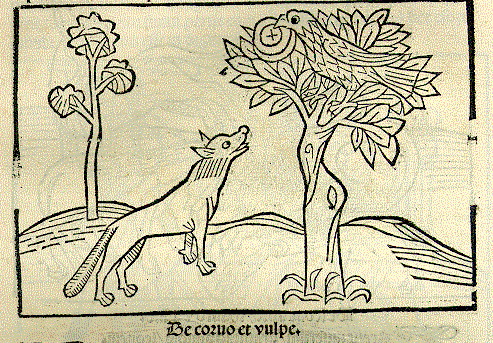
corvo vulpe

Qui se laudari gaudet verbis subdolis,
fere dat poenas turpi paenitentia.
cum de fenestra corvus raptum caseum
comesse vellet, celsa residens arbore,
vulpes invidit, deinde sic coepit loqui:
‘o qui tuarum, corve, pinnarum est nitor!
quantum decoris corpore et vultu geris!
si vocem haberes, nulla prior ales foret.’
at ille stultus, dum vocem vult ostendere,
lato ore emisit caseum, quem celeriter
dolosa vulpes avidis rapuit dentibus.
tum demum ingemuit corvi deceptus stupor.
[hac re probatur, quantum ingenium polleat,
virtute semper praevalet sapientia.]
(Phaedrus, Fab. 1.13)

He who takes delight in treacherous flattery usually pays the penalty by repentance and disgrace. When a crow, perched on a high tree, was about to eat a piece of cheese which he had carried off from a window, a fox who coveted the prize spoke up as follows: “Oh, Mr. Crow, what a lustre your plumes have, how graceful your face and your figure! If only you had a voice no bird would rate higher.” Anxious to show he did have a voice, the foolish crow opened his mouth to sing and let fall the cheese, which the crafty fox immediately snapped up with eager jaws. Too late the crow, betrayed by his own folly, moaned his loss. [This affair shows how much ingenuity can accomplish; cleverness is always more than a match for hardihood.] (tr. Ben Edwin Perry)


Aïdriēi

ostraka

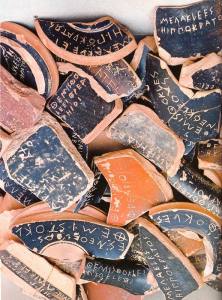
Παλαιός τις παραδέδοται λόγος ὅτι τὰς δημοκρατίας οὐχ οἱ τυχόντες τῶν ἀνθρώπων, ἀλλ’ οἱ ταῖς ὑπεροχαῖς προέχοντες καταλύουσι. διὸ καὶ τῶν πόλεων ἔνιαι τοὺς ἰσχύοντας μάλιστα τῶν πολιτευομένων ὑποπτεύουσαι καθαιροῦσιν αὐτῶν τὰς ἐπιφανείας. σύνεγγυς γὰρ ἡ μετάβασις εἶναι δοκεῖ τοῖς ἐν ἐξουσίᾳ μένουσιν ἐπὶ τὴν τῆς πατρίδος καταδούλωσιν καὶ δυσχερὲς ἀποσχέσθαι μοναρχίας τοῖς δι’ ὑπεροχὴν τὰς τοῦ κρατήσειν ἐλπίδας περιπεποιημένοις· ἔμφυτον γὰρ εἶναι τὸ πλεονεκτεῖν τοῖς μειζόνων ὀρεγομένοις καὶ τὰς ἐπιθυμίας ἔχειν ἀτερματίστους. τοιγαροῦν Ἀθηναῖοι μὲν διὰ ταύτας τὰς αἰτίας τοὺς πρωτεύοντας τῶν πολιτῶν ἐφυγάδευσαν, τὸν λεγόμενον παρ᾽ αὐτοῖς ἐξοστρακισμὸν νομοθετήσαντες. καὶ τοῦτ’ ἔπραττον οὐχ ἵνα τῶν προγεγενημένων ἀδικημάτων λάβωσι τιμωρίαν, ἀλλ’ ὅπως τοῖς δυναμένοις παρανομεῖν ἐξουσία μὴ γένηται κατὰ τῆς πατρίδος ἐξαμαρτεῖν. τῆς γὰρ Σόλωνος φωνῆς ὥσπερ χρησμοῦ τινος ἐμνημόνευον, ἐν οἷς περὶ τῆς Πεισιστράτου τυραννίδος προλέγων ἔθηκε τόδε τὸ ἐλεγεῖον·
“ἀνδρῶν δ’ ἐκ μεγάλων πόλις ὄλλυται, εἰς δὲ τυράννου
δῆμος ἀϊδρίῃ δουλοσύνην ἔπεσεν [Solon, fr. 9].”
(Diodorus Siculus, Hist. 19.1.1-4)

An old saying has been handed down that it is not men of average ability but those of outstanding superiority who destroy democracies. For this reason some cities, suspecting those of their public men who are the strongest, take away from them their outward show of power. It seems that the step to the enslavement of the fatherland is a short one for men who continue in positions of power, and that it is difficult for those to abstain from monarchy who through eminence have acquired hopes of ruling; for it is natural that men who thirst for greatness should seek their own aggrandizement and cherish desires that know no bounds. The Athenians, for example, exiled the foremost of their citizens for this reason, having established by law what was known among them as ostracism; and this they did, not to inflict punishment for any injustice previously committed, but in order that those citizens who were strong enough to disregard the laws might not get an opportunity to do wrong at the expense of their fatherland. Indeed, they used to recite as an oracle that saying of Solon in which, while foretelling the tyranny of Peisistratus, he inserts this couplet: “Destruction cometh upon a city from its great men; and through ignorance the people fall into slavery to a tyrant.” (tr. Russel M. Geer)

Auspicio

romulus & remus

Curantes magna cum cura tum cupientes
regni dant operam simul auspicio augurioque.
in Murco Remus auspicio sedet atque secundam
solus avem servat. at Romulus pulcer in alto
quaerit Aventino, servat genus altivolantum.
certabant urbem Romam Remoramne vocarent.
omnibus cura viris uter esset induperator.
expectant veluti consul quom mittere signum
volt, omnes avidi spectant ad carceris oras
quam mox emittat pictos e faucibus currus:
sic exspectabat populus atque ore timebat
rebus utri magni victoria sit data regni.
interea sol albus recessit in infera noctis.
exin candida se radiis dedit icta foras lux
et simul ex alto longe pulcerrima praepes
laeva volavit auis. simul aureus exoritur sol
cedunt de caelo ter quattuor corpora sancta
avium, praepetibus sese pulcrisque locis dant.
conspicit inde sibi data Romulus esse propritim
auspicio regni stabilita scamna solumque.
(Ennius, Ann. 1.80-100)

Carefully then, with great care, desiring kingly power, together they turn their attention to auspices and augury. On the Murcus Remus sits waiting for auspices and keeps watch alone for a favourable bird. But handsome Romulus searches on the high Aventine, keeping watch for the high-flying race. They were contending whether to call the city Roma or Remora. All men cared which of the two became commander. They wait as when a consul is about to give the signal and everyone greedily looks towards the mouths of the starting gates to see how soon he sends out the painted chariots from the traps. So the people were waiting, and fear for the outcome showed on their faces, to which of the two the victory of high rule had been granted. Meanwhile the white sun set into the depths of night. Then a bright light shone out, struck by the sun’s rays, and at once on high in the distance a very fine bird of favourable omen flew on the left. Just as the golden sun rises, twelve holy bodies of birds descended from the sky and alighted in fine and favourable places. From this, Romulus perceived that it was to him alone that, confirmed by auspices, the seat and territory of rule were granted. (tr. Nora Goldschmidt)

Cedamus

Sodoma, Cupido in un paesaggio, ca. 1510
Sodoma, Cupido in un paesaggio (ca. 1510)

Esse quid hoc dicam, quod tam mihi dura videntur
strata, neque in lecto pallia nostra sedent,
et vacuus somno noctem, quam longa, peregi,
lassaque versati corporis ossa dolent?
nam, puto, sentirem, si quo temptarer amore.
an subit et tecta callidus arte nocet?
sic erit; haeserunt tenues in corde sagittae,
et possessa ferus pectora versat Amor.
cedimus, an subitum luctando accendimus ignem?
cedamus! leve fit, quod bene fertur, onus.
vidi ego iactatas mota face crescere flammas
et rursus nullo concutiente mori.
verbera plura ferunt, quam quos iuvat usus aratri,
detractant prensi dum iuga prima boves.
asper equus duris contunditur ora lupatis,
frena minus sentit, quisquis ad arma facit.
acrius invitos multoque ferocius urget
quam qui servitium ferre fatentur Amor.
en ego confiteor! tua sum nova praeda, Cupido;
porrigimus victas ad tua iura manus.
(Ovid, Am. 1.2.1-20)

How to say what it’’s like, how hard my mattress
seems, and the sheets won’’t stay on the bed,
and the sleepless nights, so long to endure,
tossing with every weary bone of my body in pain?
But, I think, if desire were attacking me I’’d feel it.
Surely he’’s crept in and skilfully hurt me with secret art.
That’s it: a slender arrow sticks fast in my heart,
and cruel Love lives there, in my conquered breast.
Shall I give in: to go down fighting might bank the fires?
I give in! The burden that’’s carried with grace is lighter.
I’’ve seen the torch that’’s swung about grow brighter
and the still one, on the contrary, quenched.
The oxen that shirk when first seized for the yoke
get more lashes than those that are used to the plough.
The hot steed’’s mouth is bruised from the harsh curb,
the one that’’s been in harness, feels reins less.
Love oppresses reluctant lovers more harshly and insolently
than those who acknowledge they’’ll bear his slavery.
Look I confess! Cupid, I’’m your latest prize:
stretching out conquered arms towards your justice.
(tr. Tony Kline)

Delphis

David Wynne, Boy with dolphin
David Wynne, Boy with a dolphin (1974)

Καί πού τις Λίβυος κούρου πόθον οἶδεν ἀκούων,
τοῦ ποτε ποιμαίνοντος ἐράσσατο θερμὸν ἔρωτα
δελφίς, σὺν δ’ ἤθυρε παρ’ ᾐόσι, καὶ κελαδεινῇ
τερπόμενος σύριγγι λιλαίετο πώεσιν αὐτοῖς
μίσγεσθαι πόντον τε λιπεῖν ξυλόχους τ’ ἀφικέσθαι.
ἀλλ’ οὐδ’ ἠϊθέοιο πόθους ἐπὶ πᾶσα λέλησται
Αἰολίς· οὔτι παλαιόν, ἐφ’ ἡμετέρῃ δὲ γενέθλῃ·
δελφὶς ὥς ποτε παιδὸς ἐράσσατο νησαίοιο·
νήσῳ δ’ ἐνναίεσκεν, ἀεὶ δ’ ἔχε ναύλοχον ὅρμον,
ἀστὸς ὅπως, ἕταρον δὲ λιπεῖν ἠναίνετο θυμῷ,
ἀλλ’ αὐτοῦ μίμναζε παρέστιος ἐξέτι τυτθοῦ,
σκύμνος ἀεξηθείς, ὀλίγον βρέφος, ἤθεσι παιδὸς
σύντροφος· ἀλλ’ ὅθ’ ἵκοντο τέλος γυιαλκέος ἥβης,
καί ῥ’ ὁ μὲν ἠϊθέοισι μετέπρεπεν, αὐτὰρ ὁ πόντῳ
ὠκύτατος δελφὶς ἑτέρων προφερέστατος ἦεν,
δή ῥα τότ’ ἔκπαγλόν τε καὶ οὐ φατὸν οὐδ’ ἐπίελπτον
θάμβος ἔην ξείνοισι καὶ ἐνναέτῃσιν ἰδέσθαι·
πολλοὺς δ’ ὤρορε φῆμις ἰδεῖν σέβας ὁρμηθέντας,
ἠΐθεον δελφῖνι συνηβώοντας ἑταίρους·
πολλαὶ δ’ ἠϊόνων ἀγοραὶ πέλας ἦμαρ ἐπ’ ἦμαρ
ἱεμένων ἵσταντο σέβας μέγα θηήσασθαι.
ἔνθ’ ὁ μὲν ἐμβεβαὼς ἄκατον κοίλοιο πάροιθεν
ὅρμου ἀναπλώεσκε, κάλει δέ μιν οὔνομ’ ἀΰσας
κεῖνο, τό μιν φήμιξεν ἔτι πρώτης ἀπὸ φύτλης·
δελφὶς δ’ ἠΰτ’ ὀϊστός, ἐπεὶ κλύε παιδὸς ἰωήν,
κραιπνὰ θέων ἀκάτοιο φίλης ἄγχιστος ἵκανε,
σαίνων τ’ οὐραίῃ κεφαλήν τ’ ἀνὰ γαῦρος ἀείρων,
παιδὸς ἐπιψαῦσαι λελιημένος· αὐτὰρ ὁ χερσὶν
ἦκα καταρρέζεσκε, φιλοφροσύνῃσιν ἑταῖρον
ἀμφαγαπαζόμενος, τοῦ δ’ ἵετο θυμὸς ἱκέσθαι
αὐτὴν εἰς ἄκατον παιδὸς πέλας· ἀλλ’ ὅτ’ ἐς ἅλμην
κοῦφα κυβιστήσειεν, ὃ δ’ ἐγγύθι νήχετο κούρου,
αὐτῇσι πλευρῇσιν ἀνὰ πλευρὰς παρενείρων,
αὐτῇσι γενύεσσι πέλας γένυν, ἠδὲ καρήνῳ
ἐγχρίμπτων κεφαλήν· φαίης κέ μιν ἱμείροντα
κῦσσαι καὶ στέρνοισι περιπτύξαι μενεαίνειν
ἠΐθεον· τοίῃ γὰρ ὀπάονι νήχετο ῥιπῇ.
ἀλλ’ ὅτε καὶ πελάσειε παρ’ ᾐόσιν, αὐτίκα κοῦρος
ἁψάμενος λοφιῆς διερῶν διερῶν ἐπεβήσατο νώτων·
αὐτὰρ ὅ γ’ ἀσπασίως παιδὸς δέμας ἔμφρονι θυμῷ
δεξάμενος φοίτασκεν, ὅπῃ νόος ἠϊθέοιο
ἤλαεν, εἴτ’ ἄρα πόντον ἐπ’ εὐρέα τῆλε κελεύοι
στέλλεσθ’, εἴθ’ αὔτως λιμένος διὰ χῶρον ἀμείβειν,
ἢ χέρσῳ πελάειν, ὁ δ’ ἐπείθετο πᾶσαν ἐφετμήν.
οὔτε τις ἡνιόχῳ πῶλος τόσον ἐν γενύεσσι
μαλθακὸς εὐγνάμπτοισιν ἐφέσπεται ὧδε χαλινοῖς,
οὔτε τις ἀγρευτῆρι κύων ἐθὰς ὀτρύνοντι
τόσσον ὑπεικαθέων ἐπιπείθεται, ᾗ κεν ἄγῃσιν,
οὔτ’ ἔτι κεκλομένοιο τόσον θεράποντες ἄνακτος
πειθόμενοι ῥέζουσιν ἑκούσιον ἔργον ἑκόντες,
ὅσσον ὑπ’ ἠϊθέῳ δελφὶς φίλος ὀτρύνοντι
πείθετ’ ἄνευ ζεύγλης τε βιαζομένων τε χαλινῶν.
οὐ μέν μιν μοῦνον φορέειν θέλεν, ἀλλὰ καὶ ἄλλῳ
πείθετο, τῷ μιν ἄνωγεν ἄναξ ἑός, ἀν δ’ ἐκόμιζε
νώτοις, οὔτινα μόχθον ἀναινόμενος φιλότητι.
τοίη μὲν ζωῷ φιλίη πέλεν· ἀλλ’ ὅτε παῖδα
πότμος ἕλε, πρῶτον μὲν ὀδυρομένῳ ἀτάλαντος
δελφὶς ἠϊόνεσσιν ἐπέδραμεν, ἥλικα κοῦρον
μαστεύων· φαίης κεν ἐτήτυμον ὄσσαν ἀκούειν
μυρομένου· τοῖόν μιν ἀμήχανον ἄμπεχε πένθος·
οὐδ’ ἔτι κικλήσκουσιν ἐπείθετο πολλάκις ἀστοῖς
νησαίοις, οὐ βρῶσιν ὀρεγνυμένην ἐθέλεσκε
δέχνυσθαι, μάλα δ’ αἶψα καὶ ἐξ ἁλὸς ἔπλετ’ ἄϊστος
κείνης, οὐδέ τις αὐτὸν ἐπεφράσατ’, οὐδ’ ἔτι χῶρον
ἵκετο· τὸν μέν που παιδὸς πόθος οἰχομένοιο
ἔσβεσε, σὺν δὲ θανόντι θανεῖν ἔσπευσεν ἑταίρῳ.
(Oppian, Hal. 5.453-518)

And one knows, methinks, by hearsay the love of the Libyan boy whom as he herded his sheep a Dolphin loved with burning love and played with him beside the shores and for delight in his shrill pipe was fain to live among the very sheep and forsake the sea and come to the woods. Nay, nor has all Aeolis forgotten the love of a youth — not long ago but in our own generation — how a Dolphin once loved an island boy and in the island it dwelt and ever haunted the haven where ships lay at anchor, even as if it were a townsman and refused to leave its comrade, but abode there and made that its house from the time that it was little till it was a grown cub, like a little child nurtured in the ways of the boy. But when they came to the fullness of vigorous youth, then the boy excelled among the youths and the Dolphin in the sea was more excellent in swiftness than all others. Then there was a marvel strange beyond speech or thought for strangers and indwellers to behold. And report stirred many to hasten to see the wondrous sight, a youth and a Dolphin growing up in comradeship, and day by day beside the shore were many gatherings of those who rushed to gaze upon the mighty marvel. Then the youth would embark in his boat and row in front of the embayed haven and would call it, shouting the name whereby he had named it even from earliest birth. And the Dolphin, like an arrow, when it heard the call of the boy, would speed swiftly and come close to the beloved boat, fawning with its tail and proudly lifting up its head fain to touch the boy. And he would gently caress it with his hands, lovingly greet his comrade, while it would be eager to come right into boat beside the boy. But when he dived lightly into the brine, it would swim near the youth, its side right by his side and its cheek close by his and touching head with head. Thou wouldst have said that in its love the Dolphin was fain to kiss and embrace the youth: in such close companionship it swam. But when he came near the shore, straightway the youth would lay his hand upon its neck and mount on its wet back. And gladly and with understanding it would receive the boy upon its back and would go where the will of the youth drave it, whether over the wide sea afar he commanded it to travel or merely to traverse the space of the haven or to approach the land: it obeyed every behest. No colt for its rider is so tender of mouth and so obedient to the curved bit; no dog trained to the bidding of the hunter is so obedient to follow where he leads; nay, nor any servants are so obedient, when their master bids, to do his will willingly, as that friendly Dolphin was obedient to the bidding of the youth, without yoke-strap or constraining bridle. And not himself alone would it carry but it would obey any other whom his master bade it and carry him on its back, refusing no labour in its love. Such was its friendship for the boy while he lived; but when death took him, first like one sorrowing the Dolphin visited the shores in quest of the companion of its youth: you would have said you heard the veritable voice of a mourner — such helpless grief was upon it. And no more, though they called it often, would it hearken to the island townsmen nor would it accept food when offered it, and very soon it vanished from that sea and none marked it any more and it no more visited the place. Doubtless sorrow for the youth that was gone killed it, and with its dead comrade it had been fain to die. (tr. Alexander William Mair)