
Aspermos

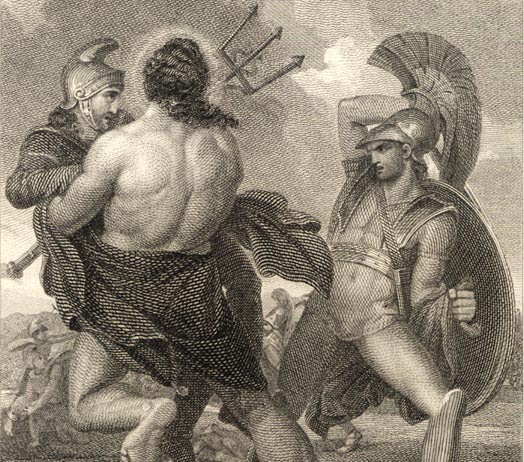
Henry Howard (kopie naar), Poseidon komt tussenbeide in de Trojaanse oorlog, 1805

Δεύτερος αὖτ’ Ἀχιλεὺς προΐει δολιχόσκιον ἔγχος,
καὶ βάλεν Αἰνείαο κατ’ ἀσπίδα πάντοσ’ ἐΐσην
ἄντυγ’ ὕπο πρώτην, ᾗ λεπτότατος θέε χαλκός,
λεπτοτάτη δ’ ἐπέην ῥινὸς βοός· ἣ δὲ διὰ πρὸ
Πηλιὰς ἤϊξεν μελίη, λάκε δ’ ἀσπὶς ὑπ᾽ αὐτῆς.
Αἰνείας δ’ ἐάλη καὶ ἀπὸ ἕθεν ἀσπίδ’ ἀνέσχε
δείσας· ἐγχείη δ᾽ ἄρ’ ὑπὲρ νώτου ἐνὶ γαίῃ
ἔστη ἱεμένη, διὰ δ’ ἀμφοτέρους ἕλε κύκλους
ἀσπίδος ἀμφιβρότης· ὃ δ’ ἀλευάμενος δόρυ μακρὸν
ἔστη, κὰδ δ’ ἄχος οἱ χύτο μυρίον ὀφθαλμοῖσι,
ταρβήσας ὅ οἱ ἄγχι πάγη βέλος. αὐτὰρ Ἀχιλλεὺς
ἐμμεμαὼς ἐπόρουσεν ἐρυσσάμενος ξίφος ὀξὺ
σμερδαλέα ἰάχων· ὃ δὲ χερμάδιον λάβε χειρὶ
Αἰνείας, μέγα ἔργον, ὃ οὐ δύο γ’ ἄνδρε φέροιεν,
οἷοι νῦν βροτοί εἰσ’· ὃ δέ μιν ῥέα πάλλε καὶ οἶος.
ἔνθά κεν Αἰνείας μὲν ἐπεσσύμενον βάλε πέτρῳ
ἢ κόρυθ’ ἠὲ σάκος, τό οἱ ἤρκεσε λυγρὸν ὄλεθρον,
τὸν δέ κε Πηλεΐδης σχεδὸν ἄορι θυμὸν ἀπηύρα,
εἰ μὴ ἄρ’ ὀξὺ νόησε Ποσειδάων ἐνοσίχθων·
αὐτίκα δ’ ἀθανάτοισι θεοῖς μετὰ μῦθον ἔειπεν·
“ὢ πόποι ἦ μοι ἄχος μεγαλήτορος Αἰνείαο,
ὃς τάχα Πηλεΐωνι δαμεὶς Ἄϊδος δὲ κάτεισι
πειθόμενος μύθοισιν Ἀπόλλωνος ἑκάτοιο
νήπιος, οὐδέ τί οἱ χραισμήσει λυγρὸν ὄλεθρον.
ἀλλὰ τί ἢ νῦν οὗτος ἀναίτιος ἄλγεα πάσχει
μὰψ ἕνεκ’ ἀλλοτρίων ἀχέων, κεχαρισμένα δ’ αἰεὶ
δῶρα θεοῖσι δίδωσι τοὶ οὐρανὸν εὐρὺν ἔχουσιν;
ἀλλ’ ἄγεθ’ ἡμεῖς πέρ μιν ὑπὲκ θανάτου ἀγάγωμεν,
μή πως καὶ Κρονίδης κεχολώσεται, αἴ κεν Ἀχιλλεὺς
τόνδε κατακτείνῃ· μόριμον δέ οἵ ἐστ’ ἀλέασθαι,
ὄφρα μὴ ἄσπερμος γενεὴ καὶ ἄφαντος ὄληται
Δαρδάνου, ὃν Κρονίδης περὶ πάντων φίλατο παίδων
οἳ ἕθεν ἐξεγένοντο γυναικῶν τε θνητάων.
ἤδη γὰρ Πριάμου γενεὴν ἔχθηρε Κρονίων·
νῦν δὲ δὴ Αἰνείαο βίη Τρώεσσιν ἀνάξει
καὶ παίδων παῖδες, τοί κεν μετόπισθε γένωνται.”
(Homer, Iliad 20.273-308)

Achilles next—he hurled his spear and its long shadow flew
and the weapon struck the balanced round shield of Aeneas
under the outer rim where the bronze ran thinnest,
backed by the thinnest bull’s-hide. Straight through
the Pelian ash burst, the shield rang out with a screech—
but Aeneas crouched low, holding the buckler off his chest,
terrified as the shaft shot past his back, hurled so hard
it plunged deep in the ground, even after it tore up
two round plies of the shield that cased his body.
Dodging the big spear, Aeneas got to his feet…
a dizzying swirl of anguish rushing down his eyes,
blind with fear, the point had stuck so close.
But drawing his sharp sword, Achilles charged, wild,
hurtling toward him, loosing a savage cry as Aeneas
hefted a boulder in his hands, a tremendous feat—
no two men could hoist it, weak as men are now,
but all on his own he raised it high with ease.
Then and there he’d have struck Achilles lunging in,
the rock would have hit him square in casque or shield,
the gear would have warded off grim death, and Achilles, closing,
would have slashed his life away with a well-honed blade—
if the god of earthquakes had not marked it quickly
and called the gods at once who grouped around him:
“Now, I tell you, my heart aches for great Aeneas!
He’ll go down to the House of Death this instant,
overwhelmed by Achilles—all because he trusted
the distant deadly Archer’s urgings. Poor fool—
as if Apollo would lift a hand to save him now
from death, grim death. Aeneas the innocent!
Why should Aeneas suffer here, for no good reason,
embroiled in the quarrels of others, not his own?
He always gave us gifts to warm our hearts,
gifts for the gods who rule the vaulting skies.
So come, let us rescue him from death ourselves,
for fear the son of Cronus might just tower in rage
if Achilles kills this man. He is destined to survive.
Yes, so the generation of Dardanus will not perish,
obliterated without an heir, without a trace:
Dardanus, dearest to Zeus of all the sons
that mortal women brought to birth for Father.
Now he has come to hate the generation of Priam.
and now Aeneas will rule the men of Troy in power—
his sons’ sons and the sons born in future years.”
(tr. Robert Fagles)
Dispansam

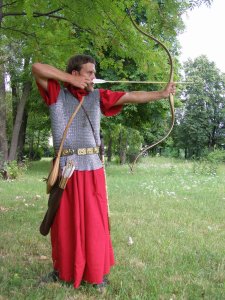
archer

Armorum nullo, sagittarum vel praecipuo studio tenebatur. centenas varii generis feras saepe in Albano secessu conficientem spectavere plerique atque etiam ex industria ita quarundam capita figentem, ut duobus ictibus quasi cornua efficeret. nonnumquam in pueri procul stantis praebentisque pro scopulo dispansam dexterae manus palmam sagittas tanta arte derexit, ut omnes per intervalla digitorum innocue evaderent.
(Suetonius, Dom. 19)

At his Alban retreat many people witnessed him* shoot a hundred animals of different kinds on numerous occasions and he would even deliberately shoot at the heads of some of them in such a way that two arrows seemed to make horns. Sometimes a slave would stand at a distance holding up the palm of his right hand as a target with the fingers outspread and Domitian would aim his shots with such skill that they would pass safely through the gaps between the boy’s fingers.

* Domitian.

(tr. Catharine Edwards)

Mutabilis

Cima da Conegliano, Dio padre, ca. 1510-17
Cima da Conegliano, Dio padre (ca. 1515)

Res enim aliqua, quaelibet omnino (quasi coepi disputare, et destiti quaerere; forte quod audivi volo loqui, auditui meo det exsultationem et vestro cum loquor): res enim quaelibet, prorsus qualicumque excellentia, si mutabilis est, non vere est; non enim est ibi verum esse, ubi est et non esse. quidquid enim mutari potest, mutatum non est quod erat: si non est quod erat, mors quaedam ibi facta est; peremptum est aliquid ibi quod erat, et non est. nigredo mortua est in capite albescentis senis, pulchritudo mortua est in corpore fessi et incurvi senis, mortuae sunt vires in corpore languentis, mortua est statio in corpore ambulantis, mortua est ambulatio in corpore stantis, mortua est ambulatio et statio in corpore iacentis, mortua est locutio in lingua tacentis: quidquid mutatur et est quod non erat, video ibi quamdam vitam in eo quod est, et mortem in eo quod fuit. denique de mortuo cum dicitur: ‘ubi est homo ille?’ respondetur: ‘fuit.’ o veritas quae vere es! Nam in omnibus actionibus et motibus nostris, et in omni prorsus agitatione creaturae duo tempora invenio, praeteritum et futurum. praesens quaero, nihil stat: quod dixi, iam non est; quod dicturus sum, nondum est: quod feci, iam non est; quod facturus sum, nondum est: quod vixi, iam non est; quod victurus sum, nondum est. praeteritum et futurum invenio in omni motu rerum: in veritate quae manet, praeteritum et futurum non invenio, sed solum praesens, et hoc incorruptibiliter, quod in creatura non est. discute rerum mutationes, invenies Fuit et Erit: cogita Deum, invenies Est, ubi Fuit et Erit esse non possit.
(Augustine, In Joh. Evang. Tract. 38.10)

For a thing, anything whatever (I have begun as it were to dispute, and have left off
inquiring. Perhaps I wish to speak what I have heard. May He grant enlargement to my hearing, and to yours, while I speak);—for anything, whatever in short be its excellence, if it is changeable, does not truly exist; for there is no true existence wherever non-existence has also a place. For whatever can be changed, so far as changed, it is not that which was: if it is no longer what it was, a kind of death has therein taken place; something that was there has been eliminated, and exists no more. Blackness has died out in the silvery locks of the patriarch, comeliness in the body of the careworn and crooked old man, strength in the body of the languishing, the [previous] standing posture in the body of one walking, walking in the body of one standing, walking and standing in the body of one reclining, speech in the tongue of the silent;—whatever changes, and is what it was not, I see there a kind of life in that which is, and death in that which was. In fine, when we say of one deceased, Where is that person? we are answered, He was. O Truth, it is thou [alone] that truly art! For in all actions and movements of ours, yea, in every activity of the creature, I find two times, the past and the future. I seek for the present, nothing stands still: what I have said is no longer present; what I am going to say is not yet come: what I have done is no longer present; what I am going to do is not yet come: the life I have lived is no longer present; the life I have still to live is not yet come. Past and future I find in every creature-movement: in truth, which is abiding, past and future I find not, but the present alone, and that unchangeably, which has no place in the creature. Sift the mutations of things, thou wilt find was and will be: think on God, thou wilt find the is, where was and will be cannot exist. (tr. John Gibb & James Innes)


Amentatas

amentum

Attamen, quae causae sunt eiusmodi, ut de earum iure dubium esse non possit, omnino in iudicium vocari non solent. num quis eo testamento, quod paterfamilias ante fecit, quam ei filius natus esset, hereditatem petit? nemo; quia constat agnascendo rumpi testamentum. ergo in hoc genere iuris iudicia nulla sunt. licet igitur impune oratori omnem hanc partem iuris incontroversi ignorare, quae pars sine dubio multo maxima est; in eo autem iure, quod ambigitur inter peritissimos, non est difficile oratori, eius partis, quamcumque defendat, auctorem aliquem invenire; a quo cum amentatas hastas acceperit, ipse eas oratoris lacertis viribusque torquebit.
(Cicero, De Or. 1.241-242)

And yet those cases which are such that the law involved in them is beyond dispute, do not as a rule come to a hearing at all. Does anyone claim an inheritance under a will made by the head of a household before the birth of a son of his? No one; since it is settled law that the will is revoked by such subsequent birth. Thus there are no judicial
decisions on this branch of the law. And so the orator may safely disregard all this region of unquestionable law, being as it certainly is by far the larger portion of the science: while, as for the law which is unsettled in the most learned circles, it is easy enough for him to find some authority in favour of whichever side he is supporting, and, having obtained a supply of thonged shafts* from him, he himself will hurl these with all the might of an orator’s arm.

* These were javelins with a slinging-strap to help the thrower.

(tr. Edward William Sutton, with his note)

Undique

lost at sea

Ego ita sum quasi a cuncto grege morbida aberrans ovis. quod nisi me bonus pastor ad sua stabula umeris impositum reportarit, lababunt gressus et in ipso conamine vestigia concident assurgentis. ego sum ille prodigus filius, qui omni, quam mihi pater crediderat, portione profusa necdum me ad genitoris genua submisi necdum coepi prioris a me luxuriae blandimenta depellere. et quia paululum non tam desivi a vitiis, quam coepi velle desinere, nunc me novis diabolus retibus ligat, nunc nova impedimenta proponens ‘maria undique circumdat et undique pontum’ [cf. Vergil, Aen. 3.193], nunc in medio constitutus elemento nec regredi volo nec progredi possum. superest, ut oratu vestro sancti spiritus aura me provehat et ad portum optati litoris prosequatur.
(Jerome, Ep. 2.3-4)

I am like the sick sheep that strays from the rest of the flock. Unless the Good Shepherd takes me on His shoulders and carries me back to His fold, my steps will falter, and in the very effort of rising my feet will give way. I am that prodigal son who wasted all the portion entrusted to me by my father. But I have not yet fallen at my father’s knees. I have not yet begun to put away from me the enticements of my former riotous living. And because I have not so much given up my sins as begun to wish a little to give them up, now the devil is trying to ensnare me in new nets. He puts new stumbling blocks in my way, he encompasses me on every side with the ocean’s waters and on every side with the ocean’s deep. I find myself in the midst of the element, unwilling to retreat and unable to advance. It remains that through your prayers the breath of the Holy Spirit waft me onward and bring me to the haven of the longed-for shore. (tr. Charles Christopher Mierow)


Senectus

senectus

Carmina qui quondam studio florente peregi,
flebilis heu maestos cogor inire modos.
ecce mihi lacerae dictant scribenda Camenae
et veris elegi fletibus ora rigant.
has saltem nullus potuit pervincere terror,
ne nostrum comites prosequerentur iter.
gloria felicis olim viridisque iuuentae,
solantur maesti nunc mea fata senis.
venit enim properata malis inopina senectus
et dolor aetatem iussit inesse suam.
intempestivi funduntur vertice cani
et tremit effeto corpore laxa cutis.
mors hominum felix, quae se nec dulcibus annis
inserit et maestis saepe vocata venit.
eheu, quam surda miseros avertitur aure
et flentes oculos claudere saeva negat!
dum levibus male fida bonis fortuna faveret
paene caput tristis merserat hora meum.
nunc quia fallacem mutavit nubila vultum
protrahit ingratas impia vita moras.
quid me felicem totiens iactastis, amici?
qui cecidit, stabili non erat ille gradu.
(Boëthius, De Consolatione Philosophiae 1.1 metrum)

I who was once at the height of my powers a master of versecraft—
Woe is me!—weeping, coerced, enter the grief-ridden mode.
Lo! Their cheeks harrowed, the Muses come tell me the words I must take down,
And they now dampen my face with lachrymose elegy’s truth.
Them, and them only, no panic could vanquish or frighten from coming
As my companions alone over the path I must tread.
They who were once the delight of a youth that was prosperous and happy
In my misfortunes console me, now a grieving old man.
For now has arrived, unexpected and hastened by evils, my old age—
Pain gave the order; its years now must be be added to mine.
Now from the top of my head flows down snow-white hair, quite out of season;
Barren, my body is sheathed, in shivering, limp, nerveless skin.
Happy the death of a man that would thrust itself not in the sweet years!
But, when incessantly called, comes to those stricken with grief.
Woe is them! With a deaf ear she rejects all pleas of the wretched—
Merciless, she will not close eyes that are brimming with tears.
While faithless Fortune was partial to me with ephemeral favors,
A single, deplorable hour nearly plunged me in my grave.
Now that she’s darkly transformed her appearances, ever deceitful,
Must then my unholy life drag out this ghastly delay?
Tell me, my friends, why you boasted so often that I was so blessèd—
Soldiers who fell never had stable ground on which to stand.
(tr. Joel C. Relihan)

Doctrinale

Doctrinale_recto

Scribere clericulis paro Doctrinale novellis,
pluraque doctorum sociabo scripta meorum.
iamque legent pueri pro nugis Maximiani
quae veteres sociis nolebant pandere caris.
praesens huic operi sit gratia Pneumatis almi;
me iuvet et faciat complere quod utile fiat.
si pueri primo nequeant attendere plene,
hic tamen attendet, qui doctoris vice fungens,
atque legens pueris laica lingua reserabit;
et pueris etiam pars maxima plana patebit.
voces in primis, quas per casus variabis,
ut levius potero, te declinare docebo.
istis confinem retinent heteroclita sedem.
atque gradus triplicis collatio subditur istis.
cuique sit articulo quae vox socianda, notabo.
hinc de praeteritis Petrum sequar ante supinis.
his defectiva suberunt et anormala verba.
verborum formas exinde notabo quaternas.
hinc pro posse meo vocum regimen reserabo.
quo iungenda modo constructio sit, sociabo.
post haec pandetur, quae syllaba quanta locetur.
accentus normas exhinc variare docebo.
tandem grammaticas pro posse docebo figuras.
quamvis haec non sit doctrina satis generalis,
proderit ipsa tamen plus nugis Maximiani.
(Alexander de Villa Dei, Doctrinale pro eruditione puerorum, prooem. 1-25)

I am getting ready to write a Doctrinale [“book of instruction”] for newer students and will adopt many works of my teachers. Instead of the nonsense of Maximianus boys will read those things which the ancients did not want to make accessible to their dear fellows. May the Grace of the nurturing Spirit be present to this work. May it help me to complete something that may be of use. If the boys should be unable to pay full attention to it at first, let him then at least pay attention, who fulfills the tasks of a teacher, who reads it to the boys, and will disclose it to them in the language of the laity; then for the most part it will be plain to the boys as well. Words [voces], which you must give different forms in different cases, I will first of all teach you to decline, in as easy a way as I can. The place next to them is taken by the heteroclitic nouns. And “comparison” [collatio] in its three grades is dealt with after those. I will indicate which word is to be combined with which article. And then I will follow Peter* on the past tenses and the supine verb-forms. Defective verbs come after these topics, and irregular ones. Subsequently, I will pick out the fourfold forms of verbs. And then, to the best of my ability, I will disclose the regimen [regimen] of words. How a construction is to be put together, I will add to this. After that it will be explained, what syllables have what length. Then I will teach what the various rules are for the accents. And finally I will teach the grammatical figures to the best of my ability. Although this doctrine is not really general enough, yet it will be more useful than the nonsense of Maximianus.

* Peter Riga

(tr. Rita Copeland & Ineke Sluiter, with their note)

Ktēseis

working the land

Ἐχόμενον δὲ τούτων ἐστὶν ἐπισκέψασθαι περὶ τῆς κτήσεως, τίνα τρόπον δεῖ κατασκευάζεσθαι τοῖς μέλλουσι πολιτεύεσθαι τὴν ἀρίστην πολιτείαν, πότερον κοινὴν ἢ μὴ κοινὴν εἶναι τὴν κτῆσιν. τοῦτο δ’ ἄν τις καὶ χωρὶς σκέψαιτο ἀπὸ τῶν περὶ τὰ τέκνα καὶ τὰς γυναῖκας νενομοθετημένων, λέγω [δὲ τὰ περὶ τὴν κτῆσιν] πότερον, κἂν ᾖ ἐκεῖνα χωρὶς, καθ’ ὃν νῦν τρόπον ἔχει πᾶσι, τάς τε κτήσεις κοινὰς εἶναι βέλτιον καὶ τὰς χρήσεις . . . , οἷον τὰ μὲν γήπεδα χωρὶς τοὺς δὲ καρποὺς εἰς τὸ κοινὸν φέροντας ἀναλίσκειν (ὅπερ ἔνια ποιεῖ τῶν ἐθνῶν), ἢ τοὐναντίον τὴν μὲν γῆν κοινὴν εἶναι καὶ γεωργεῖν κοινῇ, τοὺς δὲ καρποὺς διαιρεῖσθαι πρὸς τὰς ἰδίας χρήσεις (λέγονται δέ τινες καὶ τοῦτον τὸν τρόπον κοινωνεῖν τῶν βαρβάρων), ἢ καὶ τὰ γήπεδα καὶ τοὺς καρποὺς κοινούς. ἑτέρων μὲν οὖν ὄντων τῶν γεωργούντων, ἄλλος ἂν εἴη τρόπος καὶ ῥᾴων, αὐτῶν δ’ αὑτοῖς διαπονούντων τὰ περὶ τὰς κτήσεις πλείους ἂν παρέχοι δυσκολίας. καὶ γὰρ ἐν ταῖς ἀπολαύσεσι καὶ ἐν τοῖς ἔργοις μὴ γινομένων ἴσων, ἀναγκαῖον ἐγκλήματα γίνεσθαι πρὸς τοὺς ἀπολαύοντας μὲν ἢ λαμβάνοντας πολλὰ ὀλίγα δὲ πονοῦντας τοῖς ἐλάττω μὲν λαμβάνουσι, πλείω δὲ πονοῦσιν. ὅλως δὲ τὸ συζῆν καὶ κοινωνεῖν τῶν ἀνθρωπικῶν πάντων χαλεπόν, καὶ μάλιστα τῶν τοιούτων. δηλοῦσι δ’ αἱ τῶν συναποδήμων κοινωνίαι, σχεδὸν γὰρ οἱ πλεῖστοι διαφέρονται ἐκ τῶν ἐν ποσὶ καὶ ἐκ μικρῶν προσκρούοντες ἀλλήλοις· ἔτι δὲ τῶν θεραπόντων τούτοις μάλιστα προσκρούομεν οἷς πλεῖστα προσχρώμεθα πρὸς τὰς διακονίας τὰς ἐγκυκλίους.
(Aristotle, Pol. 1262b37-1263a21)

Connected with the foregoing is the question of property. What arrangements should be made about it, if people are going to operate the best possible constitution? Should it be held in common or not ? This question may well be considered in isolation from the legislation about children and wives. A possible answer is that while they should belong to individuals, as is the universal practice, it would be better that either property or its use should be communal. In the latter case the plots of land are in private hands and its produce pooled for common use (as is done by some foreign nations); in the former, the land is communally held and communally worked but its produce is distributed according to individual requirements. This is a form of communal ownership which is said to exist among certain non-Greek peoples. There is also the alternative that both the land and its produce be owned communally. As to its cultivation, a different system will run more smoothly, i.e. if the land is worked by others, because, if they themselves work for their own benefit, there will be greater ill-feeling about the ownership. For if the work done and the benefit accrued are equal, well and good; but if not, there will inevitably be ill-feeling between those who get a good income without doing much work and those who work harder but get no corresponding extra benefit. To live together and share in any human concern is hard enough to achieve at the best of times, and such a state of affairs makes it doubly hard. The same kind of trouble is evident when a number of people club together for the purpose of travel. How often have we not seen such partnerships break down over quarrels arising out of trivial and unimportant matters! In the household also we get most annoyed with those servants whom we employ to perform the ordinary routine tasks. (tr. Thomas Alan Sinclair, revised by Trevor J. Saunders)

Oblationes

medieval suicide 3

Oblationes defunctorum qui in aliquo crimino fuerint interempti, recipi debere censemus; si tamen non ipsi sibi mortem probentur propriis manibus intulisse.
(Concilium Aurelianense II. sub Bonifacio II anno 533, cap. 15)

We decree that oblations should be accepted for the dead who were killed as the result of a crime, at least if it is proved that they did not bring death upon themselves by their own hands. (tr. David Bauwens)

Item placuit, ut hi qui sibi ipsis aut per ferrum, aut per venenum, aut per praecipitium, aut suspendium, vel quolibet modo violentam inferunt mortem, nulla illis in oblatione commemoratio fiat, neque cum psalmis ad sepulturam eorum cadavera deducantur: multi enim sibi hoc per ignorantiam usurparunt. similiter et de his placuit, qui pro suis sceleribus puniuntur.
(Concilium Bracarense II. sub Joanne III anno 563, canon 16)

We decree that regarding those who bring violent death upon themselves by the sword, or by poison, or by jumping, or by hanging themselves, or by whatever other method, there may be no commemoration in the oblations for them, and their corpses cannot be carried to the grave with the accompaniment of psalms; for many have appropriated this right through ignorance. Likewise we decree regarding those who are being punished for their crimes. (tr. David Bauwens)

Paraphroneein

prexaspes
Cambyses and Prexaspes

Τάδε δ’ ἐς τοὺς ἄλλους Πέρσας ἐξεμάνη. λέγεται γὰρ εἰπεῖν αὐτὸν πρὸς Πρηξάσπεα, τὸν ἐτίμα τε μάλιστα καί οἱ τὰς ἀγγελίας ἐφόρεε οὗτος, τούτου τε ὁ παῖς οἰνοχόος ἦν τῷ Καμβύσῃ, τιμὴ δὲ καὶ αὕτη οὐ σμικρή· εἰπεῖν δὲ λέγεται τάδε. “Πρήξασπες, κοῖόν με τινὰ νομίζουσι Πέρσαι εἶναι ἄνδρα τίνας τε λόγους περὶ ἐμέο ποιεῦνται;” τὸν δὲ εἰπεῖν “ὦ δέσποτα, τὰ μὲν ἄλλα πάντα μεγάλως ἐπαινέαι, τῇ δὲ φιλοινίῃ σε φασὶ πλεόνως προσκέεσθαι.” τὸν μὲν δὴ λέγειν ταῦτα περὶ Περσέων, τὸν δὲ θυμωθέντα τοιάδε ἀμείβεσθαι. “νῦν ἄρα με φασὶ Πέρσαι οἴνῳ προσκείμενον παραφρονέειν καὶ οὐκ εἶναι νοήμονα· οὐδ’ ἄρα σφέων οἱ πρότεροι λόγοι ἦσαν ἀληθέες.” πρότερον γὰρ δὴ ἄρα, Περσέων οἱ συνέδρων ἐόντων καὶ Κροίσου, εἴρετο Καμβύσης κοῖός τις δοκέοι ἀνὴρ εἶναι πρὸς τὸν πατέρα τελέσαι Κῦρον, οἳ δὲ ἀμείβοντο ὡς εἴη ἀμείνων τοῦ πατρός· τά τε γὰρ ἐκείνου πάντα ἔχειν αὐτὸν καὶ προσεκτῆσθαι Αἴγυπτόν τε καὶ τὴν θάλασσαν. Πέρσαι μὲν ταῦτα ἔλεγον, Κροῖσος δὲ παρεών τε καὶ οὐκ ἀρεσκόμενος τῇ κρίσι εἶπε πρὸς τὸν Καμβύσεα τάδε. “ἐμοὶ μέν νυν, ὦ παῖ Κύρου, οὐ δοκέεις ὅμοιος εἶναι τῷ πατρί· οὐ γάρ κώ τοι ἐστὶ υἱὸς οἷον σε ἐκεῖνος κατελίπετο.” ἥσθη τε ταῦτα ἀκούσας ὁ Καμβύσης καὶ ἐπαίνεε τὴν Κροίσου κρίσιν. τούτων δὴ ὦν ἐπιμνησθέντα ὀργῇ λέγειν πρὸς τὸν Πρηξάσπεα “σύ νυν μάθε εἰ λέγουσι Πέρσαι ἀληθέα εἴτε αὐτοὶ λέγοντες ταῦτα παραφρονέουσι· εἰ μὲν γὰρ τοῦ παιδὸς τοῦ σοῦ τοῦδε ἑστεῶτος ἐν τοῖσι προθύροισι βαλὼν τύχοιμι μέσης τῆς καρδίης, Πέρσαι φανέονται λέγοντες οὐδέν· ἢν δὲ ἁμάρτω, φάναι Πέρσας τε λέγειν ἀληθέα καί με μὴ σωφρονέειν.” ταῦτα δὲ εἰπόντα καὶ διατείναντα τὸ τόξον βαλεῖν τὸν παῖδα, πεσόντος δὲ τοῦ παιδὸς ἀνασχίζειν αὐτὸν κελεύειν καὶ σκέψασθαι τὸ βλῆμα· ὡς δὲ ἐν τῇ καρδίῃ εὑρεθῆναι ἐνεόντα τὸν ὀιστόν, εἰπεῖν πρὸς τὸν πατέρα τοῦ παιδὸς γελάσαντα καὶ περιχαρέα γενόμενον “Πρήξασπες, ὡς μὲν ἐγὼ τε οὐ μαίνομαι Πέρσαι τε παραφρονέουσι, δῆλά τοι γέγονε. νῦν δέ μοι εἰπέ, τίνα εἶδες ἤδη πάντων ἀνθρώπων οὕτω ἐπίσκοπα τοξεύοντα;” Πρηξάσπεα δὲ ὁρῶντα ἄνδρα οὐ φρενήρεα καὶ περὶ ἑωυτῷ δειμαίνοντα εἰπεῖν “δέσποτα, οὐδ’ ἂν αὐτὸν ἔγωγε δοκέω τὸν θεὸν οὕτω ἂν καλῶς βαλεῖν.”
(Herodotus, Hist. 3.34-35)

He committed mad acts against the rest of the Persians as well. The case of Prexaspes, for instance, is mentioned. Cambyses gave Prexaspes the outstanding honour of bringing messages to him, and Prexaspes’ son was Cambyses’ wine-server, which was also a distinguished position to hold. It is said that Cambyses once asked him, ‘Prexaspes, what sort of man do the Persians think I am? What do they say about me?’ ‘Master,’ Prexaspes replied, ‘they have nothing but good to say about you, except in one respect: they say that you are rather too fond of wine.’ Prexaspes’ news about what the Persians were saying made Cambyses angry, and he retorted, ‘In fact the Persians are saying that my fondness for wine is driving me mad and making me lose my mind. It follows, then, that their earlier statements were false.’ The point is that once before, at a meeting between Cambyses, his Persian advisers, and Croesus, Cambyses asked what sort of man they thought him to be, compared to his father Cyrus. The Persians replied that he was a better man than his father, because he had control over the whole of his father’s possessions, while also adding dominion over Egypt and the sea. Croesus was there, however, and the Persians’ reply did not satisfy him, so he said to Cambyses, ‘In my opinion, my lord, you do not bear comparison with your father, because you do not yet have a son of the calibre of the one he left behind.’ Cambyses was delighted with this reply of Croesus’ and used to mention it with approval. This is what he was remembering when he spoke angrily to Prexaspes. ‘You’ll see whether the Persians are speaking the truth,’ he said, ‘or whether in saying this they are out of their minds. There’s your son, standing on the porch. I’ll shoot at him, and if I hit him right in the heart, that will be proof that the Persians are talking nonsense, whereas if I miss, you can say that the Persians are right and that I am out of my mind.’ With these words, he drew his bow and shot the boy with an arrow. The boy fell to the ground and Cambyses ordered his men to slit him open and examine the wound. When it was found that the arrow had pierced his heart, he turned to the boy’s father with a laugh and said delightedly, ‘So there you have it, Prexaspes! This proves that I am quite sane, and the Persians are out of their minds. Now, tell me: do you know anyone else in the world who can shoot an arrow with such accuracy?’ Prexaspes saw that he was quite mad and was afraid for himself. ‘Master,’ he said, ‘I don’t think that even the god could have made such a good shot.’ (tr. Robin Waterfield)