Quam dulcis fuit ista, quam benigna,
quae cum viveret in sinu iacebat
somni conscia semper et cubilis.
o factum male, Myia, quod peristi!
latrares modo si quis adcubaret
rivalis dominae licentiosa.
o factum male, Myia, quod peristi!
altum iam tenet insciam sepulcrum,
nec saevire potes nec insilire,
nec blandis mihi morsibus renides.
(CIL XIII.488)
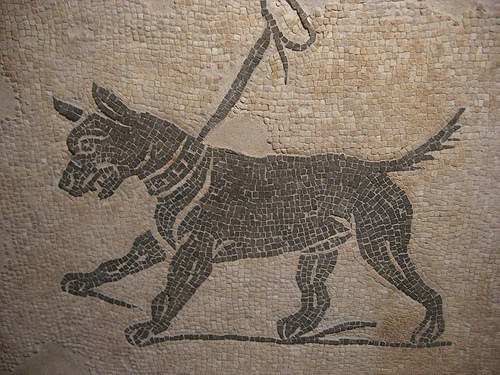
How sweet and friendly she was! While she was alive she used to lie in the lap, always sharing sleep and bed. What a shame, Midge, that you have died! You would only bark if some rival took the liberty of lying up against your mistress. What a shame, Midge, that you have died! The depths of the grave now hold you and you know nothing about it. You cannot go wild nor jump on me, and you do not bare your teeth at me with bites that do not hurt. (tr. Edward Courtney)
In the middle of India live black men called Pygmies who speak the same language as the rest of the Indians. They are very small; the tallest is two cubits while most are one and a half cubits in height. They have very long hair that reaches their knees and even lower and their beards are the longest of any man. Since they grow such a long beard, they wear no clothes at all but comb the hair from their head down their back well below their knees and pull their beards down the front to their feet and then gird the hair around their entire body using it in place of clothing. Their penises are so large that they reach their ankles and are thick too, while they themselves are snub-nosed and ugly. Their sheep are like lambs, their asses and oxen are nearly the size of rams, and their horses, mules, and all other livestock are no larger than rams. Three thousand of those Pygmies accompany the king of the Indians, for they are excellent bowmen. They are very just and follow the same laws as the Indians. They hunt hare and fox not with dogs, but with ravens, kites, crows, and eagles. (tr. Andrew Nichols)
Accipe nunc, victus tenuis quae quantaque secum
adferat. in primis valeas bene; nam variae res
ut noceant homini credas, memor illius escae,
quae simplex olim tibi sederit: at simul assis
miscueris elixa, simul conchylia turdis,
dulcia se in bilem vertent stomachoque tumultum
lenta feret pituita. vides, ut pallidus omnis
cena desurgat dubia? quin corpus onustum
hesternis vitiis animum quoque praegravat una
atque adfigit humo divinae particulam aurae.
alter ubi dicto citius curata sopori
membra dedit, vegetus praescripta ad munia surgit.
hic tamen ad melius poterit transcurrere quondam,
sive diem festum rediens advexerit annus,
seu recreare volet tenuatum corpus, ubique
accedent anni, tractari mollius aetas
imbecilla volet: tibi quidnam accedet ad istam
quam puer et validus praesumis mollitiem, seu
dura valetudo inciderit seu tarda senectus?
(Horace, Serm. 2.2.70-88)
Now listen to how simple eating brings
us all so many and such wondrous things!
First is good health because it’s manifest—
as you recall plain fare you could digest—
that it’s quite dangerous when foods collide.
Whenever you combine the boiled with fried,
or shellfish with a thrush, the sweet will turn
to bile, and clogging phlegm makes stomachs churn.
Don’t people at a ‘dinner served with doubt’
appear quite pale as they are coming out?
Moreover, overkill of yesterday
that drags a body down will also weigh
upon a soul and bury what’s divine
within the ground. If someone can combine
nursing his limbs and falling off to sleep
without delay, he’ll rise alert and keep
up with his obligations, even though
occasionally he may try to go
for something better if the passing year
brings feasting, or his wasting’s so severe
that he intends to fix his malnutrition,
or, as time flies by, his frail condition
in old age requires gentler care.
But as for you, if you are forced to bear
enfeeblement from aging and disease,
how will you bolster your infirmities
once you have blown your youthful, healthy days? (tr. A.M. Juster)
Meantime through the gray fog, Eros, unseen, achieved his goal, and brought such havoc there as gadflies make for heifers as they graze (I mean the creatures that herdsmen call breeze flies). Now standing in the doorway of the porch, he snaps his bowstring taut and from his quiver takes a fresh arrow, anguish-laden. Then unperceived he passes over the sill, then, quick-eyed for hazards, he crouches in front of Jason, centers the notch and flexes the bow between his hands, and shoots Medea. A mute amazement seized and held her spirit, and Eros, with outrageous laughter, fled away from the lofty hall, but the arrow stayed, burned deep in the girl’s body, burned like flames. Again and again on Jason the girl cast glistering glances, and in her breast the heart shuddered incessantly, and she could fix her mind on nothing but the man: her soul by such delicious sickness was distilled. And as a poor woman, spinner of wool, piles brittle twigs upon a redhot brand to coax, against the coming of the night, bright comfort for her shelter, rises early to end this chore before her work begins; so, wreathing round and round Medea’s heart, annihilating Love clandestine blazed, and on her delicate cheeks the color shifted, now paled, now crimsoned, in her reason’s ruin. (tr. W.R. Johnson)
Domenicus van Wijnen, De heksenmeester (late 17th c.)
Sed cum haec a spiritibus circa homines fiant, eam solam rerum imaginem fidelis anima non aspernatur, quae innocentiam relinquit incolumem. quod si materiam vitiis afferat, libidinem forte accendens aut avaritiam aut dominandi ingerens appetitum aut quicquid huiusmodi est ad subversionem animae, proculdubio aut caro aut spiritus malignus immittit, qui in quosdam exigentibus culpis, Domino permittente, tanta malitiae suae licentia debaccatur ut quod in spiritu patiuntur, miserrime et mendacissime credant in corporibus evenire. quale est quod noctilucam quandam vel Herodiadem vel praesidem noctis dominam concilia et conventus de nocte asserunt convocare, varia celebrari convivia, ministeriorum species diversis occupationibus exerceri, et nunc istos ad penam trahi pro meritis, nunc illos ad gloriam sullimari. praeterea infantes exponi lamiis et nunc frustratim discerptos edaci ingluvie in ventrem traiectos congeri, nunc praesidentis miseratione reiectos in cunas reponi. quis vel cecus hoc ludificantium demonum non videat esse nequitiam? quod vel ex eo patet, quod mulierculis et viris simplicioribus et infirmioribus in fide ista proveniunt. si vero quisquam eorum qui hac illusione laborat ab aliquo constanter et ex signis aliquibus arguatur, demonium statim aut superatur aut cedit et, ut dicitur, ex quo quis in luce arguitur, cessant opera tenebrarum. huius autem pestis cura efficacissima est ut fidem quis amplexus his mendaciis subtrahat mentis auditum et nequaquam respiciat ad huiusmodi vanitates et insanias falsas.
(John of Salisbury, Policraticus 2.17)
When spirits act thus in the case of human beings the devout soul should reject every image except that which leaves its innocence unimpaired. For should the dream add fuel to vice, perchance by inducing lust and avarice or by inspiring greed for dominion or anything of the sort to destroy the soul, undoubtedly it is the flesh or the evil spirit that sends it. This spirit, with the permission of the Lord because of their sins, wreaks its unbridled wickedness upon some men so violently that what they suffer in the spirit they wretchedly but falsely believe comes to pass in the flesh. For example it is said that some Moon or Herodias or Mistress of the Night calls together councils and assemblies, that banquets are held, that different kinds of rites are performed, and that some are dragged to punishment for their deeds and others raised to glory. Moreover babes are exposed to witches and at one time their mangled limbs are eagerly devoured, at another are flung back and restored to their cradles if the pity of her who presides is aroused. Cannot even the blind see that this is but the wickedness of mocking demons? This is quite apparent from the fact that it is for the weaker sex and for men of little strength or sense that they disport themselves in such a cult. If in fact anyone who suffers from such illusion is firmly censured by someone or by some sign the malign influence is either overcome or yields, and, as the saying is, as soon as one is censured in the light the works of darkness cease. The most effective cure however for this bane is for one to embrace the true faith, refuse to listen to such lies, and never to give thought to follies and inanities of the sort. (tr. Joseph B. Pike)
Impp. Valentinianus et Valens AA. ad Secundum pf. p.
ne quis deinceps nocturnis temporibus aut nefarias preces aut magicos apparatus aut sacrificia funesta celebrare conetur. detectum enim atque convictum competenti animadversione mactari perenni auctoritate censemus.
dat. V. Id. Sept. divo Ioviano A. et Varroniano coss.
interpretatio: quicumque nocturna sacrificia daemonum celebraverit vel incantationibus daemones invocauerit, capite puniatur.
(Codex Theodosianus 9.16.7)
Emperors Valentinian and Valens Augustuses to Secundus, Praetorian Prefect.
Hereafter no person shall attempt during the nighttime to engage in wicked prayers or magic preparations or funereal sacrifices. If he should be detected and convicted of such practices, We decree by Our everlasting authority that he shall be stricken with a suitable punishment.
Given on the fifth day before the ides of September in the year of the consulship of the sainted Jovian and of Varronianus. (September 9, 364)
Interpretation: If any person should celebrate nocturnal sacrifices to the demons or should invoke the demons by incantations, he shall suffer capital punishment. (tr. Clyde Pharr)
You probably know Theodore of Sicily by reputation: for he was one of the most distinguished men; he surpassed all in bodily stature and beauty as well as in the confidence which he enjoyed with the Emperor, and he had more power than any member of the royal household, but he did not bear this prosperity meekly, and having entered into a plot against the Emperor he was taken prisoner and miserably beheaded; and his wife who was not a whit inferior to your noble self in education and birth and all other respects was suddenly stripped of all her possessions, deprived even of her freedom also, and enrolled among the household slaves, and compelled to lead a life more pitiable than any bondmaid, having this advantage only over the rest that owing to the extreme severity of her calamity she moved to tears all who beheld her. And it is said also that Artemisia who was the wife of a man of high reputation, since he also aimed at usurping the throne, was reduced to this same condition of poverty, and also to blindness; for the depth of her despondency, and the abundance of her tears destroyed her sight; and now she has need of persons to lead her by the hand, and to conduct her to the doors of others that she may obtain the necessary supply of food. And I might mention many other families which have been brought down in this way did I not know you to be too pious and prudent in disposition to wish to find consolation for your own calamity out of the misfortunes of others. And the only reason why I mentioned those instances to which I referred just now was that you might learn that human things are nothingness but that truly as the prophet says “all the glory of man is as the flower of grass” [Isaiah 40:5]. For in proportion to men’s elevation and splendour is the ruin wrought for them, not only in the case of those who are under rule, but also of the rulers themselves. For it would be impossible to find any private family which has been immersed in such great calamities as the ills in which the imperial house has been steeped. For untimely loss of parents, and of husbands, and violent forms of death, more outrageous and painful than those which occur in tragedies, especially beset this kind of government. (tr. William Richard Wood Stephens, revised by Kevin Knight)
Is demum miser est qui aerumnam suam nescit occultare
foris; ita me uxor forma et factis facit, si taceam, tamen indicium,
quae nisi dotem omnia quae nolis habet. qui sapiet, de me discet,
qui quasi †ad hostis† captus liber servio salva urbe atque arce.
quae mihi quidquid placet eo privatu vim me servatam velim?
dum ego eius mortem inhio, egomet inter vivos vivo mortuus.
ea me clam se cum mea ancilla ait consuetum; id me arguit,
ita plorando, orando, instando atque obiurgando me optudit,
eam uti venderem. nunc credo inter suas
aequalis et cognatas sermonem serit:
“quis vostrarum fuit integra aetatula,
quae hoc idem a viro
impetrarit suo, quod ego anus modo
effeci, paelice ut meum privarem virum?”
haec erunt concilia hocedie; differar sermone misere.
(Caecilius Statius, Plocium 136-150 Warmington)
A poor wretch is he surely who doesn’t know how he can hide his troubles out of doors. You see, my wife, even if I say nothing, gives the show away by her looks and by her acts—she who has every thing you wouldn’t want her to have except a dowry. He who’ll be a wise man will learn a lesson from me—I’m free but still a slave to the will of enemies, though yet my town and stronghold are safe. What, am I to wish long life to the woman who is always going to rob me of whatever gives me joy? While I gape for her death, I am a living corpse among the living. She says that unknown to her there is intimacy between me and my handmaid. That’s what she accuses me of; and so by moaning and groaning and bothering and pothering she thumped me into selling her. And now I believe she’s sowing this sort of gossip among her cronies and kinsfolk: “Of all you women who is there, who, in the tender flower of her age, got out of her husband what I, an old woman, have lately accomplished—robbed my husband of his wench?” That’s the sort of mothers’ meetings there’ll be these days. I shall be damnably torn to pieces by gossip. (tr. Eric Herbert Warmington)
But perhaps this injunction to ‘wish for it to happen as it happens’ will seem to some people to be harsh and impossible. What right-thinking human being wishes for the occurrence of the widespread bad effects resulting from the universe—for instance, earthquakes, deluges, conflagrations, plagues, famine and the destruction of all sorts of animals and crops? Or the impious deeds performed by some human beings on others—the sacking of cities, taking prisoners of war, unjust killings, piracy, kidnapping, licentiousness, and tyrannical force, culminating in compelled acts of impiety? Still less the loss of culture and philosophy, of all virtue and friendship, and of faith in one another? As for all the crafts and sciences discovered and made secure through long ages, some of them have completely disappeared, so that only their names are remembered, and there are only shadows and figments left behind of many of the arts given by the gods for our assistance in life (e.g. medicine, housebuilding, carpentry and the like). These things and others of this sort—of which there has been an excess in our own lifetime—who would want to hear of them, let alone see them, take part in them or ‘wish them to happen as they happen’, except a malevolent person and a hater of all that is fine? (tr. Charles Brittain & Tad Brennan)
Victa phalanx versum dederat Maurusia dorsum:
victorum sequitur pubes veloxque tribunus.
surgit ad aethereos nubes densissima campos,
pulvere facta fugae. duro sonat ungula cornu,
et latet aspersis campus coopertus arenis.
cornipedum fodiens densis calcaribus armos
hostis uterque volat. sequitur tunc agmina pulvis,
significatque vias. dirupto carcere ventus
non aliter teneras flatu convolvit harenas,
cum tumidus Boreas, Scythica iam liber ab aula,
perfurit in campos: turbo volat horridus ante,
contortus virtute Noti; gyroque coactus
vertit harenosas, conturbans aequora, terras.
(Corippus, Iohannis 7.439-451)
The defeated Moorish phalanx had now turned their backs in flight, and the victorious soldiers and their swift tribune pursued them. The thick cloud of dust their flight produced rose into the expanse of the sky, the hard hooves of the horses thundered everywhere and the plain lay covered with the sand they tossed up. Each side flew on, goading the flanks of their horses with their spurs again and again. Dust followed their bands and marked their path. In the same way the wind, when it breaks out of its prison, whirls tiny grains of sand along in its blast. Then the swollen north wind, freed from its Scythian chamber, rages over the plain. A horrible whirlwind flies on before it, twisted by the power of the south wind and, driven in a circle, churns up the sea and rakes the sandy earth. (tr. George W. Shea)



 Crambe Repetita