Huperēren

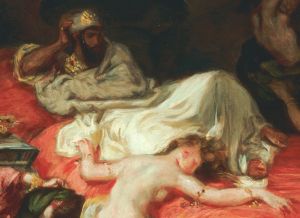
Eugène Delacroix, La mort de Sardanapale, 1827 (detail)
Eugène Delacroix, La mort de Sardanapale (1827; detail)

Σαρδανάπαλλος δέ, τριακοστὸς μὲν ὢν ἀπὸ Νίνου τοῦ συστησαμένου τὴν ἡγεμονίαν, ἔσχατος δὲ γενόμενος Ἀσσυρίων βασιλεύς, ὑπερῆρεν ἅπαντας τοὺς πρὸ αὐτοῦ τρυφῇ καὶ ῥᾳθυμίᾳ. χωρὶς γὰρ τοῦ μηδ’ ὑφ’ ἑνὸς τῶν ἔξωθεν ὁρᾶσθαι βίον ἔζησε γυναικός, καὶ διαιτώμενος μὲν μετὰ τῶν παλλακίδων, πορφύραν δὲ καὶ τὰ μαλακώτατα τῶν ἐρίων ταλασιουργῶν, στολὴν μὲν γυναικείαν ἐνεδεδύκει, τὸ δὲ πρόσωπον καὶ πᾶν τὸ σῶμα ψιμυθίοις καὶ τοῖς ἄλλοις τοῖς τῶν ἑταιρῶν ἐπιτηδεύμασιν ἁπαλώτερον πάσης γυναικὸς τρυφερᾶς κατεσκεύαστο. ἐπετήδευσε δὲ καὶ τὴν φωνὴν ἔχειν γυναικώδη καὶ κατὰ τοὺς πότους οὐ μόνον ποτῶν καὶ βρωτῶν τῶν δυναμένων μάλιστα τὰς ἡδονὰς παρέχεσθαι συνεχῶς ἀπολαύειν, ἀλλὰ καὶ τὰς ἀφροδισιακὰς τέρψεις μεταδιώκειν ἀνδρὸς ἅμα καὶ γυναικός· ἐχρῆτο γὰρ ταῖς ἐπ’ ἀμφότερα συνουσίαις ἀνέδην, τῆς ἐκ τῆς πράξεως αἰσχύνης οὐδὲν ὅλως φροντίζων. ἐπὶ τοσοῦτο δὲ προήχθη τρυφῆς καὶ τῆς αἰσχίστης ἡδονῆς καὶ ἀκρασίας ὥστ’ ἐπικήδειον εἰς αὑτὸν ποιῆσαι καὶ παραγγεῖλαι τοῖς διαδόχοις τῆς ἀρχῆς μετὰ τὴν ἑαυτοῦ τελευτὴν ἐπὶ τὸν τάφον ἐπιγράψαι τὸ συγγραφὲν μὲν ὑπ´ ἐκείνου βαρβαρικῶς, μεθερμηνευθὲν δὲ ὕστερον ὑπό τινος Ἕλληνος,
“εὖ εἰδὼς ὅτι θνητὸς ἔφυς, σὸν θυμὸν ἄεξε
τερπόμενος θαλίῃσι· θανόντι σοι οὔτις ὄνησις.
καὶ γὰρ ἐγὼ σποδός εἰμι, Νίνου μεγάλης βασιλεύσας.
ταῦτ’ ἔχω ὅσσ’ ἔφαγον καὶ ἐφύβρισα καὶ μετ’ ἔρωτος
τέρπν’ ἔπαθον, τὰ δὲ πολλὰ καὶ ὄλβια κεῖνα λέλειπται.”
τοιοῦτος δ´ ὢν τὸν τρόπον οὐ μόνον αὐτὸς αἰσχρῶς κατέστρεψε τὸν βίον, ἀλλὰ καὶ τὴν Ἀσσυρίων ἡγεμονίαν ἄρδην ἀνέτρεψε, πολυχρονιωτάτην γενομένην τῶν μνημονευομένων.
(Diodorus Siculus, Hist. 2.23)

Sardanapallus, the thirtieth in succession from Ninus, who founded the empire, and the last king of the Assyrians, outdid all his predecessors in luxury and sluggishness. For not to mention the fact that he was not seen by any man residing outside the palace, he lived the life of a woman, and spending his days in the company of his concubines and spinning purple garments and working the softest of wool, he had assumed the feminine garb and so covered his face and indeed his entire body with whitening cosmetics and the other unguents used by courtesans, that he rendered it more delicate than that of any luxury-loving woman. He also took care to make even his voice to be like a woman’s, and at his carousals not only to indulge regularly in those drinks and viands which could offer the greatest pleasure, but also to pursue the delights of love with men as well as women; for he practised sexual indulgence of both kinds without restraint, showing not the least concern for the disgrace attending such conduct. To such an excess did he go of luxury and of the most shameless sensual pleasure and in temperance, that he composed a funeral dirge for himself and commanded his successors upon the throne to inscribe it upon his tomb after his death; it was composed by him in a foreign language but was afterwards translated by a Greek as follows:
Knowing full well that thou wert mortal born,
Thy heart lift up, take thy delight in feast;
When dead no pleasure more is thine. Thus I,
Who once o’er mighty Ninus ruled, am naught
But dust. Yet these are mine which gave me joy
In life—the food I ate, my wantonness,
And love’s delights. But all those other things
Men deem felicities are left behind.
Because he was a man of this character, not only did he end his own life in a disgraceful manner, but he caused the total destruction of the Assyrian Empire, which had endured longer than any other known to history. (tr. Charles Henry Oldfather)
Laniandos

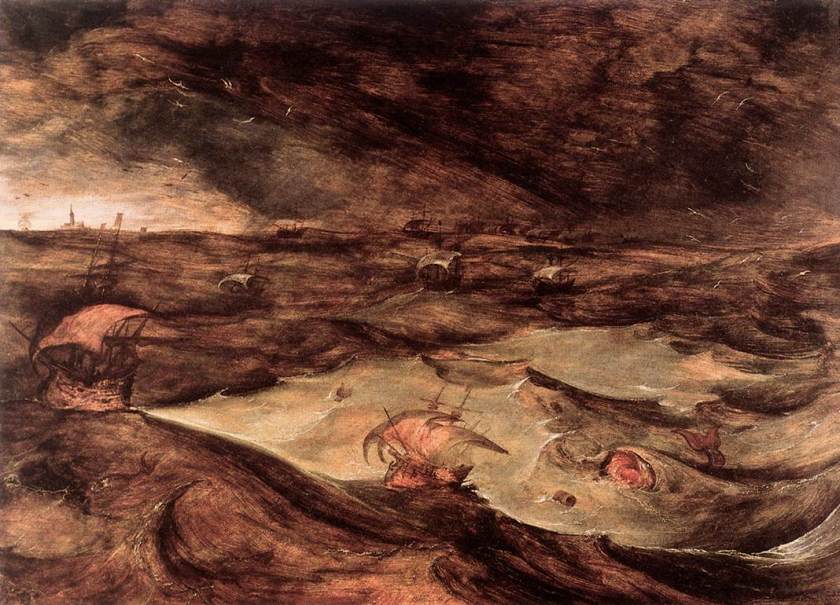
Pieter Bruegel I, De storm, ca. 1569
Pieter Bruegel I, De storm (ca. 1569)

Iamque vident post terga diem solemque relictum
iam pridem, notis extorres finibus orbis,
per non concessas audaces ire tenebras
ad rerum metas extremaque litora mundi.
nunc illum, pigris immania monstra sub undis
qui ferat, Oceanum, qui saevas undique pristes
aequoreosque canes, ratibus consurgere prensis
(accumulat fragor ipse metus), iam sidere limo
navigia et rapido desertam flamine classem
seque feris credunt per inertia fata marinis
iam non felici laniandos sorte relinqui.
atque aliquis prora caecum sublimis ab alta
aëra pugnaci luctatus rumpere visu,
ut nihil erepto valuit dinoscere mundo,
obstructa in tales effundit pectora voces:
“quo ferimur? fugit ipse dies orbemque relictum
ultima perpetuis claudit natura tenebris.
anne alio positas ultra sub cardine gentes
atque alium flabris intactum quaerimus orbem?
di revocant rerumque vetant cognoscere finem
mortales oculos: aliena quid aequora remis
et sacras violamus aquas divumque quietas
turbamus sedes?”
(Albinovanus Pedo, fr. 1)

And now they see day and sun long left behind;
Banished from the familiar limits of the world
They dare to pass through forbidden shades
To the bounds of things, the remotest shores of the world.
Now they think Ocean, that breeds beneath its sluggish waves
Terrible monsters, savage sea-beasts everywhere,
And dogs of the sea, is rising, taking the ships with it
(The very noise increases their fears): now they think the vessels
Are sinking in the mud, the fleet deserted by the swift wind,
Themselves left by indolent fate to the sea-beasts,
To be torn apart unhappily.
Someone high on the prow struggles to break
Through the blinding mist, his sight battling.
He can discern nothing—the world has been snatched away.
He pours his frustrated heart into words:
‘Where are we being carried? Day itself is in flight,
Furthest nature shuts off in everlasting shadows
The world we have left. Are we looking for races
Beyond, in another clime, a new world untouched by breezes?
The Gods call us back, forbid us to know the end of creation
With mortal eyes. Why do our oars violate seas that are not ours,
Waters that are holy? Why do we disturb the quiet home of the Gods?’
(tr. Michael Winterbottom)

Haplōs

toppic

Ἑνὸς οὖν ἄξιον ἐπιμνησθῆναι βασιλέως καὶ ἤθους καὶ ἔργου· καὶ γὰρ ἀποχρῶν ὁτιοῦν πάντα συνεφελκύσασθαι. λέγεται δή τινα τῶν οὐ λίαν ἀρχαίων, ἀλλ’ ὃν ἂν εἰδεῖεν καὶ τῶν γερόντων οἱ πάπποι, εἰ μὴ νέοι τοὺς παῖδας ἐτέκνωσαν, καὶ παρὰ νέων τῶν παίδων ἐγένοντο πάπποι· λέγεται δή τινα ἐκείνων στρατείαν μὲν ἄγειν ἐπὶ τὸν Ἀρσακίδην εἰς Ῥωμαίους ὑβρίσαντα· ἐπειδὴ δὲ πρὸς ταῖς ὑπερβολαῖς τῶν Ἀρμενίων γενέσθαι, πρὶν ἐπιχειρῆσαι τῇ πολεμίᾳ, δείπνου τε αὐτὸν ἐρασθῆναι, καὶ ἐπιτάξαι τῇ στρατιᾷ τοῖς ἀπὸ τῶν σκευοφόρων ἀγαθοῖς χρῆσθαι, ὡς ἐγγύθεν ἐπισιτιουμένοις, ἢν δέῃ. ἐδείκνυε δὲ ἄρα τοὺς Παρθυαίων ἀγρούς· ἐν τούτῳ δὲ ὄντων, πρεσβείαν ἐκ τῶν πολεμίων παρεῖναι καὶ οἴεσθαι μὲν ἥκουσαν προεντεύξεσθαι τοῖς βασιλεῖ παραδυναστεύουσι, καὶ τούτων γε αὖ πελάταις τισὶ καὶ εἰσαγγελεῦσιν, ὡς εἰς ἡμέραν πολλοστὴν ἀπ’ ἐκείνης τοῦ βασιλέως τῇ πρεσβείᾳ χρηματιοῦντος· συνενεχθῆναι δὲ κατ’ αὐτόν πως γενέσθαι τὸν βασιλέα δειπνοῦντα. οὐ γὰρ ἦν πω τὸ τῶν δορυφόρων τοιοῦτον, ἀπὸ τῆς στρατιᾶς στρατιά τις ἔκκριτος, νέοι πάντες, πάντες εὐμήκεις, τὰς κόμας ξανθοί τε καὶ περιττοί, “αἰεὶ δὲ λιπαροὶ κεφαλὰς καὶ καλὰ πρόσωπα” [Homer, Od. 15.332], χρυσάσπιδες καὶ χρυσεολόγχαι, οἷς, ὅταν ποτὲ ὀφθῶσι, τὸν βασιλέα σημαινόμεθα, καθάπερ, οἶμαι, ταῖς προανισχούσαις ἀκτῖσι τὸν ἥλιον· ἀλλὰ πᾶσα φάλαγξ τὸ οἰκεῖον ποιοῦσα, δορυφόρος ἦν τοῦ βασιλέως τε καὶ τῆς βασιλείας. οἱ δὲ ἁπλῶς ἑαυτῶν εἶχον, οὐκ ἀπὸ τῆς σκευῆς, ἀλλ’ ἀπὸ τῆς ψυχῆς βασιλεῖς ὄντες, καὶ τἄνδον τοῦ πλήθους διέφερον· τὰ δὲ ἐκτὸς ὅμοιοι τοῖς ἀγελαίοις ἐφαίνοντο, ὥσπερ ἔχοντά φασι τὸν Καρῖνον ὑπὸ τῆς πρεσβείας ὀφθῆναι. φοινικοβαφὴς χιτών, καὶ ἐπὶ τῆς πόας ἐκέκλιτο· τὸ δὲ δεῖπνον ἦν πίσινον ἕωλον ἔτνος, καὶ ἐν αὐτῷ τεμάχια ἄττα ταρίχη κρεῶν ὑείων, ἀπολελαυκότα τοῦ χρόνου. ἰδόντα δὲ αὐτόν, οὔτε ἀναθορεῖν οὔτε μεταποιῆσαί τι λέγεται· καλέσαντα δὲ αὐτόθεν τοὺς ἄνδρας, εἰδέναι τε φάναι παρ’ αὐτὸν ἥκοντας· αὐτὸς γὰρ εἶναι Καρῖνος· καὶ κελεύειν ἀπαγγεῖλαι τῷ νέῳ βασιλεῖ τήμερον, εἰ μὴ σωφρονήσοι, προσδέχεσθαι πᾶν μὲν ἄλσος αὐτῷ, πᾶν δὲ πεδίον ἐν μιᾷ σελήνῃ ψιλότερον ἔσεσθαι τῆς Καρίνου κεφαλῆς· ἅμα δὲ λέγοντά φασιν ἐκδῦναι τοῦ πίλου, δεικνύντα τὴν κεφαλὴν οὐδέν τι δασυτέραν παρακειμένου τοῦ κράνους· καὶ εἰ μὲν πεινῷεν, ἐφεῖναι συνεμβαλεῖν τῇ χύτρᾳ· μὴ δεομένους δέ, κελεύειν αὐθωρὸν ἀπηλλάχθαι καὶ ἔξω τοῦ Ῥωμαϊκοῦ χάρακος εἶναι, ὡς τῆς πρεσβείας αὐτοῖς τέλος εὑρούσης. λέγεται τοίνυν καὶ τούτων ἀνενεχθέντων ἐπὶ τὸ πλῆθος καὶ τὸν ἡγεμόνα τῶν πολεμίων, ὧν τε εἶδον ὧν τε ἤκουσαν, ὅπερ εἰκὸς ἦν συμβῆναι, φρίκην καὶ δέος ἐπιπεσεῖν ἅπασιν, εἰ πρὸς ἄνδρας μαχοῦνται τοιούτους, ὧν ὁ βασιλεὺς οὔτε βασιλεὺς ὢν οὔτε φαλακρὸς αἰσχύνεται, καὶ χύτραν παρατιθέμενος συνδείπνους καλεῖ· ἀφικέσθαι δὲ τὸν βασιλέα τὸν ἀλαζόνα κατορρωδήσαντα, πάντα εἴκειν ἕτοιμον ὄντα, τὸν ἐν τιάρᾳ καὶ κάνδυι τῷ μετὰ χιτῶνος φαύλων ἐρίων καὶ πίλου.
(Synesius, Peri Basileias 12.3-7)

It is therefore worthwhile to make mention of the character and achievements of a certain king, for any particular story will suffice to draw all others along in its wake. It is told of one of no great antiquity but such an one as even the grandfathers of our own elders might have known if only they had not begotten their children when young, and not become grandparents during the youth of their own children. It is said, then, that a certain monarch of those days was leading an expedition against the Parthians, who had behaved towards the Romans in an insulting manner. Now when they had reached the mountain frontiers of Armenia, before entering the enemy country, he was eager to dine, and gave orders to the army to make use of the provisions in the supply column, as they were now in a position to live off the neighboring country should it be necessary. He was then pointing out to them the land of the Parthians. Now, while they were so engaged, an embassy appeared from the enemy lines, thinking on their arrival to have the first conversation with the influential men who surrounded the king, and after these with some dependants and gentleman ushers, but supposing that only on a much later day would the king himself give audience to the embassy. However, it turned out somehow that the king was dining at the moment. Such a thing did not exist at that time as the Guards’ regiment, a sort of picked force detached from the army itself, of men all young, tall, fair-haired and superb, “their heads ever anointed and their faces fair,” equipped with golden shields and golden lances. At the sight of these we are made aware beforehand of the king’s approach, much as, I imagine, we recognize the sun by the rays that rise above the horizon. Here, in contrast, every phalanx doing its duty, was the guard of the king and kingdom. And these kings held themselves in simple fashion, for they were kings not in pomp but in spirit, and it was only within that they differed from other people. Externally they appeared in the likeness of the herd, and it was in such guise, they say, that Carinus was seen by the embassy. A tunic dyed in purple was lying on the grass, and for repast he had a soup of yesterday’s peas, and in some bits of salted pork that had grown old in the service. Now when he saw them, according to the story, he did not spring up, nor did he change anything; but called out to these men from the very spot and said that he knew that they had come to see him, for that he was Carinus; and he bade them tell the young king [Bahram II] that very day, that unless he conducted himself wisely, he might expect that the whole of their forest and plain would be in a single month barer than the head of Carinus. And as he spoke, they say that he took off his cap and showed his head, which was no more hairy than the helmet lying at his side. And he gave them leave if they were hungry to attack the stew-pot with him, but if not in need, he ordered them to depart at once, and to leave the Roman lines, as their mission was at an end. Now it is said that when these messages were reported to the rank and file and to the leader of the enemy, namely all that had been seen and heard, at once -as might have been expected- shuddering and fear fell upon everyone at the thought of fighting men such as these, whose very king was neither ashamed of being king nor of being bald, and who, offering them a stew-pot, invited them to share his meal. And their braggart king arrived in a state of terror and was ready to yield in everything, he of the tiara and robes, to one in a simple woolen tunic and cap. (tr. Augustine Fitzgerald)

Urbem

foro-romano-1500x630

Exaudi, Regina tui pulcherrima mundi,
inter sidereos Roma recepta polos;
exaudi, genetrix hominum genetrixque deorum,
non procul a caelo per tua templa sumus.
te canimus semperque, sinent dum fata, canemus:
sospes nemo potest immemor esse tui.
obruerint citius scelerata oblivia solem
quam tuus ex nostro corde recedat honos.
nam solis radiis aequalia munera tendis,
qua circumfusus fluctuat Oceanus.
volvitur ipse tibi, qui continet omnia, Phoebus,
eque tuis ortos in tua condit equos.
te non flammigeris Lybie tardavit arenis,
non armata suo reppulit Ursa gelu:
quantum vitales natura tetendit in axes,
tantum virtuti pervia terra tuae.
fecisti patriam diversis gentibus unam,
profuit iniustis, te dominante, capi,
dumque offers victis proprii consortia iuris,
urbem fecisti quod prius orbis erat.
(Rutilius Namatianus, De Reditu Suo 47-66)

Listen, O fairest queen of thy world, Rome, welcomed amid the starry skies, listen, thou mother of men and mother of gods, thanks to thy temples we are not far from heaven: thee do we chant, and shall, while destiny allows, for ever chant. None can be safe if forgetful of thee. Sooner shall guilty oblivion whelm the sun than the honour due to thee quit my heart; for benefits extend as far as the sun’s rays, where the circling Ocean-flood bounds the world. For thee the very Sun-God who holdeth all together doth revolve: his steeds that rise in thy domains he puts in thy domains to rest. Thee Africa hath not stayed with scorching sands, nor hath the Bear, armed with its native cold, repulsed thee. As far as living nature hath stretched towards the poles, so far hath earth opened a path for thy valour. For nations far apart thou hast made a single fatherland; under thy dominion captivity hath meant profit even for those who knew not justice: and by offering to the vanquished a share in thine own justice, thou hast made a city of what was erstwhile a world. (tr. John Wight Duff & Arnold M. Duff)

Paidagōgos

Paedagogus en jongen, 3e-2e eeuw vC

Ἐμὲ δὲ ὑγρὸν βλέπειν ῥιπτοῦντα πανταχοῦ τὰ ὄμματα, ὅπως ὑμῖν καλός, οὔτι τὴν ψυχήν, ἀλλὰ τὸ πρόσωπον ὀφθείην, ὁ τρόπος οὐ συγχωρεῖ. ἔστι γάρ, ὡς ὑμεῖς κρίνετε, ψυχῆς ἀληθινὸν κάλλος ὑγρότης βίου. ἐμὲ δὲ ὁ παιδαγωγὸς ἐδίδασκεν εἰς γῆν βλέπειν ἐς διδασκάλου φοιτῶντα· θέατρον δ’ οὐκ εἶδον πρὶν μᾶλλον κομῆσαι τῆς κεφαλῆς τὸ γένειον, ἐν ἐκείνῳ δὲ τῆς ἡλικίας ἰδίᾳ μὲν καὶ κατ̓ ἐμαυτὸν οὐδέποτε, τρίτον δὲ ἢ τέταρτον, εὖ ἴστε, Πατρόκλῳ ἐπίηρα φέρων ἅρχων ἐπέταττεν οἰκεῖος ὢν ἐμοὶ καὶ ἀναγκαῖος· ἐτύγχανον δὲ ἰδιώτης ἔτι· σύγγνωτε οὖν ἐμοί· δίδωμι γὰρ ὃν ἀντ’ ἐμοῦ δικαιότερον μισήσετε τὸν φιλαπεχθήμονα παιδαγωγόν, ὅς με καὶ τότε ἐλύπει μίαν ὁδὸν ἰέναι διδάσκων καὶ νῦν αἴτιός ἐστί μοι τῆς πρὸς ὑμᾶς ἀπεχθείας, ἐνεργασάμενος τῇ ψυχῇ καὶ ὥσπερ ἐντυπώσας ὅπερ ἐγὼ μὲν οὐκ ἐβουλόμην τότε, ὁ δὲ ὡς δή τι χαρίεν ποιῶν μάλα προθύμως ἐνετίθει, καλῶν οἶμαι σεμνότητα τὴν ἀγροικίαν καὶ σωφροσύνην τὴν ἀναισθησίαν, ἀνδρείαν δὲ τὸ μὴ εἴκειν ταῖς ἐπιθυμίαις μηδ’ εὐδαίμονα ταύτῃ γίνεσθαι. ἔφη δέ μοι πολλάκις, εὖ ἴστε, ναὶ μὰ Δία καὶ μούσας, ὁ παιδαγωγὸς ἔτι παιδαρίῳ κομιδῇ, Μή σε παραπειθέτω τὸ πλῆθος τῶν ἡλικιωτῶν ἐπὶ τὰ θέατρα φερόμενον ὀρεχθῆναί ποτε ταυτησὶ τῆς θέας. ἱπποδρομίας ἐπιθυμεῖς; ἔστι παρ’ Ὁμήρῳ δεξιώτατα πεποιημένη· λαβὼν ἐπέξιθι τὸ βιβλίον. τοὺς παντομίμους ἀκούεις ὀρχηστάς; ἔα χαίρειν αὐτούς· ἀνδρικώτερον παρὰ τοῖς Φαίαξιν ὀρχεῖται τὰ μειράκια· σὺ δ’ ἔχεις κιθαρῳδὸν τὸν Φήμιον καὶ ᾠδὸν τὸν Δημόδοκον. ἔστι καὶ φυτὰ παῤ αὐτῷ πολλὰ τερπνότερα ἀκοῦσαι τῶν ὁρωμένων·
Δήλῳ δή ποτε τοῖον Ἀπόλλωνος παρὰ βωμὸν
Φοίνικος νέον ἔρνος ἀνερχόμενον ἐνόησα. [Homer, Od. 6.162-163]
καὶ ἡ δενδρήεσσα τῆς Καλυψοῦς νῆσος καὶ τὰ τῆς Κίρκης σπήλαια καὶ ὁ Ἀλκίνου κῆπος· εὖ ἴσθι, τούτων οὐδὲν ὄψει τερπνότερον. ἆρα ποθεῖτε καὶ τοὔνομα ὑμῖν φράσω τοῦ παιδαγωγοῦ, καὶ ὅστις ὢν γένος ταῦτα ἔλεγε; βάρβαρος νὴ θεοὺς καὶ θεάς, Σκύθης μὲν τὸ γένος, ὁμώνυμος δὲ τοῦ τὸν Ξέρξην ἀναπείσαντος ἐπὶ τὴν Ἑλλάδα στρατεῦσαι, καὶ τὸ πολυθρύλητον τοῦτο δὴ πρὸ μηνῶν μὲν εἴκοσι προσκυνούμενον ὄνομα, νυνὶ δὲ προφερόμενον ἀντ̓ ἀδικήματος καὶ ὀνείδους, εὐνοῦχος ἦν, ὑπὸ τὠμῷ τεθραμμένος πάππῳ, τὴν μητέρα τὴν ἐμὴν ὅπως ἀγάγοι διὰ τῶν Ὁμήρου καὶ Ἡσιόδου ποιημάτων. ἐπεὶ δ’ ἐκείνη πρῶτον ἐμὲ καὶ μόνον τεκοῦσα μησὶν ὕστερον ὀλίγοις ἐτελεύτησεν ὑπὸ τῆς ἀμήτορος παρθένου πολλῶν συμφορῶν ἐκκλαπεῖσα κόρη καὶ νέα, μετ’ ἐνιαυτὸν ἕβδομον αὐτῷ παρεδόθην. οὗτος ἐξ ἐκείνου ταῦτα ἀνέπεισεν ἄγων ἐς διδασκάλου μίαν ὁδόν· ἄλλην δ’ οὔτ’ αὐτὸς εἰδέναι θέλων οὔτ’ ἐμοὶ βαδίζειν ξυγχωρῶν ἐποίησεν ἀπεχθάνεσθαί με πᾶσιν ὑμῖν.
(Julian, Misopōgōn 351a-352c)

No, my temperament does not allow me to look wanton, casting my eyes in all directions in order that in your sight I may appear beautiful, not indeed in soul but in face. For, in your judgment, true beauty of soul consists in a wanton life. I, however, was taught by my tutor to look on the ground when I was on my way to school; and as for a theatre, I never saw one until I had more hair on my chin than on my head, and even at that age it was never on my own account and by my own wish, but three or four times, you must know, the governor who was my kinsman and near relative, “doing a favour to Patroclus,” ordered me to attend; it was while I was still a private individual. Therefore forgive me. For I hand over to you instead of myself one whom you will more justly detest, I mean that curmudgeon my tutor who even used to harass me by teaching me to walk in one straight path and now he is responsible for my quarrel with you. It was he who wrought in my soul and as it were carved therein what I did not then desire, though he was very zealous in implanting it, as though he were producing some charming characteristic; and boorishness he called dignity, lack of taste he called sobriety, and not yielding to one’s desires or achieving happiness by that means he called manliness. I assure you, by Zeus and the Muses, that while I was still a mere boy my tutor would often say to me: “Never let the crowd of your playmates who flock to the theatres lead you into the mistake of craving for such spectacles as these. Have you a passion for horse races? There is one in Homer, very cleverly described. Take the book and study it. Do you hear them talking about dancers in pantomime? Leave them alone! Among the Phaeacians the youths dance in more manly fashion. And for citharode you have Phemius; for singer Demodocus. Moreover there are in Homer many plants more delightful to hear of than those that we can see: ‘Even so did I once see the young shoot of a date palm springing up near the altar of Apollo on Delos.’ And consider the wooded island of Calypso and the caves of Circe and the garden of Alcinous; be assured that you will never see anything more delightful than these.” And now do you want me to tell you also my tutor’s name and the nationality of the man who used to say these things? He was a barbarian, by the gods and goddesses; by birth he was a Scythian, and he had the same name as the man who persuaded Xerxes to invade Greece. Moreover he was a eunuch, a word which, twenty months ago, was constantly heard and revered, though it is now applied as an insult and a term of abuse. He had been brought up under the patronage of my grandfather, in order that he might instruct my mother in the poems of Homer and Hesiod. And since she, after giving birth to me her first and only child, died a few months later, snatched away while she was still a young girl by the motherless maiden from so many misfortunes that were to come, I was handed over to him after my seventh year. From that time he won me over to these views of his, and led me to school by one straight path; and since neither he himself desired to know any other nor allowed me to travel by any other path, it is he who has caused me to be hated by all of you. (tr. Wilmer Cave Wright)

Timōron

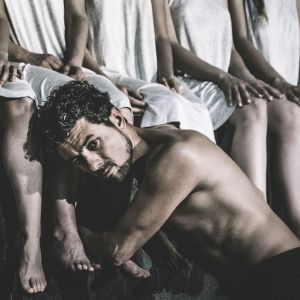
Christos Stylianou as Orestes

[ΠΑΙΔΑΓΩΓΟΣ. ΟΡΕΣΤΗΣ]

[ΠΑΙΔ.] Ὦ τοῦ στρατηγήσαντος ἐν Τροίᾳ ποτὲ
Ἀγαμέμνονος παῖ, νῦν ἐκεῖν’ ἔξεστί σοι
παρόντι λεύσσειν, ὧν πρόθυμος ἦσθ’ ἀεί.
τὸ γὰρ παλαιὸν Ἄργος οὑπόθεις τόδε,
τῆς οἰστροπλῆγος ἄλσος Ἰνάχου κόρης·
αὕτη δ’, Ὀρέστα, τοῦ λυκοκτόνου θεοῦ
ἀγορὰ Λύκειος· οὑξ ἀριστερᾶς δ’ ὅδε
Ἥρας ὁ κλεινὸς ναός· οἷ δ’ ἱκάνομεν,
φάσκειν Μυκήνας τὰς πολυχρύσους ὁρᾶν
πολύφθορόν τε δῶμα Πελοπιδῶν τόδε,
ὅθεν σε πατρὸς ἐκ φονῶν ἐγώ ποτε
πρὸς σῆς ὁμαίμου καὶ κασιγνήτης λαβὼν
ἤνεγκα κἀξέσωσα κἀξεθρεψάμην
τοσόνδ’ ἐς ἥβης, πατρὶ τιμωρὸν φόνου.
νῦν οὖν, Ὀρέστα καὶ σὺ φίλτατε ξένων
Πυλάδη, τί χρὴ δρᾶν ἐν τάχει βουλευτέον·
ὡς ἡμὶν ἤδη λαμπρὸν ἡλίου σέλας
ἑῷα κινεῖ φθέγματ’ ὀρνίθων σαφῆ
μέλαινά τ’ ἄστρων ἐκλέλοιπεν εὐφρόνη.
πρὶν οὖν τιν’ ἀνδρῶν ἐξοδοιπορεῖν στέγης,
ξυνάπτετον λόγοισιν· ὡς ἐνταῦθ’ †ἐμὲν
ἵν’ οὐκέτ᾽ ὀκνεῖν καιρός, ἀλλ’ ἔργων ἀκμή.
[ΟΡ.] ὦ φίλτατ᾽ ἀνδρῶν προσπόλων, ὥς μοι σαφῆ
σημεῖα φαίνεις ἐσθλὸς εἰς ἡμᾶς γεγώς.
ὥσπερ γὰρ ἵππος εὐγενής, κἂν ᾖ γέρων,
ἐν τοῖσι δεινοῖς θυμὸν οὐκ ἀπώλεσεν,
ἀλλ’ ὀρθὸν οὖς ἵστησιν, ὡσαύτως δὲ σὺ
ἡμᾶς τ’ ὀτρύνεις καὐτὸς ἐν πρώτοις ἕπει.
τοιγὰρ τὰ μὲν δόξαντα δηλώσω, σὺ δὲ
ὀξεῖαν ἀκοὴν τοῖς ἐμοῖς λόγοις διδούς,
εἰ μή τι καιροῦ τυγχάνω, μεθάρμοσον.
ἐγὼ γὰρ ἡνίχ’ ἱκόμην τὸ Πυθικὸν
μαντεῖον, ὡς μάθοιμ’ ὅτῳ τρόπῳ πατρὶ
δίκας ἀροίμην τῶν φονευσάντων πάρα,
χρῇ μοι τοιαῦθ᾽ ὁ Φοῖβος ὧν πεύσει τάχα·
ἄσκευον αὐτὸν ἀσπίδων τε καὶ στρατοῦ
δόλοισι κλέψαι χειρὸς ἐνδίκου σφαγάς.
ὅτ’ οὖν τοιόνδε χρησμὸν εἰσηκούσαμεν,
σὺ μὲν μολών, ὅταν σε καιρὸς εἰσάγῃ,
δόμων ἔσω τῶνδ’, ἴσθι πᾶν τὸ δρώμενον,
ὅπως ἂν εἰδὼς ἡμὶν ἀγγείλῃς σαφῆ.
οὐ γάρ σε μὴ γήρᾳ τε καὶ χρόνῳ μακρῷ
γνῶσ᾽, οὐδ’ ὑποπτεύσουσιν ὧδ᾽ ἠνθισμένον.
(Sophocles, Electra 1-43)

[OLD SLAVE. ORESTES]

[O.S.] Son of Agamemnon who once led the army before Troy, now you can gaze with your own eyes on what you have always longed to see! This is the ancient Argos for which you used to long, the precinct of the daughter of Inachus whom the gadfly stung; and this, Orestes, is the Lycean marketplace of the wolf-killing god; this ot the left is the famous temple of Hera; and at the place where we have arrived, you may say that you see Mycenae, rich in gold, and the house of the sons of Pelops here, rich in disasters, from which I once carried you, after your father’s murder, receiving you from your own sister, and kept you safe and raised you up to this stage of youthful vigour, to avenge your father’s murder. So now, Orestes, and you, dearest of host, Pylades, you must speedily decide what you must do; for already we hear the morning voices of the birds whom the bright beam of the sun is arousing, and the black night of stars has departed. So before any man leaves the house you must take counsel, since in this place this is no occasion to hesitate, but it is time to act.
[OR.] Dearest of retainers, how clearly you show your loyalty to us! Just as a noble horse, even if he is old, does not lose his spirit in a time of danger, but pricks up his ear, just so do you urge us on and yourself are foremost in support. So I will explain my decisions, and do you lend a prompt ear to my words, and if I do not hit the mark, correct me! When I went to the Pythian oracle to learn how I might get vengeance for my father on his murderers, Phoebus gave me a prophecy which you shall soon hear; that alone, without the help of armed men or of an army, I should accomplish by cunning the slaughter done by a righteous hand. Then, since this is the nature of the oracle I heard, do you go into this house, when you have the chance to enter it, and find out everything that they are doing, so that you can report to us with certain knowledge. They will never know you, grizzled as you are with age and the passage of time, and they will not suspect you.
(tr. Hugh Lloyd-Jones)

Spectaculum

590 (15)

Romae pugnasse* Fenestella tradit primum omnium in circo Claudi Pulchri aedilitate curuli M. Antonio A. Postumio cos. anno urbis DCLV, item post annos viginti Lucullorum aedilitate curuli adversus tauros. Pompei quoque altero consulatu, dedicatione templi Veneris Victricis, viginti pugnavere in circo aut, ut quidam tradunt, septendecim, Gaetulis ex adverso iaculantibus, mirabili unius dimicatione, qui pedibus confossis repsit genibus in catervas, abrepta scuta iaciens in sublime, quae decidentia voluptati spectantibus erant in orbem circumacta, velut arte, non furore belvae, iacerentur. magnum et in altero miraculum fuit uno ictu occiso; pilum autem sub oculo adactum in vitalia capitis venerat. universi eruptionem temptavere, non sine vexatione populi, circumdatis claustris ferreis. qua de causa Caesar dictator postea simile spectaculum editurus euripis harenam circumdedit, quos Nero princeps sustulit equiti loca addens. sed Pompeiani amissa fugae spe misericordiam vulgi inenarrabili habitu quaerentes supplicavere quadam sese lamentatione complorantes, tanto populi dolore, ut oblitus imperatoris ac munificentiae honori suo exquisitae flens universus consurgeret dirasque Pompeio, quas ille mox luit, imprecaretur.

* sc. elephantem

(Pliny the Elder, Nat. Hist. 8.19-21)

Fenestella states that the first elephant fought in the circus at Rome in the curule aedileship of Claudius Pulcher and the consulship of Marcus Antonius and Aulus Postumius, 99 B.C., and also that the first fight of an elephant against bulls was twenty years later in the curule aedileship of the Luculli. Also in Pompey’s second consulship at the dedication of the Temple of Venus Victrix, twenty, or, as some record, seventeen, fought in the Circus, their opponents being Gaetulians armed with javelins, one of the animals putting up a marvelous fight—its feet being disabled by wounds it crawled against the hordes of the enemy on its knees, snatching their shields from them and throwing them into the air, and these as they fell delighted the spectators by the curves they described, as if they were being thrown by a skilled juggler and not by an infuriated wild animal. There was also a marvelous occurrence in the case of another, which was killed by a single blow, as the javelin striking it under the eye had reached the vital parts of the head. The whole band attempted to burst through the iron palisading by which they were enclosed and caused considerable trouble among the public. Owing to this, when subsequently Caesar in his dictatorship was going to exhibit a similar show he surrounded the arena with channels of water; these the emperor Nero removed when adding special places for the Knighthood. But Pompey’s elephants when they had lost all hope of escape tried to gain the compassion of the crowd by indescribable gestures of entreaty, deploring their fate with a sort of wailing, so much to the distress of the public that they forgot the general and his munificence carefully devised for their honour, and bursting into tears rose in a body and invoked curses on the head of Pompey for which he soon afterwards paid the penalty. (tr. Harris Rackham)

Eratai

Anne-Louis Girodet (toegeschreven aan), Sappho, ca. 1800
Anne-Louis Girodet (?), Sappho (ca. 1800)

Oἰ μὲν ἰππήων στρότον, οἰ δὲ πέσδων,
οἰ δὲ νάων φαῖσ’ ἐπὶ γᾶν μέλαιναν
ἔμμεναι κάλλιστον, ἔγω δὲ κῆν’ ὄτ-
τω τις ἔραται·
πάγχυ δ’ εὔμαρες σύνετον πόησαι
πάντι τοῦτ’, ἀ γὰρ πόλυ περσκέθοισα
κάλλος ἀνθρώπων Ἐλένα τὸν ἄνδρα
τὸν πανάριστον
καλλίποισ’ ἔβα ‘ς Τροΐαν πλέοισα
κωὐδὲ παῖδος οὐδὲ φίλων τοκήων
πάμπαν ἐμνάσθη, ἀλλὰ παράγαγ’ αὔταν
. . . . ]σαν
Κύπρις· εὔκαμπτον γὰρ [. . .
. . . κούφως τρέπεται νόησιν
κἄμε νῦν Ἀνακτορίας ὀνέμναι-
σ’ οὐ παρεοίσας,
τᾶς κε βολλοίμαν ἔρατόν τε βᾶμα
κἀμάρυχμα λάμπρον ἴδην προσώπω
ἢ τὰ Λύδων ἄρματα καὶ πανόπλοις
πεσδομάχεντας.
(Sappho, fr. 16.1-20 Campbell)

Some might call a cavalry troop the best thing
seen on dark earth, others would name the foot troops,
others still the navy, but I will say it’s
what you desire most.

This is very easy to demonstrate to
all and sundry: Helen, above all humans
judged to be the fairest, abandoned a most
powerful spouse and

sailed to Troy and neither for child nor parents
(though they loved her) worried the slightest bit, for
she was driven on by the mighty goddess
firing her passion.

Heart and will are molded by Aphrodite:
nimbly did she turn Helen’s mind.  She brings me
thoughts of Anaktoria now, a girl who’s
gone from among us.

I would rather gaze at her lovely walk and
watch the play of light on her shining face than
see those horse-drawn Lydian cars and foot troops
battling in armor.

(tr. William Berg)

Fluitantia

flood-image

C. Plinius Macrino suo s.

Num istic quoque immite et turbidum caelum? hic assiduae tempestates et crebra diluvia. Tiberis alveum excessit et demissioribus ripis alte superfunditur; quamquam fossa quam providentissimus imperator fecit exhaustus, premit valles, innatat campis, quaque planum solum, pro solo cernitur. inde quae solet flumina accipere et permixta devehere, velut obvius retro cogit, atque ita alienis aquis operit agros, quos ipse non tangit. Anio, delicatissimus amnium ideoque adiacentibus villis velut invitatus retentusque, magna ex parte nemora quibus inumbratur fregit et rapuit; subruit montes, et decidentium mole pluribus locis clausus, dum amissum iter quaerit, impulit tecta ac se super ruinas eiecit atque extulit. viderunt quos excelsioribus terris illa tempestas deprehendit, alibi divitum apparatus et gravem supellectilem, alibi instrumenta ruris, ibi boves aratra rectores, hic soluta et libera armenta, atque inter haec arborum truncos aut villarum trabes atque culmina varie lateque fluitantia. ac ne illa quidem malo vacaverunt, ad quae non ascendit amnis. nam pro amne imber assiduus et deiecti nubibus turbines, proruta opera quibus pretiosa rura cinguntur, quassata atque etiam decussa monumenta. multi eius modi casibus debilitati obruti obtriti, et aucta luctibus damna. ne quid simile istic, pro mensura periculi vereor, teque rogo, si nihil tale, quam maturissime sollicitudini meae consulas, sed et si tale, id quoque nunties. nam parvulum differt, patiaris adversa an exspectes; nisi quod tamen est dolendi modus, non est timendi. doleas enim quantum scias accidisse, timeas quantum possit accidere. vale.
(Pliny Minor, Ep. 8.17)

To Macrinus

Is the weather in your parts as rude and boisterous as it is with us ? All here is tempest and inundation. The Tiber has overflowed its channel, and deeply flooded its lower banks. Though drained by a dyke, which the Emperor providently had cut, it submerges the valleys, swims along the fields, and entirely overspreads the flats. The streams which it ordinarily receives and carries down commingled to the sea, it now forcibly checks in their course, by, so to speak, advancing to meet them; and thus deluges with borrowed waters lands it cannot reach itself. That most delightful of rivers, the Anio, which seems invited and detained by the villas upon its banks, has destroyed and carried away much of the woods that shade its brink. It has undermined mountains, and its channel being blocked by the resulting landslides, it has wrecked houses in the endeavour to regain its course, and surges high above the ruins. Dwellers in the uplands, who were out of reach of this fearful inundation, have seen, here the household gear and heavy furniture of lordly mansions, there instruments of husbandry, elsewhere ploughs and oxen with their drivers, elsewhere again herds of cattle let loose and astray, together with trunks of trees, or beams and gables of the neighbouring villas all floating about far and wide. Nor indeed have even these uplands, to which the river did not rise, escaped calamity. For long torrential rains, and waterspouts hurled down from the clouds, have destroyed all the enclosures on the valuable farms, and shaken, and even overturned, public buildings. Numbers have been maimed, crushed, or buried by such accidents, and loss of property has been aggravated by bereavements. I am extremely uneasy lest this extensive disaster should have spread to you; I beg therefore, if it has not, you will immediately relieve my anxiety. And indeed, I desire you would inform me though it should; for there is little difference between expecting misfortune and undergoing it; except that grief has limits, whereas apprehension has none. For we grieve only for what we know has happened; but we fear all that possibly may happen.
Farewell.
(tr. William Melmoth, revised by Winifred Margaret Lambart Hutchinson)

Houtos

140224081117_1_540x360

Ὁ αὐτὸς γέρων διηγήσατο ἡμῖν πάλιν περὶ τοῦ ἀββᾶ Δανιὴλ, τοῦ Αἰγυπτίου, λέγων, ὅτι ‘ἀνῆλθεν ὁ γέρων ἐν μιᾷ εἰς Τερενούθην, τὸ ἐργόχειρον αὐτοῦ πωλῆσαι. νεώτερος δὲ τις παρεκάλει τὸν γέροντα, λέγων· “διὰ τὸν Θεὸν, καλόγηρε, δεῦρο εἰς τὸν οἶκόν μου, καὶ ποίησον ἐπάνω τῆς γυναικός μου εὐχὴν, ὅτι στείρα ἐστίν.” ὁ δὲ γέρων βιασθεὶς ὑπὸ τοῦ νεωτέρου, ἀπῆλθεν μετ’ αὐτοῦ εἰς τὸν οἶκον αὑτοῦ, καὶ ἐποίησεν εὐχὴν τῇ γυναικὶ αὐτοῦ. καὶ τοῦ Θεοῦ θελήσαντος ἔσχεν ἡ γυνὴ κατὰ γαστρός. τινὲς οὖν ἄνδρες μὴ φοβούμενοι τὸν Θεὸν ἤρξαντο διαβάλλειν τὸν γέροντα, καὶ λέγειν, ὅτι “ἀληθῶς ὁ νεώτερος ἄγονός ἐστι· ἀλλ’ ἐκ τοῦ ἀββᾶ Δανιὴλ ἔσχεν ἡ γυνή.” ἦλθεν οὖν ἡ ἀκοὴ αὕτη πρὸς τὸν γέροντα. καὶ δηλοῖ ὁ γέρων τῷ ἀνδρὶ τῆς γυναικὸς, ὅτι “ὅταν γεννήσῃ ἡ γυνή σου, δήλωσόν μοι.” ὅταν οὖν ἐγέννησεν ἡ γυνή, δηλοῖ αὐτῷ ὁ νεώτερος, λέγων; “διὰ τοῦ Θεοῦ καὶ τῶν εὐχῶν σου, Πάτερ, ἐγέννησεν.” τότε ὁ ἀββᾶς Δανιὴλ ἀπελθὼν λέγει τῷ νεωτέρῳ· “ποίησον ἄριστον, καὶ κάλει σου τοὺς συγγενεῖς καὶ τοὺς φίλους σου.” ὡς οὖν ἠρίστων, λαβὼν ὁ γέρων τὸ παιδίον εἰς τὰς χεῖρας αὑτοῦ, ἔμπροσθεν πάντων λέγει τῷ παιδίῳ· “τίς ἐστιν ὁ πατήρ σου;” λέγει ὁ παῖς· “οὗτος!” δείξας τῆς χειρὸς τὸν νεώτερον. ἦν δὲ ὁ παῖς ἡμερῶν εἴκοσι δύο, καὶ ἐδόξασαν πάντες τὸν Θεὸν τὸν φυλάσσοντα ἀλήθειαν τοῖς ἐκζητοῦσιν αὐτὸν ἐν ὅλῃ καρδίᾳ.’
(Joannes Moschos, Leimōn Pneumatikos 114)

The same old man then told us about Daniel the Egyptian abbot. He said: ‘One day Daniel went to Terenuthis to sell his manual labour, when a young man begged him, saying: “Venerable man, in God’s name, please come to my house and say a prayer over my wife, because she is infertile.” Compelled by the young man, Daniel went with him to his house and prayed for his wife, and through God’s will the wife conceived in her belly. Now some people who did not fear the lord started to slander the old man, saying: “It’s really the young man who is infertile; his wife was made pregnant by Daniel the abbot.” This rumour reached the old man’s ears, and he wrote to the wife’s husband: “When your wife gives birth, let me know.” So when the wife gave birth, the young man sent him a message, saying: “Thanks to God and your prayers, father, my wife has given birth.” Then Daniel the abbot went to him and said: “Make breakfast and invite your relatives and friends.” So when they were having breakfast together, the old man took the child into his hands and in front of everyone he asked it: “Who is your father?” And the child said: “That guy!”, pointing out the young man with its hand. The child was only 22 days old! And they all praised God who guards the truth for those who seek him out with all their hearts.’ (tr. David Bauwens)