Nēgretos

Theodoor van Thulden (naar Francesco Primaticcio), Faiaken brengen de slapende Odysseus naar Ithaca, 1632
Theodoor van Thulden (after Francesco Primaticcio), Faiaken brengen de slapende Odysseus naar Ithaca (1632)

This is part 3 of 3. Part 1 is here. Part 2 is here.

Αὐτὰρ ἐπεί ῥ’ ἐπὶ νῆα κατήλυθον ἠδὲ θάλασσαν,
αἶψα τά γ’ ἐν νηῒ γλαφυρῇ πομπῆες ἀγαυοὶ
δεξάμενοι κατέθεντο, πόσιν καὶ βρῶσιν ἅπασαν·
κὰδ δ’ ἄρ’ Ὀδυσσῆϊ στόρεσαν ῥῆγός τε λίνον τε
νηὸς ἐπ’ ἰκριόφιν γλαφυρῆς, ἵνα νήγρετον εὕδοι,
πρυμνῆς· ἂν δὲ καὶ αὐτὸς ἐβήσετο καὶ κατέλεκτο
σιγῇ· τοὶ δὲ καθῖζον ἐπὶ κληῗσιν ἕκαστοι
κόσμῳ, πεῖσμα δ’ ἔλυσαν ἀπὸ τρητοῖο λίθοις.
εὖθ᾽ οἱ ἀνακλινθέντες ἀνερρίπτουν ἅλα πηδῷ,
καὶ τῷ νήδυμος ὕπνος ἐπὶ βλεφάροισιν ἔπιπτε,
νήγρετος, ἥδιστος, θανάτῳ ἄγχιστα ἐοικώς.
ἡ δ’, ὥς τ’ ἐν πεδίῳ τετράοροι ἄρσενες ἵπποι,
πάντες ἅμ’ ὁρμηθέντες ὑπὸ πληγῇσιν ἱμάσθλης,
ὑψόσ’ ἀειρόμενοι ῥίμφα πρήσσουσι κέλευθον,
ὣς ἄρα τῆς πρύμνη μὲν ἀείρετο, κῦμα δ’ ὄπισθε
πορφύρεον μέγα θῦε πολυφλοίσβοιο θαλάσσης.
ἡ δὲ μάλ’ ἀσφαλέως θέεν ἔμπεδον· οὐδέ κεν ἴρηξ
κίρκος ὁμαρτήσειεν, ἐλαφρότατος πετεηνῶν.
ὣς ἡ ῥίμφα θέουσα θαλάσσης κύματ’ ἔταμνεν,
ἄνδρα φέρουσα θεοῖς ἐναλίγκια μήδε’ ἔχοντα·
ὃς πρὶν μὲν μάλα πολλὰ πάθ’ ἄλγεα ὃν κατὰ θυμὸν
ἀνδρῶν τε πτολέμους ἀλεγεινά τε κύματα πείρων,
δὴ τότε γ’ ἀτρέμας εὗδε, λελασμένος ὅσσ’ ἐπεπόνθει.
(Homer, Od. 13.70-92)

          When they reached the ship, the guides
took all the food and drink and packed it neatly
inside the hold. They spread a sheet and blanket
out on the stern-deck of the hollow ship
so he could sleep there soundly. Climbing on,
he lay there quietly. The rowers sat
down on the benches calmly, and then loosed
the cable from the mooring stone. They pulled,
leaning back hard; the oar blades splashed the water.
A sound sweet sleep fell on his eyes, like death;
he did not stir. As four fine stallions
rush at the whip and race their chariot
across the track, heads high, an easy canter—
so was the ship’s prow raised. The seething waves
of sounding purple sea rushed round the stern
as she sped straight ahead. The swiftest bird,
a hawk, could never overtake; she sailed
so fast, and cleaved the waves. She bore a man
whose mind was like the gods’, who had endured
many heartbreaking losses, and the pain
of war and shipwreck. Now he slept in peace,
and he remembered nothing of his pain.
(tr. Emily Wilson)

Terpeo

August Malmström, Odysseus inför Fajakernas konung Alkinoos, 1853
August Malmström, Odysseus inför Fajakernas konung Alkinoos (1853)

This is part 2 of 3. Part 1 is here.

Αἶψα δὲ Φαιήκεσσι φιληρέτμοισι μετηύδα,
Ἀλκινόῳ δὲ μάλιστα πιφαυσκόμενος φάτο μῦθον·
“Ἀλκίνοε κρεῖον, πάντων ἀριδείκετε λαῶν,
πέμπετέ με σπείσαντες ἀπήμονα, χαίρετε δ’ αὐτοί·
ἤδη γὰρ τετέλεσται ἅ μοι φίλος ἤθελε θυμός,
πομπὴ καὶ φίλα δῶρα, τά μοι θεοὶ Οὐρανίωνες
ὄλβια ποιήσειαν· ἀμύμονα δ’ οἴκοι ἄκοιτιν
νοστήσας εὕροιμι σὺν ἀρτεμέεσσι φίλοισιν.
ὑμεῖς δ’ αὖθι μένοντες ἐϋφραίνοιτε γυναῖκας
κουριδίας καὶ τέκνα· θεοὶ δ’ ἀρετὴν ὀπάσειαν
παντοίην, καὶ μή τι κακὸν μεταδήμιον εἴη.”
ὣς ἔφαθ’, οἱ δ’ ἄρα πάντες ἐπῄνεον ἠδ’ ἐκέλευον
πεμπέμεναι τὸν ξεῖνον, ἐπεὶ κατὰ μοῖραν ἔειπεν.
καὶ τότε κήρυκα προσέφη μένος Ἀλκινόοιο·
“Ποντόνοε, κρητῆρα κερασσάμενος μέθυ νεῖμον
πᾶσιν ἀνὰ μέγαρον, ὄφρ’ εὐξάμενοι Διὶ πατρὶ
τὸν ξεῖνον πέμπωμεν ἑὴν ἐς πατρίδα γαῖαν.”
ὣς φάτο, Ποντόνοος δὲ μελίφρονα οἶνον ἐκίρνα,
νώμησεν δ’ ἄρα πᾶσιν ἐπισταδόν· οἱ δὲ θεοῖσιν
ἔσπεισαν μακάρεσσι, τοὶ οὐρανὸν εὐρὺν ἔχουσιν,
αὐτόθεν ἐξ ἑδρέων. ἀνὰ δ’ ἵστατο δῖος Ὀδυσσεύς,
Ἀρήτῃ δ’ ἐν χειρὶ τίθει δέπας ἀμφικύπελλον,
καί μιν φωνήσας ἔπεα πτερόεντα προσηύδα:
“χαῖρέ μοι, ὦ βασίλεια, διαμπερές, εἰς ὅ κε γῆρας
ἔλθῃ καὶ θάνατος, τά τ’ ἐπ’ ἀνθρώποισι πέλονται.
αὐτὰρ ἐγὼ νέομαι· σὺ δὲ τέρπεο τῷδ’ ἐνὶ οἴκῳ
παισί τε καὶ λαοῖσι καὶ Ἀλκινόῳ βασιλῆϊ.”
ὣς εἰπὼν ὑπὲρ οὐδὸν ἐβήσετο δῖος Ὀδυσσεύς,
τῷ δ’ ἅμα κήρυκα προΐει μένος Ἀλκινόοιο,
ἡγεῖσθαι ἐπὶ νῆα θοὴν καὶ θῖνα θαλάσσης·
Ἀρήτη δ’ ἄρα οἱ δμῳὰς ἅμ’ ἔπεμπε γυναῖκας,
τὴν μὲν φᾶρος ἔχουσαν ἐϋπλυνὲς ἠδὲ χιτῶνα,
τὴν δ’ ἑτέρην χηλὸν πυκινὴν ἅμ’ ὄπασσε κομίζειν·
ἡ δ’ ἄλλη σῖτόν τ’ ἔφερεν καὶ οἶνον ἐρυθρόν.
(Homer, Od. 13.36-69)

At once he told the seafaring Phaeacians,
especially Alcinous, “Great king,
and all of you, please send me safely home
with offerings, and thank you. I am grateful
to you for giving me my heart’s desire:
a passage home, with gifts. I hope the gods
maintain my luck. When I am home, I pray
to find my wife still faultless, and my loved ones
safe. And may you Phaeacians live to bring
joy to your wives and children—every blessing.
I pray there is no trouble for your people.”
They praised his words and said that they must help
their guest go home, since he had spoken well.
Alcinous addressed his right-hand man.
“Pontonous, now mix a bowl of wine;
serve drinks to everybody in the hall,
so we may pray to Zeus and help our guest
back to his homeland.” So the steward mixed
a cheering bowl of wine and served them all
in turn. Still in their seats, they poured libations
to all the blessed gods that live in heaven.
Godlike Odysseus stood up and put
a double-handled cup into the hands
of Arete. His words flew out to her.
“Bless you forever, queen, until old age
and death arrive for you, as for us all.
I will leave now. Be happy in your home
and children, and your people, and your king.”
With that, the noble hero crossed the threshold.
Alcinous sent out his steward with him
to guide him to the swift ship on the shore.
Arete sent some slave girls too. One brought
a freshly laundered cloak and tunic; one
carried the well-carved chest; the third brought bread
and red wine.
(tr. Emily Wilson)

Neesthai

Francesco Hayez, Ulisse alla corte di Alcinoo, 1814-15
Francesco Hayez, Ulisse alla corte di Alcinoo (1814-15)

This is part 1 of 3. Part 2 is here.

Ὣς ἔφαθ’, οἱ δ’ ἄρα πάντες ἀκὴν ἐγένοντο σιωπῇ,
κηληθμῷ δ’ ἔσχοντο κατὰ μέγαρα σκιόεντα.
τὸν δ’ αὖτ᾽ Ἀλκίνοος ἀπαμείβετο φώνησέν τε·
“ὦ Ὀδυσεῦ, ἐπεὶ ἵκευ ἐμὸν ποτὶ χαλκοβατὲς δῶ,
ὑψερεφές, τῷ σ᾽ οὔ τι παλιμπλαγχθέντα γ’ ὀΐω
ἂψ ἀπονοστήσειν, εἰ καὶ μάλα πολλὰ πέπονθας.
ὑμέων δ’ ἀνδρὶ ἑκάστῳ ἐφιέμενος τάδε εἴρω,
ὅσσοι ἐνὶ μεγάροισι γερούσιον αἴθοπα οἶνον
αἰεὶ πίνετ’ ἐμοῖσιν, ἀκουάζεσθε δ’ ἀοιδοῦ.
εἵματα μὲν δὴ ξείνῳ ἐϋξέστῃ ἐνὶ χηλῷ
κεῖται καὶ χρυσὸς πολυδαίδαλος ἄλλα τε πάντα
δῶρ’, ὅσα Φαιήκων βουληφόροι ἐνθάδ’ ἔνεικαν·
ἀλλ’ ἄγε οἱ δῶμεν τρίποδα μέγαν ἠδὲ λέβητα
ἀνδρακάς· ἡμεῖς δ’ αὖτε ἀγειρόμενοι κατὰ δῆμον
τισόμεθ’· ἀργαλέον γὰρ ἕνα προικὸς χαρίσασθαι.”
ὣς ἔφατ’ Ἀλκίνοος, τοῖσιν δ’ ἐπιὴνδανε μῦθος.
οἱ μὲν κακκείοντες ἔβαν οἶκόνδε ἕκαστος,
ἦμος δ’ ἠριγένεια φάνη ῥοδοδάκτυλος Ἠώς,
νῆάδ’ ἐπεσσεύοντο, φέρον δ’ εὐήνορα χαλκόν.
καὶ τὰ μὲν εὖ κατέθηχ’ ἱερὸν μένος Ἀλκινόοιο,
αὐτὸς ἰὼν διὰ νηὸς ὑπὸ ζυγά, μή τιν’ ἑταίρων
βλάπτοι ἐλαυνόντων, ὁπότε σπερχοίατ’ ἐρετμοῖς.
οἱ δ’ εἰς Ἀλκινόοιο κίον καὶ δαῖτ’ ἀλέγυνον.
τοῖσι δὲ βοῦν ἱέρευσ’ ἱερὸν μένος Ἀλκινόοιο
Ζηνὶ κελαινεφέϊ Κρονίδῃ, ὃς πᾶσιν ἀνάσσει.
μῆρα δὲ κήαντες δαίνυντ’ ἐρικυδέα δαῖτα
τερπόμενοι· μετὰ δέ σφιν ἐμέλπετο θεῖος ἀοιδός,
Δημόδοκος, λαοῖσι τετιμένος. αὐτὰρ Ὀδυσσεὺς
πολλὰ πρὸς ἠέλιον κεφαλὴν τρέπε παμφανόωντα,
δῦναι ἐπειγόμενος· δὴ γὰρ μενέαινε νέεσθαι.
ὡς δ’ ὅτ’ ἀνὴρ δόρποιο λιλαίεται, ᾧ τε πανῆμαρ
νειὸν ἀν’ ἕλκητον βόε οἴνοπε πηκτὸν ἄροτρον·
ἀσπασίως δ’ ἄρα τῷ κατέδυ φάος ἠελίοιο
δόρπον ἐποίχεσθαι, βλάβεται δέ τε γούνατ’ ἰόντι·
ὣς Ὀδυσῆ’ ἀσπαστὸν ἔδυ φάος ἠελίοιο.
(Homer, Od. 13.1-35)

After he finished, all were silent, spellbound,
sitting inside the shadowy hall. At last,
Alcinous said, “Now, Odysseus,
since you have been my guest, beneath my roof,
you need not wander anymore. You have
endured enough; you will get home again.
And all you regulars, my honored friends
who always drink red wine here in my house
and listen to my singer: heed my words.
Our guest has clothes packed up inside a trunk,
and other gifts that we have given him.
Each of us now should add a mighty tripod
and cauldron. I will make the people pay
a levy, so that none of us will suffer
from unrewarded generosity.”
The king’s words pleased them all. They went back home
to rest. Then Dawn was born again; her fingers
bloomed, and they hurried back towards the ship
bringing heroic gifts of bronze. The king
embarked and stowed them underneath the beams,
to leave room for the crew when they were rowing.
Then all the men went back with him to eat.
The holy king killed sacrificial meat—
a cow to Zeus of dark clouds, son of Cronus,
who rules the world. They burned the thighs and feasted
in happiness. The well-respected singer
Demodocus made music in their midst.
But all the while Odysseus kept turning
his head towards the shining sun, impatient
for it to set. He longed to leave. As when
a man is desperate for dinnertime
after he spends the whole day with his oxen
dragging the jointed plow across the field,
and welcomes sunset, when he can go home
to eat; his legs are aching on the way—
just so Odysseus was glad of sunset.
(tr. Emily Wilson)


Epiprōson

Sexual_scene_at_a_red-figure_tondo_of_a_kylix_at_the_Museo_nazionale_(Tarquinia)

This is part 3 of 3. Part 1 is here. Part 2 is here.

Κἀγὼ ἐπειδὴ ῥᾳδίως πάντα ὑπήκουσα καὶ εἰς τέλος ἡμῖν ἔληξε τὰ παλαίσματα, λέγω πρὸς τὴν Παλαίστραν ἅμα ἐπιγελάσας, “ὦ διδάσκαλε, ὁρᾷς μὲν ὅπως εὐχερῶς καὶ εὐηκόως πεπάλαισταί μοι, σκόπει δέ, μὴ οὐκ ἐν κόσμῳ τὰ παλαίσματα ὑποβάλλῃς· ἄλλα γὰρ ἐξ ἄλλων ἐπιτάττεις.” ἡ δὲ ἐπὶ κόρρης πλήξασά με, “ὡς φλύαρον” ἔφη “παρέλαβον τὸν μαθητήν. σκόπει οὖν μὴ πληγὰς ἔτι πλείους λάβῃς ἄλλα καὶ οὐ τὰ ἐπιταττόμενα παλαίων.” καὶ ταῦτα εἰποῦσα ἐπανίσταται καὶ θεραπεύσασα ἑαυτήν, “νῦν” ἔφη “δείξεις εἴπερ νέος εἶ καὶ εὔτονος παλαιστὴς καὶ εἰ ἐπίστασαι παλαίειν καὶ ποιεῖν τὰ ἀπὸ γονατίου.” καὶ πεσοῦσα ἐπὶ τοῦ λέχους ἐς γόνυ, “ἄγε δὴ σὺ ὁ παλαιστής, ἔχεις τὰ μέσα, ὥστε τινάξας ὀξεῖαν ἐπίπρωσον καὶ βάθυνον. ψιλὸν ὁρᾷς αὐτοῦ παρακείμενον, τούτῳ χρῆσαι· πρῶτον δὲ κατὰ λόγον, ὡς ἅμμα σφίγγε, εἶτα ἀνακλάσας ἔμβαλλε καὶ σύνεχε καὶ μὴ δίδου διάστημα. ἐὰν δὲ χαλᾶται, θᾶττον ἐπάρας ἀνώτερον μετάθες καὶ κρούσας κῦψον καὶ σκόπει ὅπως μὴ ἀνασπάσῃς θᾶττον ἢ κελευσθῇς, ἀλλὰ δὴ κυρτώσας πολὺ αὐτὸν ὕφελκε, καὶ ὑποβαλὼν κάτω αὖθις τὴν παρεμβολὴν σύνεχε καὶ κινοῦ, εἶτα ἄφες αὐτόν· πέπτωκε γὰρ καὶ λέλυται καὶ ὕδωρ ὅλος ἔστι σοι ὁ ἀνταγωνιστής.” ἐγὼ δὲ ἤδη μέγα ἀναγελῶν, “ἐθέλω” ἔφην “καὶ αὐτός, ὦ διδάσκαλε, παλαίσματα ὀλίγ’ ἄττα ἐπιτάξαι, σὺ δὲ ὑπάκουσον ἐπαναστᾶσα καὶ κάθισον, εἶτα δοῦσα κατὰ χειρὸς πάραψαι τὸ λοιπὸν καὶ καταμάττου, καί με πρὸς τοῦ Ἡρακλέους περιλαβοῦσα ἤδη κοίμισον.” ἐν τοιαύταις ἡδοναῖς καὶ παιδιαῖς παλαισμάτων ἀγωνιζόμενοι νυκτερινοὺς ἀγῶνας ἐστεφανούμεθα.
(Lucian, Loukios ē Onos 10-11)

When I for my part had obeyed every order with ease and our wrestling had come to an end, I said to Palaestra with a laugh, “You can see, teacher, how readily and obediently I have done my wrestling, but take care that you aren’t getting out of order in suggesting holds. For you ask for one after another.” But she slapped my face and said, “What a chatter-box I have for my pupil! Take care that you don’t get some more slaps for using different holds from the ones I ask for.” So saying, she rose from the bed, and, after freshening up, said “Now you will show whether you’re a youthful and vigorous wrestler, and can wrestle and go into action on your knees.” Then she dropped on to one knee on the bed and said “Come now. Sir Wrestler, here you have the centre of operations. Brandish your weapon, push forward for a sharp thrust and plunge it in deep. You see it lying unfolded there; make the most of it. First, of course, you must go into a clinch with me, and then you must bend me back, attacking and gripping me tight, allowing no gap between us. If you start slacking off, you must be faster in mounting each offensive and must move to a higher point of vantage. You must put your head down and strike, and see that you don’t retire quicker than you’re told to; you must arch your battle-line into a wide curve, before making a gradual withdrawal. Then you must push down again in a controlled infiltration and keep on the move. Only then may you withdraw your spearhead from the field. For it’s now limp and lifeless, and your opponent is drenched.” I was now laughing heartily and said, “I wish to prescribe a few holds of my own, teacher, and you must get up and obey me. Now sit down. Next give me water to wash my hands, apply the rest of the ointment and wipe yourself clean. And now, by Heracles, hold me tight and lull me to sleep.” Such were our pleasant, frolicsome wrestling-bouts as we competed in nightly combat and covered ourselves with laurels. (tr. Matthew D. Macleod)

Palaiōmen

63611358.cms

This is part 2 of 3. Part 1 is here. Part 3 is here.

Κἀπειδὴ ἀφίκετό ποτε ὁ Ἵππαρχος, λουσάμενοι ἐδειπνοῦμεν καὶ πότος ἦν συχνὸς ἡμῶν ὁμιλούντων· εἶτα τοῦ ὕπνου καταψευσάμενος ἀνίσταμαι καὶ ἔργῳ ἀπῄειν ἔνθα ᾤκουν. πάντα δὲ τὰ ἔνδον εὖ παρεσκεύαστο· τῷ μὲν παιδὶ ἔξω ὑπέστρωτο, τράπεζα δὲ τῇ κλίνῃ παρειστήκει ποτήριον ἔχουσα· καὶ οἶνος αὐτοῦ παρέκειτο καὶ ὕδωρ ἕτοιμον καὶ ψυχρὸν καὶ θερμόν. πᾶσα δὲ ἦν αὕτη τῆς Παλαίστρας παρασκευή. τῶν δὲ στρωμάτων ῥόδα πολλὰ κατεπέπαστο, τὰ μὲν οὕτω γυμνὰ καθ’ αὑτά, τὰ δὲ λελυμένα, τὰ δὲ στεφάνοις συμπεπλεγμένα. κἀγὼ τὸ συμπόσιον εὑρὼν ἕτοιμον ἔμενον τὸν συμπότην. ἡ δὲ ἐπειδὴ κατέκλινε τὴν δέσποιναν, σπουδῇ παρ’ ἐμὲ ἧκε, καὶ ἦν εὐφροσύνη τὸν οἶνον ἡμῶν καὶ τὰ φιλήματα προπινόντων ἀλλήλοις. ὡς δὲ τῷ ποτῷ παρεσκευάσαμεν ἑαυτοὺς εὖ πρὸς τὴν νύκτα, λέγει πρός με ἡ Παλαίστρα· “τοῦτο μὲν πάντως δεῖ σε μνημονεύειν, ὦ νεανίσκε, ὅτι εἰς Παλαίστραν ἐμπέπτωκας, καὶ χρή σε νῦν ἐπιδεῖξαι εἰ γέγονας ἐν τοῖς ἐφήβοις γοργὸς καὶ παλαίσματα πολλὰ ἔμαθές ποτε.”—”ἀλλ᾽ οὐκ ἂν ἴδοις φεύγοντά με τὸν ἔλεγχον τοῦτον· ὥστε ἀπόδυσαι, καὶ ἤδη παλαίωμεν.” ἡ δέ “οὕτως” ἔφη “ὡς ἐγὼ θέλω, παράσχου μοι τὴν ἐπίδειξιν· ἐγὼ μὲν νόμῳ διδασκάλου καὶ ἐπιστάτου τὰ ὀνόματα τῶν παλαισμάτων ὧν ἐθέλω εὑροῦσα ἐρῶ, σὺ δὲ ἕτοιμος γίνου ἐς τὸ ὑπακούειν καὶ ποιεῖν πᾶν τὸ κελευόμενον.”—”ἀλλ’ ἐπίταττε” ἔφην “καὶ σκόπει ὅπως εὐχερῶς καὶ ὑγρῶς τὰ παλαίσματα καὶ εὐτόνως ἔσται.” ἡ δὲ ἀποδυσαμένη τὴν ἐσθῆτα καὶ στᾶσα ὅλη γυμνὴ ἔνθεν ἤρξατο ἐπιτάττειν, “ὦ μειράκιον, ἔκδυσαι καὶ ἀλειψάμενος ἔνθεν ἐκ τοῦ μύρου συμπλέκου τῷ ἀνταγωνιστῇ· δύο μηρῶν σπάσας κλῖνον ὑπτίαν, ἔπειτα  νώτερος ὑποβάλων διὰ μηρῶν καὶ διαστείλας αἰώρει καὶ τεῖνε ἄνω τὰ σκέλη, καὶ χαλάσας καὶ στήσας κολλῶ αὐτῷ καὶ παρεισελθὼν βάλε καὶ πρώσας νύσσε ἤδη πανταχοῦ ἕως πονέσῃ, καὶ ἡ ὀσφὺς ἰσχυέτω, εἶτα ἐξελκύσας κατὰ πλάτος διὰ βουβῶνος δῆξον, καὶ πάλιν συνώθει εἰς τὸν τοῖχον, εἶτα τύπτε· ἐπειδὰν δὲ χάλασμα ἴδῃς, τότ’ ἤδη ἐπιβὰς ἅμμα κατ’ ἰξύος δήσας σύνεχε, καὶ πειρῶ μὴ σπεύδειν, ἀλλ’ ὀλίγον διακαρτερήσας σύντρεχε. ἤδη ἀπολέλυσαι.”
(Lucian, Loukios ē Onos 7-9)

When Hipparchus eventually arrived, we washed and had dinner, drinking a great deal as we talked. Then I pretended I was sleepy, got up and did in fact go off to my room. Everything inside the room had been beautifully prepared. Bedding had been made up for my servant outside, while beside my bed was a table with a cup. There was wine there, and hot and cold water had been left ready; this was all the work of Palaestra. Over the bedclothes roses had been strewn in profusion, some of them in their natural state, some plucked apart, and others plaited into garlands. Finding the room prepared for the celebrations, I awaited my companion. Once she had seen her mistress to bed, she hurried to my room, and we made merry as we offered each other toasts and kisses. When we had fortified ourselves with wine for the night ahead. Palaestra said to me, “Young fellow, you must remember that it’s Palaestra with whom you’ve come to grips, and you must now show whether you’ve become a lad of mettle and have learnt many a wrestling hold.”—”Indeed you won’t see me shirking this trial of strength. Strip then, and let’s start our wrestling now.”—”You must follow my wishes as you demonstrate your prowess. I shall be like a trainer and supervisor, thinking up and calling out the names of the holds I wish, and you must be ready to obey and carry out all your orders.”—”Well give your orders,” said I, “and see how readily, how nimbly and how vigorously I shall display my holds.” She stripped off her clothing and, standing completely naked, began her instructions there and then. “Strip off, my lad; rub on some of that ointment from over there, and grapple with your adversary. Grab me by both thighs and put me on my back. Next get on top of me, slip in through my thighs and open me up, keeping your legs poised above me and stretched out. Then drop them into position, keeping glued to your target. Go right into the assault, and push forward everywhere now with a sharp attack till your opponent is worn out, and let your weapon show its strength. Then withdraw, attack on a broad front and stab your foe through the groin. Push forward again to the wall and then strike. When you notice that the resistance is weakening, that’s the very time to lock yourself in close combat and grip your opponent by the waist. Try not to hurry, but be patient for a little and match your pace to mine. Now you can fall out from class.” (tr. Matthew D. Macleod)

Phrugeis

5183_Lifestyle4

This is part 1 of 3. Part 2 is here. Part 3 is here.

Τὸν μὲν οὖν Ἵππαρχον οὐ κατέλαβον ἐν τῇ οἰκίᾳ οὐδὲ τὴν ἐκείνου γυναῖκα, ἡ δὲ Παλαίστρα τῇ ἑστίᾳ παρήδρευε δεῖπνον ἡμῖν εὐτρεπίζουσα. κἀγὼ εὐθὺς ἔνθεν ἑλών, “ὡς εὐρύθμως,” ἔφην, “ὦ καλὴ Παλαίστρα, τὴν πυγὴν τῇ χύτρᾳ ὁμοῦ συμπεριφέρεις καὶ κλίνεις. ἡ δὲ ὀσφὺς ἡμῖν ὑγρῶς ἐπικινεῖται. μακάριος ὅστις ἐνταῦθα ἐνεβάψατο.” ἡ δὲ – σφόδρα γὰρ ἦν ἰταμὸν καὶ χαρίτων μεστὸν τὸ κοράσιον—”φεύγοις ἄν,” εἶπεν, “ὦ νεανίσκε, εἴ γε νοῦν ἔχοις καὶ ζῆν ἐθέλοις, ὡς πολλοῦ πυρὸς καὶ κνίσης μεστά· ἢν γὰρ αὐτοῦ μόνον ἅψῃ, τραῦμα ἔχων πυρίκαυτον αὐτοῦ μοι παρεδρεύσει, θεραπεύσει δέ σε οὐδεὶς ἀλλ’ οὐδὲ θεὸς ἰατρός, ἀλλ’ ἡ κατακαύσασά σε μόνη ἐγώ, καὶ τὸ παραδοξότατον, ἐγὼ μέν σε ποιήσω πλέον ποθεῖν, καὶ τῆς ἀπὸ τῆς θεραπείας ὀδύνης ἀρδόμενος ἀεὶ  ἀνθέξῃ καὶ οὐδὲ λίθοις βαλλόμενος τὴν γλυκεῖαν ὀδύνην φεύξῃ. τί γελᾷς; ἀκριβῆ βλέπεις ἀνθρωπομάγειρον. οὐ γὰρ μόνα ταῦτα φαῦλα ἐδώδιμα σκευάζω, ἀλλ’ ἤδη τὸ μέγα τοῦτο καὶ καλόν, τὸν ἄνθρωπον, οἶδα ἔγωγε καὶ σφάττειν καὶ δέρειν καὶ κατακόπτειν, ἥδιστα δὲ τῶν σπλάγχνων αὐτῶν καὶ τῆς καρδίας ἅπτομαι.”—”τοῦτο μὲν ὀρθῶς” ἔφην “λέγεις· καὶ γὰρ ἐμὲ πόρρωθεν καὶ μηδὲ ἐγγὺς ὄντα οὐ κατακαύματι μὰ Δί’ ἀλλὰ ὅλῳ ἐμπρησμῷ ἐπέθηκας, καὶ διὰ τῶν ὀμμάτων τῶν ἐμῶν τὸ σὸν μὴ φαινόμενον πῦρ κάτω ἐς τὰ σπλάγχνα τἀμὰ ῥίψασα φρύγεις, καὶ ταῦτα οὐδὲν ἀδικοῦντα· ὥστε πρὸς θεῶν ἴασαί με ταύταις αἷς λέγεις αὐτὴ ταῖς πικραῖς καὶ ἡδείαις θεραπείαις, καί με ἤδη ἀπεσφαγμένον λαβοῦσα δεῖρε, ὅπως αὐτὴ θέλεις.” ἡ δὲ μέγα καὶ ἥδιστον ἐκ τούτου ἀνακαγχάσασα ἐμὴ τὸ λοιπὸν ἦν, καὶ συνέκειτο ἡμῖν, ὅπως, ἐπειδὰν κατακοιμίσῃ τοὺς δεσπότας, ἔλθῃ εἴσω παρ’ ἐμὲ καὶ καθευδήσῃ.
(Lucian, Loukios ē Onos 5-6)

Talking thus to myself, I entered the house. I found neither Hipparchus nor his wife at home, but Palaestra was busy at the fireplace preparing our dinner. I immediately did make my start from thence and said, “Palaestra, you lovely creature, how rhythmically you turn and tilt your buttocks in time with the saucepan! And my word, how nimble too is the motion of your waist. Happy the man who dips his piece in such a dish!” She, being a most lively and attractive little wench, said, “You’d run away, young fellow, if you had any sense and any desire to go on living, for it’s all full of fire and steam here. If you so much as touch it, you’ll have a nasty burn, and won’t be able to budge from here. No one will be able to cure you, no, not even the Healer God himself, but only I who gave you the burn. What’s strangest of all is that I shall make you long for more, and you’ll always submit to being treated with my painful cure and, even though you’re pelted with stones, you’ll never try to escape its sweet pain. Why do you laugh? You see before you a veritable man-cooker. For it’s not merely these common foods that I prepare, but now I know about that great and glorious dish, man. I can kill a man, skin him, and cut him up, and I take particular pleasure in getting my hands right on his inside and his heart.”—”What you say is quite true,” I replied, “for even when I was still a long way off, you didn’t just singe me but plunged me into a general conflagration; you’ve been sending your invisible fire down through my eyes into my inward parts and roasting me, even though I’ve done nothing wrong. Therefore, in heaven’s name, heal me yourself, with that bittersweet treatment of which you’ve been talking and, now that I’m already slaughtered, take me and skin me in any way you yourself please.”

At this she gave a loud and delightful laugh, and thereafter she was mine. We agreed that, once she had seen her master and mistress to bed, she was to come to my room and spend the night there.

(tr. Matthew D. Macleod)

Comparentur

alexander-iii-mosaic_med_hr

Restat ut copiae copiis comparentur vel numero vel militum genere vel multitudine auxiliorum. censebantur eius aetatis lustris ducena quinquagena milia capitum. itaque in omni defectione sociorum Latini nominis urbano prope dilectu decem scribebantur legiones; quaterni quinique exercitus saepe per eos annos in Etruria, in Umbria Gallis hostibus adiunctis, in Samnio, in Lucanis gerebat bellum. Latium deinde omne cum Sabinis et Volscis et Aequis et omni Campania et parte Umbriae Etruriaeque et Picentibus et Marsis Paelignisque ac Vestinis atque Apulis, adiuncta omni ora Graecorum inferi maris a Thuriis Neapolim et Cumas et inde Antio atque Ostiis tenus aut socios validos Romanis aut fractos bello invenisset hostes. ipse traiecisset mare cum veteranis Macedonibus non plus triginta milibus hominum et quattuor milibus equitum, maxime Thessalorum; hoc enim roboris erat. Persas Indos aliasque si adiunxisset gentes, impedimentum maius quam auxilium traheret. adde quod Romanis ad manum domi supplementum esset, Alexandro, quod postea Hannibali accidit, alieno in agro bellanti exercitus consenuisset. arma clupei essent illis sarisaeque; Romano scutum, maius corpori tegumentum, et pilum, haud paulo quam hasta vehementius ictu missuque telum. statarius uterque miles, ordines servans; sed illa phalanx immobilis et unius generis, Romana acies distinctior, ex pluribus partibus constans, facilis partienti, quacumque opus esset, facilis iungenti. iam in opere quis par Romano miles? quis ad tolerandum laborem melior? uno proelio victus Alexander bello victus esset: Romanum, quem Caudium, quem Cannae non fregerunt, quae fregisset acies? ne ille saepe, etiamsi prima prospere evenissent, Persas et Indos et imbellem Asiam quaesisset et cum feminis sibi bellum fuisse dixisset, quod Epiri regem Alexandrum mortifero vulnere ictum dixisse ferunt, sortem bellorum in Asia gestorum ab hoc ipso iuvene cum sua conferentem. equidem cum per annos quattuor et viginti primo Punico bello classibus certatum cum Poenis recordor, vix aetatem Alexandri suffecturam fuisse reor ad unum bellum. et forsitan, cum et foederibus vetustis iuncta res Punica Romanae esset et timor par adversus communem hostem duas potentissimas armis virisque urbes armaret, simul Punico Romanoque obrutus bello esset. non quidem Alexandro duce nec integris Macedonum rebus sed experti tamen sunt Romani Macedonem hostem adversus Antiochum Philippum Persen non modo cum clade ulla sed ne cum periculo quidem suo. absit invidia verbo et civilia bella sileant: numquam a pedite, numquam aperta acie, numquam aequis, utique numquam nostris locis laboravimus: equitem, sagittas, saltus impeditos, avia commeatibus loca gravis armis miles timere potest. mille acies graviores quam Macedonum atque Alexandri avertit avertetque, modo sit perpetuus huius qua vivimus pacis amor et civilis cura concordiae.
(Livy 9.19.1-17)

It remains to compare the forces on both sides, whether for numbers, or types of soldiers, or size of their contingents of auxiliaries. The quinquennial enumerations of that period put the population at 250,000. And so at the time when all the Latin allies were in revolt it was the custom to enroll ten legions, by a levy which was virtually limited to the City. In those years frequently four and five armies at a time would take the field, in Etruria, in Umbria (where they also fought the Gauls), in Samnium, and in Lucania. Later on Alexander would have found all Latium, with the Sabines, the Volsci and the Aequi, all Campania, and a portion of Umbria and Etruria, the Picentes and the Marsi and Paeligni, the Vestini and the Apulians, together with the whole coast of the Lower Sea, held by the Greeks, from Thurii as far as Naples and Cumae, and thence all the way to Antium and Ostia—all these, I say, he would have found either powerful friends of the Romans or their defeated enemies. He himself would have crossed the sea with veteran Macedonians to the number of not more than thirty thousand foot and four thousand horse—mostly Thessalians—for this was his main strength. If to these he had added Persians and Indians and other nations, he would have found them a greater burden to have dragged about than a help. Add to this, that the Romans would have had recruits ready to call upon, but Alexander, as happened afterwards to Hannibal, would have found his army wear away, while he warred in a foreign land. His men would have been armed with targets and spears: the Romans with an oblong shield, affording more protection to the body, and the Roman javelin, which strikes, on being thrown, with a much harder impact than the lance. Both armies were formed of heavy troops, keeping to their ranks; but their phalanx was immobile and consisted of soldiers of a single type; the Roman line was opener and comprised more separate units; it was easy to divide, wherever necessary, and easy to unite. Moreover, what soldier can match the Roman in entrenching? Who is better at enduring toil? Alexander would, if beaten in a single battle, have been beaten in the war; but what battle could have overthrown the Romans, whom Caudium could not overthrow, nor Cannae? Nay, many a time—however prosperous the outset of his enterprise might have been—would he have wished for Indians and Persians and unwarlike Asiatics, and would have owned that he had before made war upon women, as Alexander, King of Epirus, is reported to have said, when mortally wounded, contrasting the type of war waged by this very youth in Asia, with that which had fallen to his own share. Indeed when I remember that we contended against the Carthaginians on the seas for four-and-twenty years. I think that the whole life of Alexander would hardly have sufficed for this single war; and perchance, inasmuch as the Punic State had been by ancient treaties leagued with the Roman, and the two cities most powerful in men and arms might well have made common cause against the foe whom both dreaded, he had been crushed beneath the simultaneous attacks of Rome and Carthage. The Romans have been at war with the Macedonians—not, to be sure, when Alexander led them or their prosperity was unimpaired, but against Antiochus, Philippus, and Perses—and not only without ever suffering defeat, but even without incurring any danger. Proud word I would not speak, but never—and may civil wars be silent!—never have we been beaten by infantry, never in open battle, never on even, or at all events on favourable ground: cavalry and arrows, impassable defiles, regions that afford no road to convoys, may well occasion fear in heavy-armed troops. A thousand battle-arrays more formidable than those of Alexander and the Macedonians have the Romans beaten off—and shall do—if only our present love of domestic peace endure and our concern to maintain concord. (tr. Benjamin Oliver Foster)
Exordium

advocate

Quotiens autem prooemio fuerimus usi, tum sive ad expositionem transibimus sive protinus ad probationem, id debebit in principio postremum esse cui commodissime iungi initium sequentium poterit. illa vero frigida et puerilis est in scholis affectatio, ut ipse transitus efficiat aliquam utique sententiam et huius velut praestigiae plausum petat, ut Ovidius lascivire in Metamorphosesin solet; quem tamen excusare necessitas potest, res diversissimas in speciem unius corporis colligentem: oratori vero quid est necesse surripere hanc transgressionem, et iudicem favere qui ut ordini rerum animum intendat etiam commonendus est? peribit enim prima pars expositionis si iudex narrari nondum sciet. quapropter, ut non abrupte cadere in narrationem, ita non obscure transcendere est optimum. si vero longior sequetur ac perplexa magis expositio, ad eam ipsam praeparandus iudex erit, ut Cicero saepius, sed et hoc loco fecit: “paulo longius exordium rei demonstrandae repetam, quod quaeso, iudices, ne moleste patiamini; principiis enim cognitis multo facilius extrema intellegetis.” haec fere sunt mihi de exordio comperta.
(Quintilian, Inst. Or. 4.1.76-79)

However on all occasions when we have employed the exordium, whether we intend to pass to the statement of facts or direct to the proof, our intention should be mentioned at the conclusion of the introduction, with the result that the transition to what follows will be smooth and easy. There is indeed a pedantic and childish affectation in vogue in the schools of marking the transition by some epigram and seeking to win applause by this feat of legerdemain. Ovid is given to this form of affectation in his Metamorphoses, but there is some excuse for him owing to the fact that he is compelled to weld together subjects of the most diverse nature so as to form a continuous whole. But what necessity is there for an orator to gloss over his transitions or to attempt to deceive the judge, who requires on the contrary to be warned to give his attention to the sequence of the various portions of the speech? For instance the first part of our statement of the facts will be wasted, if the judge does not realise that we have reached that stage. Therefore, although we should not be too abrupt in passing to our statement of facts, it is best to do nothing to conceal our transition. Indeed, if the statement of fact on which we are about to embark is somewhat long and complicated, we shall do well to prepare the judge for it, as Cicero often does, most notably in the following passage: “The introduction to my exposition of this point will be rather longer than usual, but I beg you, gentlemen, not to take it ill. For if you get a firm grasp of the beginning, you will find it much easier to follow what comes last.” This is practically all that I can find to say on the subject of the exordium. (tr. Harold Edgeworth Butler)

Parturient

17056797656_0a7e196942_b

Difficile est proprie communia dicere, tuque
rectius Iliacum carmen deducis in actus
quam si proferres ignota indictaque primus.
publica materies privati iuris erit, si
non circa vilem patulumque moraberis orbem,
nec verbo verbum curabis reddere fidus
interpres nec desilies imitator in artum,
unde pedem proferre pudor vetet aut operis lex.
nec sic incipies, ut scriptor cyclicus olim:
“fortunam Priami cantabo et nobile bellum”.
quid dignum tanto feret hic promissor hiatu?
parturient montes, nascetur ridiculus mus.
quanto rectius hic, qui nil molitur inepte:
“dic mihi, Musa, virum, captae post tempora Troiae
qui mores hominum multorum vidit et urbes”.
non fumum ex fulgore, sed ex fumo dare lucem
cogitat, ut speciosa dehinc miracula promat,
Antiphaten Scyllamque et cum Cyclope Charybdim.
nec reditum Diomedis ab interitu Meleagri,
nec gemino bellum Troianum orditur ab ovo;
semper ad eventum festinat et in medias res
non secus ac notas auditorem rapit, et quae
desperat tractata nitescere posse relinquit,
atque ita mentitur, sic veris falsa remiscet,
primo ne medium, medio ne discrepet imum.
(Horace, Ep. 2.3.128-152)

It is difficult to write with propriety on subjects to which all writers have a common claim; and you with more prudence will reduce the Iliad into acts, than if you first introduce arguments unknown and never treated of before. A public story will become your own property, if you do not dwell upon the whole circle of events, which is paltry and open to every one; nor must you be so faithful a translator, as to take the pains of rendering [the original] word for word; nor by imitating throw yourself into straits, whence either shame or the rules of your work may forbid you to retreat. Nor must you make such an exordium, as the Cyclic writer of old: “I will sing the fate of Priam, and the noble war.” What will this boaster produce worthy of all this gaping? The mountains are in labor, a ridiculous mouse will be brought forth. How much more to the purpose he, who attempts nothing improperly: “Sing for me, my muse, the man who, after the time of the destruction of Troy, surveyed the manners and cities of many men.” He meditates not [to produce] smoke from a flash, but out of smoke to elicit fire, that he may thence bring forth his instances of the marvelous with beauty, [such as] Antiphates, Scylla, the Cyclops, and Charybdis. Nor does he date Diomede’s return from Meleager’s death, nor trace the rise of the Trojan war from [Leda’s] eggs: he always hastens on to the event; and hurries away his reader in the midst of interesting circumstances, no otherwise than as if they were [already] known; and what he despairs of, as to receiving a polish from his touch, he omits; and in such a manner forms his fictions, so intermingles the false with the true, that the middle is not inconsistent with the beginning, nor the end with the middle. (tr. Christopher Smart & Edward Henry Blakeney)

Ekmeleta

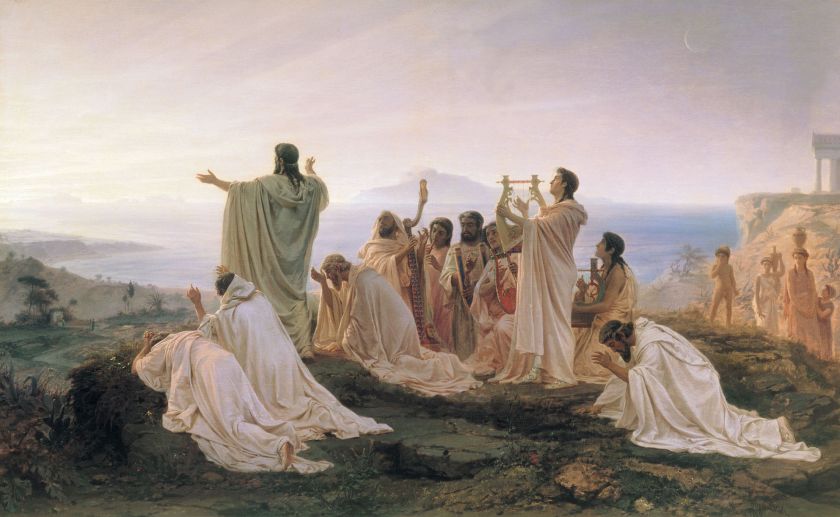
Fyodor Bronnikov, Pythagoreeërs vieren de zonsopgang, 1869
Fyodor Bronnikov, Pythagoreans celebrate sunrise (1869)

This is part 3 of 3. Part 1 is here, part 2 is here.

Ταῦτα πόνει, ταῦτ’ ἐκμελέτα· τούτων χρὴ ἐρᾶν σε,
ταῦτά σε τῆς θείης ἀρετῆς εἰς ἴχνια θήσει·
ναὶ μὰ τὸν ἁμετέρᾳ ψυχᾷ παραδόντα τετρακτὺν
παγὰν ἀενάου φύσεως· ἀλλ’ ἔρχευ ἐπ’ ἔργον,
θεοῖσιν ἐπευξάμενος τελέσαι· τούτων δὲ κρατήσας,
γνώσῃ ἀθανάτων τε θεῶν θνητῶν τ’ ἀνθρώπων
σύστασιν, ᾗ τε ἕκαστα διέρχεται, ᾗ τε κρατεῖται·
γνώσῃ δ’, ᾗ θέμις ἐστὶ, φύσιν περὶ παντὸς ὁμοίην,
ὥστε σε μήτε ἄελπτ’ ἐλπίζειν, μήτε τι λήθειν.
γνώσῃ δ’ ἀνθρώπους αὐθαίρετα πήματ’ ἔχοντας·
τλήμονας, οἵ τ’ ἀγαθῶν πέλας ὄντων οὐκ ἐσορῶσιν
οὔτε κλύουσι· λύσιν δὲ κακῶν παῦροι συνίσασι.
τοίη μοίρα βροτῶν βλάπτει φρένας· ὡς δὲ κύλινδροι
ἄλλοτ’ ἐπ’ ἄλλα φέρονται, ἀπείρονα πήματ’ ἔχοντες.
λυγρὴ γὰρ συνοπαδὸς ἔρις βλάπτουσα λέληθε
σύμφυτος, ἣν οὐ δεῖ προσάγειν, εἴκοντα δὲ φεύγειν.
Ζεῦ πάτερ, ἦ πολλῶν κε κακῶν λύσειας ἅπαντας,
εἰ πᾶσιν δείξαις, οἵῳ τῷ δαίμονι χρῶνται.
ἀλλὰ σὺ θάρσει, ἐπεὶ θεῖον γένος ἐστὶ βροτοῖσιν,
οἷς ἱερὰ προφέρουσα φύσις δείκνυσιν ἕκαστα.
ὧν εἴ σοί τι μέτεστι, κρατήσεῖς ὧν σε κελεύω,
ἐξακέσας, ψυχὴν δὲ πόνων ἀπὸ τῶνδε σαώσεις.
ἀλλ’ εἴργου βρωτῶν, ὧν εἴπομεν, ἔν τε καθαρμοῖς
ἔν τε λύσει ψυχῆς κρίνων, καὶ φράζευ ἕκαστα,
ἡνίοχον γνώμην στήσας καθύπερθεν ἀρίστην.
ἢν δ’ ἀπολείψας σῶμα ἐς αἰθέρ’ ἐλεύθερον ἔλθῃς,
ἔσσεαι ἀθάνατος θεὸς ἄμβροτος, οὐκ ἔτι θνητός.
(Pseudo-Pythagoras, Carm. Aur. 45-71)

Practise thoroughly all these things; meditate on them well; thou oughtest to love them with all thy heart.
‘Tis they that will put thee in the way of divine virtue.
I swear it by him who has transmitted into our souls the Sacred Quaternion, the source of nature, whose cause is eternal.
But never begin to set thy hand to any work, till thou hast first prayed the gods to accomplish what thou art going to begin.
When thou hast made this habit familiar to thee,
Thou wilt know the constitution of the Immortal Gods and of men.
Even how far the different beings extend, and what contains and binds them together.
Thou shalt likewise know that according to Law, the nature of this universe is in all things alike,
So that thou shalt not hope what thou ought’st not to hope; and nothing in this world shall be hid from thee.
Thou wilt likewise know, that men draw upon themselves their own misfortunes voluntarily, and of their own free choice.
Unhappy that they are! They neither see nor understand that their good is near them.
Few know how to deliver themselves out of their misfortunes.
Such is the fate that blinds mankind, and takes away his senses.
Like huge cylinders they roll to and fro, and always oppressed with ills innumerable.
For fatal strife, innate, pursues them everywhere, tossing them up and down; nor do they perceive it.
Instead of provoking and stirring it up, they ought, by yielding, to avoid it.
Oh! Jupiter, our Father! if Thou would’st deliver men from all the evils that oppress them,
Show them of what dæmon they make use.
But take courage; the race of man is divine.
Sacred nature reveals to them the most hidden mysteries.
If she impart to thee her secrets, thou wilt easily perform all the things which I have ordained thee.
And by the healing of thy soul, thou wilt deliver it from all evils, from all afflictions.
But abstain thou from the meats, which we have forbidden in the purifications and in the deliverance of the soul;
Make a just distinction of them, and examine all things well.
Leaving thyself always to be guided and directed by the understanding that comes from above, and that ought to hold the reins.
And when, after having divested thyself of thy mortal body, thou arrivest at the most pure Æther,
Thou shalt be a God, immortal, incorruptible, and Death shall have no more dominion over thee.
(tr. Florence M. Firth)