Castra

79923_camp_lg

Nam quod attinet ad soli electionem in statuenda metatione, primum locum habent quae ex campo in eminentiam leniter attolluntur, in qua positione porta decimana eminentissimo loco constituitur, ut regiones castris subiaceant. porta praetoria semper hostem spectare debet. secundum locum habent quae in plano constituuntur, tertium quae in colle, quartum quae in monte, quintum quae in loco necessario, unde et necessaria castra dicuntur. praecipue observari debebit via quae lateribus castrorum supersit. ceterum quocumque latere flumen sive fontem habere debebunt in qualicumque positione castrorum. iniqua loca, quae a prioribus novercae appellantur, omni modo vitari debent; ne mons castris immineat, per quem supervenire hostes aut prospicere possint quid in castris agatur; ne silva celatura hostes adiaceat neve fossa vel valles per quas obrepi castris occulte possit; ne vicini fluminis torrentis subita tempestate castra inundata intereant. meminisse oportet in hostico ascensus valli duplices et frequentes facere et tormentis tribunalia exstruere circum portas, in coxis in loco turrium. maxime instruendum erit vallum tormentis ab eo latere quo novercae, si vitari non potuerunt.
(Pseudo-Hyginus, De munitionibus castrorum 56-58)

Concerning the choice of terrain for the establishment of the camp; first they choose a site which rises gently above the plain, on a distinctive rise and the porta decumana is set at the highest point so that the area is dominated by the camp. The porta praetoria should always look towards the enemy. The second place is situated on a flat plain, the third is on a hill, the fourth on a mountain, the fifth in whatever place is necessary, from which it is called an “unavoidable camp”. It should be particularly noted that a road should be built which is longer than the sides of the camp. Whatever the position of the camp there should be a river or spring on one side or the other. Unfavourable positions, which were called mothers-in-law by our ancestors, should be avoided at all times: the camp should not be overlooked by a mountain from which the enemy could attack or see what is going on in the camp; there should be no forest nearby to conceal a hidden enemy, nor gulleys or valleys through which the enemy may secretly approach the camp; nor should the camp be near a fast-flowing river which might flood and overwhelm the camp in a sudden storm. In hostile territory one must remember to construct numerous double width access ramps up to the rampart and to build artillery platforms around the gates, on the projections at the corners and in places on towers. In particular the rampart should be fitted out with artillery on any side which is a mother-in-law if this cannot be avoided. (tr. Catherine M. Gilliver)
Thesmophoria

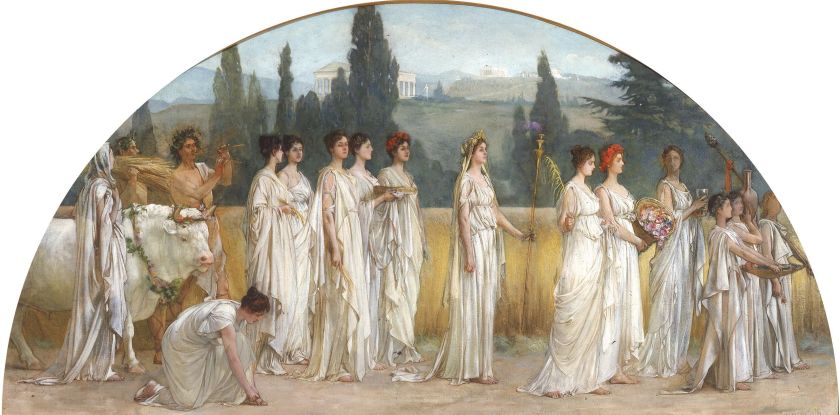
Francis Davis Millet, Thesmophoria, 1894-97
Francis Davis Millet, Thesmophoria (1894-97)

Θεσμοφορία ἑορτὴ Ἑλλήνων μυστήρια περιέχουσα, τὰ δὲ αὐτὰ καὶ Σκιρροφορία καλεῖται‎. ἤγετο δὲ κατὰ τὸν μυθωδέστερον λόγον, ὅτι‎, ὅτε‎ ἀνθολογοῦσα ἡρπάζετο ἡ Κόρη ὑπὸ τοῦ Πλούτωνος, τότε κατ‎’ ἐκεῖνον τὸν τόπον Εὐβουλεύς τις συβώτης ἔνεμεν ὗς καὶ συγκατεπόθησαν τῷ χάσματι τῆς Κόρης‎· εἰς οὖν τιμὴν τοῦ Εὐβουλέως ῥιπτεῖσθαι τοὺς χοίρους εἰς τὰ χάσματα τῆς Δήμητρος καὶ τῆς Κόρης‎. τὰ δὲ σαπέντα τῶν ἐμβληθέντων εἰς τὰ μέγαρα κάτω ἀναφέρουσιν ἀντλήτριαι καλούμεναι γυναῖκες καθαρεύσασαι τριῶν ἡμερῶν καὶ καταβαίνουσιν εἰς τὰ ἄδυτα καὶ ἀνενέγκασαι ἐπιτιθέασιν ἐπὶ τῶν βωμῶν‎· ὧν νομίζουσι τὸν λαμβάνοντα καὶ τῷ σπόρῳ συγκαταβάλλοντα εὐφορίαν ἕξειν‎. λέγουσι δὲ καὶ δράκοντας κάτω εἶναι περὶ τὰ χάσματα, οὓς τὰ πολλὰ τῶν βληθέντων κατεσθίειν‎· διὸ καὶ κρότον γίνεσθαι, ὁπόταν ἀντλῶσιν αἱ γυναῖκες καὶ ὅταν ἀποτιθῶνται πάλιν τὰ πλάσματα ἐκεῖνα, ἵνα ἀναχωρήσωσιν οἱ δράκοντες, οὓς νομίζουσι φρουροὺς τῶν ἀδύτων‎. τὰ δὲ αὐτὰ καὶ Ἀρρητοφόρια καλεῖται καὶ ἄγεται τὸν αὐτὸν λόγον ἔχοντα περὶ τῆς τῶν καρπῶν γενέσεως καὶ τῆς τῶν ἀνθρώπων σπορᾶς‎. ἀναφέρονται δὲ κἀνταῦθα ἄρρητα ἱερὰ ἐκ‎ στέατος τοῦ σίτου κατεσκευασμένα, μιμήματα δρακόντων καὶ ἀνδρείων σχημάτων‎. λαμβάνουσι δὲ κώνου θαλλοὺς διὰ τὸ πολύγονον τοῦ φυτοῦ‎. ἐμβάλλονται δὲ καὶ εἰς τὰ μέγαρα οὕτω καλούμενα ἄδυτα ἐκεῖνά τε καὶ χοῖροι, ὡς ἤδη ἔφαμεν, καὶ αὐτοὶ διὰ τὸ πολύτοκον εἰς σύνθημα τῆς γενέσεως τῶν καρπῶν καὶ τῶν ἀνθρώπων οἷον χαριστήρια τῇ Δήμητρι, ἐπειδὴ τοὺς Δημητρίους καρποὺς παρέχουσα ἐποίησεν ἥμερον τὸ τῶν ἀνθρώπων γένος‎. ὁ μὲν οὖν ἄνω τῆς ἑορτῆς λόγος ὁ μυθικός, ὁ δὲ προκείμενος φυσικός‎. Θεσμοφορία δὲ καλεῖται, καθότι θεσμοφόρος ἡ Δημήτηρ κατονομάζεται τιθεῖσα νόμους ἤτοι θεσμούς, καθ’ʼ οὓς τὴν τροφὴν πορίζεσθαί τε καὶ κατεργάζεσθαι ἀνθρώπους δέον‎.
(R-Scholia to Lucian, Hetairikoi Dialogoi 2.1)

The Thesmophoria is a festival of the Greeks that includes mysteries and is also called the Skirrophoria. It was celebrated according to the more mythical account because, when Kore was snatched by Plouton as she was gathering flowers, a certain swineherd named Eubouleus was tending pigs in the same place and they were swallowed up by Kore’s chasm. Therefore in honour of Eubouleus piglets are thrown into the chasms belonging to Demeter and Kore. And the rotting [remains] of them, after they have been thrown down into the megara (lit. ‘great halls’), are brought up by women called ‘drawers’, who have stayed pure for three days and who go down into the aduta (‘innermost sanctuaries’) and, after they have brought them up, set them on the altars. They believe that whoever takes some of these and mixes them in with his seed-corn will get an abundant crop. They also say that there are snakes down in the chasms, which eat much of what is thrown down. And on that account they clap their hands, whenever the women draw [up the rotted piglets] and whenever they put the moulded objects back again, in order that the snakes, which they consider guards of the aduta, might move away. These same things are also called Arrhetophoria and are celebrated in the same fashion for the birth of the seed and the engendering of human beings. And also brought up there [or ‘on this occasion’] are holy objects which cannot be named, which are prepared from dough made of grain and resemble snakes and male forms. And they get pine-branches because the plant is so productive [of fruit]. Those things and the piglets (these too because of their fertility) are thrown into the socalled megara, the aduta, as we said already, to symbolize the generation of crops and of men, as thank-offerings, as it were, to Demeter, since by supplying her crops she civilized the human race. The account of the festival given above is the mythical one, but the one just mentioned is the natural explanation. It is called the Thesmophoria because Demeter bears the name Thesmophoros, since she establishes laws and rites (thesmoi), in accord with which men must work and get their nourishment. (tr. Colin Austin & Stuart Douglas Olson)

Bovis

Africa Italiana inscriptie n. 295

Iovigena Liber Pater
votum quod destinaveram
Lari Severi patrio
Iovigenae solis mei
Pudens pater pro filio
ob tribunatus candidam
et ob praeturam proximam
tantamque in nos principum
conlatam indulgentiam
conpes votorum omnium
dentes duos Lucae bovis
Indorum tuorum dico.
(IRT 295)

(Statue of) Liber Pater, son of Jupiter, the offering which I had destined for the Lar of the home city of Severus, the son of Jupiter, who is my sun, my father Pudens (paid) on behalf of his son, on account of my candidature for the tribunate (at Rome) and my subsequent praetorship and the great indulgence which the two principes have conferred on us; as an offering which comprises all that I have vowed I dedicate two elephant tusks from your own Indian animals. (tr. IRT)

Sculpo

1245939084_khufu 1

Vidi pyramidas sine te, dulcissime frater,
et tibi, quod potui, lacrimas hic maesta profudi,
et nostri memorem luctus hanc sculpo querelam.
sic nomen Decimi Gentiani pyramide alta,
pontificis comitisque tuis, Traiane, triumphis
lustraque sex intra censoris, consulis, exstet.
(Terentia, CLE 270)

 I saw the pyramids without you, my dearest brother, and here I sadly shed tears for you, which is all I could do. And I inscribe this lament in memory of our grief. May thus be clearly visible on the high pyramid the name of Decimus Gentianus, who was a pontifex and companion to your triumphs, Trajan, and both censor and consul before his thirtieth year of age. (tr. Emily Hemelrijk)

Teletis

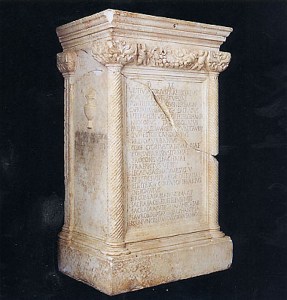
ara_funeraria_di_vettius_agorius_praetextatus_e_aconia_fabia_paulina
Funerary altar of Vettius Agorius Praetextatus and Aconia Fabia Paulina

Splendor parentum nil mihi maius dedit
quam quod marito digna iam tum visa sum,
sed lumen omne vel decus nomen viri,
Agori, superbo qui creatus germine
patriam senatum coniugemque inluminas
probitate mente moribus studiis simul,
virtutis apicem quis supremum nanctus es.
tu namque, quidquid lingua utraque est proditum
cura soforum, porta quis caeli patet,
vel quae periti condidere carmina,
vel quae solutis vocibus sunt edita,
meliora reddis quam legendo sumpseras.
sed ista parva: tu pius mystes sacris
teletis reperta mentis arcano premis
divumque numen multiplex doctus colis,
sociam benigne coniugem nectens sacris
hominum deumque consciam ac fidam tibi.
quid nunc honores aut potestates loquar
hominumque votis adpetita gaudia,
quae tu caduca ac parva semper autumans
divum sacerdos infulis celsus clues?
tu me, marite, disciplinarum bono
puram et pudicam sorte mortis eximens
in templa ducis ac famulam divis dicas;
te teste cunctis imbuor mysteriis;
tu Dindymenes Atteosque antistitem
teletis honoras taureis consors pius;
Hecates ministram trina secreta edoces
Cererisque Graiae tu sacris dignam paras.
te propter omnis me beatam, me piam
celebrant, quod ipse me bonam disseminas
totum per orbem: ignota noscor omnibus:
nam te marito cur placere non queam?
exemplum de me Romulae matres petunt
subolemque pulchram, si tuae similis, putant;
optant probantque nunc viri, nunc feminae,
quae tu magister indidisti insignia.
his nunc ademptis maesta coniunx maceror
felix, maritum si superstitem mihi
divi dedissent, sed tamen felix, tua
quia sum fuique postque mortem mox ero.
(Aconia Fabia Paulina, ILS 1259 = CIL VI.1779)

The splendor of my kinship granted me
no greater gift than this: that I seemed fit
to be your wife. For in my husband’s name,
Agorius, I find my light and grace.
You, created from proud seed, have shone
on fatherland, on senate, and on spouse
with rightness of conduct, of learning, and of mind.
You won the crown of virtue in this way.
Whatever has been penned in either tongue
by sages free to enter heaven’s door
(whether poetry composed in expert lines,
or prose that’s uttered with a looser voice),
you’ve read, and left it better than you found.
But these are little things. You piously
in mind’s most secret parts had hid away
the mysteries you learned of sacred rites.
The many-faceted numen of the gods
you knew to worship; and your faithful spouse
you bound to you as colleague in the rites,
now sharing what you knew of gods and men.
Why speak of earthly powers, public praise,
and joys men seek with sighs? You called
them fleeting, counted them as small,
while you won glory in the priestly garb.
The goodness of your teaching, husband, freed
me from death’s lot; you took me, pure,
to temples, made me servant to the gods,
stood by while I was steeped in mystery.
Devoted consort, you honored me with blood
of bull, baptized me priestess of Cybele
and Attis; readied me for Grecian Ceres’ rites;
and taught me Hecate’s dark secrets three.
On your account, all praise me as devout;
because you spread my name throughout the world,
I, once unknown, am recognized by all.
How could my husband’s spouse not win applause?
Rome’s matrons look to me as paradigm,
and if their sons resemble yours they think
them handsome. Women and men alike
now long to be upon the honor roll
which you, as master, introduced of old.
Now all these things are gone, and I, your wife,
am wasting in my grief. I had been blest
if gods had granted me the sooner grave.
But, husband, even so I’m blest: for yours
I am, and was, and after death will be.
(tr. Peter Donnelly)

Languet

5c6d5158106fbd7a59884008eaf0d86a

Rogare longo putidam te saeculo
vires quid enervet meas,
cum sit tibi dens ater et rugis vetus
frontem senectus exaret,
hietque turpis inter aridas nates
podex velut crudae bovis!
sed incitat me pectus et mammae putres,
equina quales ubera,
venterque mollis et femur tumentibus
exile suris additum.
esto beata, funus atque imagines
ducant triumphales tuum,
nec sit marita, quae rotundioribus
onusta bacis ambulet.
quid quod libelli Stoici inter Sericos
iacere pulvillos amant?
illiterati num magis nervi rigent,
minusve languet fascinum?
quod ut superbo provoces ab inguine,
ore allaborandum est tibi.
(Horace, Epod. 8)

To think that you, who have rotted away with the long passage of time, should ask what unstrings my virility, when your teeth are black, and extreme decrepitude ploughs furrows on your forehead, and your disgusting anus gapes between your shrivelled buttocks like that of a cow with diarrhea! I suppose I am excited by your bosom with its withered breasts like the udders of a mare, your flabby belly, and your scrawny thighs perched on top of your swollen ankles! Be as rich as you like. May the masks of triumphal ancestors escort your cortege! Let no wife be weighed down with fatter pearls as she walks proudly by! What of the fact that slim Stoic volumes nestle on your cushions of Chinese silk? Does that make my organ (which can’t read) any stiffer, or my phallic charm less limp? To call it forth from my proud crotch you must go to work with your mouth. (tr. Niall Rudd)

Flores

Morte_a_Venezia

De puero quodam composuit Horatius Odam,
qui facile bella possit satis esse puella.
undabant illi per eburnea colla capilli,
plus auro flavi, quales ego semper amavi.
candida frons ut nix, et lumina nigra velut pix,
implumesque genae grata dulcedine plenae,
cum in candoris vernabant luce ruboris.
nasus erat iustus, labra flamea, densque venustus.
effigies menti modulo formata decenti.
qui corpus quaeret quod tectum veste lateret,
tale coaptet ei quod conveniat faciei.
haec species oris radians, et plena decoris,
cor spectatoris face succendebat amoris.
sed puerum talem, pulchrum nimis et specialem,
irritamentum quorumlibet aspicientum,
sic natura ferum plasmaverat atque severum,
vellet ut ante mori, quam consentiret amori.
asper et ingratus, tanquam de tigride natus,
ridebat tantum mollissima verba precantum,
ridebat curas effectum non habituras,
et suspirantis lacrimas ridebat amantis.
illos ridebat quos ipse mori faciebat;
impius ille quidem, crudelis et impius idem,
qui vitio morum corpus vetat esse decorum.
bella bonam mentem facies petit, et patientem,
et non inflatam, sed ad haec et ad illa paratam.
flosculus aetatis citus est, nimiae brevitatis.
postquam marcescit, cadit et revirescere nescit
haec caro tam levis, tam lactea, tam sine naevis,
tam bona, tam bella, tam lubrica, tamque tenella.
tempus adhuc veniet, cum turpis et hispida fiet;
cum fiet vilis caro cara, caro puerilis.
ergo dum flores, maturos indue mores.
(Marbod of Rennes, Satyra in amatorem puelli sub assumpta persona, PL 117.1717-1718)

Horace composed an ode about a certain boy
Whose face was so lovely he could easily have been a girl,
Whose hair fell in waves against his ivory neck,
Whose forehead was white as snow and his eyes as black as pitch,
Whose soft cheeks were full of delicious sweetness
When they bloomed in the brightness of a blush of beauty.
His nose was perfect, his lips flame red, lovely his teeth—
An exterior formed in measure to match his mind.
. . . . . . . . . . . . . . . . . . . .*
This vision of a face, radiant and full of beauty,
Kindled with the torch of love the heart of whoever beheld him.
But this boy, so lovely and appealing,
A torment to all who looked upon him,
Was made by nature so cruel and unyielding
That he would die rather than yield to love.
Harsh and ungrateful, as if born of a tiger,
He only laughed at the soft words of admirers,
Laughed at their vain efforts,
Laughed at the tears of a sighing lover.
He laughed at those whom he himself was causing to perish.
Surely he is wicked, cruel and wicked,
Who by the viciousness of his character denies the beauty of his body.
A fair face should have a wholesome mind,
Patient and not proud but yielding in this or that.
The little flower of age is swift, of surpassing brevity;
Soon it wastes away, vanishes, and cannot be revived.
This flesh so fair, so milky, so flawless,
So healthy, so lovely, so glowing, so soft—
The time will come when it is ugly and rough,
When this youthful skin will become repulsive.
So while you bloom, adopt a more becoming demeanor.

* Two lines have been omitted here; they are difficult to render satisfactorily in English and add little to the poem.

(tr. John Boswell, with one of his notes)

Akrōtēriazein

DcLSrtp

This is part 2 of 3. Part 1 is here. Part 2 is here.

Ταῦτα μὲν οὖν εἰς ἀκοὰς ἦλθε τὰς ἡμετέρας, ἀρχαιολογούμενα παρὰ θεσπεσίοις ἀνδράσιν, οἳ τὰ Μωυσέως οὐ παρέργως διηρεύνησαν. ἐγὼ δὲ πρὸς τοῖς εἰρημένοις καὶ σύμβολον ἡγοῦμαι τὴν περιτομὴν δυοῖν εἶναι τοῖν ἀναγκαιοτάτοιν· ἑνὸς μὲν ἡδονῶν ἐκτομῆς, αἳ καταγοητεύουσι διάνοιαν· ἐπειδὴ γὰρ τὰ νικητήρια φέρεται τῶν ἐν ἡδοναῖς φίλτρων ἡ ἀνδρὸς πρὸς γυναῖκα συνουσία, τὸ ὑπηρετοῦν ταῖς τοιαύταις ὁμιλίαις ὄργανον ἀκρωτηριάζειν ἔδοξε τοῖς νομοθέταις, αἰνιττομένοις περιτομὴν περιττῆς ἐκτομὴν καὶ πλεοναζούσης ἡδονῆς, οὐ μιᾶς, ἀλλὰ διὰ μιᾶς τῆς βιαστικωτάτης καὶ τῶν ἄλλων ἁπασῶν· ἑτέρου δὲ τοῦ γνῶναί τινα ἑαυτὸν καὶ τὴν βαρεῖαν νόσον, οἴησιν, ψυχῆς ἀπώσασθαι· ἔνιοι γὰρ ὡς ἀγαθοὶ ζῳοπλάσται ζῴων τὸ κάλλιστον, ἄνθρωπον, ηὔχησαν δύνασθαι δημιουργεῖν καὶ φυσηθέντες ὑπ’ ἀλαζονείας ἑαυτοὺς ἐξεθείωσαν, τὸν ὡς ἀληθῶς αἴτιον γενέσεως ὄντα θεὸν παρακαλυψάμενοι, καίτοι γε ἐκ τῶν συνήθων ἐπανορθώσασθαι τὴν ἀπάτην δυνάμενοι· πολλοὶ μὲν γὰρ παρ’ αὐτοῖς εἰσιν ἄνδρες ἄγονοι, πολλαὶ δὲ στεῖραι γυναῖκες, ὧν ἀτελεῖς αἱ ὁμιλίαι καταγηρασάντων ἐν ἀπαιδίᾳ. πονηρὰν οὖν δόξαν ἐκτμητέον τῆς διανοίας καὶ τὰς ἄλλας ὅσαι μὴ φιλόθεοι.
(Philo, Peri tōn en merei diatagmatōn 1.8-12)

These are the explanations handed down to us from the old-time studies of divinely gifted men who made deep research into the writings of Moses. To these I would add that I consider circumcision to be a symbol of two things most necessary to our well-being. One is the excision of pleasures which bewitch the mind. For since among the love-lures of pleasure the palm is held by the mating of man and woman, the legislators thought good to dock the organ which ministers to such intercourse, thus making circumcision the figure of the excision of excessive and superfluous pleasure, not only of one pleasure but of all the other pleasures signified by one, and that the most imperious. The other reason is that a man should know himself and banish from the soul the grievous malady of conceit. For there are some who have prided themselves on their power of fashioning as witha sculptor’s cunning the fairest of creatures, man, and in their braggart pride assumed godship, closing their eyes to the Cause of all that comes into being, though they might find in their familiars a corrective for their delusion. For in their mindst are many men incapable of begetting and many women barren, whose matings are ineffective and who grow old childless. The evil belief, therefore, needs to be excised from the mind with any others that are not loyal to God. (tr. Francis Henry Colson)

Euodei

High Fountain

This is part 2 of 3. Part 1 is here. Part 3 is here.

Ἓν μὲν χαλεπῆς νόσου καὶ δυσιάτου, ποσθένης, ἀπαλλαγήν, ἣν ἄνθρακα καλοῦσιν, ἀπὸ τοῦ καίειν ἐντυφόμενον, ὡς οἶμαι, ταύτης τῆς προσηγορίας τυχόντα, ὅπερ εὐκολώτερον τοῖς ἀκροποσθίας ἔχουσιν ἐγγίνεται· δεύτερον δὲ τὴν δι’ ὅλου τοῦ σώματος καθαριότητα πρὸς τὸ ἁρμόττον τάξει ἱερωμένῃ, παρὸ καὶ ξυρῶνται τὰ σώματα προσυπερβάλλοντες οἱ ἐν Αἰγύπτῳ τῶν ἱερέων· ὑποσυλλέγεται γὰρ καὶ ὑποστέλλει καὶ θριξὶ καὶ ποσθίαις ἔνια τῶν ὀφειλόντων καθαίρεσθαι· τρίτον δὲ τὴν πρὸς καρδίαν ὁμοιότητα τοῦ περιτμηθέντος μέρους· πρὸς γὰρ γένεσιν ἄμφω παρεσκεύασται, τὸ μὲν ἐγκάρδιον πνεῦμα νοημάτων, τὸ δὲ γόνιμον ὄργανον ζῴων· ἐδικαίωσαν γὰρ οἱ πρῶτοι τῷ ἀφανεῖ καὶ κρείττονι, δι’ οὗ τὰ νοητὰ συνίσταται, τὸ ἐμφανὲς καὶ ὁρατόν, ᾧ τὰ αἰσθητὰ γεννᾶσθαι πέφυκεν, ἐξομοιῶσαι· τέταρτον δὲ καὶ ἀναγκαιότατον τὴν πρὸς πολυγονίαν παρασκευήν· λέγεται γὰρ ὡς εὐοδεῖ τὸ σπέρμα μήτε σκιδνάμενον μήτε περιρρέον εἰς τοὺς τῆς ποσθίας κόλπους· ὅθεν καὶ τὰ περιτεμνόμενα τῶν ἐθνῶν πολυγονώτατα καὶ πολυανθρωπότατα εἶναι δοκεῖ.
(Philo, Peri tōn en merei diatagmatōn 1.4-7)

One is that it secures exemption from the severe and almost incurable malady of the prepuce called anthrax or carbuncle, so named, I believe from the slow fire which it sets up and to which those who retain the foreskin are more susceptible. Secondly, it promotes the cleanliness of the whole body as befits the consecrated order, and therefore the Egyptians carry the practice to a further extreme and have the bodies of their priests shaved. For some substances which need to be cleared away collect and secrete themselves both in the hair and the foreskin. Thirdly, it assimilates the circumcised member to the heart. For as both are framed to serve for generation, thought being generated by the spirit force in the heart, living creatures by the reproductive organ, the earliest men held that the unseen and superior element to which the concepts of the mind owe their existence should have assimilated to it the visible and apparent, the natural parent of the things perceived by sense. The fourth and most vital reason is its adaptation to give fertility of offspring, for we are told that its causes semen to travel aright without being scattered or dropped into the folds of the foreskin, and therefore the circumcised nations appear the most prolific and populous. (tr. Francis Henry Colson)

Tethnēke

Francisco de Goya, El Aquellare, 1798

Francisco de Goya, El Aquellare (1798)

Περὶ δὲ θανάτου τῶν τοιούτων ἀκήκοα λόγον ἀνδρὸς οὐκ ἄφρονος οὐδ’ ἀλαζόνος. Αἰμιλιανοῦ γὰρ τοῦ ῥήτορος, οὗ καὶ ὑμῶν ἔνιοι διακηκόασιν, Ἐπιθέρσης ἦν πατήρ, ἐμὸς πολίτης καὶ διδάσκαλος γραμματικῶν. οὗτος ἔφη ποτὲ πλέων εἰς Ἰταλίαν ἐπιβῆναι νεὼς ἐμπορικὰ χρήματα καὶ συχνοὺς ἐπιβάτας ἀγούσης· ἑσπέρας δ’ ἤδη περὶ τὰς Ἐχινάδας νήσους ἀποσβῆναι τὸ πνεῦμα, καὶ τὴν ναῦν διαφερομένην πλησίον γενέσθαι Παξῶν· ἐγρηγορέναι δὲ τοὺς πλείστους, πολλοὺς δὲ καὶ πίνειν ἔτι δεδειπνηκότας· ἐξαίφνης δὲ φωνὴν ἀπὸ τῆς νήσου τῶν Παξῶν ἀκουσθῆναι, Θαμοῦν τινος βοῇ καλοῦντος, ὥστε θαυμάζειν. ὁ δὲ Θαμοῦς Αἰγύπτιος ἦν κυβερνήτης οὐδὲ τῶν ἐμπλεόντων γνώριμος πολλοῖς ἀπ’ ὀνόματος. δὶς μὲν οὖν κληθέντα σιωπῆσαι, τὸ δὲ τρίτον ὑπακοῦσαι τῷ καλοῦντι· κἀκεῖνον ἐπιτείνοντα τὴν φωνὴν εἰπεῖν “ὁπόταν γένῃ κατὰ τὸ Παλῶδες,
ἀπάγγειλον ὅτι Πὰν ὁ μέγας τέθνηκε.” τοῦτ’ ἀκούσαντας ὁ Ἐπιθέρσης ἔφη πάντας ἐκπλαγῆναι καὶ διδόντων ἑαυτοῖς λόγον εἴτε ποιῆσαι βέλτιον εἴη τὸ προστεταγμένον εἴτε μὴ πολυπραγμονεῖν ἀλλ’ ἐᾶν, οὕτως γνῶναι τὸν Θαμοῦν, εἰ μὲν εἴη πνεῦμα, παραπλεῖν ἡσυχίαν ἔχοντα, νηνεμίας δὲ καὶ γαλήνης περὶ τὸν τόπον γενομένης ἀνειπεῖν ὃ ἤκουσεν. ὡς οὖν ἐγένετο κατὰ τὸ Παλῶδες, οὔτε πνεύματος ὄντος οὔτε κλύδωνος, ἐκ πρύμνης βλέποντα τὸν Θαμοῦν πρὸς τὴν γῆν εἰπεῖν, ὥσπερ ἤκουσεν, ὅτι “ὁ μέγας Πὰν τέθνηκεν”. οὐ φθῆναι δὲ παυσάμενον αὐτὸν καὶ γενέσθαι μέγαν οὐχ ἑνὸς ἀλλὰ πολλῶν στεναγμὸν ἅμα θαυμασμῷ μεμιγμένον. οἷα δὲ πολλῶν ἀνθρώπων παρόντων ταχὺ τὸν λόγον ἐν Ῥώμῃ σκεδασθῆναι, καὶ τὸν Θαμοῦν γενέσθαι μετάπεμπτον ὑπὸ Τιβερίου Καίσαρος. οὕτω δὲ πιστεῦσαι τῷ λόγῳ τὸν Τιβέριον, ὥστε διαπυνθάνεσθαι καὶ ζητεῖν περὶ τοῦ Πανός· εἰκάζειν δὲ τοὺς περὶ αὐτὸν φιλολόγους συχνοὺς ὄντας τὸν ἐξ Ἑρμοῦ καὶ
Πηνελόπης γεγενημένον.
(Plutarch, Peri tōn ekleloipotōn khrēstēriōn 419α-ε)

“As for death among such beings, I have heard the words of a man who was not a fool nor an impostor. The father of Aemilianus the orator, to whom some of you have listened, was Epitherses, who lived in our town and was my teacher in grammar. He said that once upon a time in making a voyage to Italy he embarked on a ship carrying freight and many passengers. It was already evening when, near the Echinades Islands, the wind dropped, and the ship drifted near Paxi. Almost everybody was awake, and a good many had not finished their after-dinner wine. Suddenly from the island of Paxi was heard the voice of someone loudly calling Thamus, so that all were amazed. Thamus was an Egyptian pilot, not known by name even to many on board. Twice he was called and made no reply, but the third time he answered; and the caller, raising his voice, said, ‘When you come opposite to Palodes, announce that Great Pan is dead.’ On hearing this, all, said Epitherses, were astounded and reasoned among themselves whether it were better to carry out the order or to refuse to meddle and let the matter go. Under the circumstances Thamus made up his mind that if there should be a breeze, he would sail past and keep quiet, but with no wind and a smooth sea about the place he would announce what he had heard. So, when he came opposite Palodes, and there was neither wind nor wave, Thamus from the stern, looking toward the land, said the words as he had heard them: ‘Great Pan is dead.’ Even before he had finished there was a great cry of lamentation, not of one person, but of many, mingled with exclamations of amazement. As many persons were on the vessel, the story was soon spread abroad in Rome, and Thamus was sent for by Tiberius Caesar. Tiberius became so convinced of the truth of the story that he caused an inquiry and investigation to be made about Pan; and the scholars, who were numerous at his court, conjectured that he was the son born of Hermes and Penelopê.” (tr. Frank Cole Babbitt)