Ōzen

620x349

ηὔδα δὲ λυδίζουσα· “βασκ. . . κρολεα.”
πυγιστί· “τὸν πυγεῶνα παρ[
καί μοι τὸν ὄρχιν τῆς φαλ
κ]ράδηι συνηλοίησεν ὥσπ[ερ φαρμακῶι,
.].τοις διοζίοισιν ἐμπεδ[
καὶ δὴ δυοῖσιν ἐν πόνοισ[ι
ἥ τε κράδη με τοὐτέρωθ[εν
ἄνωθεν ἐμπίπτουσα, κ[
παραψιδάζων βολβίτωι [
ὦζεν δὲ λαύρη· κάνθαρο[ι δὲ ῥοιζέοντες
ἦλθον κατ’ ὀδμήν πλέονες ἤ πεντήκοντα·
τῶν οἱ μέν ἐμπίπτοντε[ς
κατέβαλον, οἱ δέ τοὺς ὀδ..[
οἱ δ’ ἐμπεσόντες τὰς θύρα[ς
τοῦ Πυγέλησι[. . . . .]. .[
. .]ρυσσον οἱα[. . . .]αροιμο[
. .]ω δ’ ἐς υμν[
]εντ[
(Hipponax, fr. 91)

She spoke in Lydian: Faskati krolel.
(speaking) Assian: “your ass…
and the balls of my (prick?)…
she whipped with a fig branch as [if for a scapegoat
securely with a forks (of wood?)
and in doubled pain
on the one side the fig branch (did something) to me, and from the other
falling from above,…
spattering with shit…
and the hole stank. Dung beetles buzzing
came to the smell, more than fifty.
Of them some falling in
attacked, and others the…
Those having fallen in the doors
of Ass-ville…
(3 lines too fragmentary to translate)
(tr. Kirk Ormand)

Salsissimus

bbbbbbbbbbb5

Sed scitis esse notissimum ridiculi genus, cum aliud exspectamus, aliud dicitur: hic nobismet ipsis noster error risum movet: quod si admixtum est etiam ambiguum, fit salsius; ut apud Novium videtur esse misericors ille, qui iudicatum duci videt: percontatur ita: “quanti addictus?” “mille nummum.” Si addidisset tantummodo “ducas licet”; esset illud genus ridiculi praeter exspectationem; sed quia addidit “nihil addo, ducas licet”; addito ambiguo, altero genere ridiculi, fuit, ut mihi quidem videtur, salsissimus. hoc tum est venustum, cum in altercatione arripitur ab adversario verbum et ex eo, ut a Catulo in Philippum, in eum ipsum aliquid, qui lacessivit, infligitur. sed cum plura sint ambigui genera, de quibus est doctrina quaedam subtilior, attendere et aucupari verba oportebit; in quo, ut ea, quae sint frigidiora, vitemus, (etenim cavendum est, ne arcessitum dictum putetur), permulta tamen acute dicemus. alterum genus est, quod habet parvam verbi immutationem, quod in littera positum Graeci vocant παρονομασίαν, ut “Nobiliorem, mobiliorem” Cato; aut, ut idem, cum cuidam dixisset “eamus deambulatum” et ille “quid opus fuit de?” “immo vero” inquit “quid opus fuit te?” aut eiusdem responsio illa “si tu et adversus et aversus impudicus es.” etiam interpretatio nominis habet acumen, cum ad ridiculum convertas, quam ob rem ita quis vocetur; ut ego nuper Nummium divisorem, ut Neoptolemum ad Troiam, sic illum in campo Martio nomen invenisse; atque haec omnia verbo continentur.
(Cicero, De Oratore 2.255-257)

You know already, however, that the most familiar of these is exemplified when we are expecting to hear a particular phrase, and something different is uttered. In this case our own mistake even makes us laugh ourselves. But, if there be also an admixture of equivocation, the jest is rendered more pungent: as, in that play of Novius, the man is apparently moved by compassion when, on seeing a condemned debtor taken away, he earnestly inquires the amount of the judgement. He is told, ‘A thousand sesterces.’ Had he then gone on to say merely, ‘You may take him away,’ his rejoinder would have belonged to the unexpected kind, but what he actually said was, ‘No advance from me ; you may take him away,’ whereby he brought in an element of equivocation, a different category of the laughable, the result, in my opinion at any rate, being piquancy in perfection*. This playing on words is most delightful when, during a wrangle, a word is snatched from an antagonist and used to hurl a shaft at the assailant himself, as was done by Catulus against Philippus. But since equivocation is of numerous kinds, and the teaching as to these is somewhat abstruse, we shall have to be watchful and lie in wait for the words: in this way, while avoiding the feebler retorts (for we must see to it that our bon-mot be not thought forced), we shall still find ourselves delivering very many a pointed remark.
Another category, which uses a slight change in spelling, the Greeks call ‘assonance,’ when the variation is in a letter or two; for example, one surnamed ‘the Noble’ was referred to by Cato as ‘the Mobile,’ or again Cato said to a certain man, ‘Let us go for a deambulation,’ and, on the other asking, ‘What need of the “de — ?”,’ Cato rejoined,  ‘Nay, rather, what need of thee?’ or take that other answer of the same Cato’s, ‘Whether you turn hither or thither, you are filthy.’ There is point also in the explanation of a name, when you make fun of the reason for a man being called as he is, as I said the other day of Nummius, the voters’ paymaster, that he had found a name in the Election Field**, as Neoptolemus had done at Troy. Now all such jests hinge upon a word.

* The piquant equivocation must lurk in ‘nihil addo,’ which may mean, ‘I say no more,’ or (at an auction) ‘I bid no more.’
** Pyrrhus, son of Achilles, received the name of Neoptolemus, as being ‘a new-comer to the (Trojan) war.’ Caesar facetiously derives the name ‘Nummius’ from the coins (nummi) which its bearer had distributed, in the course of his duties as bribery agent at elections.

(tr. Edward William Sutton, with some of his notes)

Orgai

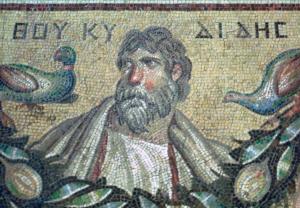
thucydides

Φαίνεται δὲ ἐπὶ τῶν Ἡροδότου χρόνων γενόμενος, εἴ γε ὁ μὲν Ἡρόδοτος μέμνηται τῆς Θηβαίων ἐσβολῆς ἐς τὴν Πλάταιαν, περὶ ἧς ἱστορεῖ Θουκυδίδης ἐν τῇ δευτέρᾳ. λέγεται δέ τι καὶ τοιοῦτον, ὥς ποτε τοῦ Ἡροδότου τὰς ἰδίας ἱστορίας ἐπιδεικνυμένου παρὼν τῇ ἀκροάσει Θουκυδίδης καὶ ἀκούσας ἐδάκρυσεν· ἔπειτά φασι τὸν Ἡρόδοτον τοῦτο θεασάμενον εἰπεῖν αὐτοῦ πρὸς τὸν πατέρα τὸν Ὄλορον· “ὦ Ὄλορε, ὀργᾷ ἡ φύσις τοῦ υἱοῦ σου πρὸς μαθήματα.”
(Marcellinus, Bios Thoukudidou 54)

He seems to have come to be in the time of Herodotus, if indeed Herodotus makes mention of the attack of the Thebans into Plataea, concerning which history Thucydides narrates in the second book. And so it is said, that once when Herodotus was making a display of his own history, Thucydides was present at the recital and, hearing it, wept. Thereupon, they say, Herodotus noticing, said to Olorus the father of Thucydides, “O Olorus, truly the nature of your son is violently bent toward learning.” (tr. Timothy Burns)

Exedendum

o-MASHED-POTATOES-570

[PHORMIO. GETA.]

[PHO.] Itane patris ais conspectum veritum hinc abiisse?
[GET.] admodum.
[PHO.] Phanium relictam solam?
[GET.] sic.
[PHO.] et iratum senem?
[GET.] oppido.
[PHO.] ad te summam solum, Phormio, rerum redit.
tute hoc intristi, tibi omnest exedendum: accingere.
[GET.] obsecro te—
[PHO.] si rogabit—
[GET.] in te spes est.
[PHO.] eccere,
quid si reddet—?
[GET.] tu impulisti.
[PHO.] sic opinor.
[GET.] subveni
[PHO.] cedo senem. iam instructa sunt mi in corde consilia omnia.
[GET.] quid ages?
[PHO.] quid vis, nisi uti maneat Phanium atque ex crimine hoc
Antiphonem eripiam atque in me omnem iram derivem senis?
[GET.] o vir fortis atque amicus! verum hoc saepe, Phormio,
vereor, ne istaec fortitudo in nervom erumpat denique.
[Terentius, Phormio 315-325]

[PHORMIO. GETA.]

[PHO.] Do you say he ran away in fear of facing his father?
[GET.] Exactly?
[PHO.] Leaving Phanium alone?
[GET.] Yes.
[PHO.] And the old man furious?
[GET.] Absolutely.
[PHO.] (to himself) The whole thing’s back in your hands, Phormio. You got them into this mess, you must get them out of it*. Gird yourself for action.
[GET.] I implore you—
[PHO.] (to himself) If he asks—
[GET.] Our hope lies in you.
[PHO.] (to himself) Look, what if he replies—?
[GET.] It was you who pushed him into it.
[PHO.] (to himself) That’s it, I think.
[GET.] Help us.
[PHO.] Bring on the old man. All my plans are now drawn up in my mind.
[GET.] What are you going to do?
[PHO.] What do you want, other than that Phanium stays, I rescue Antipho from the charges against him, and I divert all the old man’s anger on to myself?
[GET.] What a brave man you are and a true friend! But I often worry, Phormio, that this bravery of yours will land you in jail.

* Literally, “you cooked this, you must eat it up,” a proverbial expression that, as Donatus points out, is especially suitable for parasites.

(tr. John Barsby, with his note)

Amphitheatrali

Pamphobeteus_mutualism_06
© Emanuele Biggi

Araneorum his* non absurde iungatur natura, digna vel praecipua admiratione. plura autem sunt genera nec dictu necessaria in tanta notitia. phalangia ex iis appellantur quorum noxii morsus, corpus exiguum, varium, acuminatum, assultim ingredientium. altera eorum species nigri, prioribus cruribus longissimis. omnibus internodia terna in cruribus. luporum minimi non texunt, maiores in terra, et cavernis exigua vestibula praepandunt. tertium eorundem genus erudita operatione conspicuum. orditur telas tantique operis materiae uterus ipsius sufficit, sive ita corrupta alvi natura stato tempore, ut Democrito placet, sive est quaedam intus lanigera fertilitas: tam moderato ungue, tam tereti filo et tam aequali deducit stamina, ipso se pondere usus. texere a medio incipit, circinato orbe subtemina adnectens, maculasque paribus semper intervallis, sed subinde crescentibus ex angusto dilatans indissolubili nodo inplicat. quanta arte celat pedicas a scutulato rete grassantes! quam non ad hoc videtur pertinere crebratae pexitas telae et quadam politurae arte ipsa per se tenax ratio tramae! quam laxus ad flatus ac non respuenda quae veniant sinus! derelicta lasso praetendi summa parte arbitrere licia: at illa difficile cernuntur atque, ut in plagis, lineae offensae praecipitant in sinum. specus ipse qua concamaratur architectura! et contra frigora quanto villosior! quam remotus a medio aliudque agenti similis, inclusus vero sic, ut sit necne intus aliquis cerni non possit! age firmitas, quando rumpentibus ventis, qua pulverum mole degravante! latitudo telae saepe inter duas arbores, cum exercet artem et discit texere, longitudo fili a cacumine ac rursus a terra per illud ipsum velox reciprocatio, subitque pariter ac fila deducit. cum vero captura incidit, quam vigilans et paratus accursus! licet extrema haereat plaga, semper in medium currit, quia sic maxime totum concutiendo inplicat. scissa protinus reficit ad polituram sarciens namque et lacertarum catulos venantur, os primum tela involventes et tunc demum labra utraque morsu apprehendentes, amphitheatrali spectaculo, cum contigit.

* sc. bombycibus.

(Pliny the Elder, Nat. Hist. 11.79-84)

To these may be not ineptly joined the nature of spiders, which deserves even exceptional admiration. There are several kinds of spiders, but they need not be described, as they are so well known. The name of phalangium is given to a kind of spider that has a harmful bite and a small body of variegated colour and pointed shape, and advances by leaps and bounds. A second species of spider is black, with very long fore legs. All spiders have legs with two joints. Of the wolf-spiders the smallest do not weave a web, but the larger ones live in the ground and spin tiny ante-rooms in from of their holes. A third kind of the same species is remarkable for its scientific method of construction; it sets up its warp-threads, and its own womb suffices to supply the material needed for this considerable work, whether because the substance of its intestines is thus resolved at a fixed time, as Democritus holds, or because it has inside it some power of producing wool: with such careful use of its claw and such a smooth and even thread it spins the warp, employing itself as a weight. It starts weaving at the centre, twining in the woof in a circular round, and entwists the meshes in an unloosable knot, spreading them out at intervals that are always regular but continually grow less narrow. How skilfully it conceals the snares that lurk in its chequered net! How unintentional appears to be the density of the close warp and the plan of the woof, rendered by a sort of scientific smoothing automatically tenacious! How its bosom bellies to the breezes so as not to reject things that come to it! You might think the threads had been left by a weary weaver stretching in front at the top; but they are difficult to see, and, like the cords in hunting-nets, when the quarry comes against them throw it into the bosom of the net. With what architectural skill is the vaulting of the actual cave designed! and how much more hairy it is made, to give protection against cold! How distant it is from the centre, and how its intention is concealed, although it is really so roofed in that it is impossible to see whether somebody is inside or not! Then its strengthwhen is it broken by the winds? what quantity of dust weighs it down? When the spider is practising its art and learning to weave, the breadth of the web often reaches between two trees and the length of the thread stretches down from the top of the tree and there is a quick return right up the thread from the ground, and the spider goes up and brings down the threads simultaneously. But when a catch falls into the web, how watchfully and alertly it runs to it! although it may be clinging to the edge of the net, it always runs to the middle, because in that way it entangles the prey by shaking the whole. When the web is torn it at once restores it to a finished condition by patching it. And spiders actually hunt young frogs and lizards, first wrapping up their mouth with web and then finally gripping both lips with their jaws, giving a show worthy of the amphitheatre when it comes off. (tr. Harris Rackham)

Logikoi

240_F_260292907_EkY6WD3sWi0xaV7i6xrGn3UtuydDz9T4

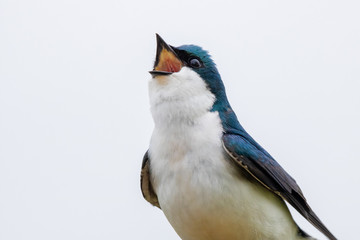
Διττοῦ δὴ λόγου κατὰ τοὺς ἀπὸ τῆς στοᾶς ὄντος, τοῦ μὲν ἐνδιαθέτου, τοῦ δὲ προφορικοῦ, καὶ πάλιν τοῦ μὲν κατωρθωμένου, τοῦ δὲ ἡμαρτημένου, ποτέρου ἀποστεροῦσι τὰ ζῷα διαρθρῶσαι προσῆκον. ἆρά γε τοῦ ὀρθοῦ μόνου, οὐχ ἁπλῶς δὲ τοῦ λόγου; ἢ παντελῶς παντὸς τοῦ τε ἔσω καὶ τοῦ ἔξω προϊόντος; ἐοίκασι δὴ τὴν παντελῆ στέρησιν αὐτῶν κατηγορεῖν, οὐ τὴν τοῦ κατωρθωμένου μόνον. οὕτω γὰρ ἂν οὐκ ἄλογα, λογικὰ δὲ ἦν ἔτι τὰ ζῷα, καθάπερ σχεδὸν πάντες κατ’ αὐτοὺς οἱ ἄνθρωποι. σοφὸς μὲν γὰρ ἢ εἷς ἢ καὶ δύο κατ’ αὐτοὺς γεγόνασιν, ἐν οἷς μόνοις ὁ λόγος κατώρθωται, οἱ δὲ ἄλλοι φαῦλοι πάντες· κἂν οἳ μὲν ὦσι προκόπτοντες, οἳ δὲ χύσιν τῆς φαυλότητος ἔχοντες, εἰ καὶ πάντες ὁμοίως λογικοί· ὑπὸ δὲ τῆς φιλαυτίας παρηγμένοι ἄλογα φασὶν τὰ ζῷα ἐφεξῆς τὰ ἄλλα σύμπαντα, τὴν παντελῆ στέρησιν τοῦ λόγου διὰ τῆς ἀλογίας μηνύειν ἐθέλοντες· καίτοι εἰ χρὴ τἀληθὲς εἰπεῖν, οὐ μόνον ἁπλῶς ὁ λόγος ἐν πᾶσι τοῖς ζῴοις θεωρεῖται, ἐν πολλοῖς δὲ αὐτῶν καὶ ὑποβολὰς ἔχων πρὸς τὸ τέλειον. ἐπεὶ τοίνυν διττὸς ἦν, ὃ μὲν ἐν τῇ προφορᾷ, ὃ δὲ ἐν τῇ διαθέσει, ἀρξώμεθα πρότερον ἀπὸ τοῦ προφορικοῦ καὶ τοῦ κατὰ τὴν φωνὴν τεταγμένου. εἰ δὴ προφορικός ἐστι λόγος φωνὴ διὰ γλώττης σημαντικὴ τῶν ἔνδον καὶ κατὰ ψυχὴν παθῶν· κοινοτάτη γὰρ ἡ ἀπόδοσις αὕτη καὶ αἱρέσεως οὐδέπω ἐχομένη, ἀλλὰ μόνον τῆς τοῦ λόγου ἐννοίας· τί τούτου ἄπεστι τῶν ζῴων ὅσα φθέγγεται; τί δὲ οὐχὶ καὶ ἃ πάσχει τι, πρότερον καὶ πρὶν εἰπεῖν ὃ μέλλει, διενοήθη; λέγω δὴ διάνοιαν τὸ ἐν τῇ ψυχῇ κατὰ σιγὴν φωνούμενον. τοῦ τοίνυν ὑπὸ τῆς γλώττης φωνηθέντος, ὅπως ἂν καὶ φωνηθῇ, εἴτε βαρβάρως εἴτε Ἑλληνικῶς εἴτε κυνικῶς ἢ βοϊκῶς, λόγου γε ὄντος μέτοχα τὰ ζῷα τὰ φωνητικά, τῶν μὲν ἀνθρώπων κατὰ νόμους τοὺς ἀνθρωπείους φθεγγομένων, τῶν δὲ ζῴων κατὰ νόμους οὓς παρὰ τῶν θεῶν καὶ τῆς φύσεως εἴληχεν ἕκαστον. εἰ δὲ μὴ ἡμεῖς ξυνίεμεν, τί τοῦτο; οὐδὲ γὰρ τῆς Ἰνδῶν οἱ Ἕλληνες οὐδὲ τῆς Σκυθῶν ἢ Θρᾳκῶν ἢ Σύρων οἱ ἐν τῇ Ἀττικῇ τραφέντες· ἀλλ’ ἴσα κλαγγῇ γεράνων ὁ τῶν ἑτέρων τοῖς ἑτέροις ἦχος προσπίπτει. καίτοι ἐγγράμματος τοῖς ἑτέροις ἡ αὐτῶν καὶ ἔναρθρος, ὡς καὶ ἡμῖν ἡ ἡμετέρα· ἄναρθρος δὲ καὶ ἀγράμματος ἡ τῶν Σύρων φέρε εἰπεῖν ἢ τῶν Περσῶν, ὡς καὶ πᾶσιν ἡ τῶν ζῴων. καθάπερ γὰρ ἡμεῖς ψόφου μόνου ἀντιλαμβανόμεθα καὶ ἤχου, ἀξύνετοι ὄντες τῆς Σκυθῶν ὁμιλίας, καὶ κλαγγάζειν δοκοῦσιν καὶ μηδὲν διαρθροῦν, ἀλλ’ ἑνὶ ψόφῳ χρῆσθαι μακροτέρῳ ἢ βραχυτέρῳ, τὸ παρηλλαγμένον δὲ αὐτοῦ εἰς σημασίαν οὐδαμῶς προσπίπτει, ἐκείνοις δὲ εὐσύνετος ἡ φθέγξις καὶ πολὺ τὸ διάφορον ἔχουσα, καθάπερ ἡμῖν ἡ συνήθης· οὕτως καὶ ἐπὶ τῶν ζῴων ἡ ξύνεσις μὲν ἐκείνοις κατὰ γένος ἰδίως προσπίπτει, ἡμῖν δὲ ὁ ψόφος μόνος ἐξάκουστος, τῆς σημασίας ἐκλειπούσης, διὰ τὸ μηδένα διδαχθέντα τὴν ἡμετέραν διδάξαι ἡμᾶς διὰ τῆς ἡμετέρας τὴν ἑρμηνείαν τῶν λεγομένων παρὰ τοῖς ζῴοις. καίτοι εἰ δεῖ πιστεύειν τοῖς παλαιοῖς καὶ τοῖς ἐφ’ ἡμῶν καὶ τῶν πατέρων γεγονόσιν, εἰσὶν οἳ λέγονται ἐπακοῦσαι καὶ σύνεσιν ἔχειν τῆς τῶν ζῴων φθέγξεως· ὡς ἐπὶ μὲν τῶν παλαιῶν ὁ Μελάμπους καὶ ὁ Τειρεσίας καὶ οἱ τοιοῦτοι, οὐ πρὸ πολλοῦ δὲ Ἀπολλώνιος ὁ Τυανεύς, ἐφ’ οὗ καὶ λέγεται, ὅτι τοῖς ἑταίροις συνόντος, χελιδόνος ἐπιπτάσης καὶ φθεγγομένης, εἶπεν ὅτι μηνύει ἡ χελιδὼν ταῖς ἄλλαις ὄνον πρὸ τοῦ ἄστεως πεπτωκέναι σίτου βαστάζοντα φορτίον, ὃ δὴ κεχύσθαι εἰς τὴν γῆν τοῦ ἀχθοφοροῦντος πεπτωκότος. ἑταῖρος δὲ ἡμῶν ἐξηγεῖτό τις, οἰκέτου εὐτυχῆσαι παιδός, ὃς πάντα ξυνίει τὰ φθέγματα τῶν ὀρνίθων, καὶ ἦν πάντα μαντικὰ καὶ τοῦ μετ’ ὀλίγον μέλλοντος ἀγγελτικά· ἀφαιρεθῆναι δὲ τὴν σύνεσιν, τῆς μητρὸς εὐλαβηθείσης μὴ δῶρον αὐτὸν βασιλεῖ πέμψειεν, καὶ καθεύδοντος εἰς τὰ ὦτα ἐνουρησάσης.
(Porphyrius, Peri Apochēs Empsuchōn 3.2-3)

According to the Stoics there are two kinds of logos, the internal and the expressive, and moreover there is correct and faulty logos. So it is proper to state exactly which of these animals lack. Is it only correct logos, and not logos altogether? Or is it logos in all respects, both the internal and that which proceeds to the outside? They appear to predicate complete deprivation of logos, not just of correct logos, for in the latter case even animals would be not irrational but rational, in the same way as (according to the Stoics) almost all human beings are. For, according to them, there have been one or even two wise men, in whom alone logos is correct, and the rest are all bad, even if some are making progress and others are overflowing with badness, and even though all alike are rational. It is self-love which leads them to say that all the other animals without exception are non-rational, meaning by ‘non-rationality’ complete deprivation of logos. But if we must speak the truth, not only can logos be seen in absolutely all animals, but in many of them it has the groundwork for being perfected. Now since there are two kinds of logos, one in expression and one in disposition, let us begin with expressive logos, logos organised by voice. If expressive logos is voice signifying with the tongue that which is experienced internally and in the soul (this is the most general definition, which does not depend on any school but only on the concept of logos) what in this is absent from those animals that speak? And why should a creature not first have thought what it experiences, even before it says what it is going to say? I mean by ‘thought’ that which is silently voiced in the soul. Now since that which is voiced by the tongue is logos however it is voiced, whether in barbarian or Greek, dog or cattle fashion, animals which have a voice share in logos, humans speaking in accordance with human customs and animals in accordance with the customs each has acquired from the gods and nature. And if we do not understand them, so what? Greeks do not understand Indian, nor do those brought up on Attic understand Scythian or Thracian or Syrian: the sound that each makes strikes the others like the calling of cranes. Yet for each their [language] can be written in letters and articulated, as ours can for us; but for us the [language] of Syrians, for instance, or Persians cannot be articulated or written, just as that of animals cannot be for any people.  For we are aware only of noise and sound, because we do not understand (for instance) Scythian conversation, and they seem to us to be calling and articulating nothing, but making one noise which is longer or shorter, whereas the modification of the noise to convey meaning does not strike us at all; yet to them their speech is easy to understand and very diverse, just as our accustomed speech is to us. Similarly in the case of animals, understanding comes to them in a way which is peculiar to each species, but we can hear only noise deficient in meaning, because no one who has been taught our language has taught us to translate into it what is said by animals. Yet, if we are to believe the ancients and those who lived in our own time and our fathers’ time, there are those who are said to have heard and understood the speech of animals. In ancient times there were Melampous and Tiresias and the like, and not long ago Apollonius of Tyana, of whom it is said that when he was with his companions a swallow flew over and called. ‘The swallow,’ he said, ‘is telling other swallows that a donkey has fallen outside the town carrying a load of grain, which spilled on the ground when the load-bearer fell.’ A friend of mine used to relate how he was lucky enough to have a slave-boy who understood all the speech of birds, and everything they said was a prophecy announcing what would shortly happen; but he lost his understanding because his mother feared that he would be sent as a gift to the emperor, and urinated in his ears as he slept. (tr. Gillian Clark)

Malchionis

Henryk Siemiradzki, Romeinse orgie in de tijd van Caesar, 1872
Henryk Siemiradzki, Roman orgy (1872)

Conviva quisquis Zoili potest esse,
Summemmianas cenet inter uxores
curtaque Ledae sobrius bibat testa:
hoc esse levius puriusque contendo.
iacet occupato galbinatus in lecto
cubitisque trudit hinc et inde convivas
effultus ostro Sericisque pulvillis.
stat exoletus suggeritque ructanti
pinnas rubentes cuspidesque lentisci,
et aestuanti tenue ventilat frigus
supina prasino concubina flabello,
fugatque muscas myrtea puer virga.
percurrit agili corpus arte tractatrix
manumque doctam spargit omnibus membris;
digiti crepantis signa novit eunuchus
et delicatae sciscitator urinae
domini bibentis ebrium regit penem.
at ipse retro flexus ad pedum turbam
inter catellas anserum exta lambentis
partitur apri glandulas palaestritis
et concubino turturum natis donat;
Ligurumque nobis saxa cum ministrentur
vel cocta fumis musta Massilitanis,
Opimianum morionibus nectar
crystallinisque murrinisque propinat.
et Cosmianis ipse fuscus ampullis
non erubescit murice aureo nobis
dividere moechae pauperis capillare.
septunce multo deinde perditus stertit:
nos accubamus et silentium rhonchis
praestare iussi nutibus propinamus.
hos malchionis patimur improbi fastus,
nec vindicari, Rufe, possumus: fellat.
(Martial, Ep. 3.82)

Whoever can stand dinner with Zoilus, let him dine among Summemmius’ wives and drink sober from Leda’s broken jar. That would be easier and cleaner, I’ll be bound. Clothed in green he lies filling up the couch and thrusts his guests on either hand with his elbows, propped up on purples and silk cushions. A youth stands by, supplying red feathers and slips of mastic as he belches, while a concubine, lying on her back, makes a gentle breeze with a green fan to relieve his heat, and a boy keeps off the flies with a sprig of myrtle. A masseuse runs over his frame nimbly and skilfully, scattering an expert hand over all his limbs. The eunuch knows the signal of his snapping finger and probes the coy urine, guiding a tipsy penis as his master drinks. But himself, bending back toward the crowd at his feet, in the midst of lapdogs who are gnawing goose livers, divides a boar’s sweetbreads among his wrestling-coaches and bestows turtle rumps on his fancy-boy. While we are served with the produce of Liguria’s rocks or must cooked in Massiliot smoke, he pledges his naturals in Opimian nectar with crystal and murrine cups. Himself dusky with Cosmus’ phials, he does not blush to distribute a needy drab’s hair oil among us out of a gold shell. Then he snores, sunk by many a half pint. We lie by, with orders not to interrupt the snorts, and pledge each other with nods. This insolence of an outrageous cad we suffer and cannot retaliate, Rufus: he sucks, males. (tr. David Roy Shackleton-Bailey)

Ichōr

Jean-Auguste-Dominique Ingres, Vénus blessée par Diomède, 1800
Jean-Auguste-Dominique Ingres, Vénus blessée par Diomède (1800)

αὐτὰρ ὅ γ’ ἥρως
ὧν ἵππων ἐπιβὰς ἔλαβ’ ἡνία σιγαλόεντα,
αἶψα δὲ Τυδεί̈δην μέθεπε κρατερώνυχας ἵππους
ἐμμεμαώς· ὃ δὲ Κύπριν ἐπῴχετο νηλέϊ χαλκῷ
γιγνώσκων ὅ τ’ ἄναλκις ἔην θεός, οὐδὲ θεάων
τάων αἵ τ’ ἀνδρῶν πόλεμον κάτα κοιρανέουσιν,
οὔτ’ ἄρ’ Ἀθηναίη οὔτε πτολίπορθος Ἐνυώ.
ἀλλ’ ὅτε δή ῥ’ ἐκίχανε πολὺν καθ’ ὅμιλον ὀπάζων,
ἔνθ’ ἐπορεξάμενος μεγαθύμου Τυδέος υἱὸς
ἄκρην οὔτασε χεῖρα μετάλμενος ὀξέϊ δουρὶ
ἀβληχρήν· εἶθαρ δὲ δόρυ χροὸς ἀντετόρησεν
ἀμβροσίου διὰ πέπλου, ὅν οἱ Χάριτες κάμον αὐταί,
πρυμνὸν ὕπερ θέναρος· ῥέε δ’ ἄμβροτον αἷμα θεοῖο
ἰχώρ, οἷός πέρ τε ῥέει μακάρεσσι θεοῖσιν·
οὐ γὰρ σῖτον ἔδουσ’, οὐ πίνουσ’ αἴθοπα οἶνον,
τοὔνεκ’ ἀναίμονές εἰσι καὶ ἀθάνατοι καλέονται.
ἣ δὲ μέγα ἰάχουσα ἀπὸ ἕο κάββαλεν υἱόν·
καὶ τὸν μὲν μετὰ χερσὶν ἐρύσατο Φοῖβος Ἀπόλλων
κυανέῃ νεφέλῃ, μή τις Δαναῶν ταχυπώλων
χαλκὸν ἐνὶ στήθεσσι βαλὼν ἐκ θυμὸν ἕλοιτο·
τῇ δ’ ἐπὶ μακρὸν ἄϋσε βοὴν ἀγαθὸς Διομήδης·
εἶκε Διὸς θύγατερ πολέμου καὶ δηϊοτῆτος·
ἦ οὐχ ἅλις ὅττι γυναῖκας ἀνάλκιδας ἠπεροπεύεις;
εἰ δὲ σύ γ’ ἐς πόλεμον πωλήσεαι, ἦ τέ σ’ ὀΐω
ῥιγήσειν πόλεμόν γε καὶ εἴ χ’ ἑτέρωθι πύθηαι.
ὣς ἔφαθ’, ἣ δ’ ἀλύουσ’ ἀπεβήσετο, τείρετο δ’ αἰνῶς·
τὴν μὲν ἄρ’ Ἶρις ἑλοῦσα ποδήνεμος ἔξαγ’ ὁμίλου
ἀχθομένην ὀδύνῃσι, μελαίνετο δὲ χρόα καλόν.
εὗρεν ἔπειτα μάχης ἐπ’ ἀριστερὰ θοῦρον Ἄρηα
ἥμενον· ἠέρι δ’ ἔγχος ἐκέκλιτο καὶ ταχέ’ ἵππω·
ἣ δὲ γνὺξ ἐριποῦσα κασιγνήτοιο φίλοιο
πολλὰ λισσομένη χρυσάμπυκας ᾔτεεν ἵππους·
φίλε κασίγνητε κόμισαί τέ με δός τέ μοι ἵππους,
ὄφρ’ ἐς Ὄλυμπον ἵκωμαι ἵν’ ἀθανάτων ἕδος ἐστί.
λίην ἄχθομαι ἕλκος ὅ με βροτὸς οὔτασεν ἀνὴρ
Τυδεΐδης, ὃς νῦν γε καὶ ἂν Διὶ πατρὶ μάχοιτο.
ὣς φάτο, τῇ δ’ ἄρ’ Ἄρης δῶκε χρυσάμπυκας ἵππους·
ἣ δ’ ἐς δίφρον ἔβαινεν ἀκηχεμένη φίλον ἦτορ,
πὰρ δέ οἱ Ἶρις ἔβαινε καὶ ἡνία λάζετο χερσί,
μάστιξεν δ’ ἐλάαν, τὼ δ’ οὐκ ἀέκοντε πετέσθην.
(Homer, Iliad 5.327-366)

Then the warrior himself
mounting behind his own horses took up the glossy reins,
and at once drove the strong-footed horses after the son of Tydeus
in fierce haste; but the son of Tydeus was ranging after Cyprian Aphrodite
with his pitiless bronze spear, knowing that she was not a fighting god,
nor of those goddesses who hold sway throughout the war of men,
not Athena, nor city-sacking Enyo.
And when, pressing hard through the great throng, he caught her,
there the son of great-hearted Tydeus reaching out,
charging with his sharp spear, wounded the tip of her
soft hand; the spear pierced her skin straight
through her immortal robe, which the Graces themselves toiled to make for her,
above the base of her palm; the immortal blood flowed from the divinity—
ichor, which alone flows in the blessed gods.
For they do not eat grain, nor drink shining wine;
and for this reason they are bloodless and are called immortals.
Shrieking loudly, she flung her son from her;
but Phoebus Apollo kept him safe in his arms
within a blue-black cloud, lest some one of the Danaans of swift horses
hurling bronze into his breast should rob him of his life.
And at her, Diomedes of the war cry shouted loud:
“Give over, daughter of Zeus, from war and battle.
Is it not enough that you beguile defenseless women?
If you make a habit of coming to war, then I think you
will shudder at war all right, even if you should only hear of it from someplace else.”
So he spoke; and she, beside herself with pain, departed in dreadful distress.
And Iris with feet like the wind, taking her up, led her out of the throng
weighed down with pain, her beautiful skin blood-dark.
Then Aphrodite found furious Ares toward the left of the fighting,
sitting, his spear propped against the mist, with his two swift horses;
and falling to her knees before her dear brother,
beseeching again and again, she asked for his gold-bridled horses:
“Dear brother, rescue me and give me your horses,
that I may go to Olympus, where stands the seat of the immortals.
I am crushed with pain in this wound, which a mortal man struck me,
the son of Tydeus, who now would fight with even Father Zeus.”
So she spoke. And Ares gave her the gold-bridled horses. She got in the chariot grieving in her dear heart,
and beside her Iris mounted and took hold of the reins in her hands,
and lashed the whip to start the horses; and they two not unwilling flew on.
(tr. Caroline Alexander)

Priōn

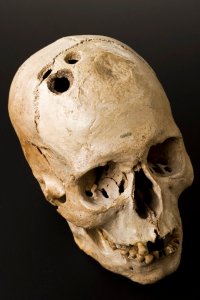
L0058402 Bronze Age skull from Jericho, Palestine, 2200-2000

Περὶ δὲ πρίσιος, ὅταν καταλάβῃ ἀνάγκη πρίσαι ἄνθρωπον, ὧδε γινώσκειν· ἢν ἐξ ἀρχῆς λαβὼν τὸ ἴημα πρίῃς, οὐ χρὴ ἐκπρίειν τὸ ὀστέον πρὸς τὴν μήνιγγα αὐτίκα· οὐ γὰρ συμφέρει τὴν μήνιγγα ψιλὴν εἶναι τοῦ ὀστέου ἐπὶ πουλὺν χρόνον κακοπαθοῦσαν, ἀλλὰ τελευτῶσά πη καὶ διεμύδησεν. ἔστι δὲ καὶ ἕτερος κίνδυνος, ἢν αὐτίκα ἀφαιρέῃς πρὸς τὴν μήνιγγα ἐκπρίσας τὸ ὀστέον, τρῶσαι ἐν τῷ ἔργῳ τῷ πρίονι τὴν μήνιγγα. ἀλλὰ χρὴ πρίοντα, ἐπειδὰν ὀλίγον πάνυ δέῃ διαπεπρίσθαι, καὶ ἤδη κινέηται τὸ ὀστέον, παύσασθαι πρίοντα, καὶ ἐᾷν ἐπὶ τὸ αὐτόματον ἀποστῆναι τὸ ὀστέον. ἐν γὰρ τῷ διαπριωτῷ ὀστέῳ καὶ ἐπιλελειμμένῳ τῆς πρίσιος οὐκ ἂν ἐπιγένοιτο κακὸν οὐδέν· λεπτὸν γὰρ τὸ λειπόμενον ἤδη γίνεται. Τὰ δὲ λοιπὰ ἰῆσθαι χρὴ, ὡς ἂν δοκέῃ ξυμφέρειν τῷ ἕλκεϊ. πρίοντα δὲ χρὴ πυκινὰ ἐξαιρέειν τὸν πρίονα τῆς θερμασίης εἵνεκα τοῦ ὀστέου, καὶ ὕδατι ψυχρῷ ἐναποβάπτειν. θερμαινόμενος γὰρ ὑπὸ τῆς περιόδου ὁ πρίων, καὶ τὸ ὀστέον ἐκθερμαίνων καὶ ἀναξηραίνων, κατακαίει, καὶ μεῖζον ποιέει ἀφίστασθαι τὸ ὀστέον τὸ περιέχον τὴν πρίσιν, ἢ ὅσον μέλλει ἀφίστασθαι. καὶ ἢν αὐτίκα βούλῃ ἐκπρῖσαι τὸ πρὸς τὴν μήνιγγα, ἔπειτα ἀφελέειν τὸ ὀστέον, ὡσαύτως χρὴ πυκινά τε ἐξαιρέειν τὸν πρίονα, καὶ ἐναποβάπτειν τῷ ὕδατι τῷ ψυχρῷ.
(Hippocrates, Peri tōn en kephalēi trōmatōn 21)

Concerning trephination, when necessity compels you to trephine a patient, here is what you must know: if you trephine, having undertaken (the patient’s) care from the beginning, you should not excise the bone down to the membrane straightaway. For it is not good for the membrane to be bare of bone and subject to damaging exposure for a long time; otherwise it may finally become macerated. And there is also another danger, that, if you trephine down to the membrane and at once remove the bone, you may, in the procedure, damage the membrane with the trephine.Rather, during trephination, when the bone lacks a very little of being sawn through and can already be moved, you should stop trephining and let the bone separate on its own. For in the case of bone which is sawn through but lacks some trephining no harm will occur, since the bone left (undivided) is now thin. The rest of the treatment should be that which seems appropriate to the wound. When trephining it is necessary to remove the trephine frequently on account of the heat transmitted to the bone and to dip it in cold water. For the trephine, heated by rotation, in turn, by heating and drying the bone, scorches it and causes more of the bone surrounding the trephination site to separate than would normally do so. If you want to trephine down to the membrane immediately, and then remove the bone, you must, in the same way, take the trephine out frequently and dip it in cold water. (tr. Maury Hanson)

Kuēma

foetus-at-8-weeks-scieproscience-photo-library

Πάλιν δ’ ἐπὶ τὴν πρώτην τοῦ ζῴου σύστασιν ἐπανάγωμεν τὸν λόγον· καὶ ὅπως γε ἡμῖν εὔτακτός τε ἅμα καὶ σαφὴς γίγνοιτο, διελώμεθα τέτταρσι χρόνοις τὴν σύμπασαν τῶν κυουμένων δημιουργίαν. πρῶτος μέν, ἐν ᾧ κατὰ τὰς ἀμβλώσεις τε καὶ κατὰ τὰς ἀνατομὰς ἡ τοῦ σπέρματος ἰδέα κρατεῖ. κατὰ τοῦτον τὸν χρόνον οὐδ’ Ἱπποκράτης ὁ πάντα θαυμάσιος ἤδη που κύημα καλεῖ τὴν τοῦ ζῴου σύστασιν, ἀλλ’, ὡς ἀρτίως ἠκούσαμεν ἐπὶ τῆς ἑκταίας ἐκπεσούσης, ἔτι γονήν. ἐπειδὰν δὲ πληρωθῇ μὲν τοῦ αἵματος, ἡ καρδία δὲ καὶ ὁ ἐγκέφαλος καὶ τὸ ἧπαρ ἀδιάρθρωτα μὲν ᾖ καὶ ἀμόρφωτα, πῆξιν δ’ ἠδη τινὰ καὶ μέγεθος ἀξιόλογον ἕχῃ, δεύτερος μὲν οὗτος ὁ χρόνος ἐστί, σαρκοειδὴς δὲ καὶ οὐκέτι γονοειδής ἐστιν ἡ οὐσία τοῦ κυήματος. οὐκοῦν οὐδὲ γονὴν ἔτι προσαγορεύοντα τὸν Ἱπποκράτην τοιαύτην ἰδέαν εὕροις ἄν, ἀλλ’, ὡς εἴρηται, κύημα. τρίτος ἐπὶ τῷδε χρόνος, ἡνίκα, ὡς εἴρηται, τὰς μὲν τρεῖς ἀρχὰς ἔστιν ἰδεῖν ἐναργῶς, ὑπογραφὴν δὲ τινα καὶ οἷον σκιαγραφίαν ἁπάντων τῶν ἄλλων μορίων. ἐναργεστέραν μὲν γὰρ ὄψει τὴν περὶ τὰς τρεῖς ἀρχὰς διάπλασιν, ἀμυδροτέραν δὲ τὴν τῶν κατὰ τὴν γαστέρα μορίων, καὶ πολὺ δὴ τούτων ἔτι τὴν κατὰ τὰ κῶλα. ταῦτα γάρ ὕστερον, ὡς Ἱπποκράτης ὠνόμαζεν, ὀζοῦται, τὴν πρὸς τοὺς κλάδους ἀναλογίαν ἐνδεικνύμενος τῇ προσηγορίᾳ. τέταρτος δ’ οὗτός ἐστι καὶ τελευταῖος χρόνος, ἡνίκα ἤδη τά τ’ ἐν τοῖς κώλοις ἅπαντα διήρθρωται, καὶ οὐδ’ ἔμβρυον ἐτι μόνον, ἀλλ’ ἤδη καὶ παιδίον ὀνομάζει τὸ κυούμενον ὁ θαυμάσιος Ἱπποκράτης, ὅτε καὶ ἀσκαρίζειν καὶ κινεῖσθαί φησιν, ὡς ζῷον ἤδη τέλειον.
(Galen, De semine 1.8.9)

But let us take the account back again to the first conformation of the animal, and in order to make our account orderly and clear, let us divide the creation of the foetus overall into four periods of time. The first is that in which, as is seen both in abortions and in dissection, the form of the semen prevails. At this time, Hippocrates too, the all-marvelous,does not yet call the conformation of the animal a foetus; as we heard just now in the case of semen voided in the sixth day, he still calls it semen. But when it has been filled with blood, and heart, brain and liver are still unarticulated and unshaped yet have by now a certain solidarity and considerable size, this is the second period; the substance of the foetus has the form of flesh and no longer the form of semen. Accordingly you would find that Hippocrates, too no longer calls such a form semen but, as was said, foetus. The third period follows on this, when, as was said, it is possible to see the three ruling parts clearly and a kind of outline, a silhouette, as it were, of all the other parts. You will see the conformation of the three ruling parts more clearly, that of the parts of the stomach more dimly, and much more still, that of the limbs. Later on they form “twigs”, as Hippocrates expressed it, indicating by the term their similarity to branches. The fourth and final period is at the stage when all the parts in the limbs have been differentiated; and at this part Hippocrates the marvellous no longer calls the foetus an embryo only, but already a child, too, when he says that it jerks and moves as an animal now fully formed. (tr. Phillip de Lacy)