Amentia

lady-and-knight-with-hawk-raffaella-lunelli

Minuit quoque frequenter amorem stulti vesanique prolatio verbi. multi namque student in mulieris aspectu amentia verba proferre, se illi placere credentes, si fatuis et indiscretis sermonibus utantur; qui re vera mirabili deceptione falluntur. plurima namque sensus laborat inopia, qui dum stulta gerit se credit sapienti placere.
(Andreas Capellanus, De Amore 2.3.5)

The utterance of silly and foolish words frequently decreases love. Many men, when with a woman, think that they will please her if they utter the first silly words that come into their heads, which is really a great mistake. The man who thinks he can please a wise woman by doing something foolish shows a great lack of sense. (tr. John Jay Parry)

Scrofa

OLYMPUS DIGITAL CAMERA

Sed quis e portu potius Italico prodit ac de suillo pecore expedit? tametsi Scrofam potissimum de ea re dicere oportere cognomen eius significat. cui Tremelius, ‘Ignorare,’ inquit, ‘videre, cur appeller Scrofa. itaque ut etiam hi propter te sciant, cognosce meam gentem suillum cognomen non habere, nec me esse ab Eumaeo ortum. avus meus primum appellatus est Scrofa, qui quaestor cum esset Licinio Nervae praetori in Macedonia provincia relictus, qui praeesset exercitui, dum praetor rediret, hostes, arbitrati occasionem se habere victoriae, impressionem facere coeperunt in castra. avos, cum cohortaretur milites ut caperent arma atque exirent contra, dixit celeriter se illos, ut scrofa porcos, disiecturum, id quod fecit. nam eo proelio hostes ita fudit ac fugavit, ut eo Nerva praetor imperator sit appellatus, avus cognomen invenerit ut diceretur Scrofa.
(Varro, De Re Rustica 2.4.1-2)

“But who sails forth from harbour, and preferably from an Italian harbour, to discourse about swine?* I need hardly ask, for that Scrofa should be chosen to speak on that subject this surname of his indicates.” “You seem,” said Tremelius in reply, “not to know why I have the nickname Scrofa. That these gentlemen, too, may learn the reason while you are being enlightened, you must know that my family does not bear a swinish surname, and that I am no descendant of Eumaeus.** My grandfather was the first to be called Scrofa. He was quaestor to the praetor Licinius Nerva, in the province of Macedonia, and was left in command of the army until the return of the praetor.*** The enemy, thinking that they had an opportunity to win a victory, began a vigorous assault on the camp. 2 In the course of his plea to the soldiers to seize arms and go to meet them, my grandfather said that he would scatter those people as a sow scatters her pigs; and he was as good as his word. For he so scattered and routed the enemy in that battle that because of it the praetor Nerva received the title of Imperator, and my grandfather earned the surname of Scrofa.****

* The other speakers are “half-Greek” (2.1.2). Now a genuine Italian is to speak of swine. And who more fittingly than one who bears a name Scrofa, which also means “brood-sow”?
** The swineherd of Odysseus (Odyss., 14.22) who received and fed his master on his return.
*** This cannot refer to the year 167 B.C., in which Nerva was praetor (Livy, 45.44); and it is possible that it occurred in 142 B.C., during a revolt in Macedonia.
**** But Macrobius (Saturn., 1.6) gives a different story: His slaves had stolen and killed a neighbour’s sow, and had hidden it under his wife’s bed. When the house was searched, he swore that he had no other sow in the house than the one under the bed-clothes, where his wife was lying.

(tr. William Davis Hooper, revised by Harrison Boyd Ash; with their notes)

 

Cave

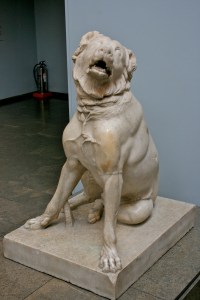
molossian_hound_british_museum
The Jennings Dog

Quid immerentis hospites vexas canis
ignavus adversum lupos?
quin huc inanis, si potes, vertis minas,
et me remorsurum petis?
nam qualis aut Molossus aut fulvus Lacon,
amica vis pastoribus,
agam per altas aure sublata nives,
quaecumque praecedet fera:
tu cum timenda voce complesti nemus,
proiectum odoraris cibum.
cave, cave: namque in malos asperrimus
parata tollo cornua,
qualis Lycambae spretus infido gener
aut acer hostis Bupalo.
an si quis atro dente me petiverit,
inultus ut flebo puer?

(Horace, Epod. 6)

How dare you go for unoffending guests, you who are a cowardly cur when confronted with wolves? Why not turn your empty threats in this direction, if you have the guts, and attack someone who will bite back? Like a Molossian or tawny Spartan, the shepherd’s sturdy friend, I shall prick up my ears and hunt down through the deep snow any animal that runs away from me, whereas you fill the woods with ferocious barking and then sniff at food thrown at your feet. Take care now, take care! For I am utterly ruthless against villains, and now toss my horns in readiness, like the son-in-law rejected by the treacherous Lycambes*, or the fierce enemy of Bupalus**. Well, if someone attacks me with the tooth of malice, am I expected to weep like a child, without retaliating?

* Archilochus. Lycambes promised his daughter, Neobule, to Archilochus and then reneged, whereupon he was hounded to death by the poet’s invective.
** Bupalus was a Greek sculptor who antagonised the iambic writer Hipponax (late 6th cent. B.C.).

(tr. Niall Rudd, with his notes)


Katedēdoken

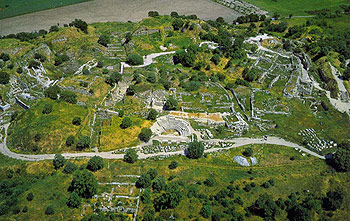
turkey_troy

Ξεῖνοι, τὴν περίβωτον ἐμὲ πτόλιν, Ἴλιον ἱρήν,
τὴν πάρος εὐπύργοις τείχεσι κλῃζομένην,
αἰῶνος τέφρη κατεδήδοκεν· ἀλλ’ ἐν Ὁμήρῳ
κεῖμαι χαλκείων ἕρκος ἔχουσα πυλῶν.
οὐκέτι με σκάψει Τρωοφθόρα δούρατ’ Ἀχαιῶν,
πάντων δ’ Ἑλλήνων κείσομαι ἐν στόμασιν.
(Euenus, Anth. Pal. 9.62)

Strangers, the ash of ages has devoured me, holy Ilion, the famous city once renowned for my towered walls, but in Homer I still exist, defended by brazen gates. The spears of the destroying Achaeans shall not again dig me up, but I shall be on the lips of all Greece. (tr. William Roger Paton)

Marios

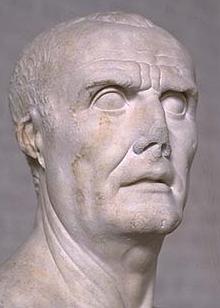
marius
Gaius Marius

Satis constat Sullam, cum deprecantibus amicissimis et ornatissimis viris aliquamdiu denegasset atque illi pertinaciter contenderent, expugnatum tandem proclamasse sive divinitus sive aliqua coniectura: vincerent ac sibi haberent, dum modo scirent eum, quem incolumem tanto opere cuperent, quandoque optimatium partibus, quas secum simul defendissent, exitio futurum; nam Caesari multos Marios inesse.
(Suetonius, Div. Iul. 1)

Everyone knows that when Sulla had long held out against the most devoted and eminent men of his party who interceded for Caesar, and they obstinately persisted, he at last gave way and cried, either by divine inspiration or a shrewd forecast: “Have your way and take him; only bear in mind that the man you are so eager to save will one day deal the death blow to the cause of the aristocracy, which you have joined with me in upholding; for in this Caesar there is more than one Marius.” (tr. John C. Rolfe)

Anthemia

fat-letter-630x419

Ἐπεὶ δὲ πορευόμενοι ἐν τοῖς φίλοις ἦσαν, ἐπεδείκνυσαν αὐτοῖς παῖδας τῶν εὐδαιμόνων σιτευτούς, τεθραμμένους καρύοις ἑφθοῖς, ἁπαλοὺς καὶ λευκοὺς σφόδρα καὶ οὐ πολλοῦ δέοντας ἴσους τὸ μῆκος καὶ τὸ πλάτος εἶναι, ποικίλους δὲ τὰ νῶτα καὶ τὰ ἔμπροσθεν πάντα ἐστιγμένους ἀνθέμια. ἐζήτουν δὲ καὶ ταῖς ἑταίραις ἃς ἦγον οἱ Ἕλληνες, ἐφανῶς συγγίγνεσθαι· νόμος γὰρ ἦν οὗτός σφισι. λευκοὶ δὲ πάντες οἱ ἄνδρες καὶ αἱ γυναῖκες. τούτους ἔλεγον οἱ στρατευσάμενοι βαρβαρωτάτους διελθεῖν καὶ πλεῖστον τῶν Ἑλληνικῶν νόμων κεχωρισμένους. ἔν τε γὰρ ὄχλῳ ὄντες ἐποίουν ἅπερ ἂν ἄλλοι ἐν ἐρημίᾳ ποιήσειαν, μόνοι τε ὄντες ὅμοια ἔπραττον ἅπερ ἂν μετ’ ἄλλων ὄντες, διελέγοντό τε αὑτοῖς καὶ ἐγέλων ἐφ’ ἑαυτοῖς καὶ ὠρχοῦντο ἐφιστάμενοι ὅπου τύχοιεν ὥσπερ ἄλλοις ἐπιδεικνύμενοι.
(Xenophon, Anab. 5.4.32-34)

And when the Greeks, as they proceeded, were among the friendly Mossynoecians, they would exhibit to them fattened children of the wealthy inhabitants, who had been nourished on boiled nuts and were soft and white to an extraordinary degree, and pretty nearly equal in length and breadth, with their backs adorned with many colours and their fore parts all tattooed with flower patterns. These Mossynoecians wanted also to have intercourse openly with the women who accompanied the Greeks, for that was their own fashion. And all of them were white, the men and the women alike. They were said by the Greeks who served on the expedition as the most uncivilized people whose country they traversed, the furthest removed from Greek customs. For they habitually did in public the things that other people would do only in private, and when they were alone they would behave just as if they were in the company of others, talking to themselves, laughing at themselves, and dancing in whatever spot they chanced to be, as though they were giving an exhibition to others. (tr. Carleton L. Brownson, revised by John Dillery)

Ideas

Horse_clouds

Ἀλλ’ εἰ χεῖρας ἔχον βόες ἵπποι τ’ ἠὲ λέοντες
ἢ γράψαι χείρεσσι καὶ ἔργα τελεῖν ἅπερ ἄνδρες,
ἵπποι μέν θ’ ἵπποισι βόες δέ τε βουσὶν ὁμοίας
καὶ κε θεῶν ἰδέας ἔγραφον καὶ σώματ’ ἐποίουν
τοιαῦθ’ οἷόν περ καὐτοὶ δέμας εἶχον ἕκαστοι.
(Xenophanes fr. 20 Graham)

Now if cattle, horses or lions had hands
and were able to draw with their hands and perform works like men,
horses like horses and cattle like cattle
would draw the forms of gods, and make their bodies
just like the body each of them had.
(tr. Daniel W. Graham)

Xunchōrousin

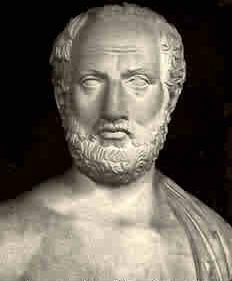
thucydides1

ΑΘ. Ἡμεῖς τοίνυν οὔτε αὐτοὶ μετ’ ὀνομάτων καλῶν, ὡς ἢ δικαίως τὸν Μῆδον καταλύσαντες ἄρχομεν ἢ ἀδικούμενοι νῦν ἐπεξερχόμεθα, λόγων μῆκος ἄπιστον παρέξομεν, οὔθ’ ὑμᾶς ἀξιοῦμεν ἢ ὅτι Λακεδαιμονίων ἄποικοι ὄντες οὐ ξυνεστρατεύσατε ἢ ὡς ἡμᾶς οὐδὲν ἠδικήκατε λέγοντας οἴεσθαι πείσειν, τὰ δυνατὰ δ’ ἐξ ὧν ἑκάτεροι ἀληθῶς φρονοῦμεν διαπράσσεσθαι, ἐπισταμένους πρὸς εἰδότας ὅτι δίκαια μὲν ἐν τῷ ἀνθρωπείῳ λόγῳ ἀπὸ τῆς ἴσης ἀνάγκης κρίνεται, δυνατὰ δὲ οἱ προύχοντες πράσσουσι καὶ οἱ ἀσθενεῖς ξυγχωροῦσιν.
(Thucydides, Hist. 5.89)

Athenians: ’Well, we shall not bulk out our argument with lofty language, claiming that our defeat of the Persians gives us the right to rule or that we are now seeking retribution for some wrong done to us. That would not convince you. Similarly we do not expect you to think there is any persuasive power in protestations that though you are a Spartan colony you have never joined their campaigns, or that you have not done us any harm. So keep this discussion practical, within the limits of what we both really think. You know as well as we do that when we are talking on the human plane questions of justice only arise when there is equal power to compel: in terms of practicality the dominant exact what they can and the weak concede what they must.’ (tr. Martin Hammond)

Fabii

Fabii caesi ad unum omnes praesidiumque expugnatum. trecentos sex perisse satis convenit, unum prope puberem aetate relictum, stirpem genti Fabiae dubiisque rebus populi Romani saepe domi bellique vel maximum futurum auxilium.
(Livy 2.50.11)

The Fabii were all slain to a man, and their fort was stormed. Three hundred and six men perished, as is generally agreed; one, who was little more than a boy in years,* survived to maintain the Fabian stock, and so to afford the very greatest help to the Roman people in its dark hours, on many occasions, at home and in the field. (tr. B.O. Foster)

* Quintus (or Quinctius) Fabius Vibulanus was said to be the only male to escape the slaughter of the gens Fabia at the Battle of the Cremera (477 BC). He became consul for the first time in 467, so he can’t have been that young!

Plagas

b9edbecb203bdc3739a190e3236b-is-corporal-punishment-acceptable-in-school

Verbera servos decent, non liberos. nobilibus pueris et maxim regibus maiorum laudes ac vituperia quam verbera commoditatem magis afferunt. illae ad honesta concitant, haec a turpitudine cohibent; in utrisque tamen adhibendus est modus, ne quid nimis sit. pueri namque immodicis celebrati laudationibus intumescunt, nimiis autem affecti iurgiis franguntur animoque deficiunt. at ex plagis odia surgunt, quae ad virilem aetatem usque perdurant. discenti autem nihil magis adversum est, quam praeceptores odisse, quos tu, si recte facere volueris, non minus amabis quam ipsa studia, et parentes esse, non quidem corporis sed mentis tuae iudicabis. multum haec pietas studio confert.
(Aeneas Silvius Piccolomini, De Liberorum Educatione 10)

Blows are suitable for slaves, not free men. For noble and especially for royal boys, the praise and blame of their elders are more serviceable than their blows. The former incites them to virtuous deeds, the latter restrains them from disgraceful behavior; yet in each case, measure must be applied lest there be excess. For boys honored with unmeasured praise become arrogant, but visited with too much criticism they become broken and low-spirited. Indeed from blows arises a hatred which endures even to manhood, yet nothing is worse for a pupil than to hate his teachers. If you wish to act rightly, you should love them not less than your studies themselves, and you will consider them as the parents, not of your body, but of your mind. This devoted affection is a great aid to study. (tr. Craig W. Kallendorf)