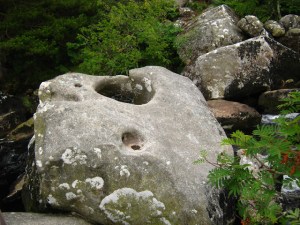
Καταμάθοις δ’ ἂν ὡς ἀνύσιμον πρᾶγμα καὶ τελεσιουργὸν ἐπιμέλεια καὶ πόνος ἐστίν, ἐπὶ πολλὰ τῶν γιγνομένων ἐπιβλέψας. σταγόνες μὲν γὰρ ὕδατος πέτρας κοιλαίνουσι, σίδηρος δὲ καὶ χαλκὸς ταῖς ἐπαφαῖς τῶν χειρῶν ἐκτρίβονται, οἱ δ’ ἁρμάτειοι τροχοὶ πόνῳ καμφθέντες οὐδ’ ἂν εἴ τι γένοιτο τὴν ἐξ ἀρχῆς δύναιντ’ ἀναλαβεῖν εὐθυωρίαν· τάς γε μὴν καμπύλας τῶν ὑποκριτῶν βακτηρίας ἀπευθύνειν ἀμήχανον, ἀλλὰ τὸ παρὰ φύσιν τῷ πόνῳ τοῦ κατὰ φύσιν ἐγένετο κρεῖττον.
(Plutarch, Peri Paidōn Agōgēs 2d)
One may understand how effective and how productive a thing is application and hard work, if he only direct his attention to many effects that are daily observed. For drops of water make hollows in rocks, steel and bronze are worn away by the touch of hands, and rims of chariot-wheels once bent by dint of labour, cannot, no matter what be done, recover their original lines. The bent staves which actors use it is impossible to straighten; indeed the unnatural shape has, through labour, come to predominate over the natural. (tr. Frank Cole Babbitt)
 Crambe Repetita